Advanced Combat Helmet Market Size, Share Demand Report By Type (Ballistic Helmets, Modular Helmets), By Application (Military, Law Enforcement), By End-Use (Defense, Private Security), By Region & Segment Forecasts, 2025–2034
USD 3950
Market Overview
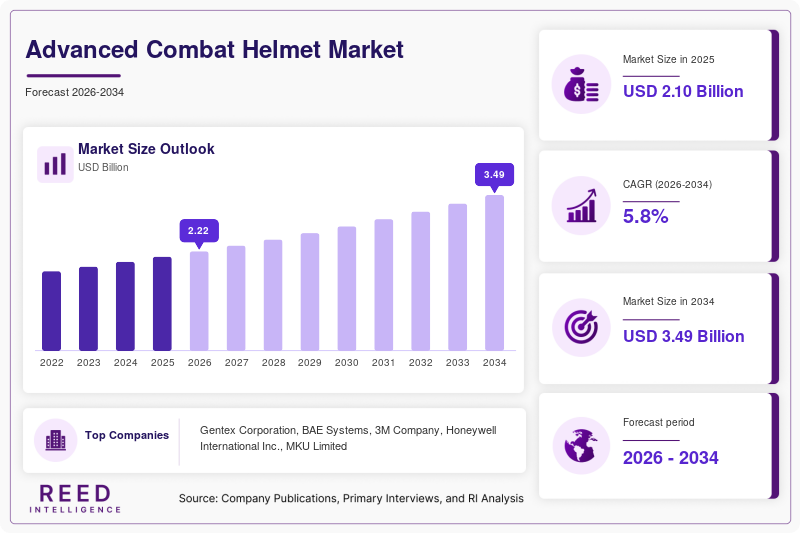
The Advanced Combat Helmet Market size was valued at approximately USD 2.1 billion in 2025 and is projected to reach around USD 2.25 billion in 2026. Over the forecast period from 2025 to 2034, the market is expected to grow at a compound annual growth rate (CAGR) of 5.8%, reaching an estimated valuation of USD 3.7 billion by 2034. The growing demand for lightweight, high-strength protective gear among military forces continues to shape the market landscape.
One of the primary growth factors driving the Advanced Combat Helmet Market is the increasing adoption of advanced materials such as aramid fibers, ultra-high-molecular-weight polyethylene (UHMWPE), and hybrid composites. These materials offer enhanced ballistic protection while reducing helmet weight, improving soldier mobility and endurance in combat scenarios. Additionally, the integration of communication systems, night vision mounts, and augmented reality capabilities into helmets is contributing to the evolution of next-generation combat headgear.
Key Highlights
- Market size was valued at USD 2.1 billion in 2025 and is estimated to reach USD 2.25 billion in 2026, reflecting steady year-on-year growth driven by ongoing defense procurement and equipment upgrades across major economies.
- The market is projected to reach USD 3.7 billion by 2034, supported by long-term military modernization initiatives and the increasing demand for advanced protective solutions in combat environments.
- The Advanced Combat Helmet Market is expected to grow at a CAGR of 5.8% from 2025 to 2034, indicating consistent expansion fueled by technological advancements and rising global security concerns.
- There is a growing adoption of lightweight composite materials such as aramid fibers and UHMWPE, which enhance ballistic protection while reducing helmet weight, improving soldier mobility and operational efficiency.
Market Trends
Integration of Smart Technologies in Combat Helmets
A significant trend shaping the Advanced Combat Helmet Market is the integration of smart technologies into helmet systems. Modern combat helmets are increasingly being equipped with communication devices, heads-up displays (HUDs), and sensor-based monitoring systems. These technologies enhance situational awareness, enabling soldiers to receive real-time battlefield information without distraction. Additionally, integration with wearable electronics and command systems supports network-centric warfare strategies. This trend is gaining momentum as defense agencies prioritize digital transformation and battlefield connectivity. Manufacturers are focusing on modular designs that allow seamless integration of electronic components while maintaining structural integrity and ballistic protection.
Shift Toward Lightweight and Modular Helmet Designs
Another key trend is the growing demand for lightweight and modular helmet designs. Traditional helmets often compromise comfort due to their weight, leading to fatigue during extended missions. As a result, manufacturers are increasingly adopting advanced materials and ergonomic designs to reduce weight without sacrificing protection. Modular systems allow customization based on mission requirements, including attachments for visors, communication gear, and lighting systems. This flexibility enhances operational efficiency and reduces the need for multiple helmet types. The trend is particularly prominent in special forces and rapid response units, where mobility and adaptability are critical performance factors.
Market Drivers
Increasing Defense Expenditure Globally
Rising defense budgets across developed and emerging economies are a major driver for the Advanced Combat Helmet Market. Governments are allocating higher funds to modernize military equipment, including personal protective gear. Countries in North America, Asia Pacific, and the Middle East are investing in advanced combat systems to enhance troop effectiveness and safety. These investments are driven by evolving security threats, border disputes, and the need for rapid response capabilities. The procurement of advanced helmets forms a key component of soldier modernization programs, contributing to consistent market demand.
Growing Focus on Soldier Safety and Performance
Another significant driver is the increasing emphasis on soldier safety and operational performance. Advanced combat helmets are designed to provide superior ballistic protection against high-velocity projectiles and fragmentation. At the same time, they are engineered for comfort, allowing soldiers to operate efficiently in challenging environments. Enhanced padding systems, improved weight distribution, and compatibility with other protective gear are key features driving adoption. Military organizations are prioritizing equipment that minimizes injury risk while maximizing performance, which is encouraging continuous innovation in helmet design and materials.
Market Restraint
High Cost of Advanced Helmet Systems
One of the primary restraints affecting the Advanced Combat Helmet Market is the high cost associated with advanced helmet systems. The use of specialized materials such as UHMWPE and aramid fibers, along with integrated electronics and modular components, significantly increases production costs. These high costs can limit adoption, particularly in developing countries with constrained defense budgets. Smaller military forces may opt for conventional helmets due to affordability concerns, slowing market penetration.
The impact of this restraint is evident in procurement delays and budget reallocations. For example, certain defense agencies may prioritize large-scale equipment purchases such as vehicles and weapon systems over personal protective gear upgrades. Additionally, maintenance and replacement costs of advanced helmets further add to the financial burden. This creates a challenge for manufacturers, who must balance innovation with cost efficiency. Addressing this restraint requires advancements in manufacturing processes and material sourcing to reduce overall production expenses without compromising quality.
Market Opportunities
Expansion in Emerging Economies
Emerging economies present a significant growth opportunity for the Advanced Combat Helmet Market. Countries in Asia Pacific, Latin America, and Africa are gradually increasing their defense spending to enhance national security. These regions are focusing on upgrading outdated military equipment, including protective gear. As a result, there is growing demand for modern combat helmets that offer improved protection and functionality. International defense collaborations and technology transfers are also facilitating market expansion in these regions. Manufacturers can capitalize on this opportunity by offering cost-effective solutions tailored to the specific needs of emerging markets.
Development of Next-Generation Materials
The development of next-generation materials offers another promising opportunity for market growth. Research in nanotechnology and advanced composites is enabling the creation of helmets with enhanced strength-to-weight ratios. These materials can provide superior ballistic resistance while maintaining lightweight characteristics. Additionally, innovations in material science are improving durability and resistance to environmental factors such as heat and moisture. Manufacturers investing in research and development can gain a competitive advantage by introducing advanced products that meet evolving military requirements. This opportunity is expected to drive long-term innovation and expansion in the market.
Segmental Analysis
By Type
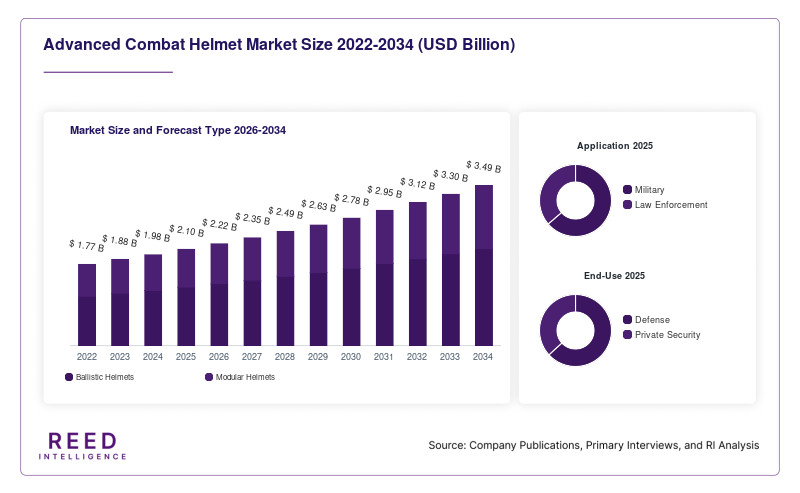
The ballistic helmets segment dominated the Advanced Combat Helmet Market in 2024, accounting for nearly 60% of the total market share. These helmets are widely used due to their superior protection against bullets and shrapnel. They are manufactured using advanced materials such as aramid fibers and UHMWPE, which provide high strength and durability. Military forces prioritize ballistic helmets for frontline operations, as they offer critical protection in combat scenarios. The demand for these helmets is further supported by continuous advancements in material technology and design improvements.
The modular helmets segment is expected to be the fastest-growing, with a projected CAGR of 6.7% during the forecast period. These helmets offer flexibility and customization options, allowing soldiers to adapt their gear based on mission requirements. The ability to integrate communication systems, visors, and other accessories makes modular helmets highly attractive. Increasing adoption of advanced technologies and the need for versatile equipment are driving the growth of this segment.
By Application
The military segment held the largest share of the market in 2024, accounting for approximately 70% of total revenue. This dominance is attributed to the extensive use of advanced combat helmets in armed forces worldwide. Military applications require high-performance helmets that provide maximum protection and comfort. Governments are investing heavily in upgrading soldier equipment, which is driving demand in this segment. Continuous procurement programs and defense modernization initiatives further support its growth.
The law enforcement segment is projected to grow at the fastest CAGR of 6.2% over the forecast period. Increasing security concerns and the need for advanced protective gear among police and special forces are driving this growth. Law enforcement agencies are adopting advanced helmets for riot control, counter-terrorism operations, and tactical missions. The rising emphasis on officer safety and operational efficiency is contributing to the expansion of this segment.
By End-Use
The defense sector dominated the market in 2024, accounting for around 75% of the total share. This segment includes army, navy, and air force personnel who require advanced protective equipment. The high demand is driven by increasing defense budgets and the need for modernized military gear. Governments are focusing on enhancing soldier safety, which is fueling the adoption of advanced combat helmets. Continuous technological advancements are also supporting growth in this segment.
The private security segment is expected to witness the fastest growth, with a CAGR of 6.0% during the forecast period. The rising demand for security services in high-risk environments is driving the adoption of advanced helmets. Private security firms are investing in protective equipment to ensure the safety of their personnel. Increasing threats and the need for enhanced protection are key factors contributing to the growth of this segment.
Regional Analysis
North America
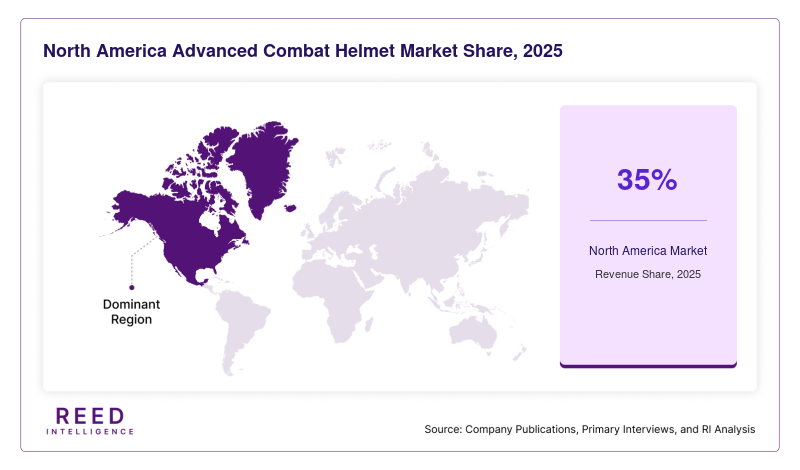
North America held the largest share of the Advanced Combat Helmet Market in 2025, accounting for approximately 35% of the global market. The region is expected to maintain its dominance over the forecast period, with a projected CAGR of 5.2% from 2025 to 2034. High defense spending and continuous investment in military modernization programs are key factors contributing to market growth in this region.
The United States dominates the North American market due to its advanced defense infrastructure and strong focus on soldier protection. A unique growth factor in this region is the integration of advanced communication and augmented reality systems into combat helmets. This focus on technological innovation is driving demand for next-generation helmet solutions.
Europe
Europe accounted for around 25% of the global market share in 2025 and is expected to grow at a CAGR of 5.5% during the forecast period. Increasing defense budgets and collaborative military initiatives among European nations are supporting market growth. The region is focusing on enhancing troop readiness and interoperability.
Germany leads the European market, driven by its strong defense manufacturing base. A unique growth factor is the emphasis on sustainability and eco-friendly materials in helmet production. European manufacturers are investing in recyclable and environmentally friendly materials to align with regulatory requirements.
Asia Pacific
Asia Pacific represented approximately 22% of the market share in 2025 and is projected to grow at the fastest CAGR of 6.5% through 2034. Rapid military modernization and rising geopolitical tensions are key drivers in this region. Countries are actively upgrading their defense capabilities.
China is the dominant country in this region, with significant investments in defense technology. A unique growth factor is the large-scale procurement programs aimed at equipping expanding military forces. This is driving substantial demand for advanced combat helmets.
Middle East & Africa
The Middle East & Africa region held about 10% of the global market share in 2025 and is expected to grow at a CAGR of 5.9%. Ongoing conflicts and security concerns are driving demand for advanced protective gear. Governments are prioritizing soldier safety.
Saudi Arabia dominates the regional market due to its high defense expenditure. A unique growth factor is the focus on equipping specialized forces with advanced protective equipment. This is boosting the adoption of high-performance combat helmets.
Latin America
Latin America accounted for approximately 8% of the market share in 2025 and is expected to grow at a CAGR of 5.3%. Increasing investments in defense modernization are supporting market growth in this region.
Brazil leads the Latin American market, driven by its efforts to strengthen military capabilities. A unique growth factor is the rising demand for cost-effective yet advanced protective solutions. This is encouraging the adoption of innovative helmet designs.
Competitive Landscape
The Advanced Combat Helmet Market is moderately consolidated, with several key players competing based on product innovation, material technology, and strategic partnerships. Leading companies are focusing on developing lightweight, high-performance helmets to meet evolving military requirements. Continuous investment in research and development is a key strategy adopted by major players.
One of the leading companies in the market is Gentex Corporation, known for its advanced helmet systems and strong presence in defense markets. A recent development includes the introduction of next-generation helmets with integrated communication systems. Other major players are also expanding their product portfolios and strengthening their global presence through collaborations and contracts with defense agencies.
Key Players
- Gentex Corporation
- BAE Systems
- 3M Company
- Honeywell International Inc.
- MKU Limited
- Revision Military
- ArmorSource LLC
- Avon Protection Systems
- DuPont
- Safariland Group
- Elbit Systems Ltd.
- Point Blank Enterprises
- Galvion
- Schuberth GmbH
- Rheinmetall AG
Recent Developments
- Gentex Corporation launched an advanced helmet system with integrated communication technology in 2025
- MKU Limited secured a defense contract to supply next-generation helmets to international forces
- BAE Systems introduced lightweight composite helmets designed for enhanced ballistic protection
Advanced Combat Helmet Market Segments
Type
- Ballistic Helmets
- Modular Helmets
Application
- Military
- Law Enforcement
End-Use
- Defense
- Private Security
By Region
- North America
- Europe
- APAC
- Middle East and Africa
- LATAM