Advanced Fiber Based Gasket Market Size, Share & Demand Report By Product Type (Compressed Fiber Gaskets), By Material Type (Aramid Fiber-Based Gaskets, Carbon Fiber-Based Gaskets, Glass Fiber-Based Gaskets), By Application (Industrial Sealing, Automotive Sealing, Power Generation Sealing), By End-Use Industry (Oil & Gas, Automotive, Chemical & Petrochemical, Power Generation), By Region & Segment Forecasts, 2026–2034
USD 3950
Market Overview
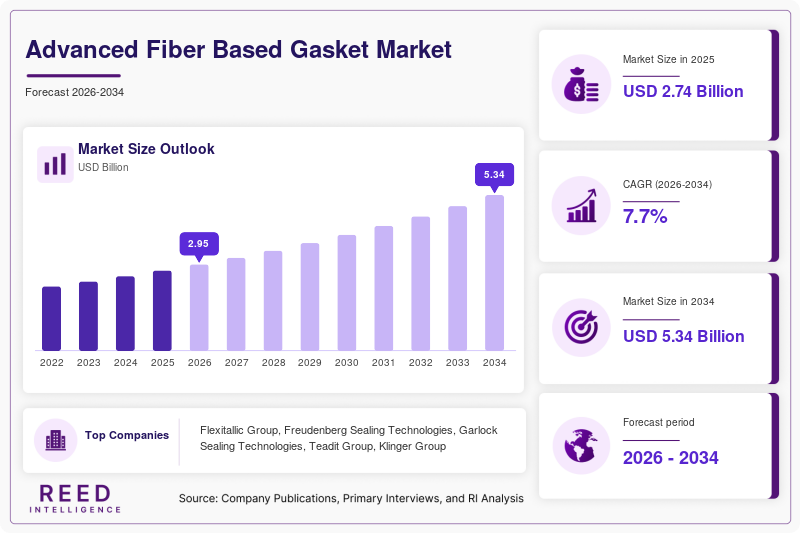
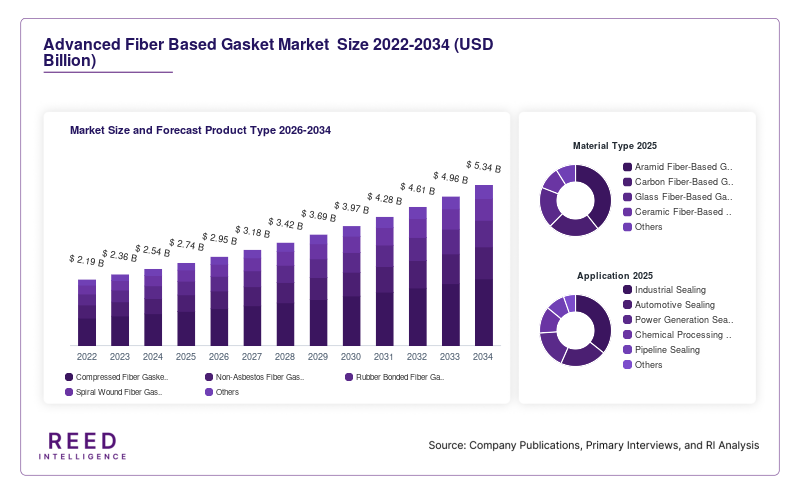
The global Advanced Fiber Based Gasket Market size was valued at USD 2.74 billion in 2026 and is projected to reach USD 4.98 billion by 2034, expanding at a CAGR of 7.7% during the forecast period (2026–2034). The market growth was supported by increasing industrial infrastructure development and rising demand for high-performance sealing solutions across automotive, oil & gas, power generation, chemical processing, and manufacturing industries.
The growing emphasis on industrial equipment efficiency and leak prevention significantly accelerated the adoption of advanced fiber-based gasket materials globally. Industries increasingly adopted fiber-based gasket systems due to their durability, thermal resistance, pressure tolerance, and cost efficiency compared to conventional sealing materials. The expansion of heavy industrial operations and rising investments in industrial maintenance activities further strengthened market demand.
Key Highlights
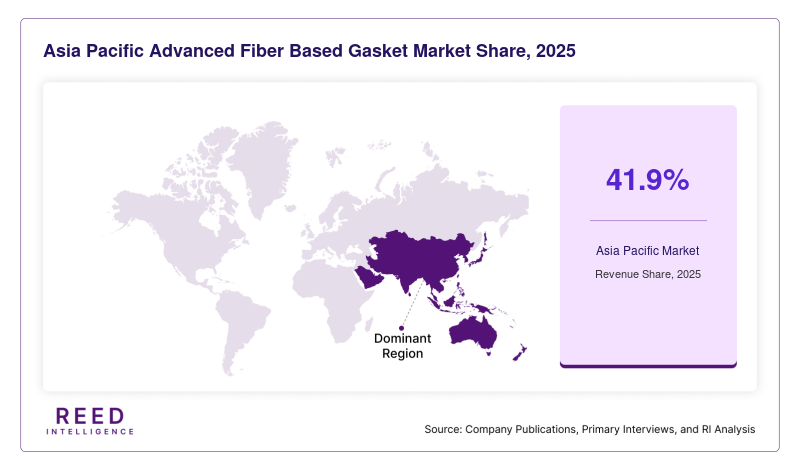
- Asia Pacific accounted for 41.9% of the global Advanced Fiber Based Gasket Market share in 2025, while Middle East & Africa is projected to witness the fastest CAGR of 8.5% during the forecast period.
- By product type, compressed fiber gaskets held the leading share of 38.6% in 2025, whereas non-asbestos fiber gaskets are expected to grow at the fastest CAGR of 8.8% through 2034.
- By material type, aramid fiber-based gaskets dominated with a 35.1% share in 2025, while carbon fiber-based gaskets are forecast to expand at a CAGR of 8.9%.
- By application, industrial sealing applications represented the largest share of 34.7% in 2025, whereas automotive sealing applications are anticipated to register the fastest CAGR of 8.6%.
- By end-use industry, oil & gas industries accounted for 29.8% of the market share in 2025, while renewable energy industries are projected to witness a CAGR of 9.1%.
- China dominated the Advanced Fiber Based Gasket Market with a market value of USD 348 million in 2024 and USD 376 million in 2025.
Market Trends
Growing Adoption of Non-Asbestos Sealing Materials
The increasing transition toward non-asbestos sealing materials emerged as a major trend in the Advanced Fiber Based Gasket Market. Industries increasingly shifted toward safer and environmentally compliant gasket materials to meet evolving industrial safety regulations.
Non-asbestos advanced fiber gaskets gained broader acceptance across automotive, chemical processing, and power generation industries due to their improved mechanical strength and thermal resistance. Manufacturers increasingly invested in advanced composite fiber technologies to improve gasket performance and operational reliability.
Integration of High-Temperature Resistant Fiber Technologies
The growing use of high-temperature resistant fiber materials significantly influenced market trends. Industrial operators increasingly required gasket systems capable of operating under extreme thermal and pressure conditions.
Advanced fiber-based gasket manufacturers introduced products utilizing aramid, carbon, ceramic, and glass fibers to improve durability and sealing efficiency. The demand gained momentum across heavy industrial applications including petrochemical refining, power generation, and industrial processing systems.
Market Drivers
Expansion of Industrial Processing Facilities
The rapid expansion of industrial processing facilities significantly contributed to the growth of the Advanced Fiber Based Gasket Market. Industries increasingly required reliable sealing solutions to improve equipment efficiency and reduce operational leakages.
Advanced fiber-based gaskets gained widespread adoption because they provided superior chemical resistance and long operational life in industrial environments. The growing development of manufacturing plants, chemical processing facilities, and industrial infrastructure projects accelerated market demand.
Increasing Automotive Production Activities
The rising global automotive production industry accelerated demand for advanced gasket materials. Automotive manufacturers increasingly utilized advanced fiber-based gaskets in engines, exhaust systems, and fluid management systems to improve sealing performance and reduce maintenance requirements.
The growing production of commercial vehicles and industrial machinery further strengthened demand for durable gasket systems capable of withstanding high mechanical stress and temperature fluctuations.
Market Restraint
Volatility in Raw Material Prices
Fluctuations in the prices of raw materials restrained the growth of the Advanced Fiber Based Gasket Market to a certain extent. Variations in the costs of aramid fibers, carbon fibers, synthetic rubbers, and industrial binders increased production expenses for gasket manufacturers. Rising material procurement costs affected profit margins and created pricing challenges across industrial supply chains.
Market Opportunities
Rising Investments in Renewable Energy Infrastructure
The increasing expansion of renewable energy infrastructure is expected to create significant opportunities for the Advanced Fiber Based Gasket Market. Wind power facilities, hydrogen production systems, and solar thermal projects increasingly require durable sealing solutions for high-pressure and high-temperature operations.
Advanced fiber-based gasket manufacturers are anticipated to benefit from rising investments in clean energy infrastructure and industrial sustainability projects.
Growth of Industrial Maintenance and Repair Operations
The growing emphasis on predictive maintenance and industrial repair operations presents favorable opportunities for the market. Industries increasingly prioritize preventive equipment maintenance to reduce downtime and improve operational safety.
Advanced fiber-based gasket replacement demand is expected to rise steadily across industrial maintenance applications due to increasing inspection cycles and industrial equipment upgrades.
Segmental Analysis
By Product Type
Based on product type, the Advanced Fiber Based Gasket Market is segmented into compressed fiber gaskets, non-asbestos fiber gaskets, rubber bonded fiber gaskets, spiral wound fiber gaskets, and others.
Compressed fiber gaskets accounted for the largest market share of 38.6% in 2025. Their dominance was attributed to strong sealing performance, high compressibility, and broad industrial compatibility. These gaskets were widely utilized across chemical processing, industrial manufacturing, and oil refining operations due to their ability to withstand pressure fluctuations and aggressive operating conditions.
Industries increasingly adopted compressed fiber gaskets because they provided reliable sealing efficiency and long operational durability. Their cost-effectiveness and ease of installation further contributed to segment growth.
Non-asbestos fiber gaskets are projected to register the fastest CAGR of 8.8% during the forecast period. The growth will be supported by stricter industrial safety regulations and increasing adoption of environmentally compliant sealing materials. Industries are expected to increasingly replace traditional asbestos-based sealing products with advanced non-asbestos alternatives to improve workplace safety and regulatory compliance.
Rubber bonded fiber gaskets are also expected to witness stable growth because of their increasing use in low-pressure industrial sealing systems and automotive applications.
By Material Type
Based on material type, the Advanced Fiber Based Gasket Market is categorized into aramid fiber-based gaskets, carbon fiber-based gaskets, glass fiber-based gaskets, ceramic fiber-based gaskets, and others.
Aramid fiber-based gaskets dominated the market with a 35.1% share in 2025. Their widespread adoption was supported by excellent mechanical strength, heat resistance, and chemical stability. These gaskets were extensively utilized across heavy industrial applications where high sealing reliability remained essential.
Manufacturers increasingly preferred aramid fiber materials due to their superior dimensional stability and long operational life. The segment also maintained strong demand in automotive and petrochemical industries.
Carbon fiber-based gaskets are projected to grow at the fastest CAGR of 8.9% during the forecast period. The growth will be driven by increasing demand for lightweight and high-performance sealing materials capable of operating under extreme thermal conditions. Carbon fiber gasket systems are expected to gain broader adoption across aerospace, renewable energy, and advanced industrial processing applications.
Glass fiber-based gaskets are also anticipated to witness stable growth due to increasing use in medium-temperature industrial sealing operations.
By Application
Based on application, the Advanced Fiber Based Gasket Market is divided into industrial sealing, automotive sealing, power generation sealing, chemical processing sealing, pipeline sealing, and others.
Industrial sealing accounted for the leading market share of 34.7% in 2025. The segment dominance was attributed to increasing demand for leak prevention systems and equipment reliability across industrial operations. Advanced fiber-based gaskets improved sealing efficiency and minimized operational losses in high-pressure industrial environments.
Manufacturers increasingly utilized these gasket systems across processing plants, industrial reactors, compressors, and pumping systems. Expanding industrial manufacturing activities further accelerated segment growth.
Automotive sealing applications are projected to register the fastest CAGR of 8.6% during the forecast period. The growth will be supported by increasing automotive production and rising demand for durable engine sealing systems. Automotive manufacturers are expected to increasingly adopt advanced gasket technologies to improve thermal management and engine performance.
Power generation sealing applications are also anticipated to witness steady growth due to rising energy infrastructure expansion and industrial turbine maintenance activities.
By End-Use Industry
Based on end-use industry, the Advanced Fiber Based Gasket Market is segmented into oil & gas, automotive, chemical & petrochemical, power generation, manufacturing industries, renewable energy industries, and others.
Oil & gas industries held the dominant market share of 29.8% in 2025. The segment growth was supported by increasing drilling activities, refining operations, and industrial pipeline installations. Advanced fiber-based gaskets played a critical role in maintaining sealing integrity in high-pressure oil & gas systems.
The expansion of offshore energy projects and petrochemical processing facilities further accelerated gasket demand. Industrial operators increasingly adopted advanced sealing technologies to improve operational safety and reduce leakage risks.
Renewable energy industries are projected to register the fastest CAGR of 9.1% during the forecast period. The growth will be driven by increasing investments in hydrogen production systems, wind turbine infrastructure, and solar thermal facilities. Renewable energy projects are expected to require advanced gasket materials capable of withstanding challenging environmental and operational conditions.
Chemical & petrochemical industries are also anticipated to witness strong growth due to rising industrial processing activities globally.
By Distribution Channel
Based on distribution channel, the Advanced Fiber Based Gasket Market is segmented into direct sales, industrial distributors, online industrial suppliers, and aftermarket suppliers.
Direct sales accounted for the dominant market share in 2025 due to increasing procurement partnerships between industrial gasket manufacturers and large-scale industrial operators. Major industries preferred direct procurement channels for customized gasket solutions and technical service support.
Online industrial suppliers are projected to witness the fastest CAGR during the forecast period due to rising digital procurement trends and increasing accessibility of industrial product platforms.
Regional Analysis
Asia Pacific
Asia Pacific held 41.9% of the global Advanced Fiber Based Gasket Market share in 2025 and is projected to expand at a CAGR of 8.1% during the forecast period. The region maintained market dominance due to expanding manufacturing industries and increasing industrial infrastructure investments.
China dominated the regional market owing to rapid industrialization, strong automotive production, and expanding petrochemical processing activities. Increasing investments in heavy industrial facilities further supported market growth.
North America
North America accounted for 24.2% of the Advanced Fiber Based Gasket Market share in 2025 and is anticipated to grow at a CAGR of 7.0% through 2034. The region experienced stable demand due to growing industrial maintenance operations and rising adoption of advanced sealing materials.
The United States led the regional market due to increasing oil & gas processing activities and expansion of industrial automation systems. Industrial equipment modernization also supported regional market expansion.
Europe
Europe represented 20.8% of the global Advanced Fiber Based Gasket Market share in 2025 and is expected to register a CAGR of 6.8% during the forecast period. The market growth was supported by increasing environmental compliance standards and strong industrial engineering capabilities.
Germany dominated the European market due to expanding automotive manufacturing operations and advanced industrial equipment production. The transition toward energy-efficient industrial systems further accelerated gasket demand.
Middle East & Africa
The Middle East & Africa accounted for 7.0% of the global Advanced Fiber Based Gasket Market share in 2025 and is forecast to grow at the fastest CAGR of 8.5% during the forecast period. Rising investments in oil refining, petrochemical processing, and industrial infrastructure supported regional growth.
Saudi Arabia emerged as the dominant country due to expanding energy infrastructure projects and increasing investments in industrial diversification initiatives. Industrial maintenance demand further strengthened market expansion.
Latin America
Latin America held 6.1% of the Advanced Fiber Based Gasket Market share in 2025 and is projected to expand at a CAGR of 7.2% through 2034. Increasing industrial processing activities and rising investments in manufacturing industries contributed to regional market growth.
Brazil dominated the regional market owing to expanding automotive manufacturing and growing industrial equipment maintenance operations. The growth of industrial processing sectors further supported gasket demand.
Competitive Landscape
The Advanced Fiber Based Gasket Market remains moderately competitive with the presence of global sealing technology manufacturers and industrial material suppliers focusing on product durability, thermal resistance, and regulatory compliance. Companies continue investing in advanced fiber technologies and environmentally compliant gasket solutions to strengthen industrial applications.
Flexitallic Group maintained a strong market position due to its broad industrial sealing portfolio and advanced engineering capabilities. The company recently introduced upgraded non-asbestos gasket materials designed for high-pressure industrial processing systems and energy infrastructure applications.
Other major companies including Freudenberg Sealing Technologies, Garlock Sealing Technologies, Teadit Group, and Klinger Group focused on expanding industrial sealing product lines and strengthening global industrial distribution networks. Investments in sustainable gasket technologies and high-temperature sealing innovations remained important competitive strategies across the market.
Key Players List
- Flexitallic Group
- Freudenberg Sealing Technologies
- Garlock Sealing Technologies
- Teadit Group
- Klinger Group
- Dana Incorporated
- Lamons Gasket Company
- James Walker Group
- Nichias Corporation
- ElringKlinger AG
- Donit Tesnit d.o.o.
- Hennig Gasket & Seals Inc.
- Leader Gasket Technologies
- Spira Power Gasket Manufacturing LLC
- EagleBurgmann
Recent Developments
- In 2025, Flexitallic Group introduced upgraded non-asbestos gasket solutions designed for high-pressure industrial applications.
- Freudenberg Sealing Technologies expanded advanced fiber gasket manufacturing capacity for industrial processing industries.
- Garlock Sealing Technologies launched high-temperature gasket systems for petrochemical and energy infrastructure projects.
- Teadit Group invested in environmentally compliant gasket technologies for industrial sealing applications.
- Klinger Group expanded global industrial sealing distribution operations across Asia Pacific and Europe.
- ElringKlinger AG introduced lightweight advanced gasket materials for automotive thermal management systems.
- Dana Incorporated strengthened industrial gasket product portfolios for renewable energy and heavy industrial applications.
Advanced Fiber Based Gasket Market Segments
Product Type
- Compressed Fiber Gaskets
- Non-Asbestos Fiber Gaskets
- Rubber Bonded Fiber Gaskets
- Spiral Wound Fiber Gaskets
- Others
Material Type
- Aramid Fiber-Based Gaskets
- Carbon Fiber-Based Gaskets
- Glass Fiber-Based Gaskets
- Ceramic Fiber-Based Gaskets
- Others
Application
- Industrial Sealing
- Automotive Sealing
- Power Generation Sealing
- Chemical Processing Sealing
- Pipeline Sealing
- Others
End-Use Industry
- Oil & Gas
- Automotive
- Chemical & Petrochemical
- Power Generation
- Manufacturing Industries
- Renewable Energy Industries
- Others
Distribution Channel
- Direct Sales
- Industrial Distributors
- Online Industrial Suppliers
- Aftermarket Suppliers
By Region
- North America
- Europe
- APAC
- Middle East and Africa
- LATAM