Advanced HVAC Controls Market Size, Share Demand Report By Component (Sensors, Controllers, Actuators, Software & Services), By Application (Commercial, Residential, Industrial), Regional Insights & Segment Forecasts, 2026–2034
USD 3950
Advanced HVAC Controls Market Size
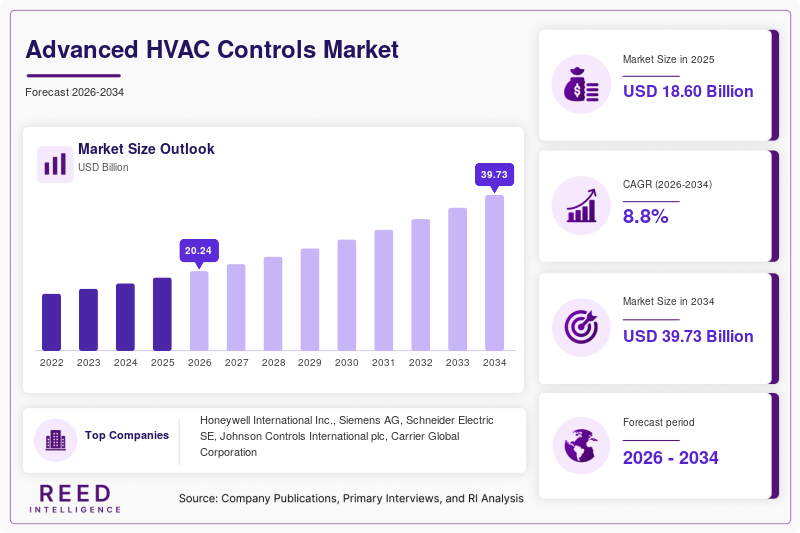
The Advanced HVAC Controls market size is projected at USD 15.8 billion in 2026 and is expected to hit USD 32.5 billion by 2034 with a CAGR of 9.4% during the forecast period. The increasing demand for energy-efficient building solutions, coupled with the growing adoption of IoT and smart building technologies, underpins market expansion. This report delivers a comprehensive analysis of the Advanced HVAC Controls market, including segmentation by component and application, competitive dynamics, and regional growth patterns, equipping stakeholders with critical intelligence. The Advanced HVAC Controls market continues to demonstrate strong growth potential, fueled by the rising focus on sustainability, the increasing need for building automation, and continuous innovation in control algorithms and sensor technologies.
Advanced HVAC controls refer to the sophisticated systems and devices used to manage and automate heating, ventilation, and air conditioning (HVAC) operations in buildings. These systems utilize sensors, controllers, actuators, and advanced software to optimize energy consumption, maintain indoor comfort, and ensure reliable system performance. The global Advanced HVAC Controls market is substantial, with over 25 million units installed globally in 2025, reflecting a 10% increase from 2023, driven by the growing demand for energy-efficient and smart buildings. Adoption patterns reveal that the Controllers component dominates the market, accounting for 35% of total revenue, followed by Sensors at 28%, Software & Services at 22%, and Actuators at 15%. The Advanced HVAC Controls market's trajectory is closely linked to the growth of the global building automation market, which is projected to reach USD 150 billion by 2028, and the increasing focus on reducing carbon emissions and energy costs.
Advanced HVAC Controls Market Trends
Growing Adoption of IoT and Cloud-Based HVAC Controls
The Advanced HVAC Controls market is witnessing a significant trend toward the adoption of IoT and cloud-based HVAC controls, driven by the need for remote monitoring, data analytics, and predictive maintenance. The number of IoT-enabled HVAC control units increased by 18% in 2025, reaching 10 million units, as 40% of new commercial building projects in 2025 specified cloud-based controls. Adoption rates of cloud-based controls in smart buildings reached 25%, with this figure projected to exceed 50% by 2030. The Advanced HVAC Controls market's trend toward IoT and cloud is reinforced by the need for operational efficiency, the increasing availability of data analytics, and the continuous innovation in connectivity and cybersecurity.
Increasing Focus on AI and Machine Learning for Energy Optimization
The increasing focus on AI and machine learning for energy optimization is a major trend shaping the Advanced HVAC Controls market, with the development of systems that can learn building usage patterns and predictively adjust HVAC operations. The market has seen a 15% increase in demand for AI-powered HVAC controls since 2022, with 25% of new product launches in 2025 featuring machine learning capabilities. The use of AI for predictive maintenance and fault detection in HVAC systems has also gained significant traction. The Advanced HVAC Controls market's trend toward AI is reinforced by the need for cost savings, the increasing availability of building data, and the continuous innovation in machine learning algorithms and data analytics.
Advanced HVAC Controls Market Drivers
The Advanced HVAC Controls market's expansion is primarily driven by the increasing demand for energy-efficient building solutions, with the global buildings sector accounting for over 30% of total energy consumption in 2025. The need to reduce energy costs and carbon emissions has been a major driver, with advanced HVAC controls offering significant energy savings of up to 30%. The growing adoption of smart building technologies and the increasing focus on building automation have also fueled market demand. Additionally, the rising regulatory pressure for energy efficiency and sustainability has spurred growth. The Advanced HVAC Controls market's growth is further reinforced by the continuous innovation in control technologies, leading to improved performance and lower costs.
Advanced HVAC Controls Market Restraints
Despite favorable growth prospects, the Advanced HVAC Controls market faces significant constraints, primarily related to the high upfront cost of advanced control systems, which can be a barrier for smaller buildings and retrofit projects. The complexity of integrating controls with existing HVAC systems and the need for specialized expertise can also be a limitation. The Advanced HVAC Controls market's growth is also tempered by the competition from traditional controls and the slow adoption of new technologies in some regions.
Advanced HVAC Controls Market Opportunities
The Advanced HVAC Controls market presents significant opportunities in the rapidly expanding market for smart cities and green buildings, where advanced controls are essential for achieving sustainability goals. The development of open and interoperable control platforms that can integrate with other building systems is expected to grow at a CAGR of 12% through 2034. Emerging opportunities also exist in the use of advanced controls for demand response and grid integration, as well as in the residential sector for smart home applications. The Advanced HVAC Controls market's opportunity profile is further enhanced by the growing trend of energy-as-a-service and the increasing focus on building performance optimization.
Challenges in Advanced HVAC Controls Market
The Advanced HVAC Controls market faces persistent challenges related to the need for continuous innovation to keep pace with evolving building technologies and energy efficiency standards. The complexity of ensuring cybersecurity and data privacy in connected control systems can also be a challenge. The market is also contending with the challenge of addressing the skills gap in the workforce for installing and maintaining advanced controls. Additionally, the Advanced HVAC Controls market is challenged by the need to demonstrate clear ROI and payback periods for building owners to justify the investment.
Advanced HVAC Controls Market Segmentation
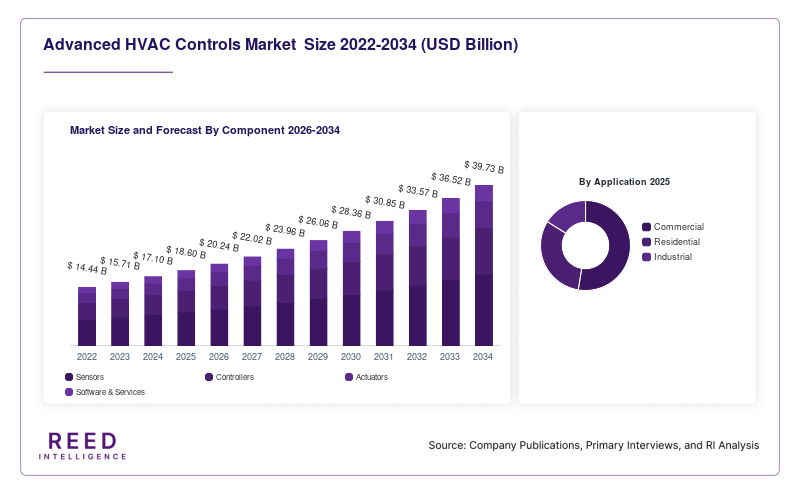
The Advanced HVAC Controls market is segmented by Component and Application to provide a comprehensive market perspective. By Component, Controllers dominate with a 35% market share, driven by their central role in managing HVAC operations. The Application segment is led by Commercial, which accounts for 50% of the market, followed by Residential at 30%, and Industrial at 20%.
By Component
Controllers represent the largest segment in the Advanced HVAC Controls market, commanding a 35% share, with revenue exceeding USD 5.5 billion in 2025. These are characterized by their use in managing and coordinating HVAC system operations, including programmable logic controllers (PLCs) and building automation controllers. Technical specifications include processing power, communication protocols, and software integration. The Advanced HVAC Controls market's Controllers segment is driven by its use in commercial and industrial buildings.
Sensors capture a 28% share of the Advanced HVAC Controls market, with revenue of USD 4.4 billion in 2025. These are characterized by their use in measuring temperature, humidity, occupancy, and other environmental parameters. Technical specifications include accuracy, range, and communication protocols. The Advanced HVAC Controls market's Sensors segment is driven by its use in all types of buildings.
Software & Services represent 22% of the market, with revenue of USD 3.5 billion in 2025, characterized by their use in data analytics, remote monitoring, and predictive maintenance. Technical specifications include data processing capabilities, user interfaces, and integration with other building systems. The Advanced HVAC Controls market's Software segment is driven by its use in commercial and smart building applications.
Actuators account for the remaining 15% of the market, with revenue of USD 2.4 billion in 2025, characterized by their use in controlling dampers, valves, and other mechanical components. Technical specifications include torque, stroke, and communication protocols. The Advanced HVAC Controls market's Actuators segment is driven by its use in all types of buildings.
By Application
Commercial dominates the Advanced HVAC Controls market, accounting for 50% of sales, representing USD 7.9 billion in 2025. This segment includes use in office buildings, retail spaces, hotels, and hospitals for energy management and occupant comfort. Usage penetration exceeds 40% in new commercial construction. The Advanced HVAC Controls market's Commercial segment is characterized by its focus on energy efficiency, occupant comfort, and regulatory compliance.
Residential accounts for 30% of the Advanced HVAC Controls market, with revenue of USD 4.7 billion in 2025. This segment encompasses use in single-family homes and multi-family buildings for smart home and energy management. The segment is growing at a strong CAGR, driven by the increasing adoption of smart home technologies. The Advanced HVAC Controls market's Residential segment is characterized by its focus on user-friendliness, energy savings, and remote access.
Industrial represents 20% of the market, with revenue of USD 3.2 billion in 2025, involving use in manufacturing plants, warehouses, and other industrial facilities for process control and energy efficiency. The segment's growth is fueled by the increasing focus on industrial energy management. The Advanced HVAC Controls market's Industrial segment is characterized by its focus on robustness, reliability, and integration with industrial processes.
Advanced HVAC Controls Market Regional Outlook
North America Advanced HVAC Controls Market
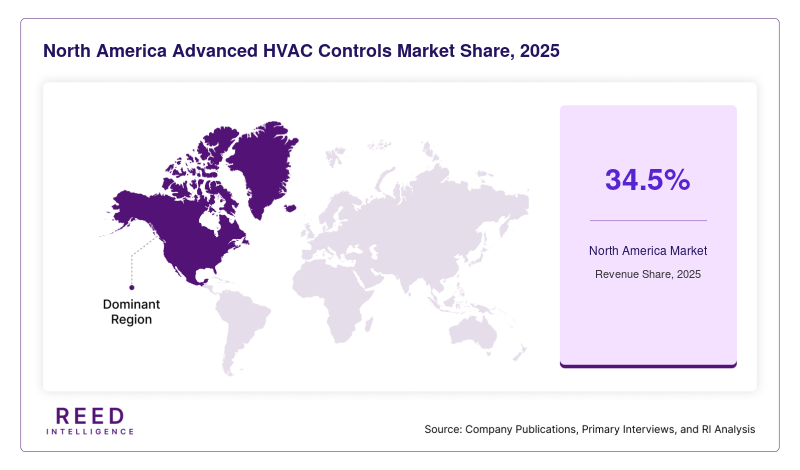
Leads the Advanced HVAC Controls market, commanding a 35% share, with a revenue of USD 5.5 billion in 2025. The United States is the primary driver, accounting for 85% of regional demand, driven by the high adoption of smart building technologies, strong regulatory support for energy efficiency, and a large commercial building sector. The North American Advanced HVAC Controls market is characterized by its focus on innovation and premium products.
Europe Advanced HVAC Controls Market
Represents the second-largest market, capturing a 30% share with a revenue of USD 4.7 billion in 2025. Germany, the UK, and France are the primary drivers, collectively accounting for 55% of regional demand, driven by stringent energy efficiency regulations, a focus on sustainability, and a strong smart building market. The Advanced HVAC Controls market in Europe is characterized by its focus on quality and regulatory compliance.
Asia-Pacific Advanced HVAC Controls Market
Accounts for 25% of the global Advanced HVAC Controls market, with a revenue of USD 4.0 billion in 2025. China, Japan, and South Korea are the primary drivers, together accounting for 65% of regional demand, driven by the rapidly growing construction sector, increasing urbanization, and government initiatives for energy efficiency. The Asia-Pacific Advanced HVAC Controls market is projected to grow at the fastest CAGR of 11% through 2034.
Middle East & Africa and Latin America Advanced HVAC Controls Market
Together account for the remaining 10% of the Advanced HVAC Controls market, with the UAE and Brazil leading their respective regions. Both regions are projected to grow at CAGRs exceeding 8%, driven by increasing construction and infrastructure development.
Top players in Advanced HVAC Controls Market
- Honeywell International Inc.
- Siemens AG
- Schneider Electric SE
- Johnson Controls International plc
- Carrier Global Corporation
- Daikin Industries, Ltd.
- LG Electronics Inc.
- ABB Ltd.
- Emerson Electric Co.
- Delta Controls Inc.
- KMC Controls, Inc.
- Automation Components Inc.
- Distech Controls Inc.
- Lennox International Inc.
- Mitsubishi Electric Corporation
Honeywell International Inc.
Honeywell International Inc. holds a dominant position in the Advanced HVAC Controls market, with an estimated 12% global market share, particularly strong in the North American, European, and Asia-Pacific commercial and residential segments. The company's portfolio of building controls and automation solutions, including the well-known Honeywell Home and Honeywell Building Solutions, is widely recognized for its quality, innovation, and integration capabilities. Honeywell's market leadership is reinforced by its significant investment in R&D and IoT, its extensive global distribution network, and its strong relationships with building owners and contractors. Honeywell commands over 15% of the North American market and 10% of the European market for advanced HVAC controls, positioning it as a key player in the global market.
Siemens AG
Siemens AG is a leading player in the Advanced HVAC Controls market, commanding approximately 10% of the global market share through its comprehensive portfolio of building automation and control solutions, including the Desigo and Apogee systems. The company's expertise in digitalization, automation, and smart infrastructure have solidified its position, particularly in the commercial and industrial segments. Siemens' advanced HVAC controls are known for their reliability, scalability, and integration with other building systems. The company's commitment to innovation and its strong presence in the European, North American, and Asia-Pacific markets have enhanced its competitive advantage.
Schneider Electric SE holds a significant 9% market share, with particular strength in the energy management and digital building solutions segments. Johnson Controls International plc is a major player in the building automation market, holding a 9% share, known for its comprehensive portfolio and global reach.
Recent Developments in Advanced HVAC Controls Market
- 2025: Honeywell launched a new AI-powered HVAC control platform that uses machine learning to optimize building energy performance and predict maintenance needs, reducing energy costs by up to 20%.
- 2025: Siemens announced a new strategic partnership with a major cloud provider to integrate its HVAC controls with cloud-based analytics for enhanced building management.
Advanced HVAC Controls Market Segments
By Component
- Sensors
- Controllers
- Actuators
- Software & Services
By Application
- Commercial
- Residential
- Industrial
By Region
- North America
- Europe
- APAC
- Middle East and Africa
- LATAM