Adventure And Safari Market Size, Share & Trends Analysis Report By Tour Type (Wildlife & Safari Tours, Hiking & Trekking Tours, Water-Based Adventure Tours, Cycling & Overland Tours, Other Adventure Tours), By Booking Type (Group Tours, Private & Customized Tours, Small-Group Tours), By Traveler Type (Solo Travelers, Couples, Families, Corporate & Incentive Travelers), By Distribution Channel (Direct Booking, Travel Agencies & Tour Operators, Online Travel Platforms) and By Region (North Americ
USD 3950
Adventure and Safari Market Size
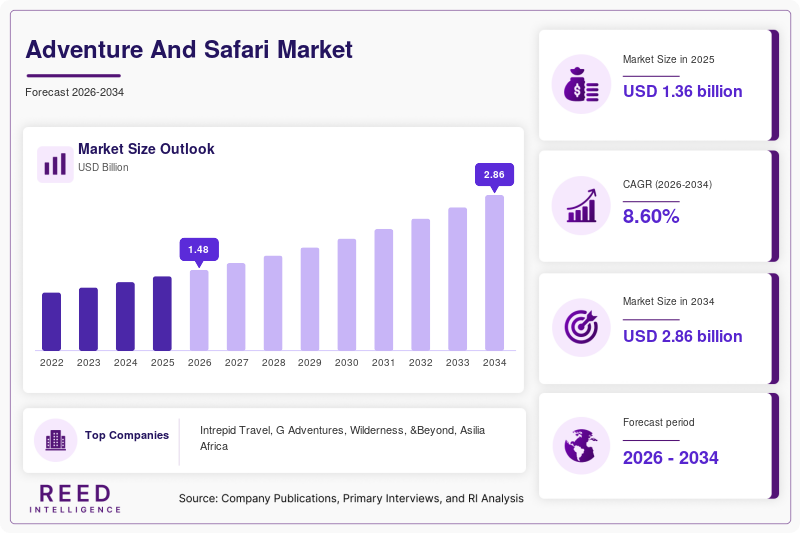
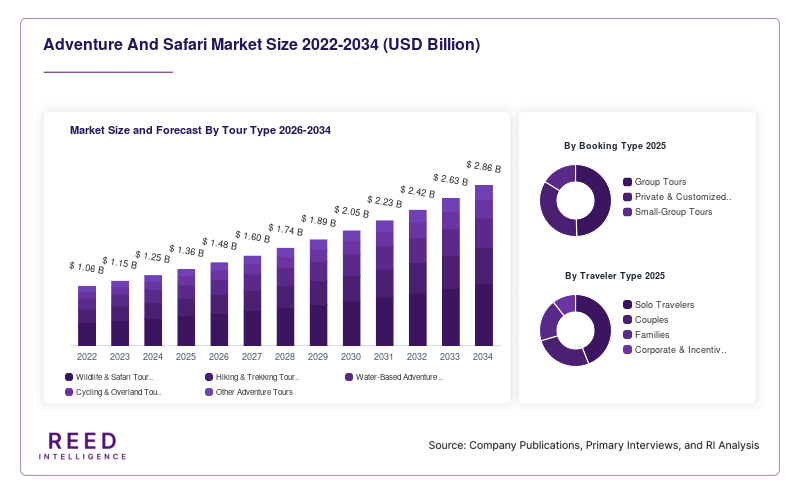
The global Adventure and Safari Market size was valued at USD 1.36 billion in 2025 and is projected to grow from USD 1.48 billion in 2026 to USD 2.86 billion by 2034, registering a CAGR of 8.60% during the forecast period from 2026 to 2034.
The Adventure And Safari Market is shifting from conventional sightseeing toward experience-led travel that combines outdoor activity, wildlife, nature, cultural immersion and smaller-group experiences. The latest Adventure Travel Trade Association (ATTA) research found that average trip fill rates remained at 64% in 2025, while nearly 60% of operators reported revenue growth. The median itinerary price was USD 2,250 for seven nights, and approximately 75% of trip spending remained in local economies. ATTA also reported continued interest in new experiences, cultural connection, off-the-beaten-path destinations, sustainability and wellness.
Safari is becoming increasingly integrated into this wider adventure proposition. ATTA's 2025 industry research identified safaris and wildlife viewing among the leading trending activities, alongside hiking, trekking, cycling, cultural experiences and nature photography.
The demand mechanism is supported by the recovery of international tourism. UN Tourism reported approximately 1.4 billion international tourist arrivals in 2024, bringing global international tourism back to pre-pandemic levels.
Adventure and Safari Market Drivers
Experience-Led Travel Is Increasing the Value of Adventure Itineraries
Travelers are increasingly purchasing journeys around experiences rather than destinations alone. ATTA's 2026 research found that travelers continue to prioritize new experiences, cultural connection and off-the-beaten-path exploration, while interest in sustainability, wellness and purpose-driven travel is also increasing.
This changes the commercial structure of tourism because a destination can sell several activities within one trip rather than relying only on accommodation and transportation. A safari can therefore be combined with walking, photography, cultural encounters, wellness, conservation visits or beach extensions.
Intrepid's 2026 product expansion demonstrates this mechanism. The company introduced 28 new active trips across six continents, including hiking, cycling, kayaking, snorkeling and rafting, increasing its active portfolio to 148 trips.
For operators, broader itineraries increase cross-selling opportunities and make trips relevant to travelers with different levels of physical activity. For destinations, adventure tourism can distribute visitors beyond conventional urban centers and major attractions.
Wildlife and Nature Tourism Are Becoming More Specialized
Safari demand is evolving from a standardized "Big Five" game-drive proposition toward specialized wildlife experiences. Travelers are increasingly interested in specific animals, conservation stories, photography and expert-led interpretation.
Exodus identified single-species safaris as a notable 2026 trend, highlighting specialized tiger experiences in India and jaguar-focused journeys in Brazil. The underlying commercial mechanism is higher specialization: operators can design itineraries around expert guides, repeated wildlife encounters and longer stays rather than selling a generic sightseeing package.
Rwanda provides another example. The country's tourism revenues reached USD 685 million in 2025, up from USD 647 million in 2024, while visitor arrivals increased 9% to 1.49 million. National parks received 155,394 visits and generated USD 40.8 million in park revenues.
This indicates that wildlife tourism can support higher-value destination economics when conservation assets, visitor management and premium experiences are combined.
Small-Group and Customized Travel Is Changing the Product Mix
Adventure travel is increasingly being sold through smaller groups, private departures and customized journeys. ATTA reported that the median number of travelers served per operator declined to 800 in its 2026 survey, reflecting smaller group sizes and more distributed travel patterns rather than a collapse in demand.
Intrepid's 2026 Premium Family range is another example. The company launched eight new trips designed for groups of three to five families, combining higher-end accommodation, extensive inclusions and local experiences. Its existing family portfolio recorded 19% year-on-year growth in 2025.
The commercial impact is important for safari operators because smaller groups can support private vehicles, specialist guides, higher accommodation rates and customized schedules. However, smaller groups can also increase the cost per traveler, making operational efficiency and premium positioning important.
Adventure and Safari Market Restraints
Accessibility, Safety and Destination Infrastructure Limit Expansion
Adventure and safari travel depends heavily on transport connectivity, road quality, aviation capacity, medical access, guide availability and destination safety. Remote parks can offer strong wildlife experiences but are more expensive and complicated to reach.
Kenya's tourism strategy recognizes the importance of infrastructure, product diversification and sustainable development in maintaining international competitiveness. The country recorded approximately 2.4 million international visitors in 2024, up 15% from the previous year, demonstrating strong demand but also the scale of infrastructure and destination-management requirements.
For adventure operators, the constraint is operational rather than simply promotional. Limited flights, seasonal roads and restricted park access can reduce itinerary frequency and raise operating costs.
Conservation Rules and Environmental Capacity Can Restrict Supply
Wildlife tourism depends on natural assets that have finite ecological capacity. Governments and park managers therefore increasingly regulate visitor numbers, routes, access periods, fees and activities.
Rwanda's gorilla tourism demonstrates the trade-off. The country's gorilla tourism operates through controlled permits and daily capacity, while tourism revenues support conservation and surrounding communities. Rwanda's 2025 tourism performance showed that national parks remained an important revenue-generating component of the wider tourism economy.
These restrictions can limit the number of travelers an operator can sell to, but they also protect the underlying resource. The market therefore increasingly depends on higher-value, lower-volume tourism rather than unrestricted visitor growth.
Adventure and Safari Market Opportunities
Premium Wildlife, Conservation and Specialist Safaris
Specialized wildlife experiences offer operators an opportunity to move beyond standard safari packages. Single-species journeys, photographic safaris, conservation-focused trips, walking safaris and scientific interpretation can support higher pricing because the product is differentiated by expertise and access.
Rwanda's experience illustrates the value of this approach. In 2024, gorilla tourism revenue increased 27%, while national park visitation increased 10.7%. The country also reinvests a portion of park revenue into surrounding communities.
The opportunity extends beyond Africa to tiger tourism in India, jaguar experiences in Brazil, bear watching in Europe and marine wildlife experiences globally.
Adventure-Wellness and Multi-Activity Travel
Adventure operators are increasingly combining physical activity with wellness, food, culture and relaxation. Wilderness launched The Sanctuary at Mombo in Botswana in October 2025, adding a wellness component to an established safari proposition.
This allows operators to address travelers who want adventure without a fully high-intensity itinerary. A safari can include game drives, walking, yoga, spa treatments, cultural experiences and nature photography within one package.
The model also improves the appeal of adventure travel to families, older travelers and premium consumers who may not want physically demanding activities throughout the entire trip.
Emerging Destinations and Destination Diversification
Adventure demand is expanding beyond the most established safari destinations. ATTA's 2026 research identified Northeast Asia and Scandinavia among trending destinations, while Intrepid's 2026 product pipeline includes destinations across Asia, Africa, Europe and Latin America.
Emerging destinations can use adventure tourism to distribute visitors geographically and create new local employment. Rwanda, Zambia, Botswana, India and parts of Latin America are developing products around wildlife, conservation and community experiences.
The commercial opportunity is particularly strong where governments combine conservation investment with infrastructure, community participation and destination marketing.
Segmental Analysis
By Tour Type
Wildlife & Safari Tours represent approximately 34% of the global market in 2025, making them the largest tour-type segment. Safari demand benefits from the combination of wildlife viewing, accommodation, guided transportation, cultural experiences and conservation activities within a single itinerary. ATTA identified safaris and wildlife viewing among the leading trending adventure activities in its 2025 industry research.
Hiking & Trekking Tours account for approximately 25%, supported by established demand for active nature experiences and comparatively broad destination availability.
Water-Based Adventure Tours represent approximately 16% and include rafting, kayaking, snorkeling, diving and related experiences.
Cycling & Overland Tours represent approximately 13%, while other adventure formats account for approximately 12%.
Water-Based Adventure Tours are the fastest-growing tour-type segment, with a CAGR of approximately 10.4%. Intrepid's 2026 launch of new kayaking, rafting and snorkeling itineraries demonstrates how operators are expanding beyond conventional hiking and safari products.
By Booking Type
Group Tours represent approximately 39% of the market in 2025. They remain important because shared transportation, guides and accommodation reduce the per-person cost of complex itineraries.
Private & Customized Tours account for approximately 34%, supported by premium travelers seeking flexible schedules, private guides and specialized experiences. Luxury safari operators increasingly use private vehicles and tailored itineraries to differentiate their products.
Small-Group Tours represent approximately 27% and are the fastest-growing booking segment, with a CAGR of approximately 9.8%. ATTA's 2026 research indicates that operators are increasingly serving smaller groups, while Intrepid has expanded premium family and small-group offerings.
By Traveler Type
Couples account for approximately 35% of the market, supported by safari holidays, wildlife photography, trekking and premium adventure itineraries.
Families represent approximately 28% and are becoming more important as operators develop easier logistics and age-appropriate activities. Intrepid's 2026 Premium Family expansion specifically combines adventure with higher-comfort accommodation and simplified trip planning.
Solo Travelers account for approximately 24%, supported by small-group departures that allow independent travelers to participate without arranging an entirely private trip.
Corporate & Incentive Travelers account for approximately 13% and include incentive travel, team-building and experiential corporate programs.
Families are the fastest-growing traveler segment, with approximately 9.7% CAGR, as operators increasingly package adventure with comfort, educational experiences and managed logistics.
By Distribution Channel
Travel Agencies & Tour Operators represent approximately 48% of the market in 2025. Complex adventure and safari trips often require destination knowledge, park permits, transfers, accommodation coordination and guide arrangements, supporting specialist intermediaries.
Direct Booking represents approximately 32%, particularly among established safari lodges and operators with strong brands and destination expertise.
Online Travel Platforms account for approximately 20% and are the fastest-growing channel, with a CAGR of approximately 11.0%. Online platforms improve price comparison, itinerary discovery and access to smaller operators.
TourRadar's 2026 organized-adventure platform demonstrates the increasing role of digital discovery, with operator performance evaluated through verified reviews, review volume, traveler content and responsiveness.
Regional Analysis
North America Adventure And Safari Market
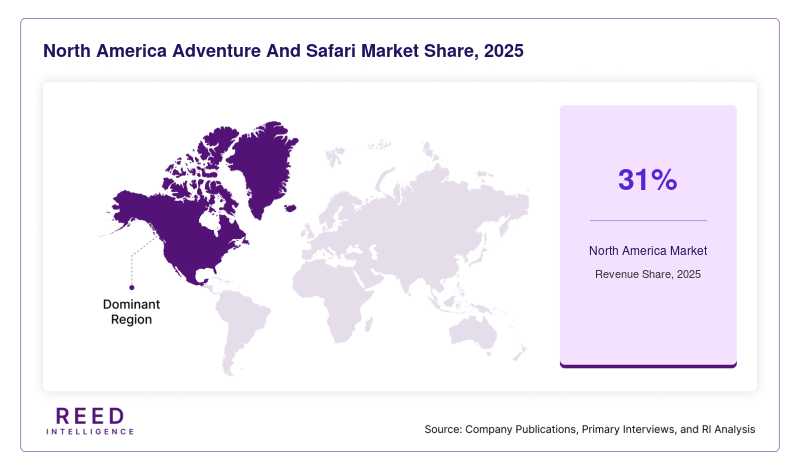
North America represents approximately 31% of the global Adventure And Safari Market in 2025. The region benefits from a large outbound travel base, high consumer spending capacity, extensive domestic national-park infrastructure and strong demand for international wildlife and nature experiences.
ATTA's 2026 market-sizing research estimated the North American outbound adventure market at USD 188 billion, covering U.S. and Canadian travelers who are open to active, cultural and nature-based experiences.
The purchasing mechanism is increasingly experience-led. Travelers can combine adventure activities with premium accommodation, wellness, food and cultural experiences. Small-group and private trips are particularly relevant for consumers who want professional logistics without sacrificing personalization.
The U.S. and Canada also provide a large domestic market for hiking, rafting, wildlife watching, national parks and outdoor recreation, creating an operator ecosystem that can cross-sell international adventures.
North America is projected to grow at approximately 7.3% CAGR through 2034. The main constraints are long-haul travel costs, foreign-exchange fluctuations and competition from domestic outdoor destinations.
Europe Adventure And Safari Market
Europe accounts for approximately 27% of the global market in 2025. The region combines high international travel participation with extensive rail and air connectivity, making multi-country adventure itineraries commercially practical.
ATTA's 2026 market-sizing research identifies the European outbound adventure market as a major global source market, while its broader industry research shows continued interest in off-the-beaten-path travel, cultural connection, nature and sustainability.
European consumers also have access to a wide range of adventure products within the continent, including Alpine trekking, cycling, winter activities, kayaking and wildlife tourism. This creates a mature customer base that can subsequently purchase long-haul safari experiences.
The region is expected to record approximately 7.7% CAGR during 2026–2034. Operators are increasingly using wellness, cultural immersion and wildlife extensions to maintain demand outside traditional peak seasons.
The principal constraint is competition for discretionary travel budgets and the sensitivity of European travelers to airfares and sustainability considerations.
APAC Adventure And Safari Market
APAC represents approximately 22% of the global market in 2025 and is the fastest-growing region, with a CAGR of approximately 10.4%.
The region combines large outbound populations with growing interest in experiential tourism. Japan, Australia, China, India, South Korea and Southeast Asia provide diverse source markets, while destinations such as India, Nepal, Indonesia, Sri Lanka and Australia offer substantial adventure and wildlife inventories.
India is particularly relevant because its adventure proposition can combine tiger safaris, trekking, rafting, cycling, cultural tourism and nature-based travel. Exodus identified specialist tiger safaris in India as an example of the increasing move toward single-species wildlife experiences.
Intrepid's 2026 destination pipeline also highlights emerging Indian adventure products, including trekking, rafting, mountain biking and jungle safari experiences in Arunachal Pradesh.
APAC's growth mechanism is therefore broader than outbound travel alone: regional destinations can simultaneously benefit from domestic, intra-regional and long-haul demand.
The main constraints include uneven infrastructure, visa complexity in some destinations, weather-related seasonality and differences in traveler spending patterns.
Middle East and Africa Adventure And Safari Market
Middle East and Africa represents approximately 13% of the global market in 2025. Africa is the central safari hub within the region, with Kenya, Tanzania, South Africa, Botswana, Rwanda, Uganda, Namibia and Zambia offering established wildlife products.
South Africa recorded 10.5 million international arrivals in 2025, followed by 5.58 million international tourists during January–June 2026, a 12.3% increase over the same period in 2025.
Kenya recorded approximately 2.4 million international visitors in 2024, with tourism earnings rising 19.79% to KSh452.2 billion.
Rwanda provides evidence of the premium conservation-tourism model. Tourism revenues reached USD 685 million in 2025, while national parks generated USD 40.8 million.
The region is expected to expand at approximately 8.9% CAGR. Conservation partnerships are also increasing the supply of viable safari landscapes. In July 2026, African Parks and Zambia renewed their long-term partnership for Liuwa Plain National Park, extending conservation management into part of the Upper West Zambezi Game Management Area.
The principal constraints are air connectivity, political and security conditions in some destinations, seasonal accessibility and the need to protect fragile ecosystems.
LATAM Adventure And Safari Market
LATAM represents approximately 7% of the global market in 2025 and is projected to expand at approximately 9.6% CAGR. The region's adventure proposition includes the Amazon, Andes, Patagonia, Galápagos, Brazilian Pantanal and extensive coastal and rainforest environments.
Wildlife tourism is particularly relevant to Brazil's Pantanal, where specialist jaguar experiences are increasingly marketed as focused wildlife journeys. Exodus identified jaguar-focused travel in the Pantanal as an example of the specialist safari trend for 2026.
The region also benefits from trekking, mountain tourism, rafting, cycling and nature photography. Adventure operators can combine these activities with cultural tourism, food experiences and community-based travel.
The commercial mechanism is destination diversification. Rather than depending solely on traditional city tourism, destinations can distribute visitor expenditure into rural areas, protected landscapes and specialist local services.
The main constraints include long-distance transportation, infrastructure gaps in remote areas, currency volatility and environmental capacity in highly sensitive destinations.
Competitive Landscape
The market contains several distinct competitive groups: global adventure-tour operators, specialist safari companies, luxury lodge groups, online travel platforms and destination-management companies.
Intrepid Travel has expanded its position through a combination of small-group travel, active adventures, premium products and family experiences. The company reported USD 873.3 million in 2025 bookings, up 26%, and launched 28 new active trips for 2026.
Wilderness competes through high-end safari camps, conservation partnerships and destination depth across Africa. In July 2026, Wilderness opened the rebuilt Wilderness Mara in Kenya's Mara Triangle, adding capacity in a major safari destination.
&Beyond uses premium safari lodges, private concessions and high-value itineraries. Its 2026 Tanzania offering includes private-guide and private-vehicle packages, while its Serengeti properties combine wildlife viewing with cultural and conservation-oriented experiences.
Key Market Players
- Intrepid Travel
- G Adventures
- Wilderness
- &Beyond
- Asilia Africa
- Exodus Adventure Travels
- TUI Group
- African Travel
- Abercrombie & Kent
- Natural Habitat Adventures
- National Geographic Expeditions
- Singita
- African Parks
- Micato Safaris
- Explore Worldwide
Recent Market Developments
- September 2026 – Uganda Wildlife Authority highlighted continued mountain-gorilla conservation. Uganda reported that the most recent completed Bwindi census recorded 459 mountain gorillas, with new genetic analysis pending. The development reinforces the link between conservation performance and the long-term availability of high-value gorilla tourism.
- August 2026 – Wilderness expanded the Mombo safari proposition. Wilderness Mombo in Botswana introduced night drives and water-based activities after regulatory restrictions affecting those activities were lifted. This expands the number of experiences that can be sold within the same safari property.
Adventure And Safari Market Segments
By Tour Type
- Wildlife & Safari Tours
- Hiking & Trekking Tours
- Water-Based Adventure Tours
- Cycling & Overland Tours
- Other Adventure Tours
By Booking Type
- Group Tours
- Private & Customized Tours
- Small-Group Tours
By Traveler Type
- Solo Travelers
- Couples
- Families
- Corporate & Incentive Travelers
By Distribution Channel
- Direct Booking
- Travel Agencies & Tour Operators
- Online Travel Platforms
By Region
- North America
- Europe
- APAC
- Middle East and Africa
- LATAM