Advocacy Software Market Size, Share & Demand Report By Type (Grassroots Advocacy Software, Government Relations Software, PAC & Fundraising Software), By Application (Nonprofits & NGOs, Corporations, Government & Public Sector, Political Campaigns) By Region & Segment Forecasts, 2026–2034
USD 3950
Advocacy Software Market Size
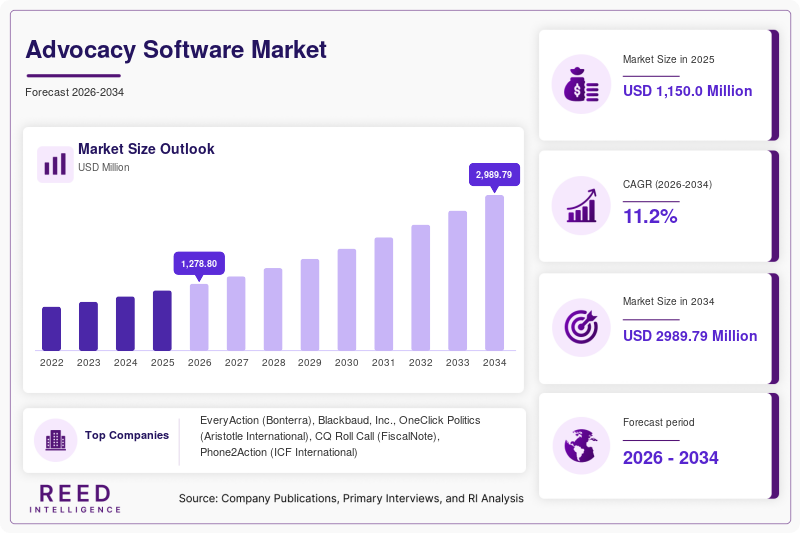
The advocacy software market size is projected at USD 1,280.0 million in 2026 and is expected to hit USD 2,980.0 million by 2034 with a CAGR of 11.2% during the forecast period. The increasing need for organizations to engage stakeholders and influence policy decisions, the growing adoption of digital advocacy campaigns, and the rising demand for data-driven insights to optimize advocacy efforts underpin market expansion. This report delivers a comprehensive analysis of the advocacy software market, including segmentation by type and application, competitive dynamics, and regional growth patterns, equipping stakeholders with critical intelligence to navigate this rapidly evolving civic technology landscape.
Advocacy Software Market Key Takeaways
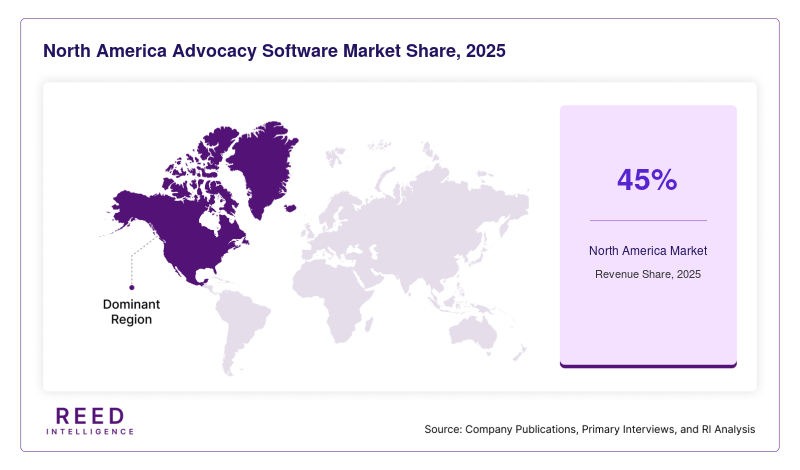
- Dominant Region: North America leads the advocacy software market with a 45% share, while Asia-Pacific is the fastest-growing region with a projected CAGR of 14.5% through 2034.
- Dominant Segment: The Grassroots Advocacy Software type dominates the market with a 48% share, while the Nonprofits & NGOs application is the leading segment with a 38% share.
- Emerging Country: India is projected to reach USD 125.0 million by 2034, expanding at a CAGR of 16.8%.
- Key Drivers: The increasing need for stakeholder engagement, the growing adoption of digital advocacy campaigns, and the rising demand for data-driven insights are driving market growth.
The advocacy software market encompasses a range of digital tools and platforms designed to help organizations engage stakeholders, mobilize supporters, and influence policy decisions. These solutions include grassroots advocacy tools for campaign management, government relations software for tracking legislation and lobbying, and PAC and fundraising software for political contributions. Globally, the adoption of advocacy software has grown substantially, with an estimated 45,000 organizations utilizing these solutions in 2025. In terms of revenue, Grassroots Advocacy Software accounted for roughly 48% of the total market share, driven by the increasing use of digital campaigns to mobilize supporters and influence policymakers, while Government Relations Software followed with 32% share, particularly utilized by corporations and trade associations to monitor legislative activity and manage lobbying efforts. The market is further characterized by a penetration rate exceeding 55% among large nonprofits and advocacy organizations in developed economies, whereas small and medium-sized organizations represent a growing adoption frontier due to the increasing availability of affordable, cloud-based solutions. The PAC & Fundraising Software segment, representing 20% of the market, is driven by the need for efficient political fundraising and donor management.
Advocacy Software Market Trends
Integration of AI and Data Analytics for Campaign Optimization
The advocacy software market is witnessing a significant trend toward the integration of Artificial Intelligence (AI) and data analytics to optimize advocacy campaigns and enhance targeting. This shift is driven by the need to identify and engage key supporters, personalize messaging, and measure campaign effectiveness. AI-powered advocacy platforms can analyze supporter data, predict engagement, and recommend actions to maximize impact. The adoption of AI-enabled advocacy tools has increased by 35% year-over-year, with over 50% of new platform deployments incorporating AI capabilities. This advocacy software market trend is supported by the growing availability of data and the increasing demand for evidence-based advocacy strategies.
Growing Demand for Mobile-First and Omnichannel Engagement Tools
The increasing demand for mobile-first and omnichannel engagement tools is a major trend shaping the advocacy software market. The development of mobile apps and responsive platforms that enable supporters to take action from their smartphones is gaining traction, driven by the need for convenience and real-time engagement. The emergence of omnichannel advocacy tools that integrate email, social media, SMS, and phone outreach is particularly prominent. This advocacy software market growth is supported by the growing use of smartphones and the increasing expectation of supporters for seamless digital experiences. The integration of social media advocacy features and peer-to-peer fundraising tools is also expanding the reach and effectiveness of advocacy campaigns.
Advocacy Software Market Drivers
The advocacy software market's expansion is primarily driven by the increasing need for organizations to engage stakeholders and influence policy decisions in an increasingly complex regulatory and political environment. The growing adoption of digital advocacy campaigns has been a major driver, with organizations seeking to mobilize supporters, amplify their message, and achieve policy outcomes more efficiently. The rising demand for data-driven insights to optimize advocacy efforts has further fueled market demand, with organizations seeking to measure the impact of their campaigns and demonstrate return on investment. The increasing focus on transparency and accountability in advocacy and lobbying has also supported market growth. Additionally, the growing availability of affordable, cloud-based advocacy software has expanded the market to smaller organizations and emerging markets.
Advocacy Software Market Restraints
Despite favorable growth prospects, the advocacy software market faces significant constraints, primarily related to the high costs associated with comprehensive advocacy platforms and the need for specialized skills to effectively use these tools. The market's growth is further tempered by the concerns about data privacy and security, particularly when managing sensitive supporter information. The complexity of integrating advocacy software with existing CRM and database systems can also present challenges for organizations. Additionally, the cyclical nature of political campaigns and the dependence on funding cycles can create volatility in demand for advocacy software.
Advocacy Software Market Opportunities
The advocacy software market presents significant opportunities in the rapidly expanding segment of AI-powered campaign optimization and predictive analytics that can enhance the effectiveness of advocacy efforts. The development of integrated platforms that combine grassroots advocacy, government relations, and fundraising capabilities represents another promising avenue. Emerging opportunities also exist in the application of advocacy software for corporate social responsibility and ESG initiatives. Furthermore, the untapped potential in emerging markets, driven by the growth of civil society and increasing digital adoption, offers a fertile ground for market expansion.
Challenges in Advocacy Software Market
The advocacy software market grapples with persistent challenges related to the need for continuous innovation to keep pace with evolving communication channels and supporter expectations. The complexity of managing multi-channel campaigns and ensuring consistent messaging across platforms presents ongoing operational challenges. The market is also contending with the challenge of demonstrating measurable impact and return on investment for advocacy efforts. Moreover, the need for effective data management and compliance with privacy regulations poses challenges for software providers and their clients.
Advocacy Software Market Segmentation Analysis
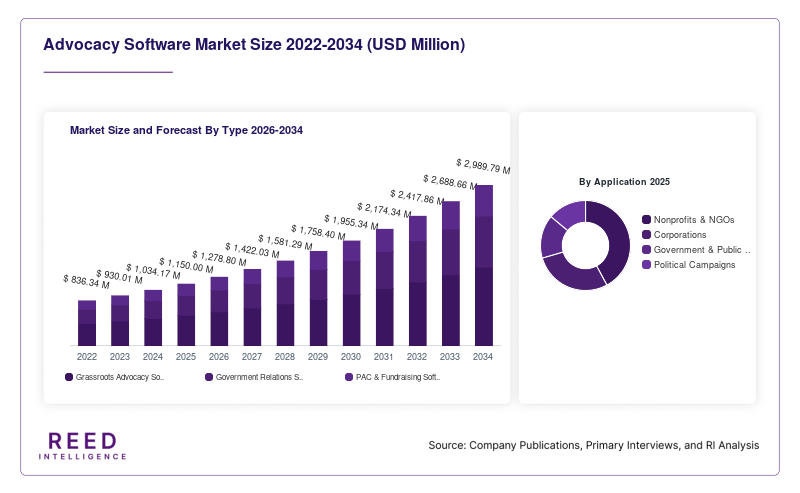
The advocacy software market is segmented by Type and Application to provide a comprehensive market perspective. By Type, Grassroots Advocacy Software dominates with a 48% market share, driven by the increasing use of digital campaigns. The Application segment is led by Nonprofits & NGOs, which accounts for 38% of the market, followed by Corporations at 28%, Government & Public Sector at 20%, and Political Campaigns at 14%.
By Type
Grassroots Advocacy Software represents the largest segment in the advocacy software market, commanding a 48% share, with revenue exceeding USD 614 million in 2025. These tools enable organizations to mobilize supporters, manage campaigns, and facilitate constituent communication with policymakers. Technical specifications include supporter management, campaign tracking, and integration with social media. The market's Grassroots Advocacy Software segment is driven by its use by nonprofits, advocacy groups, and trade associations to influence policy at local, state, and federal levels.
Government Relations Software captures a 32% share of the advocacy software market, with revenue of USD 410 million in 2025. These tools help organizations track legislation, manage lobbying efforts, and facilitate communication with government officials. Technical specifications include legislative tracking, contact management, and reporting. The market's Government Relations Software segment is driven by its use by corporations, trade associations, and lobbying firms to monitor and influence policy.
PAC & Fundraising Software represents 20% of the market, with revenue of USD 256 million in 2025, characterized by tools for managing political action committees, processing contributions, and donor management. Technical specifications include compliance features, payment processing, and donor analytics. The market's PAC & Fundraising Software segment is driven by the need for efficient political fundraising and compliance with campaign finance regulations.
By Application
Nonprofits & NGOs dominate the advocacy software market, accounting for 38% of sales, representing USD 486 million in 2025. This segment includes organizations focused on social causes, environmental issues, and human rights that use advocacy software to mobilize supporters and influence policy. Usage penetration exceeds 55% among large nonprofits in developed markets. The market's Nonprofits & NGOs segment is characterized by its focus on grassroots mobilization, volunteer management, and campaign effectiveness.
Corporations account for 28% of the advocacy software market, with revenue of USD 358 million in 2025. This segment encompasses companies that use advocacy software to manage government relations, engage employees in advocacy, and influence policy issues affecting their business. The segment is growing at a significant rate, driven by the increasing recognition of the importance of corporate advocacy. The market's Corporations segment is characterized by its focus on legislative tracking, stakeholder engagement, and reputation management.
Government & Public Sector represents 20% of the market, with revenue of USD 256 million in 2025, involving government agencies and public sector organizations that use advocacy software for constituent engagement and public affairs. The segment's growth is fueled by the increasing focus on citizen engagement and transparency. The market's Government & Public Sector segment is characterized by its focus on accessibility, compliance, and constituent communication.
Political Campaigns account for 14% of the market, with revenue of USD 179 million in 2025, encompassing political campaigns that use advocacy software for voter mobilization, fundraising, and volunteer management. The market's Political Campaigns segment is driven by the need for efficient and effective campaign operations, with a focus on data-driven targeting and rapid response.
Advocacy Software Market Regional Analysis
North America Advocacy Software Market
Leads the advocacy software market, commanding a 45% share, with revenue of USD 576 million in 2025. The United States is the primary driver, accounting for 90% of regional demand, driven by the strong advocacy culture, advanced political infrastructure, and the presence of leading software providers. The North American market is characterized by its focus on innovation, data-driven campaigning, and comprehensive engagement tools.
Europe Advocacy Software Market
Represents the second-largest market, capturing a 28% share with revenue of USD 358 million in 2025. The United Kingdom, Germany, and France are the primary drivers, together accounting for 60% of regional demand, driven by active civil society and increasing focus on policy engagement. The European market is projected to grow at a steady CAGR, supported by continuous innovation and regulatory engagement.
Asia-Pacific Advocacy Software Market
Accounts for 18% of the global advocacy software market, with revenue of USD 230 million in 2025. India, Japan, and Australia are the primary drivers, accounting for 65% of regional demand, fueled by the growing civil society, increasing digital adoption, and expanding policy engagement. The Asia-Pacific market is projected to grow at the fastest CAGR of 14.5% through 2034, driven by digital transformation and growing advocacy activities.
Latin America and Middle East & Africa Advocacy Software Market
Together account for the remaining 9% of the advocacy software market, with Brazil and South Africa leading their respective regions. Both regions are projected to grow at CAGRs exceeding 13%, driven by growing civil society and increasing digital adoption.
Top players in Advocacy Software Market
- EveryAction (Bonterra)
- Blackbaud, Inc.
- OneClick Politics (Aristotle International)
- CQ Roll Call (FiscalNote)
- Phone2Action (ICF International)
- VoterVoice (FiscalNote)
- Granicus
- Quorum Analytics
- FiscalNote Holdings
- SoftEdge
- Capitol Canary (Aristotle)
- PopVox
- New/Mode
- Muster
- Countable
Recent Developments in Advocacy Software Market
- April 2026 – EveryAction (Bonterra) launched a new AI-powered advocacy platform that provides predictive analytics for supporter engagement and campaign optimization.
- June 2025 – Blackbaud, Inc. introduced a new integrated platform combining fundraising, advocacy, and CRM capabilities for nonprofits.
- August 2025 – Phone2Action (ICF International) announced a new mobile-first advocacy app with enhanced social sharing and peer-to-peer features.
- February 2026 – FiscalNote Holdings launched a new government relations platform with expanded legislative tracking and stakeholder management capabilities.
- October 2025 – Granicus introduced a new omnichannel engagement suite for government agencies, enabling seamless constituent communication across digital channels.
Advocacy Software Market Segments
By Type
- Grassroots Advocacy Software
- Government Relations Software
- PAC & Fundraising Software
By Application
- Nonprofits & NGOs
- Corporations
- Government & Public Sector
- Political Campaigns
By Region
- North America
- Europe
- APAC
- Middle East and Africa
- LATAM