AEC Market Size, Share & Demand Report By Deployment (Cloud-Based, On-Premise), By Application (Construction Management, Infrastructure Planning, Building Design, Project Management), By End-Use (Residential, Commercial, Industrial), By Solution Type (Software, Services), By Region & Segment Forecasts, 2026–2034
USD 3950
Market Overview
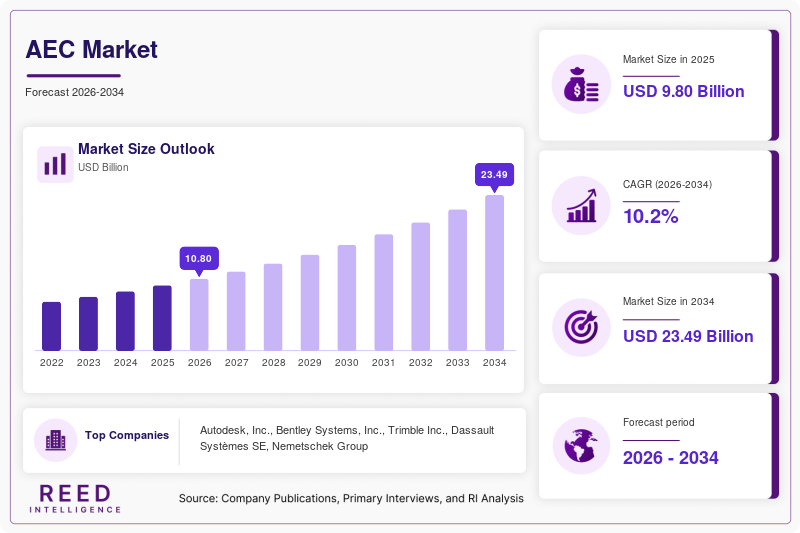
The AEC Market size was valued at USD 9.8 billion in 2026 and is projected to reach USD 21.4 billion by 2034, expanding at a CAGR of 10.2% during the forecast period (2026–2034). The market has witnessed steady expansion driven by the rapid integration of digital technologies into architectural, engineering, and construction workflows. One key global factor supporting this growth is the widespread adoption of Building Information Modeling (BIM) and cloud-based project management solutions, enabling enhanced collaboration, cost optimization, and improved project timelines across the construction value chain.
The AEC Market continues to evolve as stakeholders increasingly prioritize efficiency, sustainability, and data-driven decision-making. The shift toward smart infrastructure development and urbanization has significantly influenced demand for advanced AEC software and services. Moreover, governments and private organizations are investing in digital construction ecosystems, accelerating market expansion.
Key Highlights
- North America dominated the AEC Market with a 36.5% share in 2025, while Asia Pacific is projected to grow at the fastest CAGR of 12.8% (2026–2034).
- By deployment, cloud-based solutions held the largest share of 58.2% in 2025, while AI-integrated platforms are expected to grow at a CAGR of 13.5%.
- By application, construction management accounted for the dominant share of 34.7% in 2025, while infrastructure planning solutions are projected to expand at a CAGR of 12.1%.
- The United States remained the dominant country, with market values of USD 3.2 billion in 2024 and USD 3.5 billion in 2025.
Market Trends
Digital Twin Integration in Construction
The increasing adoption of digital twin technology is transforming project visualization and lifecycle management. AEC firms are leveraging real-time simulation models to monitor building performance, reduce operational risks, and enhance predictive maintenance capabilities.
Rise of Sustainable and Green Building Solutions
Environmental considerations are shaping the AEC Market, with growing demand for energy-efficient designs and sustainable construction materials. Software tools that enable carbon footprint analysis and compliance tracking are becoming integral to project planning.
Market Drivers
Increasing Adoption of Cloud-Based Collaboration Tools
The shift toward remote and collaborative work environments has accelerated the adoption of cloud-based AEC platforms. These tools facilitate real-time communication, centralized data management, and seamless integration across stakeholders. As construction projects become more complex, cloud solutions enable improved coordination and reduce delays, contributing to overall market growth.
Growing Demand for Infrastructure Development
Rapid urbanization and population growth have led to increased investments in infrastructure projects worldwide. Governments are focusing on smart cities, transportation networks, and residential developments. This surge in construction activities has driven the demand for advanced AEC solutions that enhance planning, design accuracy, and project execution efficiency.
Market Restraint
High Implementation and Training Costs
The adoption of advanced AEC technologies involves significant upfront investment and requires skilled professionals for effective utilization. Small and medium-sized enterprises often face challenges in deploying these solutions due to limited budgets and lack of technical expertise, which can restrain overall market growth.
Market Opportunities
Expansion of Smart City Initiatives
The growing number of smart city projects presents significant opportunities for the AEC Market. These initiatives require advanced planning tools, real-time data integration, and efficient resource management systems. AEC solutions are expected to play a critical role in enabling intelligent infrastructure development.
Integration of Artificial Intelligence and Automation
The incorporation of AI and automation technologies in AEC workflows is opening new avenues for market expansion. AI-driven design optimization, predictive analytics, and automated construction processes are expected to enhance productivity and reduce operational costs, driving future growth.
Segmental Analysis
By Deployment
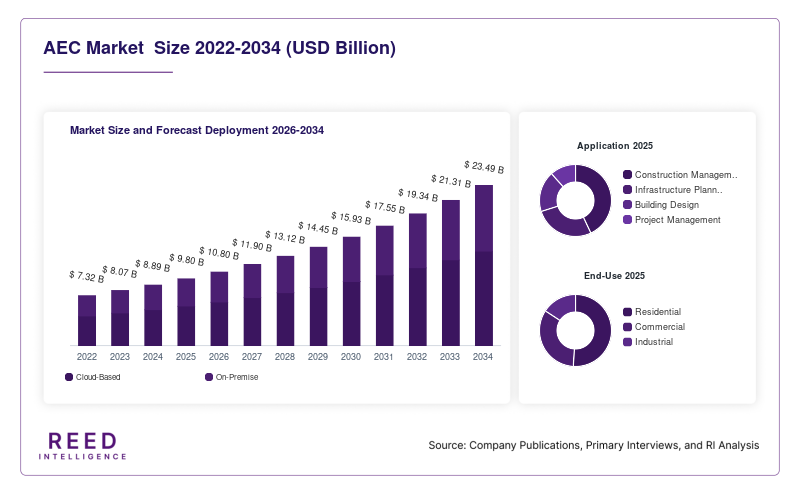
The cloud-based segment dominated the AEC Market with a 58.2% share in 2025, driven by its scalability and ease of integration across project teams. The on-premise segment is expected to grow steadily due to data security concerns in certain industries.
The AI-integrated cloud platforms segment is projected to grow at a CAGR of 13.5%, supported by increasing demand for automation and predictive analytics in construction workflows.
By Application
The construction management segment held the largest share of 34.7% in 2025, owing to the need for efficient project scheduling, cost estimation, and resource allocation.
The infrastructure planning segment is expected to grow at a CAGR of 12.1%, driven by large-scale public infrastructure projects and the need for advanced planning tools.
By End-Use
The commercial construction segment dominated with a 41.3% share in 2025, supported by increasing investments in office spaces, retail complexes, and hospitality projects.
The residential construction segment is projected to grow at a CAGR of 11.4%, fueled by rising housing demand and urban population growth.
By Solution Type
The software segment accounted for 63.9% share in 2025, driven by widespread adoption of BIM and project management tools.
The services segment, including consulting and implementation, is expected to grow at a CAGR of 10.9%, supported by the need for customized solutions and technical support.
Regional Analysis
North America
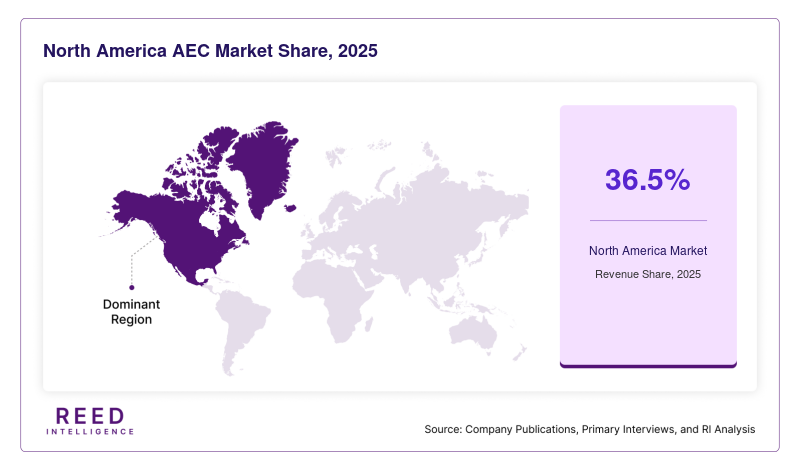
North America accounted for 36.5% of the AEC Market share in 2025 and will grow at a CAGR of 9.4% during the forecast period. The United States dominated the region due to the widespread adoption of advanced digital construction technologies and strong investment in infrastructure modernization.
Europe
Europe held 27.3% market share in 2025 and is expected to expand at a CAGR of 9.1% from 2026 to 2034. Germany emerged as the leading country, supported by stringent building regulations and increasing emphasis on sustainable construction practices.
Asia Pacific
Asia Pacific represented 22.8% share in 2025 and will grow at the fastest CAGR of 12.8%. China dominated the region due to rapid urbanization and large-scale infrastructure projects, including smart city developments and transportation networks.
Middle East & Africa
The Middle East & Africa accounted for 7.1% share in 2025 and is projected to grow at a CAGR of 10.6%. The United Arab Emirates led the region, driven by investments in commercial construction and tourism infrastructure.
Latin America
Latin America held 6.3% share in 2025 and is anticipated to expand at a CAGR of 9.8%. Brazil dominated the market, supported by increasing construction activities and government initiatives to improve urban infrastructure.
Competitive Landscape
The AEC Market is characterized by the presence of established technology providers and emerging solution developers. Key players are focusing on innovation, strategic partnerships, and product enhancements to strengthen their market position. The competitive environment is moderately consolidated, with leading companies investing in AI, cloud computing, and integrated platforms.
Autodesk, Inc. is recognized as a market leader, driven by its comprehensive portfolio of design and construction software solutions. The company recently introduced advanced AI capabilities within its BIM platform to improve design efficiency and project outcomes. Bentley Systems, Inc. and Trimble Inc. are also prominent players, offering infrastructure-focused solutions and geospatial technologies. Dassault Systèmes SE continues to expand its presence through digital twin applications, while Nemetschek Group emphasizes open BIM standards and interoperability. These companies are actively enhancing their offerings to address evolving industry requirements and maintain competitive advantage.
Key Players List
- Autodesk, Inc.
- Bentley Systems, Inc.
- Trimble Inc.
- Dassault Systèmes SE
- Nemetschek Group
- Hexagon AB
- Oracle Corporation
- SAP SE
- Procore Technologies, Inc.
- AVEVA Group plc
- RIB Software SE
- Bluebeam, Inc.
- Asite Solutions Limited
- Deltek, Inc.
- Vectorworks, Inc.
Recent Developments
- In 2025, Autodesk introduced enhanced AI-driven automation features in its BIM solutions to improve design workflows.
- Bentley Systems expanded its digital twin platform to support large-scale infrastructure monitoring projects.
- Trimble launched new cloud-based construction management tools aimed at improving field-to-office connectivity.
- Dassault Systèmes enhanced its 3D experience platform for AEC applications, focusing on sustainability analysis.
- Procore Technologies introduced advanced analytics capabilities to optimize project performance and cost management.
AEC Market Segments
Deployment
- Cloud-Based
- On-Premise
Application
- Construction Management
- Infrastructure Planning
- Building Design
- Project Management
End-Use
- Residential
- Commercial
- Industrial
Solution Type
- Software
- Services
By Region
- North America
- Europe
- APAC
- Middle East and Africa
- LATAM