AEC Software Market Size, Share & Trends Analysis Report By Solution Type (Building Information Modeling, Computer-Aided Design, Construction Management, Project Management, Cost Estimation & Analysis and Others), By Deployment (Cloud-Based and On-Premise), By Application (Architecture, Engineering, Construction and Operations & Maintenance), By End User (Architects, Engineers, Contractors, Developers and Others) and By Region (North America, Europe, Asia-Pacific, Latin America, Middle East & Af
USD 3950
AEC Software Market Size
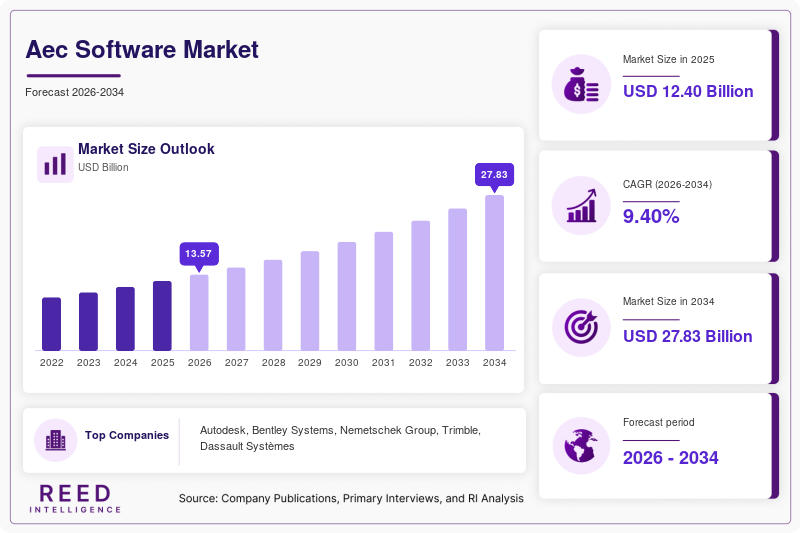
The global AEC software market was valued at USD 12.40 billion in 2025 and is projected to grow from USD 13.57 billion in 2026 to USD 27.80 billion by 2034, registering a CAGR of 9.40% during the forecast period from 2026 to 2034.
AEC software encompasses digital platforms and applications used across architecture, engineering, construction and the broader built-environment lifecycle. These solutions support design, Building Information Modeling (BIM), drafting, structural and MEP engineering, construction planning, project management, estimating, documentation, collaboration and asset operations.
The market is shifting from standalone desktop applications toward cloud-connected, collaborative and data-centric platforms. Software providers are increasingly connecting design, construction and operational workflows so that project information can move across stages without repeated manual conversion.
AEC Software Market Drivers
Increasing Adoption of BIM Accelerates Demand for Integrated AEC Software
Building Information Modeling has become an important foundation for digital project delivery because it allows project participants to work with coordinated digital representations of buildings and infrastructure.
BIM supports design coordination, clash detection, documentation, quantity estimation and information exchange across project stages. As construction projects become more complex, organizations increasingly require platforms that allow architects, engineers, contractors and owners to collaborate around a common project model.
Software providers are therefore expanding BIM functionality while improving interoperability with other design, analysis and construction-management tools.
Cloud Collaboration Is Reshaping AEC Workflows
Cloud deployment allows project teams to access models, drawings, documents and project information from different locations. This is particularly valuable for construction projects involving multiple organizations and geographically distributed teams.
Autodesk is advancing this model through its Forma industry cloud. In March 2026, Autodesk announced that Autodesk Construction Cloud had become Autodesk Forma, integrating construction capabilities into its broader AECO industry cloud.
Cloud-based workflows can reduce reliance on locally stored files and facilitate more continuous information exchange between design and construction teams.
AI Adoption Is Expanding Across Architecture, Engineering and Construction
Artificial intelligence is increasingly being integrated into AEC software to automate repetitive activities, improve design exploration and support project decision-making.
Autodesk announced in September 2026 that it was expanding agentic AI across Autodesk Forma, including capabilities designed to use connected project data and context to support users across products and teams.
Nemetschek has similarly expanded AI capabilities across its AEC portfolio, including AI-assisted design and its AI Assistant across solutions such as Archicad and ALLPLAN.
These developments are increasing the role of AI from an isolated feature to a broader layer within AEC workflows.
AEC Software Market Restraints
High Implementation Costs Can Restrict Adoption Among Smaller Firms
Advanced AEC platforms can require substantial investments in software licenses, hardware, cloud infrastructure, training and implementation services.
Smaller architecture and construction firms may have difficulty absorbing these costs, particularly when migrating from familiar legacy applications.
Although subscription and cloud models can reduce upfront expenditure, recurring software costs remain an important consideration for smaller organizations.
Interoperability Challenges Remain Across AEC Software Ecosystems
AEC projects frequently involve software from multiple vendors. Architects may use one platform for BIM, structural engineers another for analysis, contractors another for construction management and owners additional asset-management systems.
Moving information between these environments without loss of data, geometry or project context remains challenging. Open standards such as IFC can help, but differences in data structures and software capabilities can still create workflow friction.
Shortage of Digitally Skilled Professionals Can Slow Deployment
Effective use of advanced BIM, cloud and AI tools requires professionals with specialized digital skills.
Firms may need to train architects, engineers, contractors and project managers to adopt new workflows. Organizations with limited internal IT and digital-transformation resources may therefore experience longer implementation cycles.
AEC Software Market Opportunities
AI-Assisted Design Creates New Software Capabilities
AI can assist with early-stage design exploration, visualization, documentation, analysis and project information retrieval.
Autodesk's Forma platform, for example, incorporates AI-powered tools for pre-design and schematic design, while its broader strategy is connecting early-stage design with detailed Revit workflows.
This creates opportunities for vendors to offer intelligent design assistance without replacing established modeling and documentation environments.
Digital Twins Expand the Role of AEC Software Beyond Construction
Digital twins connect digital representations with information about physical assets and their operational conditions. This expands the addressable market from project design and construction into facility management, infrastructure operations and lifecycle optimization.
Infrastructure software vendors are increasingly combining engineering models, asset information and AI capabilities to support ongoing infrastructure management.
Bentley Systems, for example, has been expanding infrastructure AI capabilities and integrating engineering and infrastructure data into connected workflows.
Integrated Construction Planning Supports Growth in Cloud Platforms
Construction planning increasingly requires coordination of schedules, models, resources, costs and site information. Integrated 4D and 5D workflows can connect project schedules and cost information to digital models.
Bentley introduced SYNCHRO+ in 2025 as an AI-powered approach to 4D construction planning, with integration through Bentley Infrastructure Cloud and planned general availability in 2026.
Solution Type Segment Analysis
Building Information Modeling Holds the Largest Share
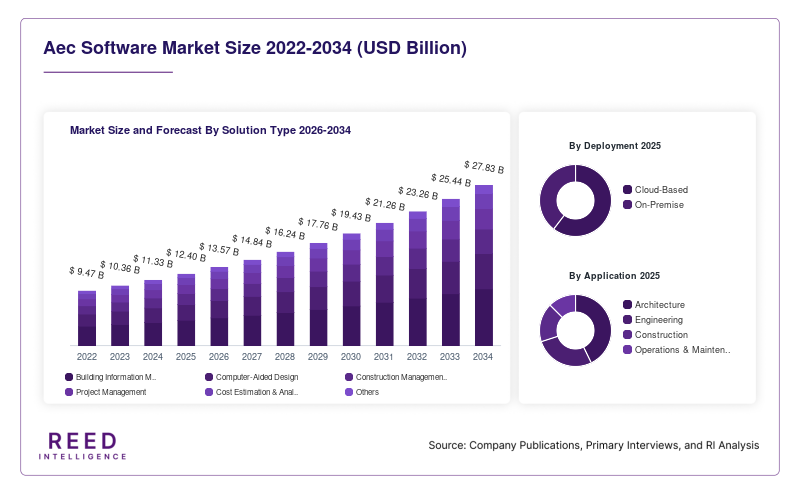
Building Information Modeling accounted for approximately 34% of the global AEC software market in 2025, making it the largest solution segment. BIM supports coordinated digital modeling across architectural, structural, MEP and construction workflows.
Its adoption is supported by the need to reduce design conflicts, improve documentation and coordinate information between project stakeholders.
Construction Management accounted for approximately 21% and is projected to grow at approximately 10.3% CAGR, making it the fastest-growing major solution segment. Cloud-based construction management is gaining relevance as contractors seek integrated tools for scheduling, field coordination, documentation and project communication.
Computer-Aided Design represented approximately 20%, Project Management 13%, Cost Estimation & Analysis 7%, and other solutions approximately 5%.
Deployment Segment Analysis
Cloud-Based Deployment Holds the Largest Share
Cloud-based AEC software accounted for approximately 58% of the market in 2025, making it the largest deployment segment. Cloud platforms enable remote access, centralized project information, real-time collaboration and easier software updates.
The shift toward connected cloud environments is being reinforced by major vendors. Autodesk has positioned Forma as an end-to-end cloud-based platform for planning, design, construction and operations.
Cloud-based deployment is also the fastest-growing segment, with approximately 11.2% CAGR through 2034.
On-premise deployment accounted for approximately 42% and is projected to grow at approximately 6.7% CAGR.
Application Segment Analysis
Engineering Holds the Largest Share
Engineering accounted for approximately 31% of the market in 2025, making it the largest application segment. Engineering firms rely on AEC software for structural design, civil engineering, MEP systems, infrastructure modeling, analysis and technical documentation.
The increasing integration of engineering models with project management and construction workflows is supporting demand for connected platforms.
Construction accounted for approximately 28% and is projected to grow at approximately 10.5% CAGR, making it the fastest-growing major application segment. Construction organizations are adopting digital project-management, BIM coordination, 4D planning and field-management tools to improve project visibility.
Architecture represented approximately 24%, while Operations & Maintenance accounted for approximately 17%.
End-User Segment Analysis
Contractors Account for the Largest Share
Contractors accounted for approximately 32% of the global market in 2025, making them the largest end-user segment. Contractors increasingly use AEC software for construction planning, scheduling, BIM coordination, estimating, procurement, field management and project documentation.
Developers represented approximately 18% and are projected to grow at approximately 10.1% CAGR, supported by increasing use of digital tools for project planning, cost management and lifecycle coordination.
Engineers represented approximately 27%, architects 18%, and other end users approximately 5%.
AEC Software Market Regional Analysis
North America Holds the Largest Share
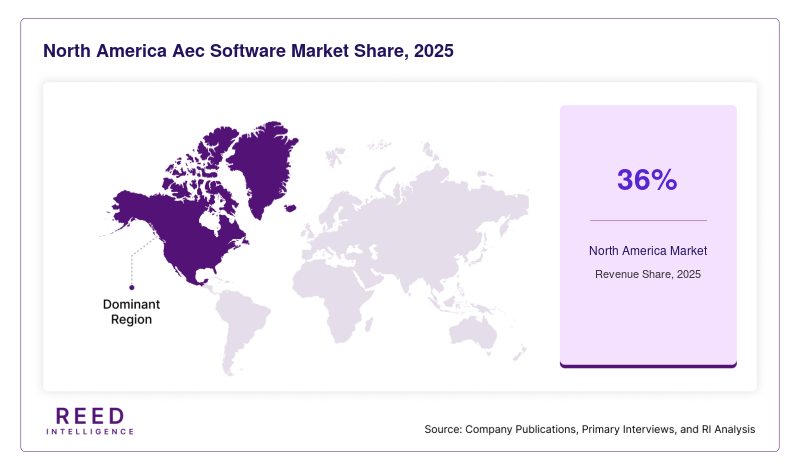
North America accounted for approximately 36% of the global AEC software market in 2025, making it the largest regional market. The region benefits from mature construction technology adoption, established BIM practices, large software vendors and significant investment in infrastructure and commercial development.
The presence of major AEC software providers and strong demand for cloud-based collaboration further supports the regional market.
Asia-Pacific accounted for approximately 25% and is projected to grow at approximately 11.2% CAGR, making it the fastest-growing major region. Rapid urbanization, infrastructure development, digital construction initiatives and increasing adoption of BIM and cloud technologies are supporting regional expansion.
Europe Maintains Strong Adoption of Digital Construction Technologies
Europe represented approximately 29% of the market in 2025 and is projected to grow at approximately 8.4% CAGR.
The region has established BIM adoption across architecture, engineering and construction and continues to emphasize digital project delivery, sustainability and building-performance analysis.
Nemetschek's continued expansion of cloud and AI capabilities across its European-rooted software ecosystem reflects the broader movement toward intelligent digital workflows in the region. The company reported 22.6% currency-adjusted revenue growth in 2025, with subscription and SaaS revenue increasing 55.6%.
Asia-Pacific Is the Fastest-Growing Region
Asia-Pacific is projected to grow at approximately 11.2% CAGR through 2034. The region is benefiting from large-scale infrastructure development, urbanization and increasing digitalization of construction activities.
Japan, China, India, South Korea and Southeast Asian markets are contributing to demand for BIM, CAD, construction management and project collaboration platforms.
The region also provides opportunities for localized software, cloud deployment and mobile-enabled construction applications.
Latin America Shows Increasing Digital Construction Adoption
Latin America accounted for approximately 6% of the market in 2025 and is projected to grow at approximately 8.2% CAGR.
Construction companies are increasingly adopting digital tools to improve project documentation, scheduling, estimating and collaboration. Cloud deployment can be particularly attractive where firms seek to avoid extensive local IT infrastructure.
Middle East & Africa Represents an Emerging Market
Middle East & Africa accounted for approximately 4% of the market in 2025 and is projected to grow at approximately 9.1% CAGR.
Large infrastructure, urban development and construction projects across the Gulf region are supporting adoption of BIM, project-management and digital construction platforms.
The region's emphasis on smart cities, digital infrastructure and complex megaprojects is creating opportunities for advanced modeling, coordination and lifecycle-management software.
AEC Software Market Competitive Landscape
Competition in the AEC software market is centered on BIM capabilities, cloud connectivity, interoperability, AI functionality, project lifecycle coverage, collaboration tools and integration with existing design and construction systems.
Leading vendors are increasingly developing connected ecosystems rather than isolated applications. The competitive environment includes large diversified software companies as well as specialized providers serving architecture, engineering, construction and infrastructure niches.
Key Market Players
- Autodesk
- Bentley Systems
- Nemetschek Group
- Trimble
- Dassault Systèmes
- Hexagon
- RIB Software
- Procore Technologies
- Oracle
- Graphisoft
AEC Software Market Recent Developments
- In March 2026, Autodesk announced that Autodesk Construction Cloud had become Autodesk Forma, advancing its strategy for a unified industry cloud covering architecture, engineering and construction. The company described Forma as a cloud-based, AI-native platform intended to connect planning, design, construction and operations. This development strengthens the movement toward lifecycle-based AEC software rather than separate applications for individual project stages.
- Autodesk announced in 2025 that Revit would become the first Forma Connected Client, enabling deeper integration between the desktop BIM environment and Autodesk's cloud platform. In 2026, Autodesk expanded this approach so Revit users could access selected Forma capabilities involving project context, analysis and connected cloud workflows. The development allows users to continue detailed design in Revit while connecting to cloud-based project information and analysis.
Aec Software Market Segments
By Solution Type
- Building Information Modeling
- Computer-Aided Design
- Construction Management
- Project Management
- Cost Estimation & Analysis
- Others
By Deployment
- Cloud-Based
- On-Premise
By Application
- Architecture
- Engineering
- Construction
- Operations & Maintenance
By End User
- Architects
- Engineers
- Contractors
- Developers
- Others
By Region
- North America
- Europe
- APAC
- Middle East and Africa
- LATAM