Aerosol Packaging Market Size, Share & Trends Analysis Report By Material (Aluminum, Steel and Plastic), By Product Type (Cans, Bottles & Cylinders, Caps & Closures), By End Use (Personal Care & Cosmetics, Household, Food & Beverages, Automotive, Healthcare) and By Region (North America, Europe, Asia Pacific, Latin America, Middle East & Africa) Forecasts, 2026–2034
USD 3950
Aerosol Packaging Market Size
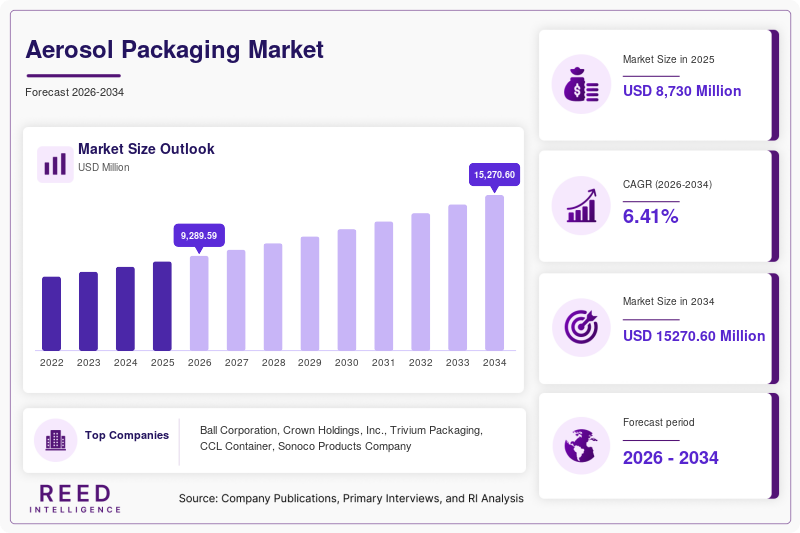
The global aerosol packaging market size was valued at USD 8,730 million in 2025 and is projected to grow from USD 9,280 million in 2026 to USD 15,270.60 million by 2034, registering a CAGR of 6.41% during the forecast period from 2026 to 2034.
Aerosol packaging consists primarily of a pressurized container, valve, actuator, and propellant system designed to dispense liquids, foams, powders, or other formulations in a controlled spray. Aluminum and steel remain the principal structural materials because they combine pressure resistance with established manufacturing and recycling infrastructure. Plastic formats are also used in selected applications where lightweight construction, design flexibility, or alternative dispensing characteristics provide a commercial advantage.
Personal care and cosmetics represent an important consumption base, including deodorants, hair sprays, shaving products, body sprays, and styling products. Household applications include air fresheners, cleaning products, insecticides, and surface-care products, while automotive and industrial aerosols include lubricants, paints, coatings, cleaners, and maintenance formulations.
Market Dynamics
Aerosol Packaging Market Drivers
Expansion of Personal Care and Cosmetic Aerosols
Deodorants, body sprays, hair sprays, shaving products, and styling products represent a substantial application base for aerosol packaging. Aerosols provide consistent dosage, fine spray characteristics, rapid application, and convenient handling, making them suitable for mass-market personal-care formulations. Demand therefore follows both personal-hygiene consumption and product innovation within beauty and grooming categories.
Premiumization is also affecting packaging specifications. Brands increasingly use shaped cans, decorative printing, lightweight structures, and differentiated dispensing systems to establish visual identity while controlling material consumption. This makes the aerosol container part of the product experience rather than simply a transport package.
Increasing Demand for Recyclable Metal Packaging
Aluminum and steel provide established recycling pathways and can support circular packaging strategies. Trivium notes that aerosol containers can be recycled but require appropriate handling because of their pressurized format, making consumer education and collection infrastructure important to actual recycling performance.
The commercial effect is increasing demand for packaging that combines recyclability with lower material intensity. Ball's ReAl alloy, for example, allows thinner aluminum walls while maintaining structural performance, while its aerosol cans can incorporate up to 50% recycled content globally.
Growth of Convenient Household and Industrial Dispensing
Aerosol formats provide controlled dispensing for household cleaners, air fresheners, insecticides, automotive products, paints, lubricants, and industrial maintenance formulations. The format allows products to be stored and transported in compact packages while enabling controlled application at the point of use.
Demand is also supported by the ability to tailor valve systems, actuators, spray patterns, and container dimensions to different formulations. This creates a broad packaging platform rather than a single standardized container category, allowing manufacturers to compete through dispensing performance and application-specific engineering.
Aerosol Packaging Market Restraints
Raw Material and Energy Costs
Aerosol packaging is sensitive to aluminum and steel prices, energy consumption, coating costs, and transportation expenses. Metal production and conversion remain energy-intensive processes, while volatile commodity prices can affect packaging procurement costs for consumer-product manufacturers.
The shift toward recycled and lower-carbon materials can reduce lifecycle emissions but may introduce additional sourcing and qualification requirements. Availability of suitable recycled metal, certified feedstock, and consistent material quality can influence production economics and supply planning.
Recycling and Pressurization Challenges
Although metal aerosols are recyclable, their pressurized nature requires appropriate handling throughout collection and recycling. Trivium identifies consumer perceptions and behavior as factors that can negatively affect aerosol recycling rates, while specialized processing is required to manage the containers safely.
Plastic aerosol alternatives can introduce additional recycling-complexity considerations depending on polymer composition and dispensing architecture. Manufacturers therefore need to balance lightweighting and material substitution with pressure performance, product compatibility, recycling infrastructure, and regulatory requirements.
Aerosol Packaging Market Opportunities
Low-Carbon and Recycled Aluminum Aerosol Cans
Low-carbon aluminum represents a significant opportunity for aerosol-packaging manufacturers because the container can retain established aluminum performance while reducing upstream emissions. In November 2025, Alcoa, Ball, and Unilever piloted an aerosol can using 50% ELYSIS primary aluminum and 50% post-consumer recycled content, connecting carbon-free smelting technology with consumer packaging.
This approach creates a value chain extending from aluminum production through can manufacturing and consumer brands. As companies increase Scope 3 reduction efforts, aerosol suppliers that can provide documented recycled content, certified sourcing, and lower-carbon material can become more strategically relevant to brand procurement decisions.
Lightweighting and Advanced Dispensing Technologies
Lightweighting can reduce raw-material consumption, packaging weight, transportation requirements, and potentially lifecycle emissions without requiring a complete change in aerosol format. Ball's ReAl technology demonstrates this mechanism, with the company reporting aerosol cans up to 30% lighter than a standard aluminum can while retaining structural integrity.
Further opportunities exist in bag-on-valve systems, precision actuators, improved valves, shaped containers, and pressure-management technologies. Trivium's aerosol portfolio includes bag-on-valve technology and lightweight aluminum formats, illustrating how dispensing performance and material efficiency can be developed simultaneously.
Aerosol Packaging Market Segmental Analysis
By Material
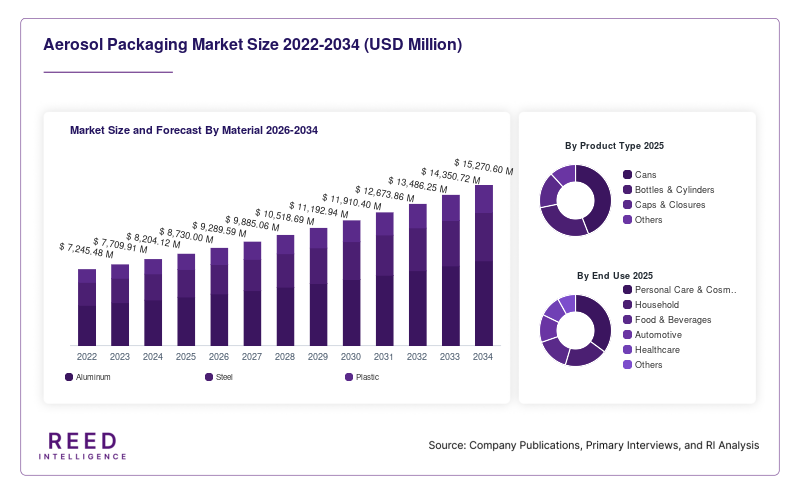
Aluminum accounted for the largest material share at approximately 49% in 2025, supported by its low weight, corrosion resistance, formability, premium appearance, and established recycling infrastructure. Aluminum is particularly important in personal-care aerosols where lightweighting and decorative finishing are commercially relevant. Plastic is projected to be the fastest-growing material at approximately 7.8% CAGR, supported by lightweight formats and selected applications seeking alternative container architectures.
Steel represented approximately 38% of the segment and is projected to grow at 5.7% CAGR, supported by pressure resistance, established manufacturing capacity, and extensive household and industrial applications. Aluminum is projected to expand at approximately 6.7% CAGR, with recycled content and lower-carbon primary aluminum becoming increasingly important in premium and sustainability-focused packaging programs.
By Product Type
Cans represented the largest product category with approximately 61% share in 2025. Their dominance reflects extensive use across deodorants, hair sprays, household products, paints, automotive products, and industrial aerosols. The format benefits from established filling infrastructure and a mature ecosystem of valves, actuators, coatings, and metal-forming technologies. Bottles & Cylinders are projected to record the fastest growth at approximately 7.2% CAGR as brands experiment with alternative dispensing formats and specialized applications.
Caps & Closures accounted for approximately 18% and are projected to expand at 5.9% CAGR, while other formats represented approximately 8% with a 5.5% CAGR. Product differentiation is increasingly shifting toward lightweighting, decoration, dispensing control, safety features, and compatibility with recycling systems.
By End Use
Personal Care & Cosmetics represented the dominant end-use segment at approximately 42% share in 2025, reflecting the extensive use of aerosols for deodorants, body sprays, hair products, shaving products, and styling formulations. The segment is projected to grow at approximately 6.8% CAGR. Healthcare is projected to be the fastest-growing end-use category at approximately 7.4% CAGR, supported by specialized topical, antiseptic, and pharmaceutical dispensing applications.
Household applications accounted for approximately 24% with a CAGR of 6.3%, while Automotive represented approximately 11% with a CAGR of 6.5%. Food and beverage applications represented 8%, growing at 5.9% CAGR, while other applications accounted for approximately 15% with a CAGR of 5.7%.
Aerosol Packaging Market Regional Analysis
North America Aerosol Packaging Market
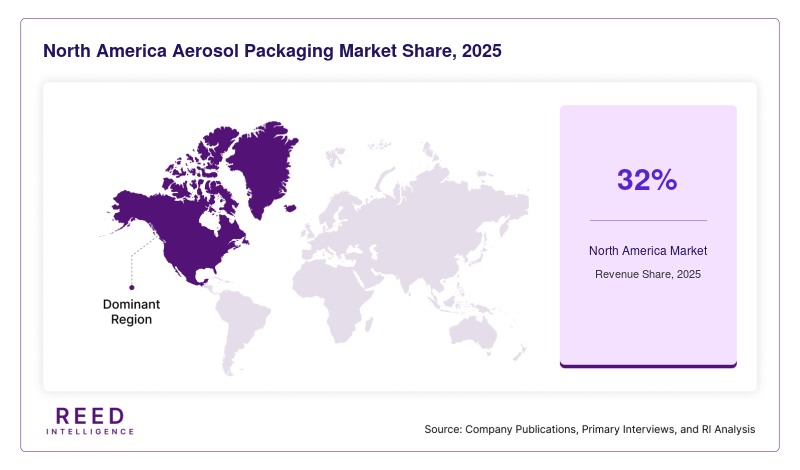
North America represented the dominant regional market with approximately 32% share in 2025, supported by established personal-care, household, food, automotive, healthcare, and industrial-product manufacturing. The region also benefits from sophisticated metal-packaging infrastructure and strong participation from major aerosol-can, dispensing, and consumer-product companies.
The region is projected to expand at approximately 5.9% CAGR through 2034. Demand is increasingly connected with lightweighting, recycled-content targets, premium personal-care products, and sustainable packaging procurement. Metal recycling infrastructure and established filling networks support continued use of aluminum and steel aerosol containers.
Europe Aerosol Packaging Market
Europe is projected to grow at approximately 6.2% CAGR through 2034. Personal care remains an important demand center, while sustainability requirements are influencing material selection, recycled content, packaging weight, and lifecycle emissions. Germany, France, the U.K., Italy, and other major European economies have mature aerosol and metal-packaging ecosystems.
The region is also a leading testing ground for circular aerosol packaging. Ball and Beiersdorf's European program increased recycled aluminum content in NIVEA Men aerosol cans to 100%, demonstrating how brand sustainability targets can translate into specific changes in packaging material procurement.
Asia Pacific Aerosol Packaging Market
Asia Pacific is projected to be the fastest-growing regional market at approximately 7.5% CAGR through 2034. Population growth, urbanization, personal-care consumption, household-product penetration, and expansion of consumer-goods manufacturing are increasing demand for aerosol packaging across China, India, Japan, South Korea, and Southeast Asia.
China and India provide substantial volume opportunities because of their large consumer bases and expanding personal-care and household-product industries. Japan and South Korea contribute more mature packaging ecosystems, while Southeast Asian economies are expanding consumer-product manufacturing and modern retail distribution, supporting demand for standardized and premium aerosol formats.
Latin America Aerosol Packaging Market
Latin America is projected to record approximately 6.4% CAGR during the forecast period. Brazil represents a major regional center for personal-care products and aerosol manufacturing, while Mexico's consumer-product and industrial base contributes to regional demand.
Sustainability-led innovation is also becoming visible in Brazil. In September 2025, Ball partnered with Brazilian brands Soffie and Aeroflex to launch what it described as the world's first ASI-certified aluminum aerosol cans, linking responsible aluminum sourcing with consumer-facing packaging.
Middle East & Africa Aerosol Packaging Market
Middle East & Africa is projected to expand at approximately 6.6% CAGR through 2034. Personal-care products, household aerosols, automotive products, insecticides, industrial maintenance products, and healthcare applications form the principal demand base.
The region's hot climates and expanding urban populations support applications where controlled dispensing and product protection are important. Growth in modern retail, local consumer-product manufacturing, and packaging modernization should support demand, while recycling infrastructure and local metal-processing capabilities remain important determinants of regional adoption.
Aerosol Packaging Market Competitive Landscape
The aerosol packaging market is moderately consolidated around large metal-packaging producers, specialized aerosol manufacturers, dispensing-system suppliers, and regional packaging companies. Competition is increasingly based on lightweighting, recycled content, carbon footprint, container design, filling compatibility, decoration, and supply reliability rather than container capacity alone.
Ball Corporation maintains a strong position in aluminum aerosol packaging through proprietary alloy technology, lightweighting, recycled-content integration, and low-carbon aluminum sourcing. Its ReAl alloy can reduce container weight while maintaining structural integrity, while its newer ASI-certified and ELYSIS-linked initiatives extend sustainability from can manufacturing into the upstream aluminum supply chain.
Key Market Players
- Ball Corporation
- Crown Holdings, Inc.
- Trivium Packaging
- CCL Container
- Sonoco Products Company
- Silgan Dispensing Systems
- Lindal Group
- Tubex GmbH
- Montebello Packaging
- Tecnocap S.p.A.
- Precision Valve Corporation
- Hindustan Tin Works Ltd.
- Can-Pack S.A.
- Graham Packaging
- Aeropak A/S
Recent Market Developments
- September 2025 - Ball Corporation launched ASI-certified aluminum aerosol cans with Brazilian brands Soffie and Aeroflex. The cans use aluminum certified under the Aluminium Stewardship Initiative framework, providing traceability and sustainability credentials directly on consumer packaging.
- November 2025 -Alcoa, Ball Corporation and Unilever piloted aerosol packaging using ELYSIS carbon-free aluminum. The aerosol can combined 50% ELYSIS primary aluminum with 50% post-consumer recycled content, demonstrating a lower-carbon material pathway for personal-care and home-care aerosol packaging.
Aerosol Packaging Market Segments
By Material
- Aluminum
- Steel
- Plastic
By Product Type
- Cans
- Bottles & Cylinders
- Caps & Closures
- Others
By End Use
- Personal Care & Cosmetics
- Household
- Food & Beverages
- Automotive
- Healthcare
- Others
By Region
- North America
- Europe
- APAC
- Middle East and Africa
- LATAM