Aerosol Whipping Cream Market Size, Share & Demand Report By Product Type (Dairy-Based Aerosol Whipping Cream, Plant-Based Aerosol Whipping Cream), By Application (Bakery and Confectionery, Beverages, Frozen Desserts, Household Desserts, Foodservice Applications), By Distribution Channel (Supermarkets and Hypermarkets, Convenience Stores, Specialty Stores, Online Retail, Foodservice Distribution), By Region & Segment Forecasts, 2026–2034
USD 3950
Market Overview
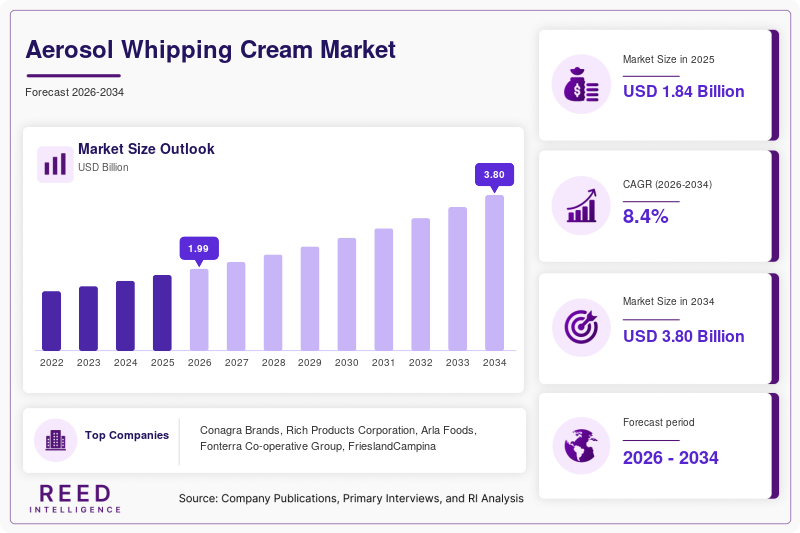
The global Aerosol Whipping Cream Market size was valued at approximately USD 1.84 billion in 2026 and is projected to reach nearly USD 3.52 billion by 2034, expanding at a CAGR of 8.4% during the forecast period from 2026 to 2034. The market continues to witness stable expansion due to the increasing demand for ready-to-use dairy products across retail, bakery, confectionery, and foodservice channels. Aerosol whipping cream products provide convenience, extended usability, controlled dispensing, and consistent texture, which supports their adoption in both household and commercial applications. The growing preference for premium desserts, café beverages, and decorative bakery products has further contributed to demand growth across developed and emerging economies.
One major global factor supporting the expansion of the Aerosol Whipping Cream Market is the rapid transformation of modern food consumption patterns. Urban consumers increasingly prefer packaged and time-saving food products that align with busy lifestyles. Foodservice chains, quick-service restaurants, and café outlets are incorporating aerosol whipping cream into beverages, pastries, waffles, cakes, and frozen desserts to improve operational efficiency and product consistency. In addition, the expansion of organized retail and e-commerce grocery platforms has improved product accessibility across urban and semi-urban markets.
Key Highlights
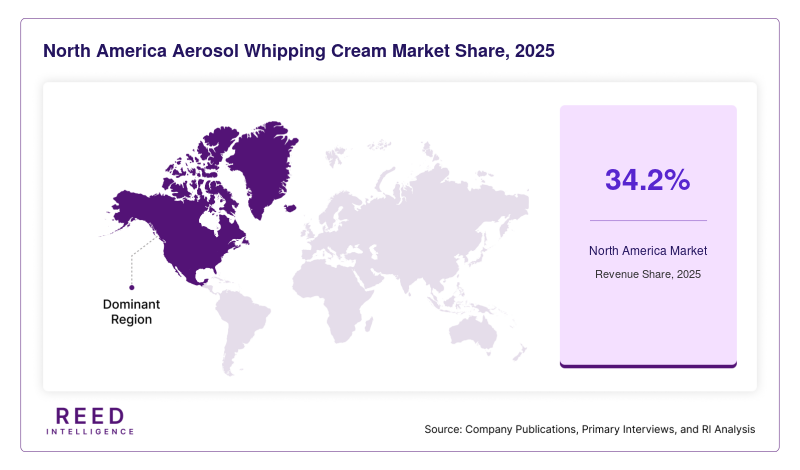
- North America dominated the market with a 34.2% share in 2025, while Asia Pacific is expected to grow at the fastest CAGR of 10.8% during 2026–2034.
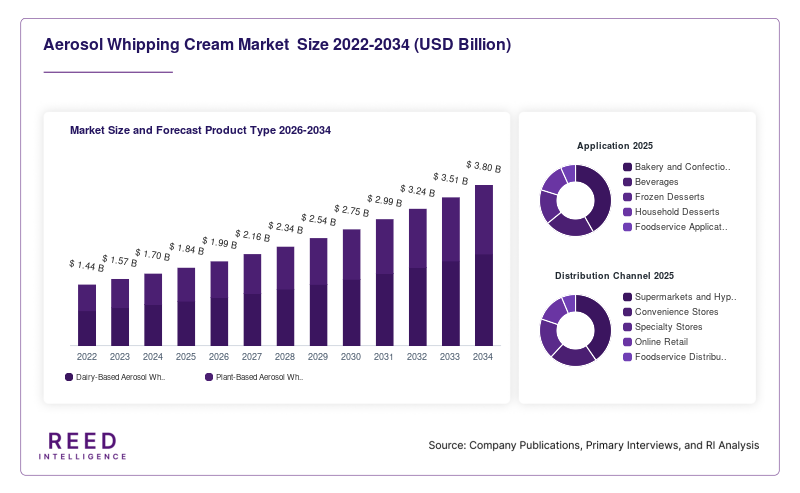
- By product type, dairy-based aerosol whipping cream accounted for the largest share of 71.4% in 2025, while plant-based aerosol whipping cream is projected to grow at a CAGR of 11.6%.
- By application, bakery and confectionery led with a 39.8% share, whereas beverages are expected to expand at a CAGR of 10.9% during the forecast period.
- By distribution channel, supermarkets and hypermarkets accounted for the dominant share of 44.5%, while online retail is projected to grow at a CAGR of 12.1%.
- The United States remained the dominant country, with market values of USD 462 million in 2024 and USD 498 million in 2025.
Market Trends
Expansion of Plant-Based and Clean-Label Product Offerings
The Aerosol Whipping Cream Market is experiencing noticeable momentum from the rising popularity of plant-based and clean-label food products. Consumers are increasingly reviewing ingredient transparency, nutritional value, and allergen-related concerns before purchasing dairy products. This shift has encouraged manufacturers to introduce coconut-based, oat-based, soy-based, and almond-based aerosol whipping cream alternatives that cater to vegan and lactose-intolerant populations. The clean-label movement has also influenced brands to reduce artificial stabilizers, synthetic flavors, and preservatives from formulations. Foodservice operators are adopting these products to diversify dessert menus and accommodate changing customer preferences. As vegan bakery and café chains expand globally, the demand for plant-based aerosol whipping cream products is expected to accelerate steadily during the forecast period.
Growing Integration Across Premium Café and Dessert Chains
The increasing presence of premium café chains and dessert-focused restaurants has become another significant trend shaping the Aerosol Whipping Cream Market. Café beverages such as flavored coffees, cold brews, milkshakes, hot chocolate drinks, and specialty frappes commonly incorporate aerosol whipping cream for texture enhancement and visual appeal. In addition, dessert outlets use aerosol whipping cream for decorating cakes, pancakes, waffles, mousses, and frozen desserts with greater efficiency and consistency. International café franchises are expanding rapidly in Asia Pacific, the Middle East, and Latin America, creating stronger demand for commercial-grade whipping cream products. Manufacturers are responding by launching high-performance dispensing cans with improved shelf stability and customized fat compositions suitable for foodservice environments.
Market Drivers
Rising Consumption of Bakery and Confectionery Products
The increasing global consumption of bakery and confectionery products continues to support the growth of the Aerosol Whipping Cream Market. Consumers are purchasing more cakes, pastries, donuts, muffins, cookies, and dessert items through retail bakeries, online food delivery platforms, and café outlets. Aerosol whipping cream is widely used in these applications because it allows quick decoration, uniform texture, and improved visual presentation. Commercial bakeries benefit from reduced preparation time and controlled portion dispensing, which improves operational productivity. Emerging economies are also witnessing increasing westernization of eating habits, particularly among younger consumers who prefer premium desserts and café-style snacks. This consumption trend has encouraged food manufacturers and bakery chains to expand their dessert portfolios using aerosol whipping cream products.
Growth of Organized Retail and Convenience Food Culture
The rapid growth of organized retail channels and convenience-driven food purchasing behavior is another major factor contributing to market expansion. Supermarkets, hypermarkets, convenience stores, and online grocery platforms are improving the visibility and accessibility of aerosol whipping cream products across urban markets. Consumers increasingly prefer packaged food products that offer ease of use and minimal preparation time. Aerosol whipping cream aligns with these preferences because it eliminates manual whipping processes while maintaining product consistency. In addition, improvements in refrigeration systems and cold-chain logistics have enabled broader product distribution across developing regions. The growing influence of social media food content and home baking trends has also encouraged household consumers to purchase aerosol whipping cream for decorative dessert applications.
Market Restraint
Fluctuating Dairy Prices and Regulatory Challenges
The Aerosol Whipping Cream Market faces operational pressure from fluctuating dairy prices and changing food safety regulations across multiple countries. Dairy-based aerosol whipping cream products rely heavily on stable milk supply chains, which are often affected by weather conditions, livestock feed costs, transportation expenses, and trade restrictions. Sudden increases in raw milk prices can reduce manufacturer profit margins and increase retail prices for consumers. In highly competitive retail environments, frequent pricing changes may affect product demand and purchasing behavior. Regulatory agencies are also implementing stricter requirements related to labeling standards, food additives, aerosol propellants, and packaging sustainability. Manufacturers operating across international markets must comply with varying regulations regarding dairy content, shelf-life standards, and environmental packaging guidelines. Smaller companies often face financial and operational difficulties in adapting to these changing regulatory frameworks, limiting their ability to scale production efficiently.
Market Opportunities
Increasing Demand for Home Baking and DIY Dessert Preparation
The growing popularity of home baking and do-it-yourself dessert preparation presents a substantial opportunity for the Aerosol Whipping Cream Market. Consumers are increasingly experimenting with cakes, pastries, beverages, and specialty desserts at home due to social media influence, cooking shows, and digital recipe platforms. Aerosol whipping cream products simplify dessert decoration and reduce preparation complexity, making them attractive for household users with limited baking experience. Retail brands are capitalizing on this trend by introducing flavored variants, smaller packaging sizes, and user-friendly dispensing systems targeted toward domestic consumers. Seasonal demand during holidays and celebrations further supports sales growth. As online recipe communities continue to expand, aerosol whipping cream products are likely to witness stronger adoption across household kitchens globally.
Expansion of Emerging Foodservice Markets in Developing Economies
Developing economies are witnessing rapid expansion in café culture, modern bakeries, dessert lounges, and quick-service restaurants, creating new growth opportunities for aerosol whipping cream manufacturers. Urbanization, rising disposable incomes, and changing consumer lifestyles are driving demand for western-style desserts and premium beverages in countries across Asia Pacific, the Middle East, and Latin America. Foodservice operators in these markets are increasingly using aerosol whipping cream to improve product presentation and reduce preparation time. International restaurant franchises and regional café chains are also increasing procurement volumes for commercial aerosol whipping cream products. Manufacturers have opportunities to establish localized production facilities, expand distribution partnerships, and introduce affordable product variants tailored to regional consumption preferences and climatic conditions.
Segmental Analysis
By Product Type
Dairy-based aerosol whipping cream accounted for the largest share of the Aerosol Whipping Cream Market in 2024, representing nearly 71.4% of total revenue. The segment continues to dominate because dairy-based formulations provide traditional taste, creamy texture, and strong compatibility with bakery, confectionery, and beverage applications. Foodservice operators prefer dairy-based aerosol whipping cream for professional dessert decoration due to its stable consistency and rich flavor profile. Commercial bakeries and café chains widely use these products in cakes, pastries, milkshakes, and specialty coffees. Consumer familiarity with dairy-based whipping cream products and strong retail availability across supermarkets and convenience stores further contribute to segment leadership. Established dairy manufacturers continue to invest in improved dispensing systems and extended shelf-life technologies to maintain product quality and operational efficiency.
By Application
Bakery and confectionery applications held the dominant share of approximately 39.8% in the Aerosol Whipping Cream Market in 2024. The segment benefits from the widespread use of aerosol whipping cream in cakes, pastries, donuts, cupcakes, mousses, and dessert toppings. Commercial bakeries rely on aerosol formats to improve operational speed, maintain decorative consistency, and reduce manual labor requirements. Consumers also increasingly purchase visually appealing bakery products for celebrations, social events, and café dining experiences. Expanding premium bakery chains and artisanal dessert outlets continue to support product demand globally. Aerosol whipping cream products are particularly valued in bakery environments because they enable efficient portion control and provide attractive presentation for high-volume dessert production.
By Distribution Channel
Supermarkets and hypermarkets represented the leading distribution channel in the Aerosol Whipping Cream Market in 2024, accounting for around 44.5% of global revenue. These retail formats provide consumers with broad product selection, attractive promotional offers, and convenient access to refrigerated dairy products. Major supermarket chains allocate dedicated shelf space for dessert ingredients, bakery toppings, and ready-to-use dairy products, improving product visibility. Consumers often prefer purchasing aerosol whipping cream from supermarkets because they can compare brands, packaging sizes, and flavor options in one location. In addition, organized retail infrastructure supports efficient cold storage and inventory management, helping maintain product freshness and quality throughout the supply chain.
Regional Analysis
North America
North America accounted for the largest share of the Aerosol Whipping Cream Market in 2025, representing approximately 34.2% of global revenue. The region is projected to maintain steady growth at a CAGR of 7.6% during the forecast period due to strong demand from bakery chains, coffee shops, and packaged dessert manufacturers. Consumers in the United States and Canada show high preference for ready-to-use dairy products, which supports continuous market expansion. The widespread presence of organized retail infrastructure and cold-chain distribution systems also strengthens regional product availability and market penetration.
The United States remained the dominant country within North America due to its large-scale foodservice industry and established café culture. One unique factor supporting market growth is the high adoption of specialty coffee beverages that incorporate whipped cream toppings. Major café chains and restaurant operators continue to expand seasonal beverage offerings using aerosol whipping cream products. In addition, rising consumer participation in home baking activities and dessert preparation has contributed to increased retail sales across supermarkets and online grocery platforms.
Europe
Europe represented a significant portion of the global Aerosol Whipping Cream Market in 2025 and is expected to grow at a CAGR of 7.9% during 2026–2034. The region benefits from strong dairy consumption patterns and a mature bakery industry across countries such as Germany, France, Italy, and the United Kingdom. Consumers regularly purchase cream-based dessert products, pastries, and confectionery items, which supports stable demand for aerosol whipping cream. Increasing preference for premium desserts and café beverages has also contributed to higher consumption across urban markets.
Germany emerged as the dominant country in the European market due to its extensive bakery manufacturing sector and strong retail distribution network. A unique growth factor supporting the German market is the increasing demand for organic and clean-label dairy products. Consumers are showing greater interest in aerosol whipping cream products containing natural ingredients and sustainable packaging materials. Manufacturers are responding by launching environmentally friendly aerosol cans and reduced-fat formulations that align with evolving consumer purchasing preferences across the region.
Asia Pacific
Asia Pacific is expected to register the fastest CAGR of 10.8% in the Aerosol Whipping Cream Market during the forecast period. The region is witnessing rapid urbanization, rising disposable income levels, and increasing exposure to western food culture. Countries including China, India, Japan, South Korea, and Australia are experiencing growing demand for premium bakery products, specialty beverages, and frozen desserts. Expanding retail chains and food delivery services are also improving accessibility to aerosol whipping cream products across metropolitan and tier-two cities.
China remained the leading contributor within Asia Pacific due to its expanding café industry and rapidly growing bakery sector. One distinctive factor driving market growth in China is the increasing influence of social media-driven food trends among younger consumers. Dessert cafés and beverage chains frequently introduce visually appealing menu items topped with aerosol whipping cream to attract digital engagement and customer traffic. Domestic manufacturers are also increasing production capacity to meet rising commercial demand from urban foodservice operators.
Middle East & Africa
The Middle East & Africa Aerosol Whipping Cream Market is projected to expand at a CAGR of 8.1% during the forecast period, supported by increasing tourism activity and the expansion of international foodservice brands. Urban consumers in Gulf countries are showing stronger preference for premium desserts, specialty coffees, and western-style pastries. The hospitality sector continues to incorporate aerosol whipping cream into hotel desserts, café beverages, and restaurant menu offerings. Rising investments in modern retail infrastructure and refrigerated logistics systems are also improving regional product availability.
Saudi Arabia dominated the regional market due to its growing quick-service restaurant sector and expanding café culture among younger populations. A unique growth factor supporting the Saudi Arabian market is the increasing number of luxury dessert lounges and premium coffee chains across major urban centers. These establishments commonly utilize aerosol whipping cream for decorative beverage applications and dessert enhancement. Government-led tourism development programs and entertainment sector investments are also supporting higher demand from hospitality businesses.
Latin America
Latin America accounted for a moderate share of the global Aerosol Whipping Cream Market in 2025 and is anticipated to grow at a CAGR of 8.5% through 2034. The market is benefiting from changing dietary preferences, increasing bakery product consumption, and gradual expansion of organized food retail networks. Countries such as Brazil, Mexico, and Argentina are witnessing stronger demand for packaged dessert ingredients and café-style beverages. Improvements in cold-storage infrastructure and retail refrigeration capabilities are further supporting product distribution across urban and semi-urban regions.
Brazil emerged as the dominant country within Latin America due to its large consumer base and expanding bakery sector. One important growth factor supporting the Brazilian market is the rising popularity of premium dessert cafés and celebration-oriented bakery products. Consumers increasingly purchase cakes, pastries, and sweet beverages for social gatherings and festive occasions, creating sustained demand for aerosol whipping cream products. Manufacturers are also introducing localized flavors and smaller packaging formats to improve product affordability and accessibility.
Competitive Landscape
The Aerosol Whipping Cream Market is characterized by the presence of multinational dairy companies, regional food manufacturers, and specialized dessert ingredient suppliers competing through product innovation, packaging improvements, and distribution expansion. Leading companies are focusing on clean-label formulations, plant-based alternatives, and sustainable aerosol packaging solutions to strengthen market positioning. Product differentiation through flavor innovation and premium texture enhancement has become a key competitive strategy among major manufacturers.
Conagra Brands remains one of the leading participants in the global market due to its established retail presence and extensive portfolio of dessert-related products. The company has focused on expanding flavored aerosol whipping cream offerings and improving recyclable packaging initiatives. Other major participants are increasing investment in regional production facilities and cold-chain distribution systems to strengthen supply efficiency.
Key Players
- Conagra Brands
- Rich Products Corporation
- Arla Foods
- Fonterra Co-operative Group
- FrieslandCampina
- Lactalis Group
- Land O’Lakes
- Danone SA
- Nestlé SA
- Dean Foods
- Saputo Inc.
- Dairy Farmers of America
- Müller Group
- Yili Group
- Mengniu Dairy
Recent Developments
- Conagra Brands introduced a new line of flavored aerosol whipping cream products featuring caramel and mocha variants for beverage applications in 2025.
- Arla Foods expanded its production capacity for premium aerosol dairy products in Europe to strengthen supply capabilities for bakery and café customers in 2024.
- Rich Products Corporation launched a plant-based aerosol whipping cream product targeting vegan dessert and specialty coffee chains across North America in 2025.
- Lactalis Group invested in recyclable aerosol can packaging technology to improve sustainability performance and reduce packaging waste across selected product lines in 2024.
- Nestlé SA expanded its retail distribution partnerships in Asia Pacific to improve the availability of aerosol whipping cream products through modern grocery channels in 2025.
Aerosol Whipping Cream Market Segments
Product Type
- Dairy-Based Aerosol Whipping Cream
- Plant-Based Aerosol Whipping Cream
Application
- Bakery and Confectionery
- Beverages
- Frozen Desserts
- Household Desserts
- Foodservice Applications
Distribution Channel
- Supermarkets and Hypermarkets
- Convenience Stores
- Specialty Stores
- Online Retail
- Foodservice Distribution
By Region
- North America
- Europe
- APAC
- Middle East and Africa
- LATAM