Aerospace Adhesive Market Size, Share & Demand Report By Resin Type (Epoxy Adhesives, Polyurethane Adhesives, Acrylic Adhesives, Silicone Adhesives), By Application (Structural Bonding, Interior Applications, Exterior Applications, Others), By End-Use (Commercial Aviation, Defense Aviation, General Aviation), By Region & Segment Forecasts, 2026–2034
USD 3950
Market Overview
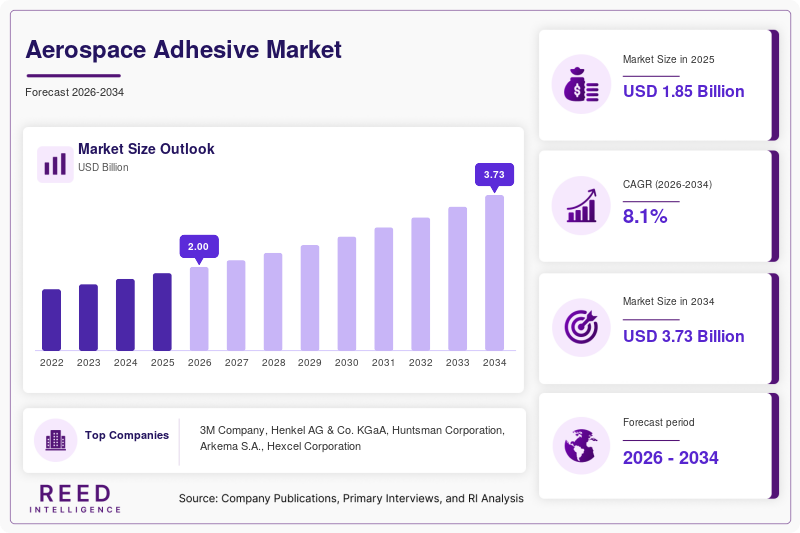
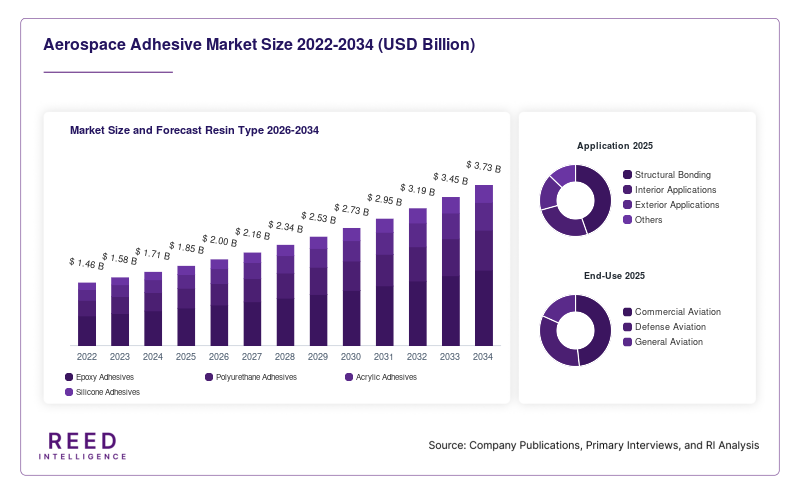
The Aerospace Adhesive Market size was valued at approximately USD 1.85 billion in 2026 and is projected to reach USD 3.45 billion by 2034, expanding at a CAGR of 8.1% during the forecast period (2026–2034). The market is witnessing consistent expansion due to the increasing use of lightweight materials in aircraft manufacturing, where adhesives play a critical role in bonding composites and reducing overall structural weight. As aerospace manufacturers continue to shift away from traditional mechanical fastening methods, adhesives are becoming essential for improving fuel efficiency, durability, and aerodynamic performance.
A key global factor supporting the growth of the Aerospace Adhesive Market is the rising demand for fuel-efficient and next-generation aircraft. Airlines are under pressure to reduce carbon emissions and operational costs, which has accelerated the adoption of composite-intensive aircraft designs. Adhesives enable stronger, lighter joints and reduce stress concentration compared to rivets and bolts, making them indispensable in modern aerospace engineering. This trend is further reinforced by increased defense spending and the expansion of commercial aviation fleets, particularly in emerging economies.
Key Highlights
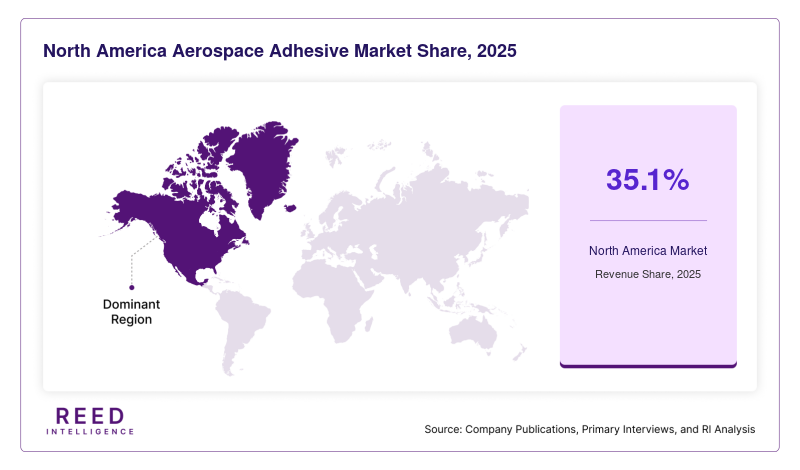
- North America dominated the market with a 35.1% share in 2025.
- Asia Pacific is expected to grow at the fastest CAGR of 9.6% during 2026–2034.
- By resin type, epoxy adhesives accounted for the largest share of 42.8%.
- while polyurethane adhesives are projected to grow at a CAGR of 9.3%.
- By application, structural bonding led with a 46.2% share, whereas interior applications are expected to expand at a CAGR of 8.9%.
- The United States remained the dominant country, with market values of USD 520 million in 2024 and USD 575 million in 2025.
Market Trends
Increasing Adoption of Lightweight Composite Materials
The growing integration of lightweight composite materials such as carbon fiber reinforced polymers is shaping the Aerospace Adhesive Market. Aircraft manufacturers are prioritizing weight reduction to enhance fuel efficiency and reduce emissions. Adhesives are preferred for bonding composites as they distribute stress evenly and prevent damage that can occur with mechanical fasteners. This shift is particularly evident in next-generation commercial aircraft, where composite structures account for a significant share of the airframe. Adhesive technologies are evolving to provide higher thermal resistance, durability, and compatibility with advanced substrates, further strengthening their role in aerospace manufacturing.
Advancements in High-Performance Adhesive Formulations
Technological innovation in adhesive formulations is another important trend influencing market growth. Manufacturers are developing adhesives that can withstand extreme temperatures, pressure variations, and chemical exposure encountered during flight operations. New formulations offer faster curing times, improved bonding strength, and enhanced resistance to fatigue and corrosion. These advancements are particularly relevant for both commercial and defense aviation sectors, where reliability and safety are critical. The introduction of smart adhesives with monitoring capabilities is also emerging, enabling predictive maintenance and improving aircraft lifecycle management.
Market Drivers
Rising Aircraft Production and Fleet Expansion
The steady increase in global air passenger traffic has driven airlines to expand their fleets, which directly impacts the Aerospace Adhesive Market. Aircraft manufacturers are ramping up production rates to meet this demand, leading to higher consumption of adhesives in assembly processes. Adhesives are extensively used in fuselage construction, wing assembly, and interior fittings. As production volumes rise, manufacturers are seeking cost-effective and efficient bonding solutions, further boosting adhesive adoption. The expansion of low-cost carriers and regional aviation networks is also contributing to sustained demand across both developed and developing regions.
Growing Emphasis on Fuel Efficiency and Emission Reduction
Environmental regulations and sustainability goals are pushing the aerospace industry toward more efficient designs. Adhesives contribute to weight reduction by eliminating the need for heavy fasteners, thereby improving fuel efficiency. This benefit aligns with global efforts to reduce carbon emissions from aviation. Additionally, adhesives help enhance structural integrity and reduce maintenance requirements, supporting long-term operational efficiency. The increasing focus on green aviation technologies is expected to drive further innovation and adoption of advanced adhesive solutions in the coming years.
Market Restraint
Stringent Certification and Testing Requirements
The Aerospace Adhesive Market faces challenges due to stringent regulatory standards and certification processes. Adhesives used in aerospace applications must undergo rigorous testing to ensure they meet safety, durability, and performance requirements. This process can be time-consuming and costly, often delaying product approvals and market entry. Manufacturers must invest heavily in research, testing facilities, and compliance procedures, which can limit innovation and increase overall production costs. For example, introducing a new adhesive formulation may require extensive validation under various environmental conditions, including temperature extremes and mechanical stress scenarios. These regulatory hurdles can slow down the adoption of new technologies and create barriers for smaller market participants.
Market Opportunities
Expansion of Urban Air Mobility and Electric Aircraft
The emergence of urban air mobility and electric aircraft presents new growth avenues for the Aerospace Adhesive Market. These platforms require lightweight and efficient bonding solutions to optimize performance and energy consumption. Adhesives play a crucial role in assembling battery systems, lightweight frames, and advanced materials used in electric propulsion systems. As investments in electric aviation increase, the demand for specialized adhesives with high thermal conductivity and electrical insulation properties is expected to rise. This segment offers significant potential for innovation and market expansion.
Increasing Maintenance, Repair, and Overhaul Activities
The growing global aircraft fleet has led to a rise in maintenance, repair, and overhaul activities. Adhesives are widely used in repair applications due to their ability to restore structural integrity without adding significant weight. The demand for efficient and cost-effective repair solutions is driving the adoption of advanced adhesive technologies in MRO operations. Additionally, aging aircraft fleets in several regions require frequent maintenance, further supporting market growth. The development of easy-to-apply and fast-curing adhesives is expected to enhance their usage in repair and refurbishment processes.
Segmental Analysis
By Resin Type
Epoxy adhesives dominated the Aerospace Adhesive Market in 2024, accounting for a share of 42.8%. These adhesives are widely used due to their excellent mechanical strength, thermal stability, and resistance to environmental factors. Epoxy-based adhesives are particularly suitable for structural bonding applications, where reliability and durability are critical. Their ability to bond a wide range of materials, including metals and composites, makes them a preferred choice in aerospace manufacturing. Additionally, advancements in epoxy formulations have improved their curing times and performance characteristics, further enhancing their adoption across various applications.
Polyurethane adhesives are expected to be the fastest-growing subsegment, with a CAGR of 9.3% during the forecast period. These adhesives offer flexibility, impact resistance, and excellent adhesion to diverse substrates. Their ability to withstand dynamic loads and vibrations makes them suitable for applications such as interior components and lightweight structures. The growing demand for versatile and high-performance adhesives is driving the adoption of polyurethane formulations. Additionally, ongoing research and development efforts are focused on improving their thermal and chemical resistance, which is expected to further boost their market growth.
By Application
Structural bonding emerged as the dominant application segment in 2024, with a market share of 46.2%. Adhesives used in structural bonding provide high strength and durability, making them essential for critical aircraft components such as wings and fuselage sections. The increasing use of composite materials in aircraft construction has further driven the demand for structural adhesives. These adhesives help reduce weight and improve load distribution, contributing to enhanced aircraft performance. The growing focus on fuel efficiency and safety is expected to sustain the demand for structural bonding applications.
Interior applications are projected to be the fastest-growing segment, with a CAGR of 8.9%. Adhesives are widely used in bonding interior components such as panels, सीटिंग structures, and insulation materials. The demand for lightweight and aesthetically appealing interiors is driving the adoption of advanced adhesive solutions. Additionally, the need for fire-resistant and low-emission materials in aircraft interiors is influencing the development of specialized adhesives. These factors are expected to contribute to the growth of this segment over the forecast period.
By End-Use
Commercial aviation dominated the market in 2024, accounting for a significant share of 58.6%. The increasing number of air passengers and the expansion of airline fleets are driving demand for adhesives in commercial aircraft manufacturing. Adhesives are used extensively in assembling various components, including fuselage, wings, and interiors. The shift toward lightweight materials and fuel-efficient designs is further boosting the adoption of adhesives in this segment. Continuous investments in new aircraft programs are expected to sustain growth in commercial aviation.
Defense aviation is anticipated to be the fastest-growing end-use segment, with a CAGR of 8.7%. The rising defense budgets and increasing focus on advanced military aircraft are driving demand for high-performance adhesives. These adhesives are used in applications that require exceptional strength, durability, and resistance to extreme conditions. The development of next-generation defense aircraft and unmanned aerial vehicles is expected to further boost demand in this segment. Additionally, the need for maintenance and repair of existing defense fleets contributes to sustained growth.
Regional Analysis
North America
North America held a dominant share of 35.1% in 2025 and is expected to maintain steady growth with a CAGR of 7.8% during the forecast period. The region benefits from a well-established aerospace manufacturing ecosystem and strong demand from both commercial and defense sectors. Continuous investments in research and development, along with the presence of major aircraft manufacturers, contribute to the sustained demand for advanced adhesive solutions.
The United States leads the regional market due to its extensive aerospace industry and high production volumes. A key growth factor is the increasing focus on next-generation aircraft programs, which require advanced materials and bonding technologies. The country’s emphasis on innovation and technological advancement further strengthens its position in the global market.
Europe
Europe accounted for a significant share of 27.4% in 2025 and is projected to grow at a CAGR of 7.5%. The region’s aerospace sector is characterized by strong collaboration between manufacturers and research institutions. The adoption of sustainable aviation practices is driving the demand for lightweight and high-performance adhesives.
Germany remains the dominant country in Europe, supported by its robust manufacturing capabilities and technological expertise. A unique growth factor is the region’s focus on reducing carbon emissions, which encourages the use of advanced materials and bonding techniques in aircraft production.
Asia Pacific
Asia Pacific is the fastest-growing region, with a CAGR of 9.6% during the forecast period and a 2025 market share of 22.3%. Rapid expansion of the aviation sector and increasing aircraft orders are driving market growth. The region is also witnessing rising investments in aerospace manufacturing infrastructure.
China dominates the Asia Pacific market, driven by its growing domestic aviation industry. A key growth factor is the government’s support for local aircraft production programs, which boosts demand for adhesives in manufacturing and assembly processes.
Middle East & Africa
The Middle East & Africa region held a 7.2% share in 2025 and is expected to grow at a CAGR of 6.9%. The region’s aviation sector is expanding due to increasing air travel demand and strategic investments in airport infrastructure. Adhesives are gaining traction in aircraft maintenance and repair operations.
The United Arab Emirates leads the market in this region, supported by its strong airline industry. A unique growth factor is the region’s focus on becoming a global aviation hub, which drives demand for advanced aerospace technologies and materials.
Latin America
Latin America accounted for a 8.0% share in 2025 and is projected to grow at a CAGR of 6.7%. The region’s market is supported by the gradual expansion of commercial aviation and increasing focus on fleet modernization. Adhesives are widely used in both manufacturing and maintenance applications.
Brazil dominates the Latin American market due to its established aerospace manufacturing base. A key growth factor is the presence of regional aircraft manufacturers, which contribute to consistent demand for aerospace adhesives.
Competitive Landscape
The Aerospace Adhesive Market is moderately consolidated, with several global and regional players competing based on product innovation, performance, and regulatory compliance. Leading companies are focusing on developing advanced adhesive formulations that meet the evolving requirements of the aerospace industry. Strategic collaborations, mergers, and investments in research and development are common strategies adopted by market participants.
Henkel AG & Co. KGaA is considered a leading player in the market due to its extensive product portfolio and strong presence in the aerospace sector. The company recently introduced a new range of high-performance adhesives designed for composite bonding applications, enhancing its competitive position. Other key players are also investing in sustainable and eco-friendly adhesive solutions to align with industry trends.
Key Players List
- 3M Company
- Henkel AG & Co. KGaA
- Huntsman Corporation
- Arkema S.A.
- Hexcel Corporation
- Solvay S.A.
- Dow Inc.
- H.B. Fuller Company
- Sika AG
- Permabond LLC
- Parson Adhesives Inc.
- Master Bond Inc.
- Avery Dennison Corporation
- Illinois Tool Works Inc.
- Lord Corporation
Recent Developments
- Henkel introduced a new aerospace adhesive with enhanced thermal resistance for composite bonding applications in 2025.
- 3M Company expanded its aerospace adhesive production capacity to meet growing global demand.
- Arkema S.A. developed a new range of eco-friendly adhesives aimed at reducing environmental impact in aerospace manufacturing.
Aerospace Adhesive Market Segments
Resin Type
- Epoxy Adhesives
- Polyurethane Adhesives
- Acrylic Adhesives
- Silicone Adhesives
Application
- Structural Bonding
- Interior Applications
- Exterior Applications
- Others
End-Use
- Commercial Aviation
- Defense Aviation
- General Aviation
By Region
- North America
- Europe
- APAC
- Middle East and Africa
- LATAM