Aerospace And Defense Market Size, Share & Demand Report By Platform (Military Aircraft, Commercial Aircraft, Unmanned Aerial Systems, Naval Systems, Ground Defense Systems, Space Systems), By Application (Defense Operations, Commercial Aviation, Homeland Security, Space Exploration and Satellite Services), By End User (Government and Military Organizations, Commercial Aviation Operators, Private Aerospace Companies, Commercial and Private Space Organizations), By Region & Segment Forecasts, 202
USD 3950
Market Overview
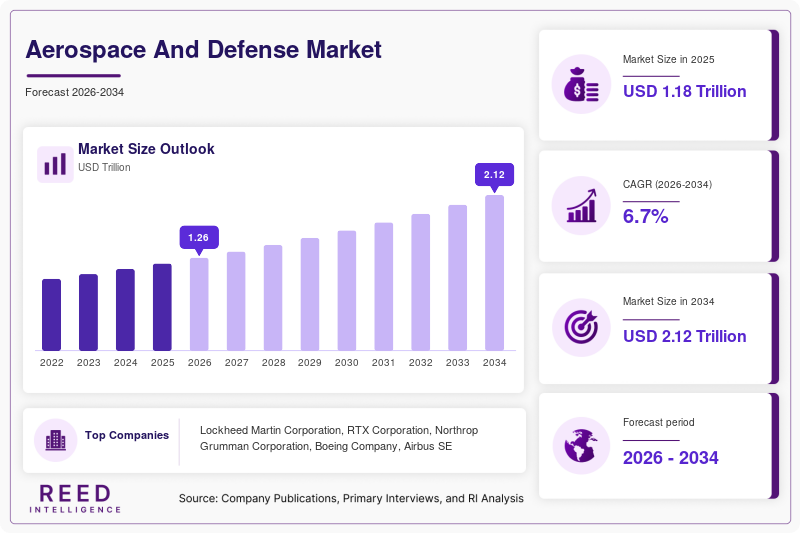
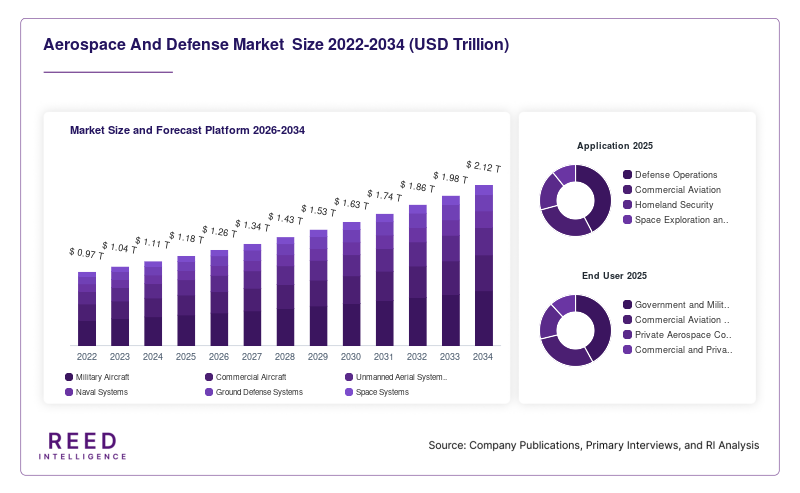
The Aerospace And Defense Market size was valued at USD 1.18 trillion in 2026 and is projected to reach USD 1.98 trillion by 2034, expanding at a CAGR of 6.7% during the forecast period from 2026 to 2034. The market continues to experience stable expansion due to increasing defense modernization programs, rising commercial aircraft demand, and growing investments in advanced aerospace technologies. Governments across major economies are increasing military expenditure to strengthen national security capabilities, while commercial aviation companies are expanding fleets to accommodate rising passenger traffic and cargo transportation requirements.
A significant global factor supporting market growth is the increasing emphasis on geopolitical security and defense preparedness. Nations are investing heavily in next-generation fighter aircraft, missile defense systems, unmanned aerial vehicles, satellite infrastructure, and cybersecurity solutions. Simultaneously, commercial aerospace manufacturers are focusing on fuel-efficient aircraft, sustainable aviation technologies, and digital maintenance systems to improve operational efficiency and reduce environmental impact.
Key Highlights
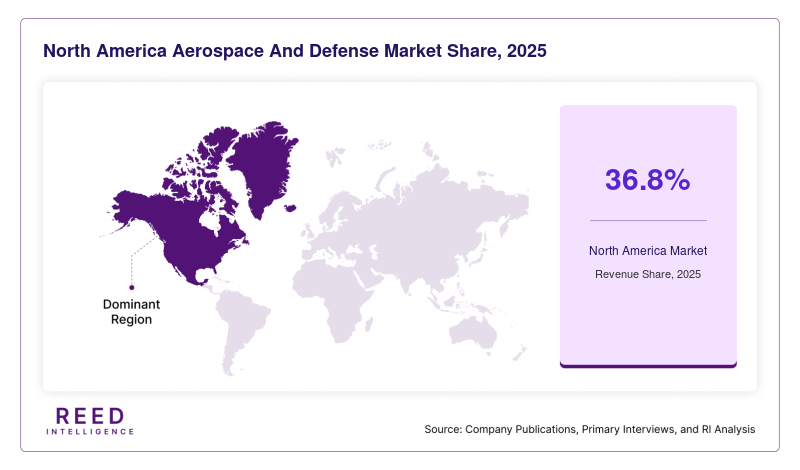
- North America dominated the market with a 36.8% share in 2025, while Asia Pacific is expected to grow at the fastest CAGR of 8.4% during 2026–2034.
- By platform, military aircraft accounted for the largest share of 32.6%, while unmanned aerial systems are projected to grow at a CAGR of 9.8%.
- By application, defense operations led with a 57.3% share, whereas space exploration and satellite services are expected to expand at a CAGR of 9.4%.
- The United States remained the dominant country, with market values of USD 368 billion in 2024 and USD 392 billion in 2025.
Market Trends
Expansion of Autonomous and Unmanned Systems
Autonomous technologies are becoming increasingly important across the Aerospace And Defense Market. Defense agencies are investing in unmanned aerial vehicles, autonomous maritime platforms, robotic ground systems, and intelligent surveillance solutions to improve operational effectiveness while reducing personnel risk. These systems provide enhanced situational awareness, real-time intelligence gathering, and extended mission endurance. Military organizations are integrating artificial intelligence and machine learning capabilities into autonomous platforms to support faster decision-making and mission execution. The growing deployment of unmanned systems in border monitoring, reconnaissance, combat support, and disaster response activities is creating sustained demand. Commercial aerospace organizations are also exploring autonomous flight technologies to improve operational efficiency and reduce long-term costs.
Growing Adoption of Digital Engineering and Smart Manufacturing
Digital engineering is transforming aerospace and defense production environments. Manufacturers are increasingly utilizing digital twins, predictive analytics, advanced simulation tools, and cloud-based design platforms to streamline product development. These technologies help reduce production cycles, improve quality assurance, and optimize maintenance planning. Smart manufacturing facilities equipped with robotics, automation systems, and additive manufacturing technologies are enabling companies to achieve greater operational flexibility. Aerospace manufacturers are also leveraging real-time data analytics to monitor aircraft performance throughout their lifecycle. The shift toward digitalized operations supports cost reduction, improves supply chain visibility, and accelerates innovation, making digital engineering a critical trend shaping future industry development.
Market Drivers
Rising Global Defense Expenditure and Military Modernization
The continuous increase in defense budgets across developed and emerging economies is a major growth driver for the Aerospace And Defense Market. Governments are prioritizing military modernization programs to strengthen national defense capabilities amid evolving security challenges. Investments are being directed toward advanced fighter aircraft, missile defense systems, surveillance technologies, naval platforms, and cyber defense infrastructure. Several countries are replacing aging military assets with technologically advanced alternatives that offer improved operational efficiency and mission effectiveness. Growing demand for intelligence, surveillance, and reconnaissance capabilities is further stimulating procurement activities. Long-term defense contracts and strategic procurement initiatives provide a stable revenue stream for manufacturers and suppliers operating within the industry.
Recovery of Commercial Aviation and Fleet Expansion Programs
The recovery of global air travel continues to support aerospace industry growth. Airlines are expanding and modernizing fleets to accommodate rising passenger traffic, increasing cargo demand, and stricter fuel efficiency requirements. Aircraft manufacturers are receiving substantial orders for narrow-body and wide-body aircraft designed to improve operational performance and reduce environmental impact. Emerging economies are witnessing increased airline investments due to growing middle-class populations and rising air connectivity. Maintenance, repair, and overhaul services are also experiencing growth as airlines focus on extending aircraft life cycles. The combination of fleet expansion, route development, and technological upgrades is creating strong demand across commercial aerospace value chains.
Market Restraint
Supply Chain Disruptions and High Development Costs
One of the primary challenges affecting the Aerospace And Defense Market is the complexity of global supply chains combined with substantial development expenditures. Aerospace and defense products often require highly specialized materials, advanced electronic components, and precision-engineered systems sourced from multiple countries. Any disruption in supplier networks can significantly delay production schedules and increase operational costs. Long certification processes, stringent regulatory requirements, and extensive testing procedures further contribute to project timelines and budget pressures.
The development of next-generation aircraft, defense platforms, and space systems requires billions of dollars in research, engineering, and manufacturing investments. Smaller suppliers frequently face financial challenges when adapting to evolving technological requirements. Cost overruns can affect procurement programs and delay equipment deployment. For example, delays in semiconductor availability, specialized alloys, or propulsion system components can impact aircraft production rates and defense equipment deliveries. These challenges require manufacturers to diversify supplier networks, invest in localized production capabilities, and enhance inventory management strategies to maintain competitiveness and operational resilience.
Market Opportunities
Increasing Investments in Space Exploration and Satellite Infrastructure
Space exploration activities are creating substantial growth opportunities within the Aerospace And Defense Market. Governments and private organizations are increasing investments in satellite deployment, lunar missions, deep-space exploration, and space-based communication systems. Satellites play an essential role in navigation, weather forecasting, telecommunications, defense intelligence, and environmental monitoring. The growing demand for low-earth orbit satellite constellations is encouraging manufacturers to develop cost-effective launch systems and advanced satellite technologies. Emerging commercial space enterprises are also contributing to industry expansion by introducing innovative launch services and space infrastructure solutions. As nations prioritize space capabilities for economic and strategic purposes, demand for aerospace technologies and services is expected to increase significantly.
Development of Sustainable Aviation Technologies
The transition toward sustainable aviation presents another promising opportunity for industry participants. Airlines, aircraft manufacturers, and regulatory agencies are focusing on reducing carbon emissions through alternative fuels, hybrid-electric propulsion systems, and lightweight aircraft materials. Sustainable aviation fuel adoption is accelerating across several markets as organizations seek to achieve environmental targets. Aerospace companies are investing in next-generation propulsion technologies and energy-efficient aircraft designs that can support long-term sustainability goals. The increasing regulatory focus on emissions reduction is encouraging innovation throughout the value chain. Companies capable of delivering environmentally responsible aerospace solutions are likely to benefit from emerging demand and evolving industry requirements over the forecast period.
Segmental Analysis
By Platform
Military aircraft emerged as the dominant subsegment, accounting for 32.6% of the market share in 2024. This leadership position is attributed to rising defense modernization initiatives, increasing procurement of advanced fighter jets, and ongoing replacement of aging military fleets. Governments worldwide continue investing in multi-role combat aircraft capable of supporting complex missions. Military aircraft provide strategic advantages through enhanced surveillance, mobility, and combat capabilities. Growing geopolitical concerns have encouraged nations to strengthen air superiority programs, resulting in increased procurement contracts. Additionally, continuous technological advancements in avionics, stealth systems, and propulsion technologies contribute to the sustained demand for military aircraft across developed and emerging economies.
Unmanned aerial systems are expected to register the fastest CAGR of 9.8% during the forecast period. The increasing demand for intelligence gathering, surveillance, reconnaissance, and precision operations is supporting rapid adoption. Defense organizations are deploying drones to improve operational flexibility while minimizing risks to personnel. Technological advancements in artificial intelligence, autonomous navigation, and sensor integration are enhancing platform capabilities. Commercial applications such as infrastructure inspection, disaster management, and environmental monitoring are also contributing to market expansion. As regulatory frameworks evolve and autonomous technologies mature, unmanned aerial systems are expected to become an increasingly important component of aerospace and defense operations worldwide.
By Application
Defense operations represented the largest application segment, holding 57.3% of the market share in 2024. The segment's dominance reflects continuous investments in military preparedness, strategic deterrence, and national security initiatives. Governments are allocating substantial budgets toward advanced defense platforms, surveillance systems, communication networks, and intelligence capabilities. Defense operations require highly reliable aerospace technologies to support air, land, maritime, and cyber missions. The integration of advanced analytics, autonomous systems, and secure communication technologies further enhances operational effectiveness. Growing geopolitical uncertainty and evolving security challenges continue to drive demand for sophisticated aerospace and defense solutions designed to improve mission readiness and response capabilities.
Space exploration and satellite services are projected to grow at the fastest CAGR of 9.4% through 2034. Increasing satellite deployments for communication, navigation, earth observation, and defense intelligence applications are supporting market expansion. Governments and private organizations are investing in advanced launch systems, orbital infrastructure, and deep-space exploration missions. The growing importance of space-based assets for national security and commercial applications is accelerating innovation across the industry. Emerging opportunities associated with low-earth orbit satellite networks, space tourism initiatives, and lunar exploration programs are expected to generate additional demand. Continuous advancements in launch technology and satellite miniaturization further strengthen growth prospects.
By End User
Government and military organizations held the dominant position in the market, accounting for 64.8% of total revenue share in 2024. These entities remain the primary consumers of aerospace and defense products due to their responsibility for national security, defense preparedness, and strategic operations. Procurement programs involving aircraft, defense systems, surveillance technologies, and communication infrastructure continue to generate substantial revenue. Governments are increasingly investing in modernization initiatives aimed at improving operational efficiency and mission effectiveness. Long-term procurement contracts and defense partnerships provide stability for manufacturers while supporting ongoing technological advancement. The sustained focus on security enhancement continues to reinforce the importance of this end-user segment.
Commercial and private space organizations are anticipated to witness the fastest CAGR of 10.1% during the forecast period. Growing private-sector participation in space exploration, satellite deployment, and commercial launch services is driving segment growth. Investments from venture capital firms and technology companies are accelerating innovation across the space economy. Private organizations are developing reusable launch vehicles, advanced satellite systems, and space-based communication infrastructure. The increasing commercialization of space activities is creating new revenue streams and expanding market participation. As launch costs decline and technological capabilities improve, commercial space enterprises are expected to play a larger role in shaping future industry growth.
Regional Analysis
North America
North America accounted for 36.8% of the Aerospace And Defense Market in 2025, making it the largest regional contributor. The region is projected to expand at a CAGR of 5.9% during the forecast period. Strong defense spending, advanced aerospace manufacturing capabilities, and continuous investments in research and development support market growth. The presence of established aircraft manufacturers, defense contractors, and space technology providers further strengthens regional competitiveness. Government procurement programs and modernization initiatives continue to generate significant opportunities across multiple industry segments.
The United States remains the dominant country within North America due to its extensive defense budget and advanced aerospace ecosystem. A unique growth factor is the country's leadership in space-based defense and satellite modernization initiatives. Continuous investments in missile defense systems, military aircraft procurement, and commercial aviation expansion are supporting long-term market development. Increasing collaboration between government agencies and private aerospace firms is accelerating innovation and strengthening technological leadership.
Europe
Europe represented 25.4% of the Aerospace And Defense Market in 2025 and is expected to grow at a CAGR of 6.1% through 2034. The region benefits from strong aerospace manufacturing capabilities, collaborative defense programs, and increasing investments in advanced military technologies. Several European countries are upgrading defense infrastructure while supporting indigenous aircraft development initiatives. The expansion of commercial aviation activities and the adoption of sustainable aerospace technologies also contribute to regional market growth.
Germany continues to lead the European market due to its strong industrial base and advanced engineering expertise. A unique growth factor is the country's focus on sustainable aviation innovation and advanced manufacturing technologies. Investments in lightweight materials, alternative propulsion systems, and digital aerospace production processes are enhancing competitiveness. Additionally, participation in multinational defense programs is creating opportunities for technology development and export growth.
Asia Pacific
Asia Pacific held 21.7% of the Aerospace And Defense Market in 2025 and is projected to register the fastest CAGR of 8.4% between 2026 and 2034. Rising defense expenditures, expanding commercial aviation networks, and growing domestic manufacturing capabilities are driving regional growth. Governments are investing heavily in military modernization programs, advanced aircraft procurement, and indigenous defense production. Increasing passenger traffic and infrastructure development are also supporting aerospace industry expansion across major economies.
China dominates the Asia Pacific market due to its significant investments in aerospace manufacturing, military modernization, and space exploration programs. A unique growth factor is the country's emphasis on developing domestic aerospace technologies and reducing dependence on imported systems. Large-scale investments in commercial aircraft production, satellite infrastructure, and next-generation defense capabilities continue to strengthen market growth prospects and technological advancement.
Middle East & Africa
The Middle East & Africa region accounted for 8.4% of the Aerospace And Defense Market in 2025 and is expected to expand at a CAGR of 6.8% during the forecast period. Growing defense procurement programs, increasing security requirements, and investments in aviation infrastructure are supporting market growth. Several countries are modernizing military capabilities and expanding commercial airline operations to strengthen economic diversification efforts. Regional governments continue to prioritize advanced surveillance and defense technologies.
Saudi Arabia represents the dominant market within the region due to its substantial defense expenditure and long-term modernization initiatives. A unique growth factor is the country's strategic investment in domestic defense manufacturing capabilities. Efforts to localize aerospace and defense production are creating opportunities for technology transfer, industrial partnerships, and workforce development. These initiatives are expected to enhance regional competitiveness and reduce reliance on imported equipment.
Latin America
Latin America captured 7.7% of the Aerospace And Defense Market in 2025 and is forecast to grow at a CAGR of 5.7% through 2034. The market is supported by expanding aviation infrastructure, fleet modernization activities, and increasing demand for surveillance and security solutions. Governments across the region are investing in border security technologies, air traffic management systems, and defense modernization programs. Commercial aviation growth also contributes to increased demand for aircraft and maintenance services.
Brazil remains the leading country in the Latin American market due to its established aerospace manufacturing sector and growing defense capabilities. A unique growth factor is the country's strong regional aircraft production industry, which supports both domestic and export demand. Investments in advanced aerospace engineering, military aviation programs, and commercial aircraft development continue to strengthen Brazil's position as a significant contributor to regional market growth.
Competitive Landscape
The Aerospace And Defense Market is characterized by the presence of large multinational corporations with extensive engineering capabilities, diversified product portfolios, and long-term government contracts. Competition focuses on technological innovation, advanced manufacturing, strategic partnerships, and contract acquisition. Market participants are investing heavily in research and development to strengthen capabilities in autonomous systems, digital engineering, advanced materials, and next-generation aerospace platforms.
Among leading companies, Lockheed Martin maintains a strong market position through its broad portfolio of military aircraft, missile systems, and space technologies. Recent development efforts have focused on advanced autonomous defense solutions and next-generation mission systems. Other major participants continue expanding through mergers, strategic collaborations, and investments in emerging aerospace technologies. Increasing demand for sustainable aviation solutions and space-based infrastructure is encouraging companies to diversify offerings and strengthen innovation pipelines. Competitive intensity is expected to remain high as governments and commercial customers seek advanced, cost-effective, and technologically sophisticated aerospace and defense solutions.
Key Players
- Lockheed Martin
- RTX Corporation
- Northrop Grumman
- Boeing
- Airbus
- General Dynamics
- BAE Systems
- L3Harris Technologies
- Leonardo S.p.A.
- Thales Group
- Safran
- Rolls-Royce Holdings
- Embraer
- Honeywell Aerospace
- Elbit Systems
Recent Developments
- In 2025, Lockheed Martin expanded development programs focused on autonomous mission systems and advanced battlefield connectivity solutions for defense applications.
- In 2025, Airbus introduced enhanced sustainable aviation technology initiatives aimed at improving fuel efficiency and reducing lifecycle emissions across commercial aircraft platforms.
- In 2024, RTX Corporation strengthened its next-generation radar and missile defense portfolio through investments in advanced sensor integration and digital defense capabilities.
- In 2024, Northrop Grumman advanced space-based surveillance programs by developing new satellite technologies designed to improve strategic intelligence and communication capabilities.
- In 2025, Boeing accelerated digital manufacturing adoption across selected aerospace production facilities to improve productivity and reduce development timelines.
Aerospace And Defense Market Segments
Platform
- Military Aircraft
- Commercial Aircraft
- Unmanned Aerial Systems
- Naval Systems
- Ground Defense Systems
- Space Systems
Application
- Defense Operations
- Commercial Aviation
- Homeland Security
- Space Exploration and Satellite Services
End User
- Government and Military Organizations
- Commercial Aviation Operators
- Private Aerospace Companies
- Commercial and Private Space Organizations
By Region
- North America
- Europe
- APAC
- Middle East and Africa
- LATAM