Aerospace Cold Forgings Market Size, Share & Trends Analysis Report By Material Type (Aluminum Alloys, Titanium Alloys, Stainless Steel, Nickel-Based Alloys, Carbon & Alloy Steel), By Component Type (Fasteners, Bushings & Sleeves, Pins & Shafts, Structural Fittings & Brackets), By Aircraft Type (Commercial Narrow-Body Aircraft, Wide-Body & Long-Range Aircraft, Military Aircraft), By Application (Airframe Structures, Engines & Propulsion, Landing Gear) and By Region (North America, Europe, APAC,
USD 3950
Aerospace Cold Forgings Market Size
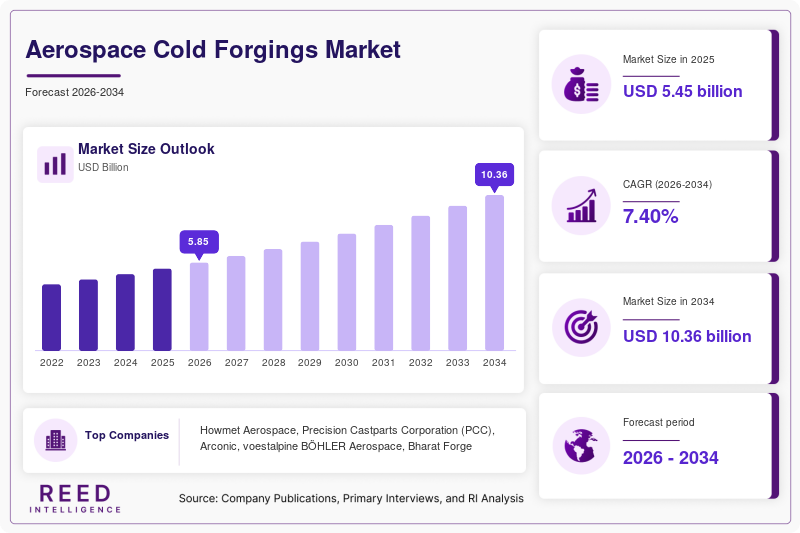
The global Aerospace Cold Forgings Market size was valued at USD 5.45 billion in 2025 and is projected to grow from USD 5.84 billion in 2026 to USD 10.36 billion by 2034, registering a CAGR of 7.40% during the forecast period from 2026 to 2034.
The Aerospace Cold Forgings Market is being supported by two linked developments: higher aircraft production requirements and increasing demand for lightweight, high-strength, highly repeatable metallic components. Cold forging is particularly relevant to aerospace fasteners, pins, bushings, fittings and other precision parts where dimensional consistency, favorable grain flow, fatigue resistance and material utilization are important. Aerospace suppliers use aluminum, titanium, stainless steel and high-strength alloy steels depending on the load, temperature and corrosion requirements of the component.
Aircraft production is providing a direct demand signal. Airbus delivered 793 commercial aircraft in 2025 and ended the year with a record backlog of 8,754 aircraft. Boeing delivered 600 commercial aircraft in 2025 and ended the year with more than 6,100 commercial airplanes in backlog.
The production ramp is continuing into 2026. Airbus is targeting an A320 Family production rate of 70–75 aircraft per month by the end of 2027, while Boeing is working toward 47 737 aircraft per month and has opened a fourth 737 production line to support rates above 47 per month.
For forging suppliers, this creates demand not only for new aircraft components but also for qualified capacity, tooling, inspection, heat treatment and material availability. At the same time, certification requirements, specialty-metal sourcing and OEM qualification cycles limit how quickly new forging capacity can enter production.
Aerospace Cold Forgings Market Drivers
Commercial Aircraft Production Ramp-Ups Are Increasing Forged-Component Requirements
The strongest near-term demand signal is the planned increase in commercial-aircraft production. Airbus is building toward 75 A320 Family aircraft per month and has expanded its global final-assembly footprint across Toulouse, Hamburg, Mobile and Tianjin. The company reported an A320 Family backlog of 7,577 aircraft at the end of August 2026.
Boeing is undertaking a similar production recovery. Its 737 program is moving toward a 47-aircraft monthly rate, while its new Everett North Line provides additional capacity for future production above that level. Boeing's commercial-aircraft backlog exceeded 6,200 aircraft in June 2026.
The transmission mechanism to cold forging is direct: every incremental aircraft requires large numbers of qualified fasteners, fittings, pins, bushings and other metallic precision parts. Because aerospace components require traceability and qualification, OEM production increases must be matched by approved supplier capacity rather than simply additional raw material.
Lightweight Materials and Near-Net-Shape Manufacturing Are Raising Forging Demand
Aerospace manufacturers continue to pursue lower aircraft weight without compromising strength, fatigue resistance or temperature performance. This supports titanium and aluminum alloys in selected airframe and propulsion applications, while high-strength steels and nickel-based alloys remain relevant for demanding environments.
Howmet's Engineered Structures business illustrates the integration of material production, forging and machining: the company produces titanium ingot and mill products and is vertically integrated into titanium, aluminum and nickel forgings for airframe, wing, aero-engine and landing-gear applications.
Near-net-shape forging also reduces the amount of material that must subsequently be removed through machining. voestalpine BÖHLER Aerospace specifically positions near-net-shape forging as a way to reduce machining requirements and improve material efficiency.
The commercial implication is that aerospace customers can evaluate forging suppliers on total manufacturing cost, buy-to-fly ratio, machining requirements and material utilization rather than simply the price of a forged blank.
Engine and Defense Programs Are Creating Additional Qualified Forging Demand
Aerospace forging demand extends beyond commercial airframes. Engine programs require high-integrity metallic components that operate under substantial thermal and mechanical loads, while military programs require specialized structural and propulsion parts.
Safran Aircraft Engines announced a €150 million investment in April 2026 to install a 30,000-metric-ton hydraulic press at its Gennevilliers site. The press will manufacture strategic parts for commercial and military engines, become operational in 2029 and support a production increase that Safran expects to nearly double the site's output by 2035.
GE Aerospace is also expanding manufacturing capacity. In May 2026, the company announced an additional INR 100 crore investment in its Pune facility for welding technology, inspection equipment, precision tools, gauges and infrastructure supporting GE90, GEnx, GE9X and LEAP programs.
These investments increase demand for qualified forging and machining capacity across engine and structural supply chains and create longer-term requirements for specialty-metal processing.
Aerospace Cold Forgings Market Restraints
Aerospace Qualification Requirements Lengthen Capacity Expansion
Cold-forged aerospace components must satisfy strict dimensional, metallurgical, mechanical and traceability requirements. Suppliers may need customer-specific approvals, aerospace quality systems, nondestructive testing and specialized process qualifications before components can enter serial production.
voestalpine BÖHLER Aerospace describes an integrated process extending from preliminary material through forging, heat treatment, testing and machining, with aerospace special processes approved through PRI/NADCAP requirements.
The constraint is commercially important because a new press does not immediately equal usable aerospace capacity. Tool development, process validation, first-article inspection and customer qualification can extend the time between capital expenditure and revenue generation.
A 2026 European aerospace standard project also illustrates the continuing specification environment: EN 4072 covers a titanium-alloy aerospace screw with defined strength, temperature and coating requirements.
Specialty-Metal Supply and Aerospace Supply-Chain Bottlenecks Can Limit Output
Aerospace forgings depend on qualified titanium, nickel, aluminum and high-strength steel feedstock. The supply chain therefore remains exposed to material availability, processing capacity, transportation and supplier concentration.
GE Aerospace's 2025 annual report described active work with suppliers to increase material availability and production capacity; priority-supplier material input increased 40% year over year and total engine deliveries increased 26% in 2025.
This matters because a forging producer can have available press capacity but still be unable to increase output if aerospace-grade billet, bar or specialty alloy supply is constrained. The result is greater emphasis on vertical integration, multiple qualified sources and closer OEM-supplier collaboration.
Aerospace Cold Forgings Market Opportunities
Titanium and High-Performance Alloy Cold Forgings
Titanium is becoming increasingly important where aerospace designers need high strength with lower weight and corrosion resistance. The opportunity is strongest in aircraft structural hardware, fasteners, fittings and selected engine-adjacent components.
Aerospace suppliers are increasing their ability to process titanium across multiple stages. Howmet combines titanium material production with forging and machining, while voestalpine BÖHLER Aerospace produces titanium and nickel-base alloy forgings for safety-critical applications.
The commercial opportunity lies in supplying higher-value qualified parts rather than commodity forgings. Titanium also creates an opportunity for suppliers that can control the complete material-to-forged-component chain, reducing traceability and quality risks.
Aerospace Supply-Chain Localization
Aircraft manufacturers are expanding supplier networks closer to major production centers. India is emerging as one of the clearest examples.
Airbus said in March 2026 that its annual sourcing from India had increased from approximately USD 500 million in 2019 to more than USD 1.5 billion, with more than 100 Indian companies supplying components for global programs. The company is targeting more than USD 2 billion in annual Indian sourcing before the end of the decade.
India's C295 program is also creating local production of detail parts, with 37 Indian suppliers onboarded and more than 13,000 detail parts planned for manufacture in the country.
This creates opportunities for regional forging companies capable of meeting aerospace quality, traceability and process-certification requirements.
Automation, Inspection and Digital Process Control
Cold forging suppliers can improve competitiveness through automated handling, process monitoring, digital tooling and inspection systems. The value comes from reducing variation and scrap while increasing repeatability across high-volume aerospace components.
voestalpine BÖHLER Aerospace already uses virtual and digital twins in forging development and production, while its production system integrates tooling, forging, heat treatment, testing and machining.
For aerospace customers, digital process records can also strengthen traceability and support faster root-cause analysis. This becomes particularly valuable as production rates rise and suppliers need to increase output without compromising certification requirements.
Segmental Analysis
By Material Type
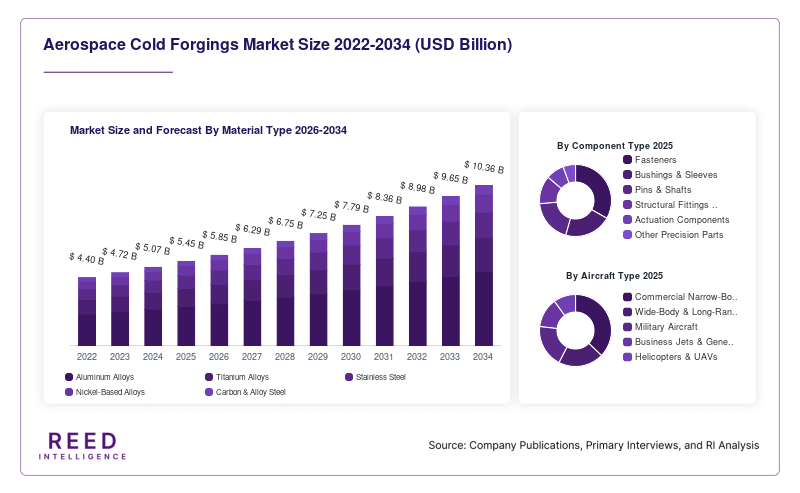
Aluminum Alloys represent approximately 31% of the global market in 2025, supported by their favorable strength-to-weight characteristics and extensive use across aircraft structures and precision hardware. Aluminum remains particularly relevant where weight reduction and corrosion performance must be balanced against manufacturing cost.
Titanium Alloys account for approximately 27% and are the fastest-growing material category, with a CAGR of approximately 9.2%. Titanium is increasingly relevant to high-strength, weight-sensitive aerospace components. Howmet maintains integrated titanium material, forging and machining capabilities, while aerospace fastener standards continue to specify titanium-alloy products for flight applications.
Stainless Steel represents approximately 22%, supported by corrosion resistance and strength requirements.
Carbon & Alloy Steel represents approximately 13%, while Nickel-Based Alloys account for approximately 7%, with their use concentrated in more demanding temperature and propulsion environments.
By Component Type
Fasteners hold approximately 36% of the market in 2025, reflecting the high unit volume of bolts, screws, nuts and related fastening components used throughout aircraft. Cold heading is particularly suited to high-volume production where consistent geometry and material utilization are required.
Structural Fittings & Brackets account for approximately 18%, followed by Bushings & Sleeves at 15%, Pins & Shafts at 14%, Actuation Components at 9% and other precision parts at 8%.
Structural Fittings & Brackets are the fastest-growing component segment at approximately 8.3% CAGR, supported by aircraft production increases and continued use of lightweight metallic components in airframe and control systems.
By Aircraft Type
Commercial Narrow-Body Aircraft represent approximately 46% of the market in 2025. The segment benefits from the scale of the Airbus A320 Family and Boeing 737 programs. Airbus had more than 7,500 A320 Family aircraft in backlog in August 2026, while Boeing's commercial backlog exceeded 6,200 aircraft in June.
Military Aircraft represent approximately 22%, Wide-Body & Long-Range Aircraft 20%, Business Jets & General Aviation 7%, and Helicopters & UAVs 5%.
Military Aircraft are the fastest-growing aircraft category at approximately 8.6% CAGR, supported by defense production and modernization programs. Airbus reported 2025 Defence and Space order intake of €17.7 billion, while Safran's new Gennevilliers forging investment will serve both commercial and military engine programs.
By Application
Airframe Structures account for approximately 37% of the market in 2025. Forged fittings, brackets, pins and fastening components are used throughout structural assemblies where strength, repeatability and traceability are required.
Landing Gear represents approximately 22%, Engines & Propulsion 20%, Flight Controls & Actuation 14%, and other aerospace applications 7%.
Engines & Propulsion are the fastest-growing application at approximately 8.5% CAGR. Engine production is increasing as aircraft manufacturers raise output, while LEAP and other next-generation propulsion programs require additional component capacity. GE Aerospace reported record LEAP deliveries in 2025 and continued production and supply-chain investments in 2026.
Regional Analysis
North America Aerospace Cold Forgings Market
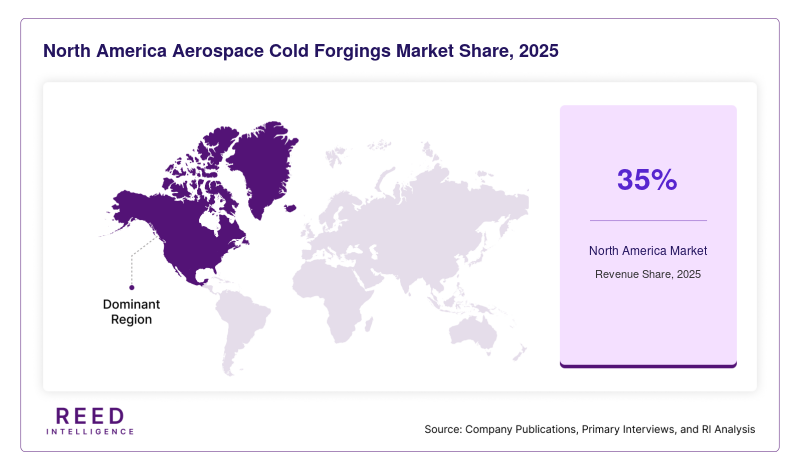
North America represents approximately 35% of the global Aerospace Cold Forgings Market in 2025, making it the largest regional market. The region benefits from the world's largest concentration of aerospace OEMs, engine manufacturers, defense programs, Tier-1 suppliers and specialized forging companies.
Boeing delivered 600 commercial aircraft in 2025 and had more than 6,100 commercial aircraft in backlog. By June 2026, its commercial backlog had increased to more than 6,200 aircraft. The company is also increasing 737 production toward 47 aircraft per month and has opened a fourth production line in Everett.
Howmet provides another important supply-chain signal. Its Engineered Structures business produces titanium, aluminum and nickel forgings for airframe, engine and landing-gear applications, while its fastening business supplies aerospace fasteners and fluid fittings.
North America is projected to grow at approximately 6.8% CAGR through 2034. The market benefits from defense spending and commercial-aircraft production but remains exposed to labor availability, qualification timelines and supply-chain bottlenecks.
Europe Aerospace Cold Forgings Market
Europe accounts for approximately 29% of the global market in 2025. The region has a deep aerospace manufacturing ecosystem centered around Airbus, Safran, Rolls-Royce, MTU and numerous specialized materials and forging suppliers.
Airbus delivered 793 commercial aircraft in 2025 and ended the year with a record 8,754-aircraft commercial backlog. The company continues to expand A320 Family production toward 75 aircraft per month.
Safran is reinforcing the European forging supply base through its €150 million Gennevilliers investment. The new 30,000-metric-ton press will produce up to 14,000 parts annually at full production and is expected to support nearly double the site's production by 2035.
voestalpine BÖHLER Aerospace adds specialized capacity in titanium, nickel and high-alloy steel forgings, with production capabilities spanning very large screw presses, counterblow hammers and open-die processes.
Europe is projected to record approximately 6.9% CAGR through 2034. The principal growth mechanism is the combination of commercial-aircraft production, defense programs and investment in regional aerospace supply-chain resilience.
APAC Aerospace Cold Forgings Market
APAC represents approximately 23% of the global market in 2025 and is the fastest-growing region, with a CAGR of approximately 9.1%.
The region's expansion is supported by aircraft fleet growth, local aerospace manufacturing and increasing participation in global OEM supply chains. Airbus forecasts that Asia-Pacific, including China and India, will require approximately 19,560 new passenger aircraft over the next 20 years, representing 46% of global demand.
China remains a major production and demand center. Airbus delivered the first aircraft from its second Tianjin A320 Family final-assembly line in September 2026, expanding its industrial footprint in China.
India is becoming increasingly important for aerospace sourcing. Airbus reported more than USD 1.5 billion of annual sourcing from India in 2026, with more than 100 Indian companies supplying components for global programs. GE Aerospace has also invested more than INR 510 crore over three years in its Pune manufacturing facility.
The region's principal growth mechanism is localization: aircraft assembly, engine manufacturing and component sourcing are increasingly distributed across India, China, Japan, Southeast Asia and other Asian aerospace clusters. The main constraints are qualification requirements, advanced metallurgy capability and the need for internationally recognized aerospace certifications.
Middle East and Africa Aerospace Cold Forgings Market
Middle East and Africa represents approximately 7% of the global market in 2025 and is projected to grow at approximately 7.8% CAGR.
The region's aerospace manufacturing base is smaller than those of North America, Europe and APAC, but commercial aviation expansion and defense modernization create downstream demand for aerospace components. The Middle East is also an important aircraft-delivery and maintenance hub, particularly around the UAE, Saudi Arabia and Qatar.
Airbus forecasts strong long-term aircraft demand across the broader Middle East and emerging Asia corridor, while Boeing's global outlook identifies emerging markets as major contributors to future fleet expansion.
Local aerospace industrialization is gradually increasing the addressable market for precision metallic components. However, dependence on imported specialty materials and a smaller local forging ecosystem remain constraints.
LATAM Aerospace Cold Forgings Market
LATAM accounts for approximately 6% of the global market in 2025 and is projected to grow at approximately 7.5% CAGR.
Brazil is the principal aerospace manufacturing hub, with Embraer creating demand for aircraft structures, engines, landing gear and precision components across commercial, executive and defense programs. The wider region is also connected to global aerospace supply chains through aircraft operators, MRO facilities and component suppliers.
The market's development depends on the expansion of local aerospace manufacturing and greater integration of regional suppliers into international OEM programs. Export-oriented production provides an opportunity for Latin American forging companies that can achieve required aerospace quality and traceability standards.
The principal constraints are the smaller regional production base compared with North America, Europe and APAC, along with currency volatility and dependence on imported specialty materials and equipment.
Competitive Landscape
The Aerospace Cold Forgings Market is characterized by high qualification barriers, long customer relationships and increasing vertical integration. Competition is not based solely on forging capacity. Aerospace customers evaluate metallurgy, tooling, process repeatability, nondestructive testing, traceability, machining capabilities, delivery reliability and certification history.
Howmet Aerospace has a vertically integrated position spanning titanium materials, forgings, extrusions and machining for airframe, engine and landing-gear applications. Its 2026 activities also included the acquisition of Consolidated Aerospace Manufacturing for approximately USD 1.8 billion, strengthening its portfolio of aerospace fasteners, fluid fittings and engineered products.
Safran is expanding internal forging capacity through its Gennevilliers investment, which will support commercial and military engine programs and future high-tonnage forging requirements.
Key Market Players
- Howmet Aerospace
- Precision Castparts Corporation (PCC)
- Arconic
- voestalpine BÖHLER Aerospace
- Bharat Forge
- Safran
- LISI Aerospace
- Otto Fuchs
- VSMPO-AVISMA
- ATI
- Kobe Steel
- IHI Corporation
- GKN Aerospace
- Magellan Aerospace
- MTU Aero Engines
- Aichi Steel
Recent Market Developments
- April 2026 – Safran invested €150 million in a 30,000-metric-ton forging press at Gennevilliers. The press is scheduled to enter operation in 2029 and is designed to increase production across commercial and military engine families, strengthening Safran's internal forging capacity.
- April 2026 – Howmet completed its USD 1.8 billion acquisition of Consolidated Aerospace Manufacturing. CAM adds precision fasteners, fluid fittings and engineered aerospace products, strengthening Howmet's position in the aerospace fastening supply chain.
Aerospace Cold Forgings Market Segments
By Material Type
- Aluminum Alloys
- Titanium Alloys
- Stainless Steel
- Nickel-Based Alloys
- Carbon & Alloy Steel
By Component Type
- Fasteners
- Bushings & Sleeves
- Pins & Shafts
- Structural Fittings & Brackets
- Actuation Components
- Other Precision Parts
By Aircraft Type
- Commercial Narrow-Body Aircraft
- Wide-Body & Long-Range Aircraft
- Military Aircraft
- Business Jets & General Aviation
- Helicopters & UAVs
By Application
- Airframe Structures
- Engines & Propulsion
- Landing Gear
- Flight Controls & Actuation
- Other Aerospace Applications
By Region
- North America
- Europe
- APAC
- Middle East and Africa
- LATAM