Aerospace Engine Vibration Monitoring System Market Size, Share, Demand Report By Equipment Type (Sensors, Software Solutions, Hardware Systems, MEMS-Based Monitoring Devices), By Application (Structural Health Monitoring, Fault Detection, Corrosion Detection, Engine Performance Diagnostics), By End-Use (Commercial Aviation), By Region & Segment Forecasts, 2026–2034
USD 3950
Market Overview
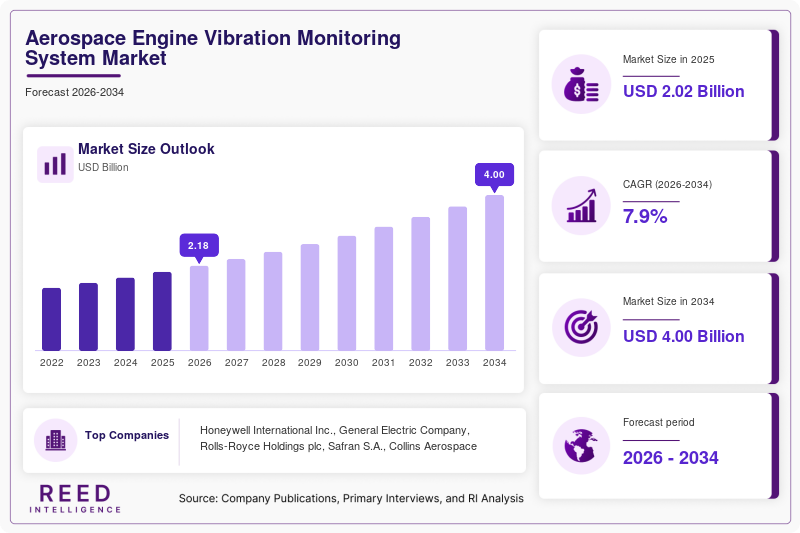
The Aerospace Engine Vibration Monitoring System Market size is projected to reach USD 2.18 billion in 2026 and is expected to grow to USD 4.05 billion by 2034, registering a CAGR of 7.9% during 2026–2034. The market expansion is primarily driven by the increasing emphasis on predictive maintenance, operational safety, and real-time engine performance diagnostics across commercial and defense aviation sectors. Rising global air traffic and the growing complexity of modern turbine engines have significantly increased the need for advanced vibration monitoring technologies that ensure engine reliability and reduce unplanned downtime.
A major global factor supporting market growth is the widespread digital transformation in aviation maintenance systems. Airlines and defense operators are increasingly integrating sensor-based monitoring solutions with AI-powered analytics platforms to enhance predictive capabilities. This shift toward condition-based maintenance is reducing lifecycle costs and improving fleet efficiency, thereby boosting adoption of vibration monitoring systems across both OEM and aftermarket segments.
Key Highlights
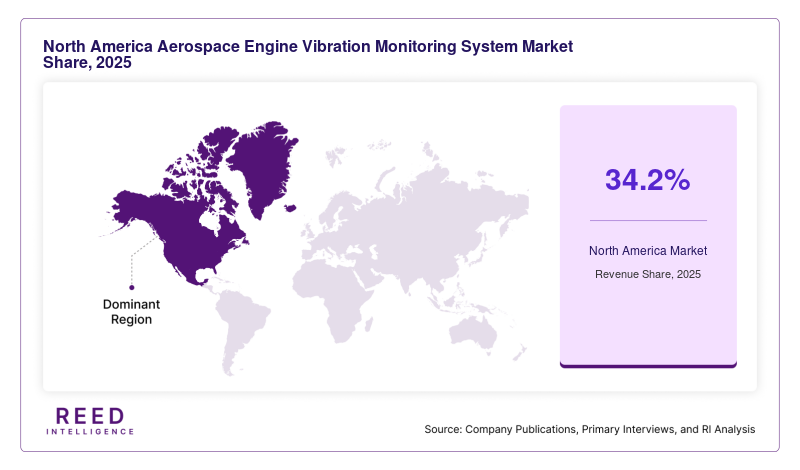
- North America dominated the market with a 34.2% share in 2025.
- Asia Pacific is expected to grow at the fastest CAGR of 11.2% during 2026–2034.
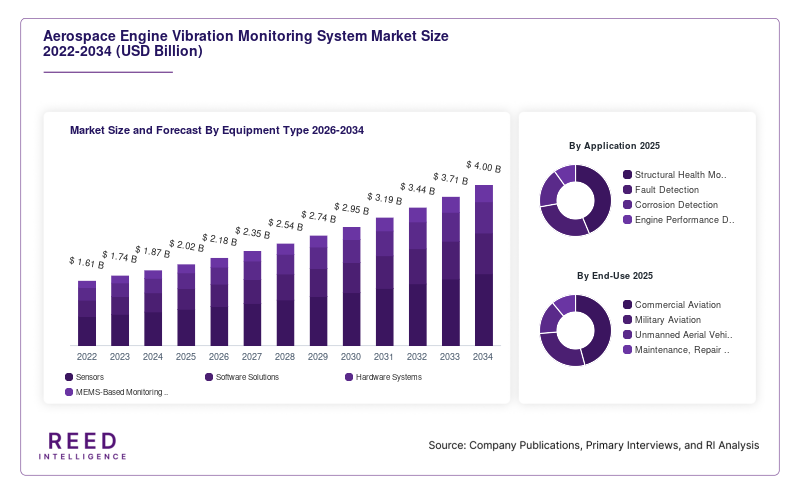
- By equipment type, sensors accounted for the largest share of 38.5%, while software solutions are projected to grow at a CAGR of 12.4%.
- By application, structural health monitoring led with a 41.7% share, whereas corrosion detection is expected to expand at a CAGR of 11.8%.
- The United States remained the dominant country, with market values of USD 510 million in 2024 and USD 560 million in 2025.
Market Trends
Integration of AI-Enabled Predictive Maintenance Systems
One of the most significant trends shaping the Aerospace Engine Vibration Monitoring System Market is the integration of artificial intelligence and machine learning into predictive maintenance platforms. Airlines and defense operators are increasingly deploying AI algorithms that analyze vibration patterns in real time to predict engine failures before they occur. This reduces unscheduled maintenance events and improves operational efficiency. Advanced analytics also enable early detection of anomalies in turbine blades, bearings, and shafts, improving aircraft safety. The combination of IoT sensors and cloud-based analytics is further enhancing data accuracy and enabling remote diagnostics across global fleets.
Shift Toward Wireless and Lightweight Sensor Technologies
Another major trend is the growing adoption of wireless and lightweight vibration sensors in modern aircraft engines. Traditional wired systems are gradually being replaced due to weight constraints and installation complexity. Wireless sensor networks offer easier integration, reduced maintenance requirements, and improved scalability. These systems are particularly valuable in next-generation aircraft designs where fuel efficiency is a priority. Additionally, advancements in MEMS (Micro-Electro-Mechanical Systems) technology are enabling compact sensor development with higher sensitivity, allowing real-time monitoring even in extreme operating conditions such as high-temperature turbine environments.
Market Drivers
Rising Demand for Aircraft Safety and Engine Reliability
A primary driver of the Aerospace Engine Vibration Monitoring System Market is the increasing global emphasis on aviation safety and engine reliability. Aircraft engines operate under extreme stress conditions, and even minor vibration anomalies can indicate serious mechanical issues. Regulatory authorities and aviation organizations are mandating stricter maintenance protocols, encouraging airlines to adopt advanced vibration monitoring systems. These systems help detect imbalance, misalignment, and wear in engine components at an early stage, thereby preventing catastrophic failures. The growing commercial aviation fleet worldwide is further accelerating demand for continuous engine health monitoring solutions.
Expansion of Commercial and Military Aircraft Fleets
The expansion of global aircraft fleets in both commercial and defense sectors is significantly driving market growth. Rising passenger traffic has led airlines to increase fleet size, while defense modernization programs are fueling demand for advanced military aircraft. Each new generation of aircraft incorporates sophisticated engine monitoring systems as standard equipment. Additionally, long-haul operations require higher engine efficiency and reduced maintenance downtime, which further supports adoption. Emerging economies are also investing heavily in aviation infrastructure, increasing procurement of next-generation aircraft equipped with vibration monitoring technologies.
Market Restraint
High Implementation and Integration Costs
One of the key restraints in the Aerospace Engine Vibration Monitoring System Market is the high cost associated with system installation and integration. Advanced vibration monitoring systems require high-precision sensors, data acquisition units, and sophisticated analytics software, all of which contribute to significant upfront investment. Smaller airlines and maintenance operators often face budget constraints that limit adoption. Additionally, integrating these systems into existing aircraft engines and maintenance frameworks can be technically complex and time-consuming. The need for specialized training and skilled personnel further increases operational costs, making it challenging for cost-sensitive operators to adopt these technologies widely.
Market Opportunities
Growing Adoption of Digital Twin Technology
The increasing use of digital twin technology presents a strong opportunity for the Aerospace Engine Vibration Monitoring System Market. Digital twins enable real-time virtual replication of aircraft engines, allowing engineers to simulate performance, predict failures, and optimize maintenance schedules. When integrated with vibration monitoring systems, digital twins enhance predictive accuracy by continuously updating engine models with live sensor data. This enables airlines and OEMs to improve asset utilization and reduce maintenance costs. The growing adoption of Industry 4.0 practices in aviation is expected to accelerate the deployment of digital twin-enabled vibration monitoring systems globally.
Rising Demand in Emerging Aviation Markets
Emerging aviation markets in Asia Pacific, the Middle East, and Latin America present significant growth opportunities. Rapid urbanization, increasing disposable income, and expanding tourism industries are driving air travel demand in these regions. As a result, airlines are expanding fleets and investing in advanced maintenance technologies. Governments in these regions are also investing in airport infrastructure and aviation safety regulations, encouraging the adoption of vibration monitoring systems. Local aircraft maintenance, repair, and overhaul (MRO) facilities are increasingly upgrading their capabilities, creating strong demand for advanced engine monitoring solutions.
Segmental Analysis
By Equipment Type
Sensors accounted for 38.5% share in 2024, making them the dominant subsegment in the Aerospace Engine Vibration Monitoring System Market. Their widespread use in real-time vibration detection across turbine engines has made them essential components in aviation maintenance systems. High sensitivity and accuracy in detecting mechanical irregularities have further strengthened their market position across commercial and defense aviation applications.
Software solutions are expected to grow at a CAGR of 12.4%, driven by increasing demand for analytics-driven maintenance platforms. These systems enable predictive insights, data visualization, and integration with cloud-based aviation management systems. Growing adoption of AI and machine learning algorithms is further enhancing software capabilities, allowing airlines to optimize maintenance schedules and reduce operational disruptions.
By Application
Structural health monitoring held the largest share of 41.7% in 2024, driven by its critical role in ensuring aircraft engine safety and performance. This application enables continuous assessment of engine components, helping detect fatigue and stress-related issues in real time. Airlines prioritize structural health monitoring to comply with strict aviation safety regulations and improve fleet reliability.
Corrosion detection is projected to grow at a CAGR of 11.8%, supported by increasing aircraft lifespan and exposure to harsh operating environments. Advanced vibration monitoring systems are increasingly being used to detect early signs of corrosion in engine components, reducing maintenance costs and improving operational safety across long-haul fleets.
By End-Use
Commercial aviation dominated with a 44.6% share in 2024, driven by the expansion of global airline fleets and rising passenger traffic. Airlines are increasingly investing in vibration monitoring systems to enhance fuel efficiency and reduce maintenance downtime, ensuring better fleet utilization.
Military aviation is expected to grow at a CAGR of 9.6%, supported by rising defense budgets and modernization programs. Advanced fighter jets and transport aircraft increasingly rely on vibration monitoring systems for mission-critical engine performance and operational readiness.
Regional Analysis
North America
North America accounted for 34.2% market share in 2025, with a projected CAGR of 7.2% during 2026–2034. The region benefits from a strong presence of aircraft OEMs, advanced defense infrastructure, and high adoption of predictive maintenance technologies. The Aerospace Engine Vibration Monitoring System Market in North America continues to expand due to early adoption of digital aviation technologies and strong regulatory frameworks supporting aviation safety.
The United States dominates the regional market, driven by extensive commercial airline operations and defense modernization programs. A key growth factor is the strong presence of leading aerospace companies investing heavily in sensor innovation and AI-based maintenance systems. This has significantly accelerated the integration of vibration monitoring systems across both civil and military aviation fleets.
Europe
Europe held approximately 26.8% market share in 2025, with a forecast CAGR of 7.5% during 2026–2034. The region is characterized by strong aviation manufacturing capabilities and stringent safety regulations. Increasing focus on fuel efficiency and emission reduction is further driving adoption of advanced engine monitoring technologies across European airlines.
Germany leads the European market, supported by its robust aerospace engineering sector. A major growth factor is the rising investment in sustainable aviation initiatives, which encourages the use of predictive maintenance systems to extend engine life and reduce carbon emissions.
Asia Pacific
Asia Pacific captured 22.5% market share in 2025, and is expected to grow at the fastest CAGR of 11.2% during 2026–2034. Rapid expansion of commercial aviation, increasing air passenger traffic, and rising defense budgets are key drivers in the region. Airlines are increasingly investing in advanced maintenance technologies to support fleet expansion.
China dominates the regional market due to its large-scale aircraft procurement programs. A key growth factor is the expansion of domestic aircraft manufacturing capabilities, which is driving integration of vibration monitoring systems into next-generation aircraft platforms.
Middle East & Africa
The Middle East & Africa region accounted for 9.3% market share in 2025, with a projected CAGR of 8.1% during 2026–2034. Growth is driven by increasing airline fleet expansion and strategic investments in aviation infrastructure, particularly in Gulf countries.
The United Arab Emirates leads the regional market, supported by its status as a global aviation hub. A key growth factor is the expansion of long-haul international flight operations, which requires advanced engine monitoring solutions to ensure operational reliability.
Latin America
Latin America held 7.2% market share in 2025, with a forecast CAGR of 7.8% during 2026–2034. The region is witnessing gradual adoption of advanced aviation maintenance systems driven by modernization of airline fleets and airport infrastructure upgrades.
Brazil dominates the regional market, supported by its growing commercial aviation sector. A key growth factor is the increasing investment in regional connectivity, which is encouraging airlines to adopt predictive maintenance technologies to improve aircraft availability.
Competitive Landscape
The Aerospace Engine Vibration Monitoring System Market is moderately consolidated, with key players focusing on sensor innovation, AI integration, and strategic partnerships. Major companies include Honeywell International Inc., General Electric Company, Safran S.A., Rolls-Royce Holdings plc, and Meggitt PLC. Honeywell leads the market due to its strong aerospace sensor portfolio and integration of predictive analytics in engine monitoring systems. Recent developments include expansion of AI-driven engine health monitoring platforms and collaboration with aircraft OEMs to enhance real-time diagnostics capabilities.
Key Players List
- Honeywell International Inc.
- General Electric Company
- Safran S.A.
- Rolls-Royce Holdings plc
- Meggitt PLC
- Collins Aerospace
- Siemens AG
- Curtiss-Wright Corporation
- Parker Hannifin Corporation
- Vibro-Meter SA
- Teledyne Technologies Incorporated
- LORD Corporation
- SKF Group
- Moog Inc.
- Analog Devices Inc.
Recent Developments
- A leading aerospace manufacturer introduced AI-integrated vibration sensors capable of real-time anomaly detection in turbine engines.
- A global engine OEM expanded its predictive maintenance platform by integrating cloud-based vibration analytics across its commercial aircraft fleet.
- A sensor technology company launched next-generation MEMS-based vibration monitoring systems designed for high-temperature jet engine environments.
Aerospace Engine Vibration Monitoring System Market Segments
By Equipment Type
- Sensors
- Software Solutions
- Hardware Systems
- MEMS-Based Monitoring Devices
By Application
- Structural Health Monitoring
- Fault Detection
- Corrosion Detection
- Engine Performance Diagnostics
By End-Use
- Commercial Aviation
- Military Aviation
- Unmanned Aerial Vehicles (UAVs)
- Maintenance, Repair & Overhaul (MRO) Services
By Region
- North America
- Europe
- APAC
- Middle East and Africa
- LATAM