Aerospace Galley Trolley Market Size, Share & Demand Report By Type (Standard Trolleys, Half-Size Trolleys, Full-Size Trolleys, Smart Trolleys), By Application (Food and Beverage Service, Waste Management, Storage and Logistics), By End-Use (Commercial Aviation, Business Aviation, Military Aviation), By Region & Segment Forecasts, 2026–2034
USD 3950
Market Overview
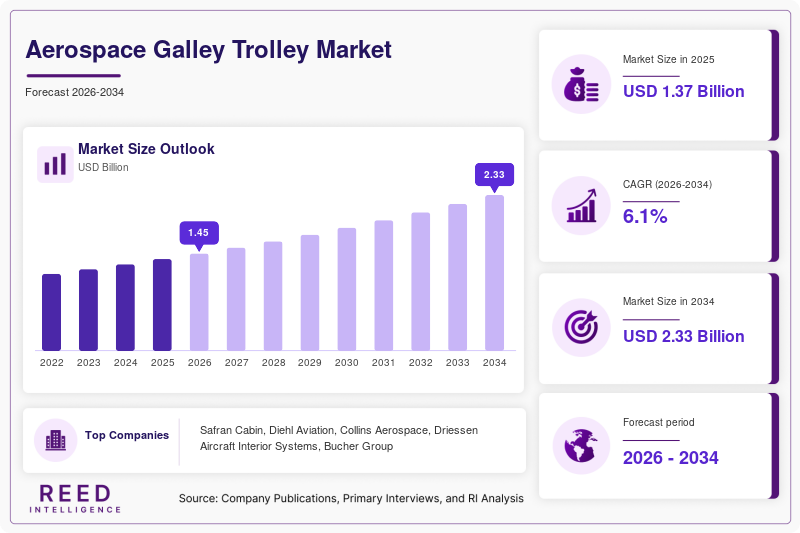
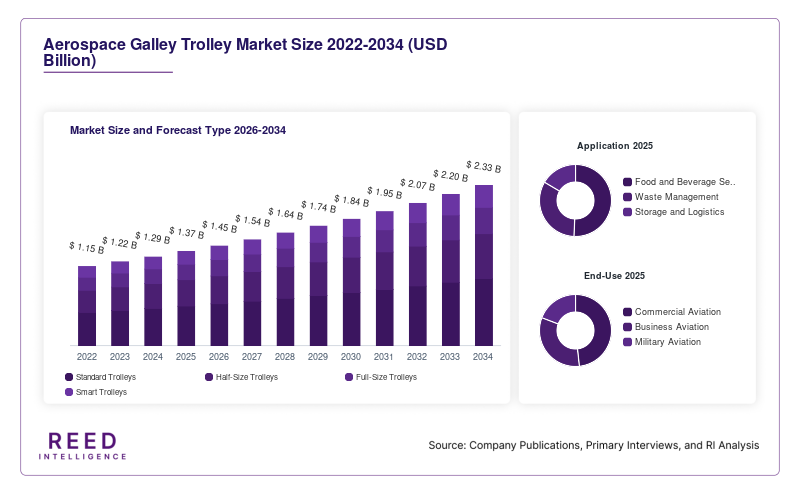
The Aerospace Galley Trolley Market size is estimated to reach a market size of USD 1.45 billion in 2026 and is projected to expand to approximately USD 2.32 billion by 2034, growing at a CAGR of 6.1% during the forecast period (2026–2034). The steady increase in global air passenger traffic and the expansion of airline fleets are among the primary factors supporting market growth. Airlines are focusing on enhancing onboard services and optimizing cabin space efficiency, which has led to increased adoption of lightweight and durable galley trolley systems. Additionally, rising demand for low-cost carriers and long-haul travel routes has further amplified the need for advanced galley equipment.
Another key factor contributing to growth is the emphasis on fuel efficiency and weight reduction in aircraft components. Aerospace galley trolleys manufactured using composite materials and aluminum alloys are gaining traction due to their ability to reduce overall aircraft weight and improve operational efficiency. Airlines are also upgrading their cabin interiors to improve passenger experience, which includes modernized galley trolleys with enhanced storage, modular design, and ergonomic features.
Key Highlights
- North America accounted for approximately 34.5% of the global market share in 2025.
- Asia Pacific is expected to grow at the fastest CAGR of 7.4%. The standard trolley segment dominated with a 58% share in 2024, whereas smart trolleys are projected to grow at a CAGR of 8.1%.
- Commercial aviation held the largest share at 72%, while business aviation is expected to expand at a CAGR of 6.8%.
- The United States remained the dominant country, with market values of USD 410 million in 2024 and USD 435 million in 2025.
Market Trends
Increasing Adoption of Lightweight and Composite Materials
Aircraft manufacturers and airlines are placing increasing emphasis on weight reduction to enhance fuel efficiency and reduce operational costs. This has led to a shift toward lightweight materials such as carbon fiber composites, advanced plastics, and aluminum alloys in the production of galley trolleys. These materials not only reduce weight but also improve durability and resistance to wear and tear, making them suitable for long-term usage in demanding aviation environments.
The integration of lightweight materials also contributes to environmental sustainability, as lower aircraft weight translates to reduced fuel consumption and lower carbon emissions. Manufacturers are investing in research and development to create innovative trolley designs that maintain structural integrity while minimizing weight. Additionally, regulatory bodies are encouraging the use of eco-friendly materials, further driving the adoption of advanced material solutions in the market.
Integration of Smart and Connected Galley Solutions
The aerospace industry is witnessing a gradual transition toward smart cabin solutions, including connected galley trolleys equipped with digital features. These smart trolleys are designed to enhance operational efficiency by enabling real-time inventory tracking, temperature monitoring, and automated service management. Airlines are increasingly adopting such technologies to streamline in-flight service operations and reduce manual errors.
Smart galley trolleys also support data-driven decision-making by providing insights into passenger consumption patterns and inventory usage. This helps airlines optimize catering logistics and reduce waste. Furthermore, the integration of IoT-enabled sensors and connectivity features allows for predictive maintenance, ensuring that trolleys remain functional and safe throughout their lifecycle. This trend is expected to gain traction as airlines continue to invest in digital transformation initiatives.
Market Drivers
Expansion of Global Airline Fleet and Passenger Traffic
The consistent growth in global air passenger traffic has significantly increased the demand for new aircraft deliveries and retrofitting of existing fleets. Airlines are expanding their operations to meet the rising demand for both domestic and international travel, which directly drives the need for galley equipment, including trolleys. The growth of low-cost carriers and regional airlines has further accelerated this demand, as these operators require efficient and cost-effective cabin solutions.
Additionally, emerging economies are investing in airport infrastructure and aviation connectivity, leading to increased aircraft utilization rates. As airlines aim to enhance passenger experience, the demand for modern and efficient galley trolleys continues to rise. This driver is expected to remain strong throughout the forecast period, supported by increasing travel demand and fleet modernization programs.
Focus on Cabin Modernization and Passenger Experience
Airlines are increasingly focusing on improving passenger experience by upgrading cabin interiors and service quality. Galley trolleys play a crucial role in onboard service delivery, making them a key component of cabin modernization initiatives. Airlines are investing in ergonomically designed trolleys that facilitate efficient service while ensuring comfort for cabin crew.
Moreover, premium airlines are incorporating customized galley solutions to cater to different passenger segments, including business and first-class travelers. These enhancements include improved storage capacity, noise reduction features, and aesthetic design improvements. The growing emphasis on passenger satisfaction and brand differentiation is driving airlines to adopt advanced galley trolley systems, thereby supporting market growth.
Market Restraint
High Initial Costs and Maintenance Challenges
The adoption of advanced aerospace galley trolleys involves significant upfront costs, particularly for models incorporating smart technologies and lightweight composite materials. Airlines, especially smaller operators and low-cost carriers, may find it challenging to allocate substantial capital for upgrading galley equipment. This cost factor can limit the widespread adoption of advanced trolley solutions, particularly in price-sensitive markets.
In addition to initial costs, maintenance and repair requirements also pose challenges. Galley trolleys are subject to frequent usage and handling, leading to wear and tear over time. Advanced materials and integrated technologies may require specialized maintenance procedures, increasing operational costs. For instance, smart trolleys with electronic components may require regular software updates and technical support, adding to the overall cost burden. These factors can act as a restraint for market growth, particularly among smaller airlines.
Market Opportunities
Growth in Emerging Aviation Markets
Emerging economies in Asia Pacific, Latin America, and the Middle East are experiencing rapid growth in their aviation sectors. Increasing disposable income, urbanization, and government initiatives to improve air connectivity are driving demand for air travel in these regions. This presents significant opportunities for aerospace galley trolley manufacturers to expand their presence and cater to new airline operators.
Airlines in these regions are investing in new aircraft and upgrading their fleets to meet rising passenger demand. This creates a favorable environment for the adoption of modern galley trolley systems. Additionally, partnerships with local manufacturers and suppliers can help global players establish a strong foothold in these markets, further enhancing growth opportunities.
Advancements in Customization and Modular Design
The demand for customized and modular galley trolley solutions is increasing as airlines seek to optimize cabin space and improve service efficiency. Manufacturers are developing trolleys that can be tailored to specific airline requirements, including size, configuration, and functionality. Modular designs allow for easy customization and replacement of components, reducing maintenance costs and enhancing operational flexibility.
This trend also supports the development of innovative solutions such as multi-functional trolleys that can be used for different purposes, including food service, waste management, and storage. The ability to offer customized solutions provides a competitive advantage for manufacturers and opens new avenues for market growth.
Segmental Analysis
By Type
The standard galley trolley segment dominated the market with a share of approximately 58% in 2024. These trolleys are widely used across commercial airlines due to their cost-effectiveness, durability, and compatibility with existing aircraft configurations. Standard trolleys are designed to meet basic service requirements, including food and beverage storage and transportation. Their widespread adoption is supported by their simplicity and ease of maintenance.
Another factor contributing to the dominance of this segment is the availability of standardized designs that comply with aviation regulations. Airlines prefer these trolleys for their reliability and proven performance in various operational conditions. Additionally, manufacturers offer a wide range of standard trolley models, catering to different aircraft types and service requirements, further strengthening their market position.
The smart trolley segment is expected to witness the fastest growth, with a CAGR of 8.1% during the forecast period. These trolleys incorporate advanced technologies such as IoT sensors, digital displays, and automated inventory management systems. The increasing focus on digital transformation in the aviation industry is driving the adoption of smart trolley solutions.
A key growth factor for this segment is the ability to enhance operational efficiency and reduce manual workload for cabin crew. Smart trolleys enable real-time monitoring of inventory and temperature, ensuring optimal service quality. Additionally, airlines can use data collected from these trolleys to optimize catering operations and reduce waste, making them an attractive investment.
By Application
The food and beverage service segment accounted for the largest share of 64% in 2024. This segment is essential for in-flight service operations, as galley trolleys are primarily used for transporting meals, drinks, and other consumables. The consistent demand for onboard catering services across all flight types supports the dominance of this segment.
Airlines are continuously enhancing their catering offerings to improve passenger experience, which drives the need for efficient and well-designed trolleys. The integration of temperature control features and ergonomic designs further enhances the functionality of these trolleys, making them indispensable in food and beverage service operations.
The waste management segment is expected to grow at the fastest CAGR of 7.2%. Increasing emphasis on hygiene and environmental sustainability is driving the demand for specialized trolleys designed for waste collection and segregation. Airlines are adopting these solutions to comply with regulatory requirements and improve onboard cleanliness.
A significant growth factor is the implementation of waste reduction initiatives by airlines, including recycling and efficient disposal practices. Specialized waste management trolleys enable better handling of different types of waste, contributing to improved operational efficiency and environmental compliance.
By End-Use
The commercial aviation segment dominated the market with a share of 72% in 2024. The large number of commercial aircraft in operation and the high frequency of flights contribute to the significant demand for galley trolleys in this segment. Airlines rely on these trolleys for efficient service delivery and passenger satisfaction.
The continuous expansion of airline fleets and the introduction of new routes further support the growth of this segment. Additionally, the increasing focus on enhancing passenger experience and service quality drives airlines to invest in advanced galley trolley systems, reinforcing the dominance of commercial aviation.
The business aviation segment is expected to grow at a CAGR of 6.8% during the forecast period. This segment includes private jets and chartered flights, where customization and premium service are key priorities. Galley trolleys used in business aviation are often designed to meet specific requirements and offer enhanced features.
A major growth factor is the increasing demand for luxury travel and personalized services. Business jet operators are investing in high-quality and aesthetically designed trolleys to provide a premium experience. This trend is expected to drive the adoption of advanced and customized galley trolley solutions in the segment.
Regional Analysis
North America
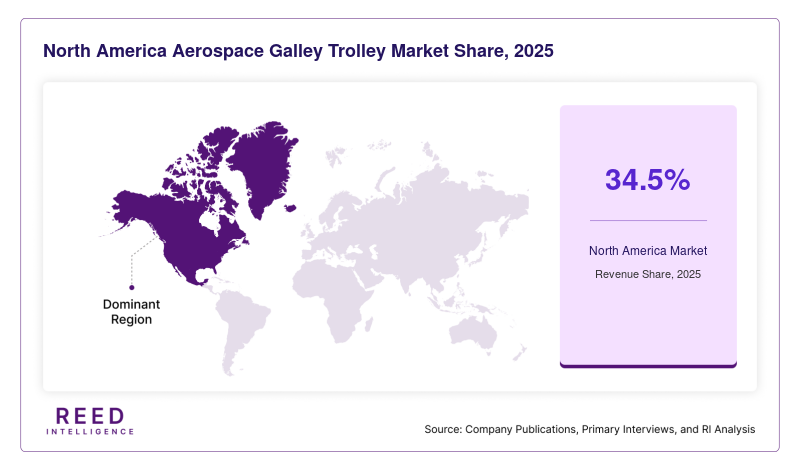
North America held a dominant share of approximately 34.5% in 2025 and is expected to grow at a CAGR of 5.8% during the forecast period. The region benefits from a well-established aviation industry, with a large number of commercial and business aircraft in operation. Continuous investments in fleet modernization and cabin upgrades are supporting the demand for advanced galley trolley systems.
The United States remains the leading country in the region, driven by its extensive airline network and strong presence of aircraft manufacturers. One unique growth factor is the increasing adoption of premium cabin services, which require high-quality and efficient galley equipment. This trend is encouraging airlines to invest in innovative trolley solutions.
Europe
Europe accounted for around 27.2% of the market share in 2025 and is projected to grow at a CAGR of 5.6%. The region’s focus on sustainability and environmental regulations is driving the adoption of lightweight and eco-friendly galley trolley materials. Airlines are also investing in modernizing their fleets to comply with stringent emission standards.
Germany is a key market within Europe, supported by its strong aerospace manufacturing base. A unique growth factor is the region’s emphasis on circular economy practices, encouraging the use of recyclable materials in trolley production. This approach aligns with the broader sustainability goals of the European aviation sector.
Asia Pacific
Asia Pacific is the fastest-growing region, with a CAGR of 7.4% and a market share of 22.8% in 2025. Rapid urbanization, increasing middle-class population, and expanding airline networks are driving demand for air travel in the region. This growth is translating into higher demand for galley trolley systems.
China leads the regional market, driven by significant investments in aviation infrastructure and fleet expansion. A unique growth factor is the rise of low-cost carriers, which require cost-effective and efficient galley solutions to maintain operational efficiency and competitive pricing.
Middle East & Africa
The Middle East & Africa region accounted for 9.5% of the market share in 2025 and is expected to grow at a CAGR of 6.3%. The region’s strategic location as a global transit hub supports the growth of its aviation industry. Airlines are investing in premium services to attract international passengers.
The United Arab Emirates is the dominant country, driven by its major airlines and global connectivity. A unique growth factor is the focus on luxury travel experiences, leading to the adoption of high-end galley trolley systems with advanced features and customization options.
Latin America
Latin America held a market share of 6.0% in 2025 and is projected to grow at a CAGR of 5.9%. The region is witnessing gradual growth in air travel, supported by economic development and improved connectivity. Airlines are focusing on upgrading their fleets to enhance service quality.
Brazil is the leading country in the region, driven by its large domestic aviation market. A unique growth factor is the increasing adoption of regional aircraft, which require compact and efficient galley trolley solutions to maximize cabin space utilization.
Competitive Landscape
The Aerospace Galley Trolley Market is characterized by the presence of several established players competing on product innovation, quality, and customization capabilities. Companies are focusing on developing lightweight and technologically advanced trolley solutions to meet evolving airline requirements. Strategic partnerships, mergers, and acquisitions are common strategies adopted to strengthen market position.
One of the leading players in the market is Safran Cabin, which has a strong portfolio of galley equipment and continues to invest in research and development. A recent development includes the introduction of lightweight composite trolleys designed to improve fuel efficiency and reduce operational costs. Other key players are also focusing on expanding their product offerings and enhancing their global presence through collaborations with airlines and aircraft manufacturers.
Key Players
- Safran Cabin
- Diehl Aviation
- Collins Aerospace
- Driessen Aircraft Interior Systems
- Bucher Group
- Aerospace Interior Products
- Zodiac Aerospace
- AVIC Cabin Systems
- Korita Aviation
- Geven S.p.A.
- Recaro Aircraft Seating
- STG Aerospace
- Jamco Corporation
- AIM Altitude
- Turkish Cabin Interiors
Recent Developments
- Safran Cabin introduced a new range of eco-friendly galley trolleys made from recyclable composite materials to support sustainability goals.
- Collins Aerospace partnered with a major airline to develop smart galley solutions featuring real-time inventory tracking and predictive maintenance capabilities.
- Diehl Aviation expanded its production capacity in Europe to meet increasing demand for lightweight and customized galley trolley systems.
Aerospace Galley Trolley Market Segments
Type
- Standard Trolleys
- Half-Size Trolleys
- Full-Size Trolleys
- Smart Trolleys
Application
- Food and Beverage Service
- Waste Management
- Storage and Logistics
End-Use
- Commercial Aviation
- Business Aviation
- Military Aviation
By Region
- North America
- Europe
- APAC
- Middle East and Africa
- LATAM