Aerospace Military Auxiliary Power Unit APU Market Size, Share & Demand Report By Aircraft Type (Fighter Aircraft, Transport Aircraft, Helicopters, Unmanned Aerial Vehicles, Surveillance Aircraft), By Platform (Airborne Military Platforms, Naval Aviation Support Platforms, Ground Support Aviation Platforms), By Power Output (Below 100 kW, 100–300 kW, Above 300 kW), By Region & Segment Forecasts, 2026–2034
USD 3950
Market Overview
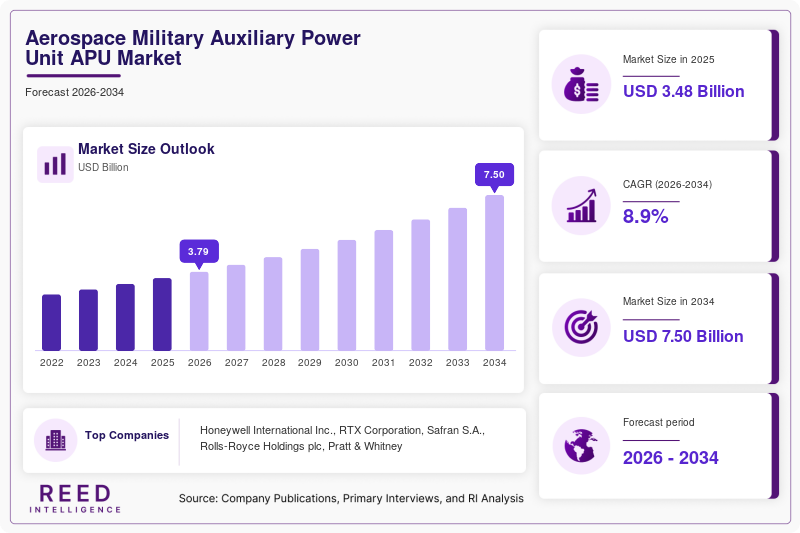
The global Aerospace Military Auxiliary Power Unit APU Market size was valued at USD 3.48 billion in 2026 and is projected to reach USD 6.92 billion by 2034, expanding at a CAGR of 8.9% during the forecast period from 2026 to 2034. Auxiliary power units are becoming a critical component across modern military aircraft fleets due to rising demand for improved onboard power generation, enhanced operational efficiency, and reduced dependency on ground support systems. Military aviation authorities are investing in advanced aircraft modernization programs that require lightweight and fuel-efficient APU systems capable of supporting radar systems, avionics, surveillance equipment, and mission-critical electronics during combat and standby operations.
The growth of global defense expenditure has supported the expansion of the Aerospace Military Auxiliary Power Unit APU Market. Several countries are increasing investments in fighter jets, transport aircraft, unmanned aerial systems, and airborne surveillance fleets. Modern combat aircraft require higher electrical loads and dependable backup power systems, which has accelerated procurement of advanced APUs. In addition, the transition toward more-electric aircraft architecture is increasing the requirement for compact and high-performance auxiliary power technologies. The industry is also benefiting from improvements in thermal management systems, turbine efficiency, and digital monitoring capabilities that improve lifecycle performance.
Key Highlights
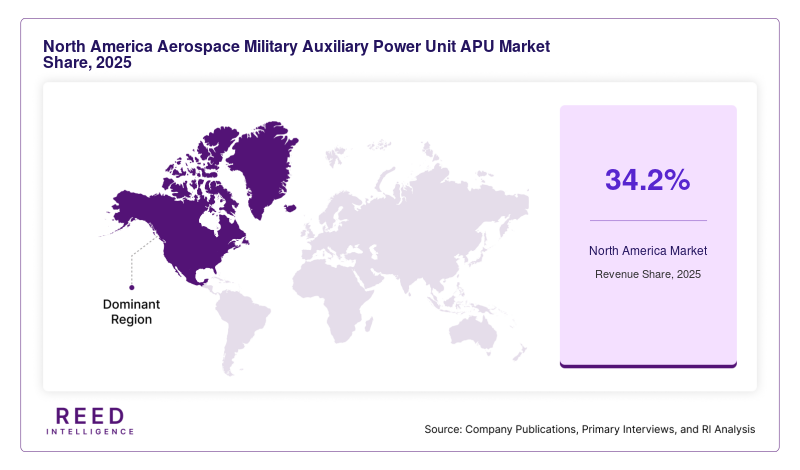
- North America dominated the market with a 34.2% share in 2025.
- Asia Pacific is expected to grow at the fastest CAGR of 10.8% during 2026–2034.
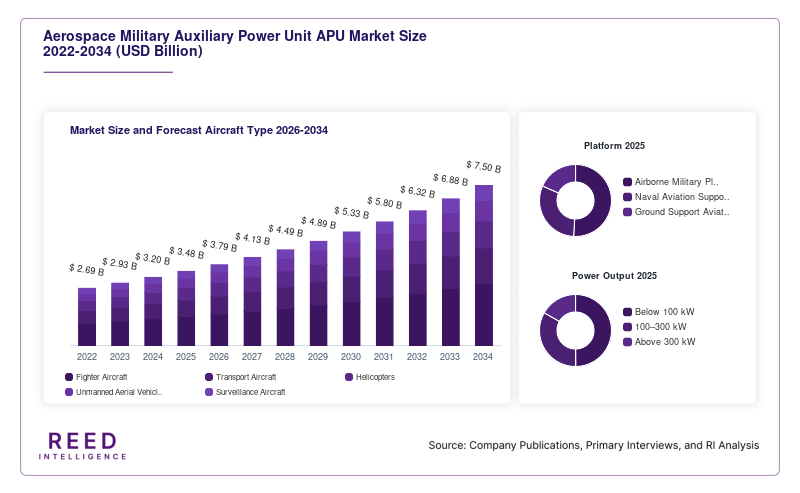
- By aircraft type, fighter aircraft accounted for the largest share of 39.1%.
- while unmanned aerial vehicles are projected to grow at a CAGR of 11.6%.
- By platform, airborne military platforms led with a 44.5% share.
- whereas naval aviation support platforms are expected to expand at a CAGR of 10.9%.
- By power output, the 100–300 kW category held the largest share of 42.7%.
- while above 300 kW systems are expected to grow at a CAGR of 11.1%.
- The United States remained the dominant country, with market values of USD 710 million in 2024 and USD 770 million in 2025.
Market Trends
Integration of More-Electric Aircraft Technologies
Military aircraft manufacturers are increasingly integrating more-electric aircraft technologies into next-generation combat and surveillance platforms. This trend is influencing the Aerospace Military Auxiliary Power Unit APU Market because advanced electrical systems require stable onboard power support during both ground and flight operations. Modern APUs are being designed with higher electrical output capacity, digital control systems, and lower fuel consumption to support sophisticated avionics, electronic warfare systems, and onboard communications equipment. Defense agencies are prioritizing lightweight power systems that reduce aircraft weight while improving mission endurance. The growing deployment of fifth-generation fighter aircraft and advanced airborne early warning systems is further encouraging adoption of compact and high-efficiency APU technologies across global defense fleets.
Expansion of Military Aircraft Modernization Programs
The increasing modernization of aging military aircraft fleets is creating strong demand for replacement and retrofit auxiliary power units. Several air forces are extending aircraft operational life cycles through avionics upgrades, engine improvements, and power management enhancements. As a result, modern APUs are being installed to improve reliability and reduce maintenance downtime. Retrofit demand is particularly high among transport aircraft, maritime patrol aircraft, and tactical helicopters that continue to operate in long-duration missions. Defense ministries are focusing on reducing operational costs while enhancing aircraft readiness, which is accelerating the adoption of digitally monitored and fuel-efficient APU systems. The market is also witnessing increased collaboration between aerospace suppliers and military organizations to develop customized APU solutions for legacy and next-generation aircraft platforms.
Market Drivers
Rising Global Defense Spending on Advanced Aircraft Fleets
The steady increase in global defense expenditure is one of the major factors driving the Aerospace Military Auxiliary Power Unit APU Market. Countries across North America, Europe, and Asia Pacific are increasing investments in advanced military aviation programs to strengthen air superiority and rapid response capabilities. Modern combat aircraft and surveillance systems require dependable onboard auxiliary power for mission-critical operations, especially during standby conditions and remote deployments. The procurement of next-generation fighter jets, transport aircraft, and special mission aircraft is increasing demand for efficient APUs that can support advanced electronics and communication systems. In addition, military organizations are emphasizing aircraft readiness and operational flexibility, which is boosting replacement demand for high-performance and low-maintenance auxiliary power units.
Growing Demand for Reliable Power in Remote Military Operations
Military operations increasingly rely on electronic systems such as radar, intelligence equipment, targeting systems, and satellite communication technologies. These systems require uninterrupted power availability even in remote and high-risk operational zones where external ground power support may not be accessible. This factor is contributing significantly to the growth of the Aerospace Military Auxiliary Power Unit APU Market. APUs allow military aircraft to operate independently during field missions and emergency deployments, reducing operational delays and improving mobility. The expansion of expeditionary warfare strategies and rapid deployment missions is increasing the need for reliable onboard power generation systems. Furthermore, advancements in turbine technology and fuel efficiency are improving APU operational performance and encouraging broader deployment across multiple military aircraft categories.
Market Restraint
High Development and Maintenance Costs of Advanced APU Systems
The high cost associated with the development, integration, and maintenance of advanced auxiliary power units remains a key challenge for the Aerospace Military Auxiliary Power Unit APU Market. Military-grade APUs require advanced engineering standards, thermal management systems, durable materials, and extensive testing procedures to comply with defense operational requirements. These factors significantly increase manufacturing and certification expenses. In addition, APUs operating in combat aircraft are exposed to harsh environmental conditions and demanding operational cycles, leading to higher maintenance and replacement costs. Smaller defense budgets in developing economies often limit procurement of advanced systems and delay modernization programs. For example, some military operators continue to rely on aging aircraft platforms with outdated power systems because replacing APUs across large fleets requires substantial capital investment. Extended procurement cycles and complex integration procedures also slow adoption of next-generation technologies, particularly in cost-sensitive defense programs.
Market Opportunities
Increasing Adoption of Unmanned Military Aircraft Platforms
The rapid expansion of unmanned military aircraft programs is creating substantial opportunities for the Aerospace Military Auxiliary Power Unit APU Market. Unmanned aerial vehicles are increasingly being used for surveillance, reconnaissance, border security, and combat support missions. These platforms require lightweight and highly efficient power generation systems capable of supporting onboard sensors, communication equipment, and autonomous navigation technologies. Manufacturers are developing compact APUs with reduced thermal signatures and improved fuel efficiency to meet the operational requirements of advanced unmanned systems. Growing investments in high-altitude long-endurance drones and tactical UAV fleets across the United States, China, Israel, and India are expected to create long-term demand for specialized APU technologies tailored for unmanned operations.
Development of Hybrid and Sustainable Aviation Power Solutions
The aerospace defense sector is witnessing rising interest in hybrid-electric propulsion systems and sustainable aviation technologies. This transition is opening new opportunities for companies operating in the Aerospace Military Auxiliary Power Unit APU Market. Defense organizations are evaluating hybrid power architectures that reduce fuel consumption and improve operational efficiency in both manned and unmanned aircraft. Advanced APUs integrated with energy storage systems and smart power management technologies are gaining attention for future combat aircraft programs. Manufacturers are also investing in low-emission turbine systems and sustainable fuel compatibility to align with broader environmental goals within defense aviation. The development of lightweight materials, digital diagnostics, and predictive maintenance solutions is expected to further enhance growth opportunities for suppliers offering next-generation auxiliary power technologies.
Segmental Analysis
By Aircraft Type
Fighter aircraft represented the dominant subsegment within the Aerospace Military Auxiliary Power Unit APU Market in 2024, accounting for approximately 39.1% of total revenue. The high share is linked to increasing procurement of advanced combat aircraft equipped with sophisticated avionics, radar systems, and electronic warfare technologies that require dependable onboard power support. Modern fighter jets operate in demanding mission environments where auxiliary power units are essential for engine start functions, onboard electrical support, and emergency power management. Military organizations are prioritizing combat readiness and operational flexibility, which is encouraging investments in advanced APU technologies with higher power density and improved fuel efficiency. In addition, growing deployment of fifth-generation fighter aircraft across North America, Europe, and Asia Pacific continues to support strong demand within this segment.
Unmanned aerial vehicles are projected to witness the fastest growth within the aircraft type segment, expanding at a CAGR of 11.6% during the forecast period. The increasing adoption of UAVs for intelligence gathering, reconnaissance, and tactical combat operations is driving demand for lightweight and compact APUs. Modern unmanned systems require efficient onboard power generation to support surveillance sensors, communication technologies, and autonomous navigation systems during long-duration missions. Defense agencies are investing heavily in high-altitude long-endurance drone programs that require advanced thermal management and energy-efficient power systems. Manufacturers are responding by developing compact auxiliary power technologies with reduced acoustic and thermal signatures, enabling improved operational stealth and endurance for military drone platforms operating in sensitive mission environments.
By Platform
Airborne military platforms accounted for the largest share of the Aerospace Military Auxiliary Power Unit APU Market in 2024, representing around 44.5% of total market revenue. This dominance is supported by increasing demand for tactical aircraft, surveillance systems, and strategic transport fleets that require reliable onboard power during mission operations. Airborne platforms often operate in remote or combat environments where external power support is limited, making APUs critical for maintaining operational independence. Military aircraft equipped with advanced sensors, communication systems, and mission electronics require stable power management solutions to maintain functionality during standby and emergency conditions. Rising investments in airborne intelligence and surveillance operations are further contributing to the expansion of APU deployment across advanced military aviation fleets worldwide.
Naval aviation support platforms are expected to record the fastest growth during the forecast period, with a projected CAGR of 10.9%. Growing deployment of carrier-based aircraft and maritime surveillance systems is increasing the need for durable and compact auxiliary power technologies capable of operating in harsh marine conditions. Naval aircraft frequently require independent power support for onboard electronics and maintenance operations during ship-based deployment. Several defense organizations are modernizing naval aviation fleets to strengthen maritime security and surveillance capabilities, which is creating substantial opportunities for APU manufacturers. Additionally, the integration of advanced radar systems and electronic warfare technologies into maritime patrol aircraft is encouraging adoption of high-capacity APUs with improved reliability and corrosion-resistant materials.
By Power Output
The 100–300 kW category held the dominant share in the Aerospace Military Auxiliary Power Unit APU Market in 2024, accounting for approximately 42.7% of total revenue. This segment is widely used across fighter aircraft, tactical transport fleets, and surveillance platforms because it offers balanced power generation capabilities suitable for modern military aviation requirements. APUs within this power range can support advanced avionics, environmental control systems, and onboard mission electronics while maintaining fuel efficiency and operational reliability. The increasing deployment of medium-sized military aircraft equipped with sophisticated communication systems has strengthened demand for auxiliary power units in this category. Manufacturers are also focusing on improving thermal efficiency and digital monitoring capabilities to enhance lifecycle performance and reduce maintenance requirements for military operators.
Above 300 kW systems are anticipated to experience the fastest growth rate, registering a CAGR of 11.1% between 2026 and 2034. The growing adoption of large military transport aircraft, airborne command centers, and next-generation surveillance platforms is contributing to increasing demand for high-capacity APUs. These aircraft require substantial onboard electrical power to support radar systems, electronic warfare equipment, and advanced mission-control technologies. Defense agencies are prioritizing integrated power management systems capable of supporting higher electrical loads associated with modern combat operations. Furthermore, advances in turbine engineering and lightweight materials are enabling manufacturers to develop powerful auxiliary systems with lower fuel consumption and improved operational durability, making them suitable for heavy-duty military aviation applications.
Regional Analysis
North America
North America accounted for the largest share of the Aerospace Military Auxiliary Power Unit APU Market in 2025, representing approximately 34.2% of global revenue. The region is projected to maintain steady growth at a CAGR of 8.3% through 2034 due to continued military modernization and high defense spending. The United States Department of Defense continues to invest heavily in advanced fighter aircraft, airborne surveillance systems, and strategic transport fleets that require dependable onboard power systems. Demand for technologically advanced APUs is increasing because military operators are prioritizing operational readiness, mission flexibility, and reduced maintenance downtime.
The United States remains the dominant country within the regional market due to large-scale procurement of next-generation combat aircraft and modernization of existing fleets. One unique growth factor in the country is the increasing deployment of more-electric aircraft technologies across defense aviation programs. Advanced aircraft platforms require higher electrical power generation capabilities, encouraging the integration of digitally controlled APUs with improved thermal efficiency. Canada is also supporting regional growth through investments in military transport aircraft upgrades and airborne surveillance capabilities.
Europe
Europe represented a significant share of the Aerospace Military Auxiliary Power Unit APU Market in 2025 and is forecast to grow at a CAGR of 8.1% during the assessment period. Rising geopolitical tensions and increased defense collaboration among European countries are contributing to stronger procurement activity for military aircraft systems. Regional governments are allocating higher defense budgets toward combat aircraft modernization, intelligence surveillance programs, and advanced air mobility initiatives. The demand for reliable auxiliary power systems is increasing as military operators seek improved mission reliability and reduced dependence on external ground support infrastructure.
Germany emerged as the leading country in the European market due to its ongoing military aviation modernization programs and investments in aerospace manufacturing capabilities. A unique growth factor supporting the German market is the expansion of collaborative European defense aircraft projects focused on integrating advanced electronic warfare and communication systems. France and the United Kingdom are also supporting market growth through investments in fighter aircraft upgrades and airborne early warning systems. These initiatives are creating strong demand for compact and efficient APU technologies capable of supporting advanced avionics.
Asia Pacific
Asia Pacific is expected to register the fastest growth in the Aerospace Military Auxiliary Power Unit APU Market, with a forecast CAGR of 10.8% from 2026 to 2034. The region is experiencing rapid military aviation expansion driven by rising defense expenditure, regional security concerns, and increasing procurement of advanced aircraft platforms. Countries across the region are investing in fighter jets, surveillance aircraft, tactical transport fleets, and unmanned aerial systems to strengthen defense preparedness. Demand for high-performance APUs is increasing because military aircraft operators require reliable onboard power systems capable of supporting sophisticated electronics and long-duration missions.
China remains the dominant country in the regional market due to its large-scale military aircraft production and modernization activities. One unique growth factor driving the Chinese market is the rapid development of indigenous aerospace technologies and domestically manufactured combat aircraft platforms. India is also emerging as a major contributor through investments in defense manufacturing and airborne surveillance programs. Japan and South Korea continue to support regional expansion through procurement of advanced fighter aircraft and growing adoption of digitally integrated military aviation systems.
Middle East & Africa
The Middle East & Africa region is witnessing moderate but stable growth in the Aerospace Military Auxiliary Power Unit APU Market and is projected to expand at a CAGR of 7.7% during the forecast period. Defense modernization efforts and increasing military procurement activities are supporting market expansion across several countries in the region. Governments are investing in advanced combat aircraft, airborne intelligence systems, and border surveillance platforms to strengthen national security infrastructure. Military operators are increasingly seeking reliable APUs that improve aircraft readiness and operational flexibility in harsh climatic conditions.
Saudi Arabia represents the dominant country within the regional market due to extensive defense spending and continued acquisition of advanced military aircraft fleets. A unique growth factor in the country is the rising focus on local aerospace manufacturing and defense industry localization initiatives. The United Arab Emirates is also contributing to market growth through investments in next-generation aviation technologies and strategic partnerships with international aerospace suppliers. In Africa, modernization of tactical transport fleets and peacekeeping aviation operations is generating gradual demand for auxiliary power systems.
Latin America
Latin America accounted for a smaller share of the Aerospace Military Auxiliary Power Unit APU Market in 2025 but continues to present long-term growth opportunities with a forecast CAGR of 7.2% through 2034. Regional military organizations are gradually modernizing transport aircraft, maritime patrol fleets, and surveillance systems to improve border security and disaster response capabilities. Budget limitations continue to affect procurement volumes in several countries; however, ongoing modernization initiatives are supporting stable demand for replacement and retrofit APU systems.
Brazil remains the leading country in the Latin American market due to its relatively advanced aerospace manufacturing sector and military aviation modernization programs. One unique growth factor driving the Brazilian market is the expansion of domestic aircraft production and defense export activities. The country is increasingly focusing on improving indigenous aerospace capabilities, which is encouraging collaboration with international APU manufacturers. Mexico and Chile are also supporting regional growth through upgrades to airborne surveillance and transport aircraft fleets used in security and humanitarian missions.
Competitive Landscape
The Aerospace Military Auxiliary Power Unit APU Market is characterized by strong competition among established aerospace component manufacturers and defense technology providers. Companies are focusing on product innovation, fuel efficiency improvements, digital monitoring systems, and strategic partnerships with defense organizations to strengthen their market position. The market also reflects growing investment in lightweight auxiliary systems designed for next-generation combat aircraft and unmanned aerial platforms.
Honeywell International Inc. remains one of the leading participants in the market due to its broad aerospace product portfolio and strong integration across military aviation platforms. The company continues to invest in compact and fuel-efficient APU technologies that support modern more-electric aircraft architectures. RTX Corporation, Safran, Pratt & Whitney, and Rolls-Royce Holdings plc are also major contributors to market expansion through continuous research and development initiatives.
A recent development in the industry involved increased collaboration between aerospace suppliers and defense ministries for modernization programs focused on advanced airborne surveillance and transport aircraft. Companies are also expanding predictive maintenance capabilities using digital analytics and condition-monitoring technologies to improve reliability and reduce operational downtime for military operators.
Key Players
- Honeywell International Inc.
- RTX Corporation
- Safran S.A.
- Rolls-Royce Holdings plc
- Pratt & Whitney
- PBS Group
- AeroControlex Group
- The Marvin Group
- Jenoptik AG
- Kinetics Ltd.
- Hamilton Sundstrand
- Elbit Systems Ltd.
- GE Aerospace
- Liebherr-Aerospace
- Aerosila JSC
Recent Developments
- Honeywell International Inc. expanded its defense aerospace testing capabilities in 2025 to support development of next-generation compact auxiliary power systems for military aircraft.
- Safran S.A. announced a collaboration with a European defense aviation program in 2024 to develop advanced high-efficiency APUs for modern combat aircraft.
- RTX Corporation introduced upgraded digital monitoring technology for military auxiliary power units in 2025 to improve predictive maintenance and operational reliability.
- Rolls-Royce Holdings plc increased investment in lightweight turbine technologies aimed at supporting future hybrid-electric military aviation systems in 2024.
Aerospace Military Auxiliary Power Unit APU Market Segments
Aircraft Type
- Fighter Aircraft
- Transport Aircraft
- Helicopters
- Unmanned Aerial Vehicles
- Surveillance Aircraft
Platform
- Airborne Military Platforms
- Naval Aviation Support Platforms
- Ground Support Aviation Platforms
Power Output
- Below 100 kW
- 100–300 kW
- Above 300 kW
By Region
- North America
- Europe
- APAC
- Middle East and Africa
- LATAM