Aerospace Special Metal Market Size, Share & Trends Analysis Report By Metal Type (Titanium Alloys, Nickel-Based Superalloys, Aluminum Alloys, Stainless Steel and Others), By Product Form (Sheet & Plate, Bar & Rod, Tube & Pipe, Forgings and Others), By Application (Aircraft Structures, Engines & Propulsion Systems, Landing Gear, Fasteners and Others), By Aircraft Type (Commercial Aircraft, Military Aircraft, Business & General Aviation and Helicopters) and By Region (North America, Europe, Asia-
USD 3950
Aerospace Special Metal Market Size
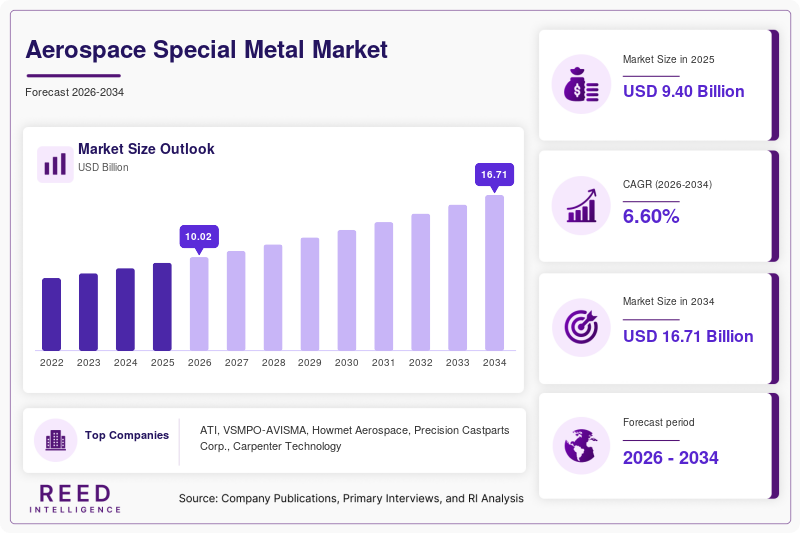
The global aerospace special metal market was valued at USD 9.40 billion in 2025 and is projected to grow from USD 10.02 billion in 2026 to USD 16.71 billion by 2034, registering a CAGR of 6.60% during the forecast period from 2026 to 2034.
Aerospace special metals are high-performance metallic materials engineered to meet demanding requirements for strength-to-weight ratio, fatigue resistance, corrosion resistance, high-temperature stability and dimensional reliability. The market includes titanium alloys, nickel-based superalloys, high-performance aluminum alloys, stainless steels and other specialty metals used throughout aircraft structures and propulsion systems.
Demand is closely linked to commercial aircraft production, military aviation, engine manufacturing, fleet modernization and maintenance, repair and overhaul (MRO) activity. Aircraft manufacturers increasingly require materials that can withstand higher temperatures and stresses while helping reduce structural weight and improve fuel efficiency.
Aerospace Special Metal Market Drivers
Increasing Commercial Aircraft Production Supports Demand for Aerospace Metals
Growing passenger air travel is supporting aircraft production and, consequently, demand for aerospace-grade metals. Commercial aircraft require substantial quantities of specialized materials across fuselages, wings, landing systems, engines and structural components.
The replacement of older aircraft with newer, more fuel-efficient platforms also creates demand for advanced alloys capable of meeting increasingly demanding performance specifications.
Aircraft manufacturers are simultaneously seeking lightweight materials that can reduce operating costs while maintaining structural integrity. This supports continued use of titanium and advanced aluminum alloys alongside high-strength steels and nickel-based materials.
Growth in Aircraft Engine Production Increases Demand for High-Temperature Alloys
Aircraft engines operate under extreme temperatures, pressures and mechanical loads. Components such as turbine blades, disks, shafts and combustion-system parts therefore require materials capable of maintaining mechanical properties at elevated temperatures.
Nickel-based superalloys are widely used for these applications because of their high-temperature strength and creep resistance.
Increasing adoption of higher-efficiency engines creates demand for materials capable of operating under increasingly severe conditions. This supports continued development of advanced superalloys, powder metallurgy and specialized processing technologies.
Lightweighting Increases Adoption of Titanium and Advanced Aluminum Alloys
Reducing aircraft weight can improve fuel efficiency and payload performance. As a result, aerospace manufacturers continue to substitute conventional materials with lighter, higher-performance alloys where technically and economically feasible.
Titanium provides a particularly valuable combination of low density, high strength and corrosion resistance. Advanced aluminum alloys remain important for large structural components where weight savings and manufacturability are critical.
The transition toward lightweight materials creates opportunities for suppliers capable of producing aerospace-grade metals with consistent mechanical properties and tight dimensional tolerances.
Aerospace Special Metal Market Restraints
High Production and Processing Costs Limit Wider Use of Specialty Metals
Aerospace-grade metals require stringent manufacturing, testing and certification procedures. Titanium and nickel-based superalloys can also involve energy-intensive extraction, melting and processing operations.
Specialized forging, rolling, machining and heat-treatment requirements further increase production costs.
These factors can limit the use of premium alloys in applications where lower-cost materials can satisfy performance requirements.
Complex Qualification Requirements Increase Time to Market
Aerospace materials must meet rigorous specifications before they can be incorporated into aircraft or engine components. Qualification may involve extensive testing for fatigue, corrosion, temperature performance, fracture toughness and other properties.
Material suppliers therefore face long development cycles and significant certification expenses.
The high qualification threshold protects aerospace performance standards but can make it difficult for new suppliers and materials to enter established supply chains quickly.
Supply-Chain Concentration Creates Material Availability Risks
Aerospace manufacturing relies on globally distributed sources of titanium, nickel, aluminum and other specialty metals. Disruptions affecting mining, refining, melting, forging or transportation can affect downstream component production.
Long qualification cycles can make substitution between suppliers difficult because manufacturers cannot always switch material sources immediately.
Aerospace Special Metal Market Opportunities
Additive Manufacturing Creates New Applications for Aerospace Special Metals
Additive manufacturing enables aerospace companies to produce complex components with reduced material waste and potentially lower part counts.
Titanium and nickel-based powders are particularly relevant to aerospace additive manufacturing because they can be used to produce lightweight structures and geometrically complex components.
The technology can also reduce material waste associated with machining components from large metal billets, creating opportunities for high-value specialty-metal suppliers.
Next-Generation Aircraft Create Demand for Advanced Alloys
New aircraft designs are placing greater emphasis on fuel efficiency, thermal performance and structural optimization. These requirements can increase demand for metals capable of operating under higher mechanical and thermal loads.
Advanced titanium alloys, nickel superalloys and high-performance aluminum materials can benefit from this trend.
The development of new propulsion architectures, including more efficient turbine engines and emerging hybrid-electric systems, is also creating new material requirements.
Aerospace MRO Creates Recurring Demand for Specialty Metals
The installed global aircraft fleet creates a recurring requirement for replacement components, repairs and maintenance.
Specialty metals are used in replacement structural components, engine parts, fasteners, landing gear and other critical systems.
As aircraft remain in service for longer periods, MRO activity can provide a more stable source of demand alongside new-aircraft manufacturing.
Metal Type Segment Analysis
Titanium Alloys Hold the Largest Share
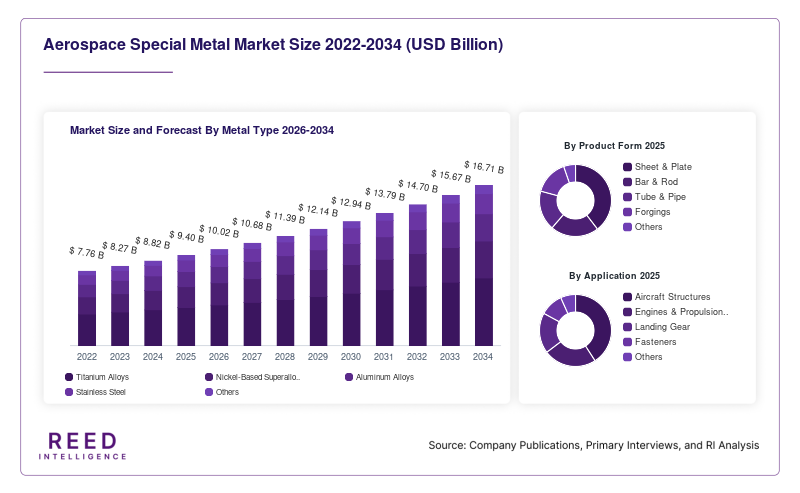
Titanium alloys accounted for approximately 32% of the global aerospace special metal market in 2025, making them the largest metal-type segment. Their combination of high strength-to-weight ratio, corrosion resistance and compatibility with demanding aerospace applications supports extensive use in airframes, engine components and landing systems.
Titanium is particularly valuable where weight reduction and structural performance must be balanced with long-term durability.
Nickel-based superalloys accounted for approximately 29% and are projected to grow at approximately 7.2% CAGR, making them the fastest-growing major metal segment. Demand is supported by aircraft-engine applications where materials must maintain strength and stability at elevated temperatures.
Aluminum alloys represented approximately 24%, stainless steel 9%, and other materials approximately 6%.
Product Form Segment Analysis
Sheet & Plate Holds the Largest Share
Sheet & plate products accounted for approximately 35% of the market in 2025, supported by their extensive use in aircraft structures, skins, panels and other large components.
The segment benefits from continued demand for lightweight structural materials and advanced aluminum and titanium alloys.
Forgings accounted for approximately 27% and are projected to grow at approximately 7.4% CAGR, making them the fastest-growing major product-form segment. Forged aerospace components are widely used in high-load applications such as landing gear, engine components and structural assemblies.
Bar & rod represented approximately 18%, tube & pipe 11%, and other product forms approximately 9%.
Application Segment Analysis
Aircraft Structures Account for the Largest Share
Aircraft structures accounted for approximately 38% of the global market in 2025, making them the largest application segment. Specialty metals are used in fuselage structures, wings, frames, bulkheads, attachment systems and other load-bearing components.
The need to reduce aircraft weight while maintaining structural reliability supports continued demand for advanced titanium and aluminum alloys.
Engines & propulsion systems represented approximately 31% and are projected to grow at approximately 7.5% CAGR, making them the fastest-growing major application segment. Increasing engine efficiency and operating temperatures are supporting demand for nickel-based superalloys and other high-temperature materials.
Landing gear accounted for approximately 14%, fasteners 8%, and other applications approximately 9%.
Aircraft Type Segment Analysis
Commercial Aircraft Hold the Largest Share
Commercial aircraft accounted for approximately 54% of the market in 2025, making them the largest aircraft-type segment. Commercial aircraft production requires substantial volumes of structural alloys, engine materials, landing-gear metals and fasteners.
Fleet renewal and demand for fuel-efficient aircraft continue to support material requirements.
Military aircraft accounted for approximately 26% and are projected to grow at approximately 7.1% CAGR, making them the fastest-growing major aircraft-type segment. Defense modernization programs and demand for high-performance aircraft support specialty-metal consumption.
Business & general aviation represented approximately 13%, while helicopters accounted for approximately 7%.
Aerospace Special Metal Market Regional Analysis
North America Holds the Largest Share
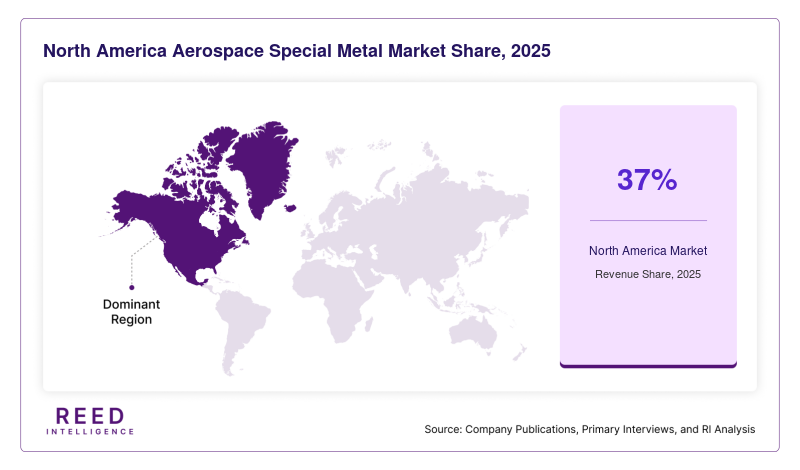
North America accounted for approximately 37% of the global aerospace special metal market in 2025, making it the largest regional market. The region benefits from a large aerospace manufacturing base, major aircraft and engine manufacturers, extensive defense programs and a substantial MRO industry.
The United States represents a major center for aircraft production and aerospace materials development, supporting demand for titanium, nickel superalloys, aluminum alloys and specialty steels.
Asia-Pacific accounted for approximately 25% and is projected to grow at approximately 8.1% CAGR, making it the fastest-growing major region. Expanding commercial aviation fleets, aircraft manufacturing capabilities, defense spending and aerospace supply-chain development are supporting regional demand.
Europe Maintains Strong Aerospace Materials Demand
Europe accounted for approximately 29% of the market in 2025 and is projected to grow at approximately 5.9% CAGR.
The region has a mature aerospace manufacturing ecosystem spanning aircraft structures, engines, landing systems and advanced materials.
European aerospace manufacturers are also emphasizing weight reduction, fuel efficiency and lower lifecycle emissions, supporting demand for advanced specialty metals.
Asia-Pacific Is the Fastest-Growing Region
Asia-Pacific is projected to grow at approximately 8.1% CAGR through 2034. Commercial aviation expansion is increasing demand for new aircraft, while domestic aerospace manufacturing capabilities are developing across major economies.
China, India, Japan and other Asian markets are investing in aircraft manufacturing, engine development, defense aviation and aerospace supply chains.
These developments are increasing demand for qualified local and international suppliers of titanium, nickel-based alloys and advanced aluminum materials.
Latin America Develops Through Fleet Expansion and MRO
Latin America accounted for approximately 5% of the market in 2025 and is projected to grow at approximately 5.8% CAGR.
Commercial fleet modernization and maintenance activities support demand for aerospace-grade metals. Regional MRO capabilities also create recurring requirements for replacement components and specialized materials.
Middle East & Africa Represents an Emerging Market
Middle East & Africa accounted for approximately 4% of the market in 2025 and is projected to grow at approximately 6.7% CAGR.
Demand is supported by expanding airline fleets, aircraft maintenance activities and defense aviation programs. Gulf countries in particular are investing in aerospace manufacturing and MRO capabilities, creating opportunities for specialty-metal suppliers.
Aerospace Special Metal Market Competitive Landscape
Competition in the aerospace special metal market is based on material performance, product consistency, aerospace certification, processing capabilities, supply reliability, technical support and long-term relationships with aircraft and engine manufacturers.
Leading companies are investing in advanced alloys, powder metallurgy, additive manufacturing, recycling and specialized processing technologies.
Key Market Players
- ATI
- VSMPO-AVISMA
- Howmet Aerospace
- Precision Castparts Corp.
- Carpenter Technology
- Allegheny Technologies
- Aperam
- Arconic
- Constellium
- Timet
Aerospace Special Metal Market Recent Developments
- ATI has continued investing in aerospace manufacturing capacity to address long-term demand from commercial aerospace and defense customers. The company's strategy has focused on expanding production of titanium and nickel-based specialty materials and improving manufacturing capabilities. The development reflects broader aerospace supply-chain efforts to secure qualified domestic material capacity and reduce bottlenecks in critical components.
- VSMPO-AVISMA remains a major participant in the global titanium supply chain, supplying titanium products for aerospace applications. Titanium remains strategically important because of its combination of strength, corrosion resistance and low density, making supply security an important consideration for aerospace manufacturers.
Aerospace Special Metal Market Segments
By Metal Type
- Titanium Alloys
- Nickel-Based Superalloys
- Aluminum Alloys
- Stainless Steel
- Others
By Product Form
- Sheet & Plate
- Bar & Rod
- Tube & Pipe
- Forgings
- Others
By Application
- Aircraft Structures
- Engines & Propulsion Systems
- Landing Gear
- Fasteners
- Others
By Aircraft Type
- Commercial Aircraft
- Military Aircraft
- Business & General Aviation
- Helicopters
By Region
- North America
- Europe
- APAC
- Middle East and Africa
- LATAM