Aerospace Testing Market Size, Share & Trends Analysis Report By Testing Type (Flight Testing, Ground Testing, Structural Testing, Engine & Propulsion Testing, Avionics & Software Testing), By Aircraft Type (Commercial Aircraft, Military Aircraft, Business & General Aviation, ) and By Application (Aircraft Certification, Component Qualification, Safety & Reliability Testing,) Forecasts 2026–2034
USD 3950
Aerospace Testing Market Size
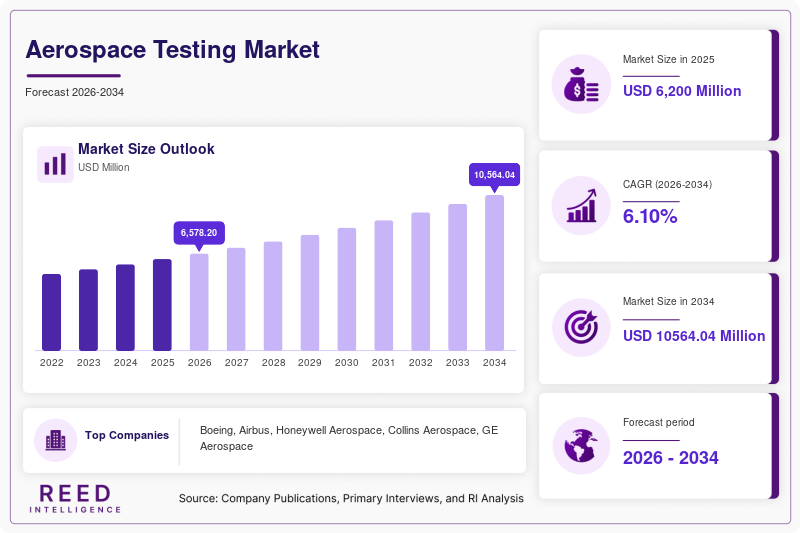
The global aerospace testing market size was valued at USD 6,200 million in 2025 and is projected to grow from USD 6,500 million in 2026 to USD 10,564.04 million by 2034, registering a CAGR of 6.10% during the forecast period from 2026 to 2034.
Aerospace testing provides the evidence required to demonstrate that aircraft, engines, components, software, structures, and systems satisfy defined performance and safety requirements. Testing can occur throughout the product lifecycle, beginning with component-level qualification and continuing through system integration, ground testing, flight testing, certification, production validation, and in-service inspection.
Aircraft certification remains one of the most testing-intensive applications. The FAA requires testing and evaluation covering aircraft operation, maintenance suitability, and compliance with applicable requirements, while manufacturers and regulators work through extensive technical documentation and safety assessments.
Aerospace Testing Market Drivers
Increasing Aircraft Certification and Development Activity
New aircraft programs require extensive validation before entering commercial or military service. Testing encompasses aerodynamic performance, flight controls, structural loads, propulsion, avionics, environmental conditions, emergency systems, human factors, and system safety. The scale of these programs creates sustained demand for specialized testing facilities, instrumentation, engineering services, data acquisition, simulation, and certification support.
Boeing's 737-7 certification program illustrates the resource intensity involved: the program accumulated nearly 700 flight-test hours across 440 test flights and approximately 350 ground-test hours, in addition to extensive technical documentation and regulatory interaction.
Increasing Complexity of Aircraft Systems
Modern aircraft contain increasingly integrated digital, electrical, thermal, propulsion, communication, and control systems. Testing must therefore verify not only individual components but also interactions between systems under normal, abnormal, and failure conditions.
The commercial mechanism is a shift from isolated component testing toward integrated system validation. Software-in-the-loop, hardware-in-the-loop, digital twins, automated data acquisition, environmental simulation, and real-time monitoring can reduce repeated physical iterations while still requiring physical validation before certification.
Development of New Aviation Technologies
Electric propulsion, hybrid systems, unmanned aircraft, advanced air mobility, reusable space vehicles, and new propulsion architectures are broadening the aerospace testing requirement. EASA introduced 2026 decisions addressing continuing-airworthiness rules for electric and hybrid propulsion aircraft, while the FAA has continued developing regulatory approaches for emerging aviation technologies.
These aircraft require new test protocols for batteries, electric motors, thermal management, flight-control software, energy storage, electromagnetic compatibility, and system redundancy. The result is a wider testing scope extending beyond conventional aircraft structures and propulsion.
Aerospace Testing Market Restraints
High Cost of Specialized Testing Infrastructure
Aerospace testing requires specialized wind tunnels, structural test rigs, engine test cells, flight-test instrumentation, environmental chambers, telemetry systems, simulation platforms, and highly qualified engineering personnel. Large-scale facilities require significant capital investment and long qualification cycles.
Testing infrastructure must also satisfy regulatory and customer requirements. Equipment calibration, data integrity, cybersecurity, traceability, maintenance, and facility certification add operating costs, particularly for organizations seeking to test safety-critical systems.
Long Certification Cycles and Complex Regulatory Requirements
Certification requires extensive technical evidence and coordination between manufacturers, designated organizations, and aviation authorities. Complex aircraft programs can therefore experience prolonged testing and documentation cycles when design changes generate additional analyses or test requirements.
Boeing's 737-10 program illustrates this relationship: after completing planned certification flight testing, the program still needed to close development-assurance reviews and system safety assessments before final regulatory submissions.
Aerospace Testing Market Opportunities
Digital Testing and Simulation
Digital engineering is creating opportunities to move portions of aerospace validation into simulation environments before physical testing. Model-based systems engineering, digital twins, hardware-in-the-loop testing, computational fluid dynamics, automated data analysis, and virtual certification evidence can help engineers identify issues earlier in the development process.
The commercial value comes from reducing repeated physical test cycles and allowing manufacturers to evaluate more design configurations before committing to expensive hardware. Physical testing remains essential for certification, but digital methods can increase the information obtained from each physical test campaign.
Testing for Electric, Hybrid and Advanced Air Mobility Aircraft
Emerging propulsion architectures create new demand for specialized testing of batteries, electric motors, power electronics, thermal-management systems, propulsion controls, electromagnetic compatibility, and energy-storage safety.
EASA's 2026 work on continuing-airworthiness requirements for electric- and hybrid-propulsion aircraft demonstrates that regulatory frameworks are adapting to these aircraft architectures. As certification frameworks mature, suppliers capable of combining conventional aerospace testing with electrical and software validation can address a broader set of programs.
Aerospace Testing Market Segmental Analysis
By Testing Type
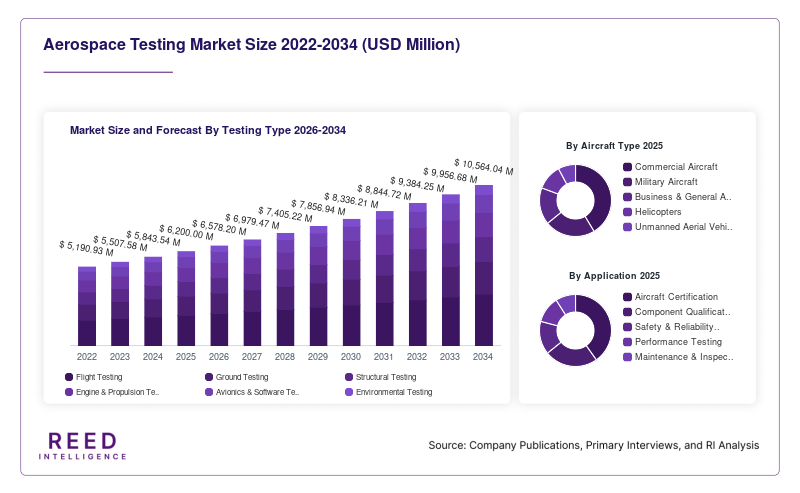
Flight Testing represented the largest testing-type segment at approximately 29% share in 2025, reflecting its central role in aircraft certification and validation of aerodynamic performance, flight controls, propulsion, handling qualities, environmental performance, and integrated systems. Avionics & Software Testing is projected to be the fastest-growing category at approximately 7.4% CAGR, supported by increasing software content, autonomous functions, connected aircraft systems, and integrated digital flight-control architectures.
Ground Testing accounted for approximately 22% and is projected to grow at 5.8% CAGR, while Structural Testing represented approximately 17% with a 5.9% CAGR. Engine & Propulsion Testing accounted for 14%, growing at 6.7% CAGR, while Environmental Testing represented approximately 9% with a 6.4% CAGR. Other specialized testing activities accounted for the remaining share.
By Aircraft Type
Commercial Aircraft represented the dominant aircraft category with approximately 43% share in 2025. The segment benefits from continued development and certification of new narrow-body, wide-body, ultra-long-range, and specialized commercial aircraft. Airbus and Boeing continue to operate extensive certification and flight-test programs; Airbus's A350-1000ULR campaign is one example of dedicated flight testing for a new operational configuration.
Unmanned Aerial Vehicles are projected to be the fastest-growing aircraft category at approximately 8.2% CAGR, supported by autonomous flight, defense applications, commercial drones, advanced air mobility development, and increasingly complex onboard systems. Military Aircraft accounted for approximately 27% with a 6.4% CAGR, while Business & General Aviation represented 13% with 5.3% CAGR. Helicopters accounted for approximately 10%, growing at 5.7% CAGR.
By Application
Aircraft Certification accounted for approximately 34% share in 2025, reflecting the extensive evidence required before new or modified aircraft can enter service. Certification activities incorporate flight tests, ground tests, system safety assessments, compliance documentation, and regulatory reviews. Safety & Reliability Testing is projected to be the fastest-growing application at approximately 7.2% CAGR as aircraft systems become increasingly integrated and software-intensive.
Component Qualification represented approximately 23% and is projected to grow at 6.0% CAGR, while Performance Testing accounted for approximately 21% with a 6.4% CAGR. Maintenance & Inspection represented approximately 14%, growing at 5.5% CAGR, with the remaining applications accounting for approximately 8%.
Aerospace Testing Market Regional Analysis
North America Aerospace Testing Market
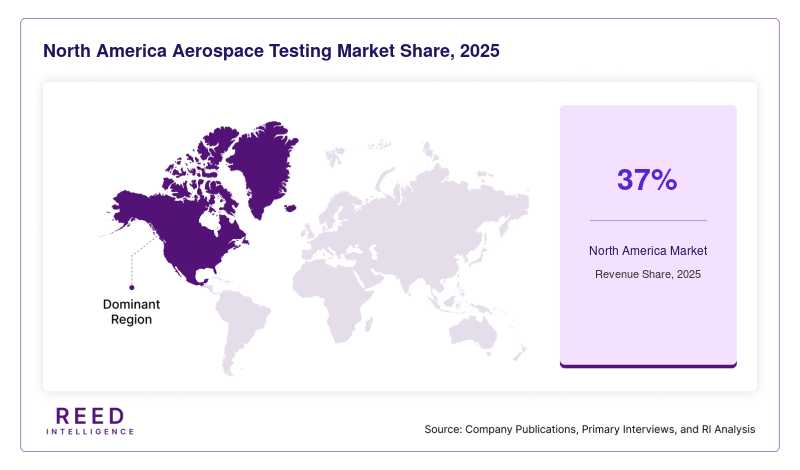
North America remained the dominant regional market with approximately 37% share in 2025, supported by the United States' large commercial aerospace, defense, space, propulsion, avionics, and certification ecosystem. The region contains major aircraft manufacturers, engine producers, defense contractors, testing laboratories, research organizations, and regulatory institutions.
The regional market is projected to expand at approximately 5.7% CAGR through 2034. FAA certification activity, commercial-aircraft development, military modernization, space programs, and emerging aircraft technologies continue to generate testing requirements. In July 2026, the FAA also resumed allowing Boeing to issue airworthiness certificates for 737 MAX and 787 aircraft under continued FAA oversight, following an eight-month review of production-quality data.
Europe Aerospace Testing Market
Europe is projected to register approximately 5.9% CAGR through 2034. The region benefits from Airbus's aircraft-development programs, a large aerospace supplier network, military aviation programs, engine development, research institutions, and EASA's certification infrastructure.
Regulatory modernization is creating additional testing requirements for new aircraft architectures. EASA's certification platform went live in June 2026 to digitize certification processes covering type certificates, supplemental type certificates, major and minor changes and repairs, and ETSO authorizations. The digitalization of certification workflows can increase traceability and coordination between testing organizations and regulators.
Asia Pacific Aerospace Testing Market
Asia Pacific is projected to be the fastest-growing region at approximately 7.3% CAGR through 2034. China, Japan, India, South Korea, Singapore, and other regional aerospace centers are expanding aircraft manufacturing, defense programs, maintenance capabilities, space activity, and aviation infrastructure.
The region's testing demand is also being supported by the development of indigenous aircraft and propulsion systems. As manufacturers move from component development toward complete aircraft programs, requirements for structural, environmental, propulsion, avionics, flight, and certification testing increase correspondingly.
Latin America Aerospace Testing Market
Latin America is projected to grow at approximately 5.8% CAGR during the forecast period. Brazil represents the region's most established aerospace manufacturing center, while Mexico contributes through aerospace component manufacturing and international supply-chain integration.
Regional testing demand is closely connected to aircraft production, maintenance, repair and overhaul, defense aviation, and component qualification. Increasing localization of aerospace manufacturing can create additional demand for testing laboratories and certification-support services closer to production facilities.
Middle East & Africa Aerospace Testing Market
Middle East & Africa is projected to expand at approximately 6.3% CAGR through 2034. Demand is supported by commercial aviation fleet expansion, defense procurement, MRO activities, airport development, unmanned systems, and aerospace industrialization programs.
The Gulf states are particularly important because of investment in aviation infrastructure, defense capabilities, and aerospace manufacturing. Testing demand is expected to encompass aircraft maintenance and inspection, component qualification, avionics verification, structural testing, and certification-support activities as regional aerospace capabilities expand.
Aerospace Testing Market Competitive Landscape
The Aerospace Testing Market includes aircraft manufacturers, independent testing laboratories, engineering-service providers, certification organizations, propulsion specialists, and specialized inspection companies. Competition is influenced by testing infrastructure, regulatory expertise, instrumentation capabilities, data analytics, engineering depth, geographic coverage, and the ability to support complex certification programs.
Boeing maintains extensive internal testing capabilities covering flight testing, ground testing, certification, propulsion integration, structural validation, and technology demonstration. Its 737-10 program completed almost 1,000 flights and more than 2,000 flight hours before moving into the final documentation and regulatory-review phase. Boeing also operates the ecoDemonstrator program to test emerging technologies in flight and operational environments.
Key Market Players
- Boeing
- Airbus
- Honeywell Aerospace
- Collins Aerospace
- GE Aerospace
- RTX
- Safran
- Rolls-Royce
- Intertek Group plc
- SGS S.A.
- Element Materials Technology
- Expleo Group
- TÜV Rheinland
- National Technical Systems (NTS)
- Mistras Group
- Applus+
- Bureau Veritas
- Dassault Aviation
Aerospace Testing Market Recent Developments
- July 2026 - Boeing completed the planned certification flight-testing phase of the 737-10. The program accumulated 976 flights, more than 2,060 flight hours and approximately 1,040 ground-test hours, covering landing gear, braking, engine anti-ice and enhanced angle-of-attack systems. The program subsequently moved toward closing development-assurance reviews and system safety assessments.
- June 2026 - Airbus began the certification flight-test campaign for the A350-1000ULR. The test aircraft was equipped with approximately five tonnes of customized flight-test instrumentation for the two-month certification program associated with Qantas' Project Sunrise aircraft.
Aerospace Testing Market Segments
By Testing Type
- Flight Testing
- Ground Testing
- Structural Testing
- Engine & Propulsion Testing
- Avionics & Software Testing
- Environmental Testing
By Aircraft Type
- Commercial Aircraft
- Military Aircraft
- Business & General Aviation
- Helicopters
- Unmanned Aerial Vehicles
By Application
- Aircraft Certification
- Component Qualification
- Safety & Reliability Testing
- Performance Testing
- Maintenance & Inspection
By Region
- North America
- Europe
- APAC
- Middle East and Africa
- LATAM