Aerospace Titanium Market Size, Share & Trends Analysis Report By Product Form (Titanium Mill Products, Titanium Forgings, Titanium Castings, Titanium Bars & Billets, Titanium Sheets & Plates), By Alloy Type (Alpha & Near-Alpha Alloys, Alpha-Beta Alloys, Beta Alloys), By Application (Airframe Structures, Engine Components, Landing Gear, Fasteners & Fittings, Other Aerospace Applications), By Aircraft Type (Commercial Aircraft, Military Aircraft, Business Jets & General Aviation, Helicopters & UA
USD 3950
Aerospace Titanium Market Size
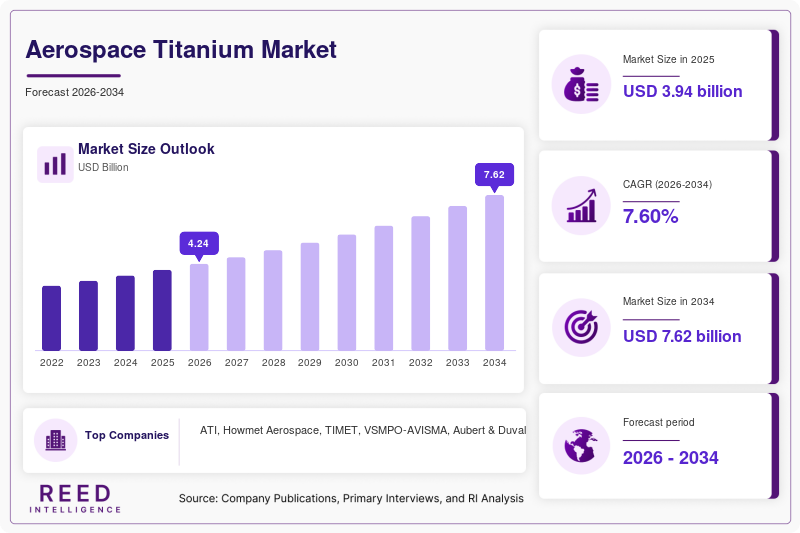
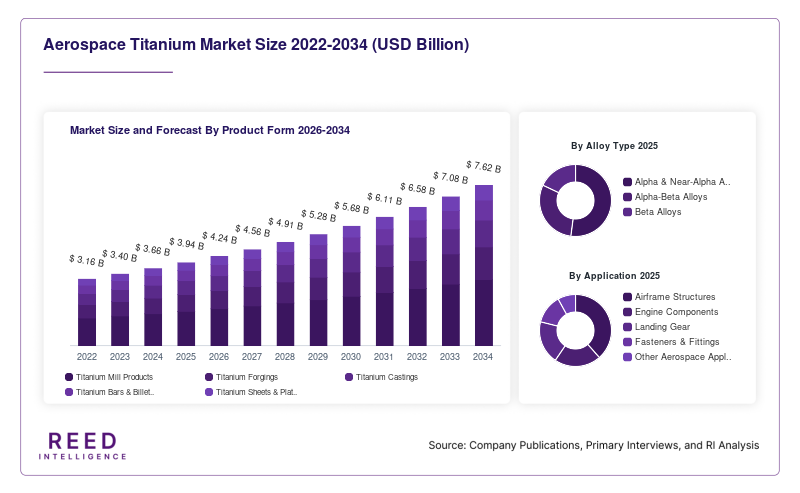
The global Aerospace Titanium Market size was valued at USD 3.94 billion in 2025 and is projected to grow from USD 4.22 billion in 2026 to USD 7.62 billion by 2034, registering a CAGR of 7.60% during the forecast period from 2026 to 2034.
The Aerospace Titanium Market is being shaped by rising aircraft production, increasing use of lightweight materials in airframes and engines, and a strategic push to secure aerospace-grade titanium supply. Titanium is valued in aircraft because it combines high strength-to-weight performance, corrosion resistance, fatigue resistance and compatibility with carbon-fiber composite structures. TIMET states that titanium use in modern aircraft has expanded alongside composite adoption and can account for approximately 15% of airframe structural weight in next-generation designs.
Aircraft production provides the most direct demand mechanism. Airbus delivered 793 commercial aircraft in 2025 and recorded 886 gross commercial orders in the first half of 2026. Boeing reported more than 6,200 commercial aircraft in backlog at June 2026, while its 737 program was transitioning toward a 47-aircraft monthly production rate.
Titanium demand is also becoming more strategically important because aerospace-grade material depends on qualified melting, alloying, forging, rolling and machining capacity. Airbus has been diversifying titanium sourcing and developing recycling loops, while ATI has expanded titanium melt capacity in response to customer commitments.
At the same time, additive manufacturing and improved material utilization create a counterbalance. Airbus is testing titanium wire-directed-energy deposition to reduce material waste compared with conventional machining and forging routes.
Aerospace Titanium Market Drivers
Commercial Aircraft Production Is Increasing Titanium Consumption
The strongest demand signal for aerospace titanium is the production ramp across major commercial-aircraft programs. Airbus delivered 793 aircraft in 2025 and reported 821 net commercial aircraft orders in the first half of 2026. Boeing reported 314 commercial deliveries during the first half of 2026 and a commercial-aircraft backlog exceeding 6,200 aircraft.
The mechanism extends through the complete aerospace-material supply chain. Every new aircraft requires titanium sheet, plate, bar, billet, forgings, fasteners and other titanium-containing components. Twin-aisle aircraft such as the Boeing 787 and Airbus A350 have particularly high titanium content because titanium works effectively alongside carbon-fiber composites and provides strength, corrosion resistance and temperature performance.
Aircraft production therefore creates recurring demand for qualified titanium rather than simply spot-market metal. Long qualification cycles make supply reliability particularly important because manufacturers cannot easily replace an approved titanium source when production rates rise.
This demand is also reinforced by defense programs and engine production. ATI reported that aerospace and defense represented 69% of its sales during the first half of 2026, with commercial jet-engine sales increasing 13% year over year.
Titanium's Weight, Corrosion and Composite Compatibility Support Material Substitution
Titanium occupies applications where aluminum can face strength, temperature, corrosion or galvanic-compatibility limitations and where steel would impose a higher weight penalty. Airbus identifies titanium alloys as important for pylons, engines and landing gear, while TIMET highlights titanium's compatibility with carbon-fiber composite structures.
This creates a structural demand mechanism beyond aircraft unit production. As aircraft designers increase composite content, titanium can become more attractive at interfaces between composite and metallic structures because of its corrosion behavior and relatively compatible thermal expansion characteristics.
The material also remains relevant to engine applications. TIMET supplies premium titanium billet and bar for jet-engine rotating applications and works with engine manufacturers on specialty alloys and processing technologies.
For suppliers, the commercial value increasingly lies in qualified aerospace-grade alloys, near-net-shape processing and integrated material solutions. This can reduce machining, scrap and total production cost for aircraft manufacturers.
Supply-Security Investments Are Increasing the Strategic Value of Titanium
Titanium has become a strategic aerospace material because qualified supply cannot be replaced immediately. Boeing has historically identified titanium as one of the most important raw materials for aerospace products and noted that qualification of alternative sources can take a year or more.
Airbus has subsequently diversified its titanium sourcing and explicitly addressed Russian-sourced titanium risks in its 2025 financial reporting.
ATI expanded titanium melt capacity beginning in 2024, supported by customer commitments. In 2026, the company said aerospace and defense demand was exceeding available supply and that targeted investments were expanding capacity.
Airbus and Safran also agreed in June 2026 to acquire Tikehau Capital's stake in Aubert & Duval. The company produces titanium, aluminum, superalloys and specialty steels and has a role in securing critical-material supply in France and Europe.
The market impact is a greater emphasis on domestic and regional supply chains, long-term customer agreements, recycling and vertical integration.
Aerospace Titanium Market Restraints
Aerospace Qualification Requirements Restrict Rapid Supplier Substitution
Aerospace titanium is not interchangeable simply because two materials have similar nominal chemistry. Aerospace programs specify alloy grades, processing routes, mechanical properties, surface conditions, heat treatment and traceability requirements.
Boeing has previously noted that qualification of alternative raw-material sources can take a year or more.
This creates a barrier for new titanium producers and downstream processors. A company can add melting or rolling capacity but still require substantial time to qualify the resulting material with aircraft and engine manufacturers.
The constraint becomes more pronounced during production ramps. If an OEM increases aircraft output faster than its qualified titanium suppliers can expand, the bottleneck can move upstream from final assembly into billet, plate, forging or specialty-processing capacity.
High Material Cost and Manufacturing Waste Encourage Material-Efficient Alternatives
Titanium delivers strong performance but is expensive to process. Airbus notes that titanium is a high-value raw material and that conventional production can result in substantial material waste. Its assessment of titanium wire-directed-energy deposition notes that traditional routes can require recycling 80–95% of purchased titanium for some components.
This creates pressure to improve buy-to-fly ratios, use near-net-shape forging and increase scrap recovery. Airbus has expanded titanium recycling through EcoTitanium and produced an aerospace-grade ingot incorporating end-of-life titanium from an Airbus pylon in 2025.
The counterbalance is that additive manufacturing and advanced recycling do not eliminate titanium demand. Instead, they change the quantity and form of virgin material required and create new demand for high-quality recycled feedstock.
Aerospace Titanium Market Opportunities
Aerospace Titanium Recycling and Closed-Loop Supply
Recycling is becoming an increasingly important component of aerospace titanium supply. Airbus reported that approximately 480 tonnes of titanium scrap were recovered from its French and German sites during 2025, while EcoTitanium produced an ingot containing end-of-life titanium from an Airbus pylon.
The commercial opportunity extends from scrap collection to sorting, remelting, alloy control, billet production and qualification. Because aerospace-grade titanium requires controlled chemistry and traceability, suppliers capable of producing qualified recycled-content material can potentially reduce dependence on virgin sponge while meeting customer sustainability requirements.
Airbus also describes an operating titanium revert loop in which production scrap can be recycled into aerospace-grade titanium.
Titanium for Next-Generation Aircraft and Engine Programs
New aircraft programs provide an opportunity for higher-value titanium products. Composite-intensive airframes and increasingly efficient engines require materials that can operate under mechanical, thermal and corrosion stresses without adding excessive weight.
TIMET identifies the Boeing 787 and Airbus A350 as aircraft with significantly greater use of titanium and carbon-fiber composites than earlier generations.
ATI's aerospace and defense business is also benefiting from next-generation commercial aircraft and engine production. Its 2026 results showed commercial jet-engine sales rising 13% year over year in the first half.
The opportunity is therefore concentrated in qualified titanium mill products, forgings, billet, bar, plate and specialty alloys linked to long-cycle aircraft and engine programs.
Advanced Titanium Manufacturing and Additive Processing
Airbus is developing titanium wire-directed-energy deposition for structural components, with the objective of reducing waste and creating near-net-shape parts. The company is evaluating applications beyond current A350 components, including potential future use in wings and landing gear.
This creates a complementary opportunity for titanium producers. Instead of selling only conventional plate or billet, suppliers can provide wire, optimized alloys and application-specific feedstock for additive manufacturing.
The technology also changes the economics of titanium-intensive designs by allowing complex components to be manufactured with less material removal and potentially fewer assembled parts.
Segmental Analysis
By Product Form
Titanium Mill Products represent approximately 34% of the global market in 2025, supported by demand for sheet, plate, bar and other forms used in airframe and engine manufacturing. Titanium mill products are especially important because they provide the feedstock from which many downstream aerospace components are manufactured.
Titanium Forgings account for approximately 29%, reflecting the extensive use of forged titanium in structural and engine applications. Howmet supplies titanium and other high-performance materials and components across airframe and engine programs.
Titanium Bars & Billets represent approximately 18%, followed by Titanium Sheets & Plates at 14% and Titanium Castings at 5%.
Titanium Forgings are the fastest-growing product-form segment, with a CAGR of approximately 8.5%, supported by increasing aircraft production and demand for high-strength, near-net-shape components.
By Alloy Type
Alpha-Beta Alloys represent approximately 51% of the global market in 2025, supported by their balance of strength, ductility, fatigue performance and manufacturability. Ti-6Al-4V and related alpha-beta grades remain important across aerospace structures, fasteners and engine applications.
Alpha & Near-Alpha Alloys account for approximately 32%, particularly where elevated-temperature performance is required.
Beta Alloys represent approximately 17% but are the fastest-growing alloy category, with a CAGR of approximately 9.1%. Their high strength and heat-treatment response support selected advanced aerospace structural and landing-gear applications.
By Application
Airframe Structures represent approximately 39% of the market in 2025. Titanium is used in structural areas including pylons, fittings and interfaces with carbon-fiber composite structures. Airbus identifies titanium as one of the primary metals used in structural aerospace manufacturing.
Engine Components account for approximately 29%, followed by Landing Gear at 13%, Fasteners & Fittings at 12% and other aerospace applications at 7%.
Engine Components are the fastest-growing application, with approximately 8.7% CAGR. ATI reported strong commercial jet-engine demand during 2026, while TIMET identifies jet-engine rotating applications as a core titanium market.
By Aircraft Type
Commercial Aircraft account for approximately 58% of the global market in 2025, making them the dominant aircraft category. Airbus delivered 793 aircraft in 2025 and reported strong order activity during the first half of 2026, while Boeing had more than 6,200 commercial aircraft in backlog at June 2026.
Military Aircraft represent approximately 25%, supported by defense modernization and high-performance aircraft requirements.
Business Jets & General Aviation account for approximately 10%, while Helicopters & UAVs represent approximately 7%.
Military Aircraft are the fastest-growing aircraft segment at approximately 8.6% CAGR, supported by higher defense-aircraft production and continued demand for lightweight, high-strength materials.
Regional Analysis
North America Aerospace Titanium Market
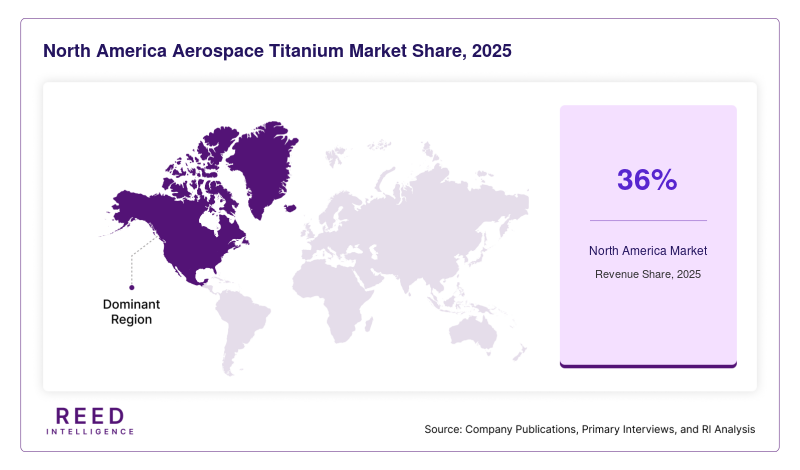
North America represents approximately 36% of the global Aerospace Titanium Market in 2025, making it the largest regional market. The region has a dense ecosystem of aircraft manufacturers, engine companies, titanium producers, specialty-material processors and defense contractors.
Howmet identifies aerospace as its largest and fastest-growing market and supplies titanium extrusions, titanium mill products, forgings and fasteners for aircraft and engines.
ATI is another major supply-chain participant. Aerospace and defense represented 69% of ATI sales in the first half of 2026, while commercial jet-engine sales increased 13% year over year. ATI has also expanded titanium melt capacity since 2024, supported by customer commitments.
Boeing's production recovery adds further demand visibility. Its commercial backlog exceeded 6,200 aircraft at June 2026, and the 737 program was transitioning toward a 47-aircraft monthly production rate.
North America is projected to grow at approximately 6.9% CAGR through 2034. The region's main constraints are labor availability, qualification lead times and the need to maintain sufficient domestic titanium feedstock and processing capacity.
Europe Aerospace Titanium Market
Europe accounts for approximately 30% of the global market in 2025. The region has a strong aerospace-material ecosystem built around Airbus, Safran, Rolls-Royce, specialty-material companies and advanced titanium processors.
Airbus has been actively securing titanium supply and developing circular material systems. Its 2025 reporting described multiple titanium sourcing solutions and a recycling program that recovered approximately 480 tonnes of titanium scrap from French and German operations.
In June 2026, Airbus and Safran agreed to acquire Tikehau Capital's stake in Aubert & Duval, strengthening direct control of a European producer of titanium, superalloys, aluminum and specialty steels.
The region is also investing in material circularity. EcoTitanium produced an ingot containing end-of-life titanium from an Airbus pylon, creating a route from retired aircraft material back into aerospace-grade production.
Europe is expected to record approximately 7.1% CAGR through 2034. The growth mechanism combines aircraft production, engine demand, defense programs and strategic supply-chain localization.
APAC Aerospace Titanium Market
APAC represents approximately 22% of the global Aerospace Titanium Market in 2025 and is the fastest-growing region, with a CAGR of approximately 9.3%.
Aircraft fleet expansion is a major demand mechanism. Airbus identifies Asia-Pacific as the world's largest regional aircraft market and forecasts substantial long-term demand for new passenger aircraft.
China is increasing its role in aircraft manufacturing. Airbus has expanded its Tianjin A320 Family final-assembly footprint, while Boeing and other global aerospace companies maintain extensive Asian supplier networks.
India is also becoming more important. Airbus has increased sourcing from Indian suppliers to more than USD 1.5 billion annually and has targeted further expansion in the country's aerospace supply chain.
The region's titanium demand is therefore driven by both aircraft consumption and manufacturing localization. Japan, China, India, South Korea and Southeast Asia provide opportunities for titanium mills, component manufacturers and aerospace-qualified processors.
The principal constraints are the concentration of advanced aerospace qualification capabilities, dependence on imported specialty inputs in some countries and the long validation cycles required for new material suppliers.
Middle East and Africa Aerospace Titanium Market
Middle East and Africa represents approximately 6% of the global market in 2025 and is projected to grow at approximately 8.0% CAGR.
The region's aerospace titanium demand is linked primarily to commercial-aircraft fleet expansion, defense aircraft, engine maintenance and the development of aerospace manufacturing and MRO centers.
The UAE, Saudi Arabia and Qatar are developing aviation ecosystems around airlines, MRO, aerospace manufacturing and defense. These activities create downstream demand for titanium replacement components even where primary titanium melting and mill production remain concentrated elsewhere.
The region is also positioned as a logistics and maintenance hub between Europe and Asia. As aircraft fleets grow, MRO requirements can increase demand for titanium fasteners, structural components, engine parts and replacement material.
However, the region remains more dependent on imported titanium and aerospace-grade components than North America, Europe and APAC. Building local downstream processing and qualification capabilities is therefore a major commercial opportunity.
LATAM Aerospace Titanium Market
LATAM represents approximately 6% of the global market in 2025 and is expected to grow at approximately 7.8% CAGR.
Brazil is the principal aerospace manufacturing center, led by Embraer and a supporting network of aerospace suppliers. Titanium demand is linked to aircraft structures, engines, landing systems and high-strength components used in commercial and executive aviation.
The region's opportunity comes from greater integration with international aerospace supply chains. Suppliers able to achieve aerospace certification and deliver traceable titanium components can participate in both Embraer-related programs and broader international aerospace manufacturing.
LATAM's aerospace titanium market remains smaller than those of North America, Europe and APAC, and the regional supply chain is more dependent on imported titanium feedstock. Currency fluctuations, logistics and limited domestic specialty-material capacity remain constraints.
Competitive Landscape
The Aerospace Titanium Market has high barriers to entry because aerospace customers require consistent metallurgy, traceability, mechanical performance and long-term supply reliability. Competition therefore occurs across the complete material chain, from melting and alloy development through billet, bar, plate, forging, machining and recycling.
ATI is strengthening its position through titanium melt capacity and long-term aerospace customer relationships. The company reported a record USD 4.4 billion backlog in Q2 2026, with demand for its aerospace and defense materials exceeding available supply.
Howmet Aerospace has a vertically integrated aerospace position spanning titanium mill products, extrusions, forgings, engine components, airframe structures and fasteners. Its 2025 revenue reached approximately USD 8.3 billion, with commercial aerospace revenue increasing 12%.
TIMET competes through premium titanium billet and bar, including products for jet-engine rotating applications, airframe structures and specialty alloys. Its service network also provides titanium inventory and value-added processing across major aerospace regions.
Key Market Players
- ATI
- Howmet Aerospace
- TIMET
- VSMPO-AVISMA
- Aubert & Duval
- PCC Rollmet
- Arconic
- Allegheny Technologies
- Kobe Steel
- Toho Titanium
- Osaka Titanium Technologies
- Baoji Titanium Industry
- Western Metal Materials
- Norsk Titanium
- VSMPO-AVISMA aerospace businesses
Recent Market Developments
- June 2026 – Airbus and Safran agreed to acquire Tikehau Capital's stake in Aubert & Duval. The transaction strengthens Airbus and Safran's direct position in a European producer of titanium, superalloys, aluminum and specialty steels and reinforces the strategic focus on aerospace-material supply security.
- August 2026 – ATI reported record backlog and strong aerospace demand. Q2 sales increased 11% year over year, aerospace and defense sales rose 13%, and the company reported a USD 4.4 billion backlog. ATI said demand for its differentiated aerospace and defense materials continued to exceed available supply.
Aerospace Titanium Market Segments
By Product Form
- Titanium Mill Products
- Titanium Forgings
- Titanium Castings
- Titanium Bars & Billets
- Titanium Sheets & Plates
By Alloy Type
- Alpha & Near-Alpha Alloys
- Alpha-Beta Alloys
- Beta Alloys
By Application
- Airframe Structures
- Engine Components
- Landing Gear
- Fasteners & Fittings
- Other Aerospace Applications
By Aircraft Type
- Commercial Aircraft
- Military Aircraft
- Business Jets & General Aviation
- Helicopters & UAVs
By Region
- North America
- Europe
- APAC
- Middle East and Africa
- LATAM