Agitator Bead Mill Market Size, Share & Demand Report By Equipment Type (Vertical Agitator Bead Mills, Nano Bead Mills, Laboratory Bead Mills), By Application (Inks and Pigments, Battery Materials Processing, Pharmaceuticals, Food and Beverages), By End-Use Industry (Pharmaceutical Manufacturing, Electronics, Automotive, Food Processing, Industrial Manufacturing, Others), By Region & Segment Forecasts, 2026–2034
USD 3950
Market Overview
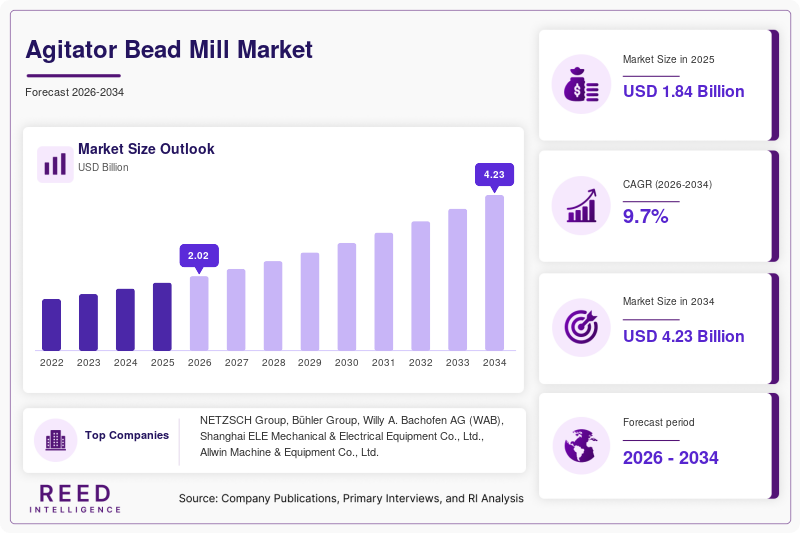
The global Agitator Bead Mill Market size was valued at USD 1.84 billion in 2026 and is projected to reach USD 3.87 billion by 2034, expanding at a CAGR of 9.7% during 2026–2034. Agitator bead mills are widely used for ultra-fine grinding, particle size reduction, dispersion, and homogenization processes across industries such as paints and coatings, chemicals, pharmaceuticals, food processing, electronics, and advanced materials manufacturing. Growing demand for high-performance materials and improved product consistency continues to support market expansion across both developed and emerging economies.
One of the primary global factors supporting market growth is the increasing demand for advanced materials with precise particle size distribution. Manufacturers are focusing on product quality, process efficiency, and energy optimization to remain competitive. Agitator bead mills provide superior grinding performance, improved dispersion efficiency, and enhanced productivity compared to conventional milling technologies. As industries seek higher throughput and lower operational costs, investments in modern milling systems are increasing. Additionally, the growth of battery materials, specialty chemicals, nanotechnology applications, and pharmaceutical formulations is creating sustained demand for high-precision grinding equipment.
Key Highlights
- North America dominated the market with a 35.1% share in 2025.
- Asia Pacific is expected to grow at the fastest CAGR of 11.4% during 2026–2034.
- By equipment type, horizontal agitator bead mills accounted for the largest share of 43.8%.
- while nano bead mills are projected to grow at a CAGR of 12.8%.
- By application, paints and coatings led with a 39.6% share.
- whereas battery materials processing is expected to expand at a CAGR of 13.1%.
- By end-use industry, chemical manufacturing held the largest share of 36.4%.
- while pharmaceutical manufacturing is anticipated to grow at a CAGR of 12.3%.
- The United States remained the dominant country, with market values of USD 455 million in 2024 and USD 502 million in 2025.
Market Trends
Rising Integration of Automation and Smart Process Control
Automation is becoming a significant trend in the Agitator Bead Mill Market as manufacturers seek higher operational efficiency and process consistency. Modern bead mills are increasingly equipped with programmable logic controllers, real-time monitoring systems, digital sensors, and predictive maintenance capabilities. These technologies allow operators to optimize grinding parameters, monitor equipment performance, and reduce downtime. Industries such as specialty chemicals and pharmaceuticals require highly controlled particle size distributions, making automated milling solutions increasingly attractive. Smart systems also help manufacturers improve energy utilization and reduce production variability. As Industry 4.0 adoption expands across manufacturing facilities, demand for intelligent agitator bead mills is expected to increase steadily throughout the forecast period.
Growing Adoption in Nanomaterial and Battery Material Production
The increasing production of nanomaterials and battery components is creating substantial demand for advanced grinding technologies. Agitator bead mills are gaining attention because they can achieve ultra-fine particle sizes required for lithium-ion batteries, electronic ceramics, conductive inks, and advanced coatings. Manufacturers are investing in specialized nano grinding equipment capable of delivering consistent particle distributions at industrial scales. The rapid expansion of electric vehicle production and energy storage systems is encouraging battery manufacturers to upgrade processing technologies. Furthermore, research institutions and material developers are utilizing bead milling systems to enhance material performance. This growing focus on high-value materials is expected to remain an important trend supporting long-term market growth.
Market Drivers
Expanding Demand from Paints and Coatings Manufacturing
The growth of the global paints and coatings industry continues to drive demand for agitator bead mills. Manufacturers require efficient grinding equipment to achieve superior pigment dispersion, color consistency, and coating performance. Construction activity, infrastructure investments, automotive production, and industrial maintenance projects are increasing coating consumption across major economies. Agitator bead mills help producers improve product quality while reducing processing time and operational costs. Advanced coating formulations increasingly require finer particle sizes and uniform dispersion characteristics, further strengthening equipment demand. As environmental regulations encourage the development of water-based and specialty coatings, manufacturers are investing in modern milling systems capable of handling complex formulations efficiently.
Increasing Production of Pharmaceuticals and Specialty Chemicals
The pharmaceutical and specialty chemical sectors are generating strong demand for precision milling technologies. Drug manufacturers require controlled particle size reduction to improve bioavailability, stability, and formulation performance. Similarly, specialty chemical producers depend on fine grinding processes to create high-value products with specific performance characteristics. Agitator bead mills provide accurate control over particle size distribution and deliver reliable processing results. Rising healthcare expenditures, expanding pharmaceutical manufacturing capacity, and increasing research activities are supporting equipment investments globally. The growing need for customized formulations and advanced chemical products is expected to sustain demand for high-performance milling solutions throughout the forecast period.
Market Restraint
High Initial Investment and Maintenance Requirements
The high capital cost associated with advanced agitator bead mill systems remains a notable challenge for market growth. Modern equipment often incorporates sophisticated control systems, wear-resistant materials, specialized grinding chambers, and energy-efficient components, increasing purchase costs. Small and medium-sized enterprises may find it difficult to justify large investments, particularly in regions where manufacturing margins remain under pressure. In addition, maintenance expenses can be substantial because grinding media, liners, seals, and other critical components experience continuous wear during operation.
The impact of these costs is particularly evident in price-sensitive industries where manufacturers prioritize short-term operational expenditures over long-term productivity gains. For example, a medium-sized chemical producer may delay upgrading to advanced milling equipment due to budget constraints, despite potential efficiency improvements. Extended payback periods can also discourage investment decisions. Furthermore, inadequate maintenance practices may reduce equipment lifespan and performance, increasing total ownership costs. While technological improvements are reducing operating expenses, the combination of high acquisition and maintenance costs continues to limit adoption among certain end users and developing-market manufacturers.
Market Opportunities
Growth of Electric Vehicle Battery Manufacturing
The rapid expansion of electric vehicle production is creating significant opportunities for agitator bead mill manufacturers. Battery producers require precise particle size reduction and dispersion processes to manufacture cathode materials, anode materials, and conductive additives. High-performance grinding systems are essential for ensuring battery efficiency, durability, and energy density. Governments worldwide are promoting electric mobility through incentives and sustainability initiatives, encouraging large-scale investments in battery manufacturing facilities. As battery production capacity expands across Asia Pacific, North America, and Europe, demand for advanced bead milling technologies is expected to increase. Equipment suppliers that develop specialized solutions for battery material processing are likely to benefit from this expanding market opportunity.
Rising Industrialization in Emerging Economies
Industrial growth in emerging economies presents another promising opportunity for the Agitator Bead Mill Market. Countries across Asia, Latin America, the Middle East, and Africa are investing heavily in manufacturing infrastructure, chemical production facilities, and pharmaceutical industries. These investments are increasing demand for efficient particle processing technologies. Local manufacturers are seeking equipment that improves productivity, product quality, and operational efficiency. In addition, foreign direct investments and industrial modernization programs are accelerating technology adoption. As industrial output continues to rise in developing regions, the need for advanced grinding equipment is expected to grow. Market participants that establish strong distribution networks and localized service capabilities can capitalize on this expanding demand.
Segmental Analysis
By Equipment Type
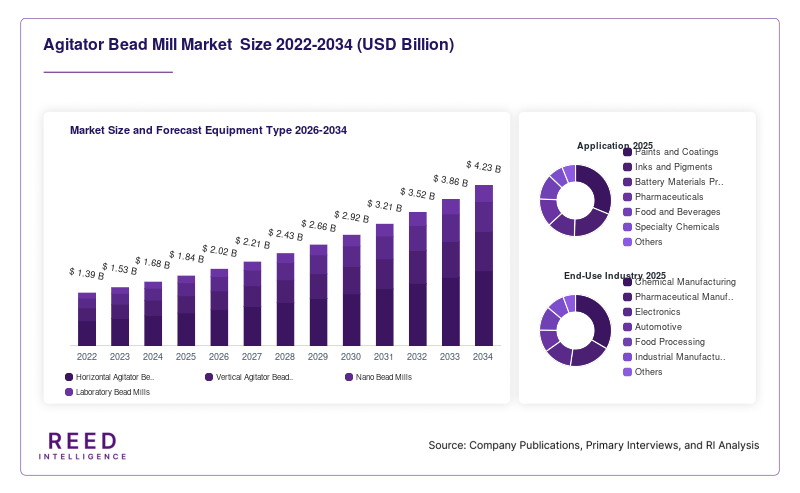
Horizontal agitator bead mills represented the dominant equipment type and accounted for approximately 43.8% market share in 2024. Their popularity stems from high grinding efficiency, superior heat dissipation, and the ability to process large production volumes continuously. These systems are widely utilized in paints and coatings, chemical manufacturing, and mineral processing applications. Manufacturers favor horizontal designs because they provide consistent particle size reduction and improved operational reliability. The growing demand for large-scale industrial production is further supporting adoption. Additionally, advancements in chamber design, wear-resistant materials, and process automation are improving performance while reducing maintenance requirements, strengthening the segment's leadership position within the market.
Nano bead mills are projected to be the fastest-growing equipment category, expanding at a CAGR of 12.8% through 2034. Growth is driven by increasing demand for ultra-fine grinding applications in battery materials, pharmaceuticals, electronic components, and nanotechnology products. These systems are capable of producing extremely small particle sizes while maintaining tight distribution control. Manufacturers of advanced materials increasingly require precision processing technologies to enhance product performance and meet stringent quality requirements. Research and development activities focused on next-generation materials are also contributing to demand. As industries continue to prioritize product innovation and performance optimization, adoption of nano bead mills is expected to accelerate significantly.
By Application
Paints and coatings constituted the largest application segment, accounting for approximately 39.6% of total market share in 2024. The segment benefits from extensive use of agitator bead mills for pigment dispersion, particle size reduction, and formulation enhancement. Coating manufacturers rely on these systems to achieve uniform color distribution, improved durability, and superior surface finishes. Growth in construction, infrastructure development, automotive production, and industrial maintenance activities continues to support coating demand globally. Furthermore, the transition toward advanced and environmentally friendly coating formulations requires enhanced processing capabilities. These factors collectively reinforce the dominant position of paints and coatings within the overall market landscape.
Battery materials processing is anticipated to emerge as the fastest-growing application segment, recording a CAGR of 13.1% during the forecast period. The rapid growth of electric vehicles and energy storage systems is driving substantial investments in battery manufacturing facilities. Agitator bead mills play a critical role in processing cathode materials, conductive additives, and other specialized components. Producers require highly controlled particle size distributions to optimize battery performance and energy density. Government support for clean energy initiatives and expanding battery production capacity are creating favorable market conditions. As the global transition toward electrification continues, this application segment is expected to witness strong and sustained growth.
By End-Use Industry
Chemical manufacturing held the leading position among end-use industries and captured approximately 36.4% market share in 2024. The industry relies extensively on agitator bead mills for producing specialty chemicals, pigments, dispersions, and functional additives. Precise particle size control is essential for achieving product consistency and desired performance characteristics. Increasing demand for high-value chemical products across automotive, construction, electronics, and consumer goods sectors continues to support equipment adoption. Furthermore, manufacturers are investing in advanced processing technologies to improve operational efficiency and reduce production costs. These factors contribute to the segment's continued dominance within the global market.
Pharmaceutical manufacturing is expected to register the fastest growth rate, advancing at a CAGR of 12.3% through 2034. The segment benefits from rising demand for advanced drug formulations and increasing pharmaceutical research activities. Agitator bead mills are used to improve active ingredient dispersion, enhance bioavailability, and achieve precise particle size specifications. Growing healthcare expenditures, aging populations, and expanding access to medicines are driving pharmaceutical production worldwide. In addition, the development of complex drug delivery systems requires highly controlled processing technologies. These trends are expected to generate significant opportunities for bead mill manufacturers serving the pharmaceutical sector.
Regional Analysis
North America
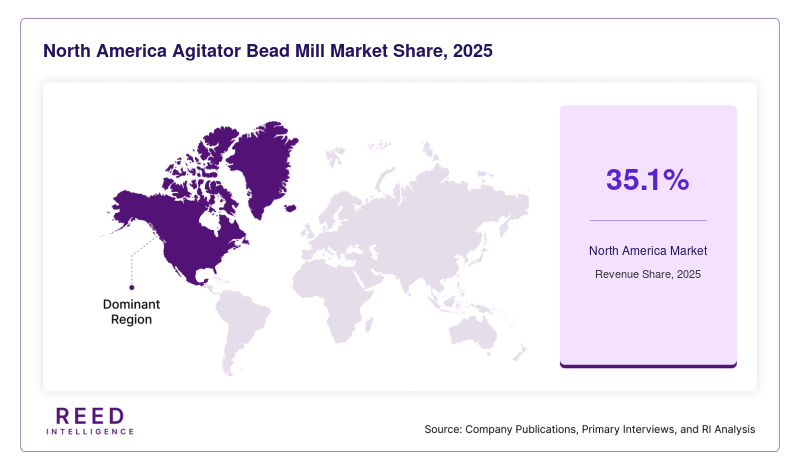
North America accounted for approximately 35.1% of the global market share in 2025 and maintained its position as the leading regional market. The region is projected to register a CAGR of 8.7% through 2034. Strong demand from pharmaceuticals, specialty chemicals, advanced materials, and paints and coatings industries continues to support market expansion. The presence of established manufacturing infrastructure and significant investments in process automation further contribute to regional growth.
The United States remains the dominant country within North America. A key growth factor is the increasing investment in battery material production and advanced manufacturing technologies. The country's strong research ecosystem and growing adoption of high-performance processing equipment are encouraging manufacturers to modernize milling operations. Demand from pharmaceutical formulation development and specialty coatings production also supports equipment sales.
Europe
Europe represented nearly 28.4% of global market revenue in 2025 and is expected to grow at a CAGR of 8.9% during the forecast period. The region benefits from a mature industrial base, strong chemical manufacturing sector, and increasing focus on sustainable production technologies. Environmental regulations are encouraging companies to adopt efficient processing equipment capable of reducing waste and energy consumption while maintaining product quality standards.
Germany continues to dominate the European market due to its advanced engineering capabilities and large chemical industry. A unique growth factor is the region's emphasis on sustainable manufacturing and energy-efficient production processes. Industrial companies are investing in modern grinding technologies to improve operational performance and comply with environmental objectives. These investments are supporting steady market development across the region.
Asia Pacific
Asia Pacific held approximately 24.7% of the market share in 2025 and is forecast to expand at the fastest CAGR of 11.4% through 2034. Rapid industrialization, increasing manufacturing investments, and expanding demand for specialty materials are fueling regional growth. Countries across the region are strengthening production capabilities in chemicals, electronics, pharmaceuticals, and battery materials, creating substantial opportunities for equipment suppliers.
China is the leading country within Asia Pacific and continues to drive regional demand. A major growth factor is the country's extensive investment in electric vehicle battery manufacturing and advanced materials production. Large-scale industrial projects and expanding export-oriented manufacturing activities are increasing the need for high-precision grinding equipment. This trend is expected to sustain strong market growth over the coming years.
Middle East & Africa
The Middle East & Africa accounted for approximately 6.2% of global market revenue in 2025 and is anticipated to register a CAGR of 9.1% during 2026–2034. The region is benefiting from economic diversification initiatives that promote industrial development beyond traditional energy sectors. Growth in chemicals, construction materials, and food processing industries is contributing to increased demand for advanced milling technologies.
Saudi Arabia represents the dominant country in the regional market. A unique growth factor is the government's continued investment in industrial diversification and downstream manufacturing projects. These initiatives are encouraging the establishment of new processing facilities that require efficient grinding and dispersion equipment. As industrial capacity expands, demand for agitator bead mills is expected to increase steadily.
Latin America
Latin America captured around 5.6% of the global market share in 2025 and is projected to grow at a CAGR of 8.8% through 2034. The region's market growth is supported by increasing industrial production, modernization of manufacturing facilities, and rising demand for paints, coatings, and specialty chemicals. Companies are investing in productivity-enhancing technologies to remain competitive in both domestic and export markets.
Brazil dominates the Latin American market due to its extensive industrial base and growing chemical manufacturing sector. A distinctive growth factor is the expansion of local coatings and agricultural chemical production. Manufacturers are adopting advanced processing equipment to improve product consistency and operational efficiency. This trend is expected to support sustained demand for agitator bead mills across the country.
Competitive Landscape
The Agitator Bead Mill Market is moderately consolidated, with several global and regional manufacturers competing through technological innovation, product customization, and service capabilities. Companies are focusing on energy-efficient designs, automation features, wear-resistant materials, and application-specific solutions to strengthen market positions. Strategic partnerships, product launches, and manufacturing capacity expansions remain common competitive strategies.
NETZSCH Group continues to be recognized as a market leader due to its extensive product portfolio, strong global distribution network, and advanced grinding technologies. The company recently expanded its intelligent process monitoring capabilities across selected milling systems to improve productivity and predictive maintenance performance. Other prominent participants include Bühler Group, Willy A. Bachofen AG, Shanghai ELE Mechanical & Electrical Equipment Co., Ltd., and Allwin Machine & Equipment Co., Ltd. These companies continue to invest in research and development initiatives to meet evolving customer requirements. Increasing demand from battery materials, pharmaceuticals, and specialty chemicals is encouraging manufacturers to introduce highly specialized solutions. Competition is expected to intensify as emerging regional suppliers expand their presence and industrial modernization drives new equipment investments.
Key Players
- NETZSCH Group
- Bühler Group
- Willy A. Bachofen AG (WAB)
- Shanghai ELE Mechanical & Electrical Equipment Co., Ltd.
- Allwin Machine & Equipment Co., Ltd.
- Ashizawa Finetech Ltd.
- Hockmeyer Equipment Corporation
- Root Group
- FrymaKoruma
- VMA-GETZMANN GmbH
- Dongguan Longly Machinery Co., Ltd.
- SIEHE Industry
- Changsha Mitr Instrument Equipment Co., Ltd.
- Tipco Engineering Works
- Fullbrook Systems Ltd.
Recent Developments
- NETZSCH Group introduced enhanced digital monitoring features for selected agitator bead mill platforms to improve process optimization and predictive maintenance capabilities.
- Bühler Group expanded its advanced wet-grinding solutions portfolio targeting battery material and specialty chemical applications with improved energy-efficiency performance.
- Willy A. Bachofen AG launched a new high-capacity bead mill configuration designed to support industrial-scale nanomaterial production and ultra-fine dispersion requirements.
- Shanghai ELE Mechanical & Electrical Equipment Co., Ltd. increased manufacturing capacity to address growing demand from Asia Pacific battery and chemical processing industries.
Agitator Bead Mill Market Segments
Equipment Type
- Horizontal Agitator Bead Mills
- Vertical Agitator Bead Mills
- Nano Bead Mills
- Laboratory Bead Mills
Application
- Paints and Coatings
- Inks and Pigments
- Battery Materials Processing
- Pharmaceuticals
- Food and Beverages
- Specialty Chemicals
- Others
End-Use Industry
- Chemical Manufacturing
- Pharmaceutical Manufacturing
- Electronics
- Automotive
- Food Processing
- Industrial Manufacturing
- Others
By Region
- North America
- Europe
- APAC
- Middle East and Africa
- LATAM