Agricultural Crop Insurance Market Size, Share, Growth & Demand Report by Insurance Type (Yield-Based Crop Insurance, Revenue-Based Crop Insurance, Index-Based Crop Insurance), By Distribution Channel (Government-Supported Programs, Private Insurance Providers, Digital Platforms, Cooperative Societies), By Application (Field Crops, Horticultural Crops, Plantation Crops, Cash & Commercial Crops), and Regional Forecasts 2026–2034
USD 3950
Market Overview
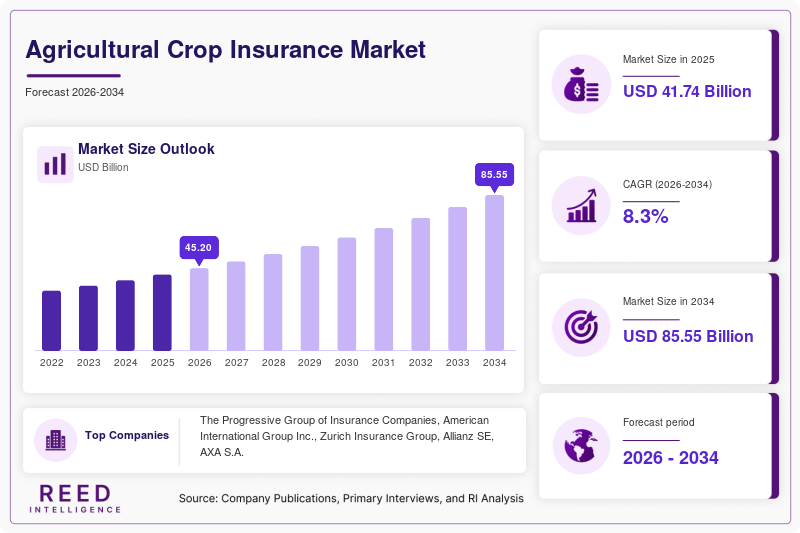
The Agricultural Crop Insurance Market Size is projected to expand steadily through the forecast period, supported by rising climate volatility, increasing agricultural financing needs, and government-backed risk mitigation programs. In 2026, the global market size is estimated at USD 45.2 billion and is expected to reach approximately USD 85.6 billion by 2034, registering a CAGR of 8.3% during 2026–2034. Growth is primarily influenced by the increasing frequency of droughts, floods, and unseasonal weather patterns that continue to affect global crop productivity and farmer income stability.
A significant global factor supporting market expansion is the integration of digital agriculture technologies with insurance frameworks. The adoption of satellite-based crop monitoring, IoT-enabled field sensors, and AI-driven risk modeling has improved claim accuracy and reduced processing time. These advancements have encouraged insurers to expand coverage into previously underserved rural regions, improving penetration in emerging economies and strengthening underwriting efficiency.
Key Highlights
- North America accounted for a 34.6% share in 2025.
- Asia Pacific is projected to grow at a CAGR of 11.4% during 2026–2034.
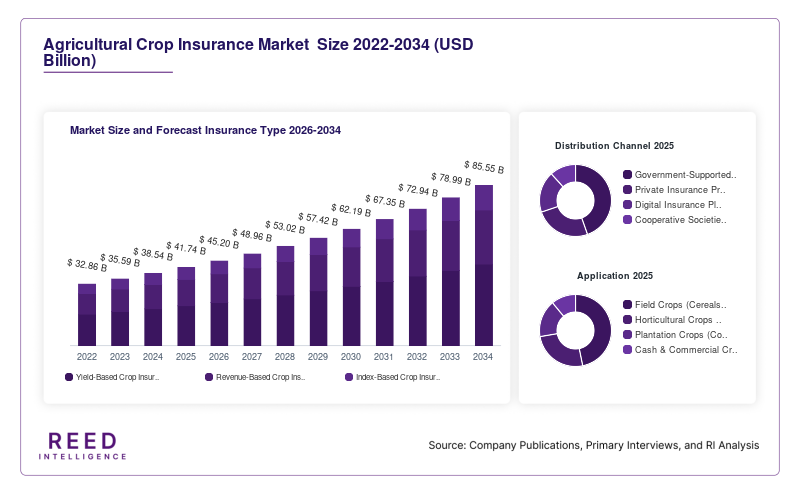
- By coverage type, yield-based insurance held a 39.2% share, while index-based insurance is expected to expand at a CAGR of 12.1%.
- By distribution channel, government-supported programs led with a 42.5% share, whereas digital platforms are projected to grow at a CAGR of 13.0%.
- The United States recorded market values of USD 520 million in 2024 and USD 565 million in 2025.
Market Trends
Expansion of Index-Based Crop Insurance Models
Index-based crop insurance is gaining traction due to its simplified claim settlement structure and reduced administrative complexity. Unlike traditional indemnity models, payouts in index-based systems are triggered by predefined parameters such as rainfall levels, temperature thresholds, or vegetation indices. This approach reduces disputes between farmers and insurers while enabling faster compensation cycles. Governments in developing economies are increasingly promoting index-based schemes to improve rural financial inclusion. Additionally, advancements in satellite imaging and remote sensing have enhanced the accuracy of index measurements, making these products more reliable for both insurers and agricultural stakeholders.
Digital Transformation in Insurance Underwriting and Claims
The agricultural crop insurance sector is undergoing a major shift toward digitalization, driven by AI analytics, machine learning models, and geospatial technologies. Insurers are increasingly relying on real-time crop health monitoring and predictive analytics to assess risk exposure and pricing accuracy. Mobile-based policy management systems are also improving accessibility for farmers in remote areas. Blockchain integration is emerging as a tool to streamline claim validation and reduce fraud risks. This digital transformation is not only reducing operational costs but also enhancing transparency and trust across the agricultural insurance ecosystem.
Market Drivers
Increasing Climate Variability and Agricultural Risk Exposure
The rising unpredictability of weather conditions is a major driver of the Agricultural Crop Insurance Market. Extreme weather events such as prolonged droughts, flash floods, and heatwaves have led to significant crop losses across multiple regions. Farmers are increasingly exposed to income instability, prompting greater adoption of insurance products as a financial safeguard. Governments are also expanding subsidy programs to support premium affordability, particularly in developing countries where agriculture forms a large part of GDP. As climate risks intensify, demand for structured risk transfer solutions is expected to grow steadily.
Government Support and Agricultural Subsidy Programs
Government intervention plays a crucial role in driving market growth through premium subsidies, reinsurance support, and policy frameworks that encourage insurance adoption. Many countries have introduced national crop insurance schemes that reduce financial burdens on farmers and ensure minimum income protection. These programs are particularly impactful in regions with high agricultural dependency. Additionally, international development organizations are supporting rural insurance penetration through funding and capacity-building initiatives. The combination of public funding and private insurer participation is strengthening market expansion and improving accessibility for smallholder farmers.
Market Restraint
Low Awareness and Limited Penetration in Rural Regions
One of the primary restraints affecting the Agricultural Crop Insurance Market is the limited awareness among small and marginal farmers regarding insurance benefits and claim processes. In many rural regions, farmers still rely on informal coping mechanisms rather than structured financial protection tools. Lack of financial literacy, inadequate distribution networks, and language barriers further restrict adoption rates. Even in regions where government schemes exist, enrollment levels remain inconsistent due to mistrust in claim settlement timelines. This gap in awareness continues to hinder full-scale market penetration, particularly in developing agricultural economies.
Market Opportunities
Expansion of AI and Satellite-Based Risk Assessment Solutions
The integration of artificial intelligence and satellite-based monitoring presents a significant opportunity for market expansion. These technologies enable insurers to evaluate crop conditions in real time, assess yield risks more accurately, and automate claim validation processes. AI-driven predictive models also help in identifying high-risk zones and optimizing premium pricing structures. As data accessibility improves, insurers are expected to expand coverage to previously underinsured agricultural regions. This technological advancement enhances operational efficiency and supports scalable insurance frameworks across global markets.
Growth of Microinsurance Products for Smallholder Farmers
Microinsurance is emerging as a strong opportunity within the Agricultural Crop Insurance Market, particularly in developing economies with large populations of smallholder farmers. These products offer low-premium, high-accessibility coverage tailored to limited-income agricultural communities. Digital payment systems and mobile platforms are making microinsurance distribution more efficient and cost-effective. Governments and NGOs are also collaborating with insurers to promote financial inclusion in rural areas. As affordability barriers reduce, microinsurance adoption is expected to increase significantly, supporting broader market expansion.
Segmental Analysis
By Insurance Type
Yield-based crop insurance continues to hold a significant position in the Agricultural Crop Insurance Market, accounting for approximately 39.2% share in 2025. This dominance is attributed to its long-established adoption across traditional agricultural economies where historical yield data is widely available. The structure of yield-based insurance allows compensation based on actual production losses, making it highly suitable for staple crop cultivation such as wheat, rice, and maize. Its familiarity among farmers and integration with government-backed insurance frameworks further strengthens its adoption. Additionally, insurers prefer this model in regions with stable agricultural reporting systems, as it allows more predictable risk evaluation and structured claim settlements.
Index-based insurance is emerging as the fastest-growing subsegment, projected to expand at a CAGR of 12.1% during the forecast period. This growth is driven by its efficiency in reducing administrative complexities and minimizing disputes in claim settlement. Instead of relying on individual farm loss assessments, payouts are triggered based on predefined indices such as rainfall levels, temperature fluctuations, or satellite vegetation data. The increasing use of remote sensing technologies and AI-driven analytics has significantly improved the accuracy of index calculations. Governments in developing economies are actively promoting this model to expand coverage among smallholder farmers, thereby enhancing financial inclusion and improving insurance penetration in high-risk agricultural zones.
By Distribution Channel
Government-supported insurance programs dominated the distribution landscape, capturing around 42.5% share in 2025. These programs play a crucial role in ensuring affordability and accessibility for farmers, particularly in emerging economies where agricultural income is highly vulnerable to climate risks. Subsidized premium structures and public reinsurance support have enabled large-scale participation in national insurance schemes. These initiatives are often integrated with rural development policies, ensuring wider outreach across farming communities. The dominance of government channels is also reinforced by policy mandates that encourage compulsory or semi-compulsory enrollment in crop insurance programs for credit-linked farmers.
Digital platforms represent the fastest-growing distribution channel, projected to register a CAGR of 13.0% over the forecast period. The increasing penetration of smartphones and mobile internet in rural regions has significantly transformed insurance accessibility. Farmers can now purchase policies, track coverage, and file claims through mobile applications and online portals. Insurtech companies are leveraging AI chatbots, automated underwriting tools, and geospatial data integration to streamline policy issuance and claim verification. This shift toward digital ecosystems is reducing operational costs for insurers while enhancing transparency and customer engagement. As digital literacy improves, adoption of online insurance channels is expected to accelerate further.
By Application
Field crops accounted for the largest share of 41.7% in 2025 within the Agricultural Crop Insurance Market. This dominance is primarily driven by the large-scale cultivation of essential food crops such as wheat, rice, corn, and barley, which are highly sensitive to weather fluctuations. These crops form the backbone of global food security, prompting governments and insurers to prioritize coverage in this segment. The structured nature of field crop production allows for more standardized risk assessment and insurance modeling. Additionally, government-backed schemes frequently focus on staple crops due to their economic and social importance, further strengthening this segment’s market position.
Horticultural crops are projected to be the fastest-growing application segment, expanding at a CAGR of 11.6% during the forecast period. This growth is supported by rising demand for fruits, vegetables, and high-value crops in both domestic and export markets. Horticulture farming is more susceptible to pest attacks, temperature variation, and irregular rainfall, increasing the need for specialized insurance coverage. The growing commercialization of horticultural farming and expansion of greenhouse cultivation systems are further driving insurance adoption. Insurers are also developing tailored policies for high-value crops, integrating weather analytics and real-time monitoring tools to improve risk coverage accuracy.
Regional Analysis
North America
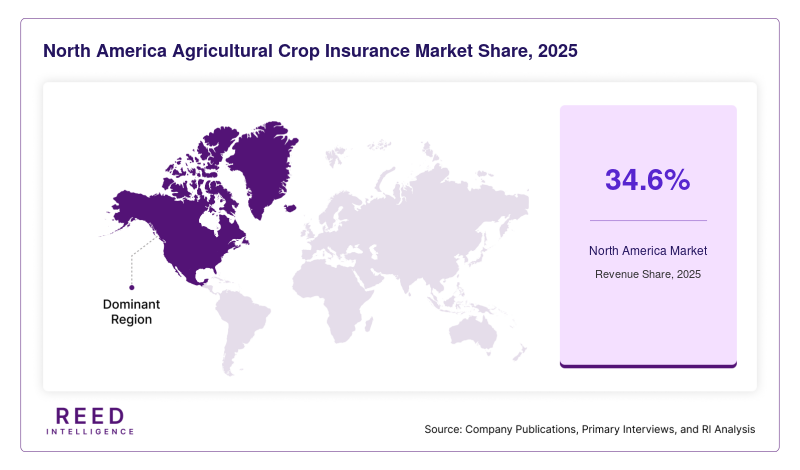
North America held approximately 34.6% market share in 2025 and is projected to grow at a CAGR of 7.9% during the forecast period. The region benefits from strong institutional frameworks, advanced agricultural practices, and well-established insurance ecosystems. High adoption of precision farming technologies has enabled better risk assessment and improved insurance underwriting efficiency. The presence of large-scale commercial farms further strengthens demand for comprehensive crop insurance solutions, particularly in weather-exposed agricultural zones.
The United States remains the leading country in the region, supported by federal subsidy programs and strong private insurer participation. A key growth factor is the integration of satellite imaging and data analytics into agricultural insurance systems, which enhances yield prediction accuracy and accelerates claim processing efficiency across large farming operations.
Europe
Europe accounted for 22.1% market share in 2025 and is expected to expand at a CAGR of 7.4% through 2034. The region’s growth is supported by structured regulatory frameworks and increasing emphasis on sustainable agriculture practices. Climate adaptation policies across the European Union are encouraging farmers to adopt risk mitigation tools such as crop insurance. Strong cooperative farming structures also contribute to stable insurance penetration across rural areas.
Germany leads the regional market due to its advanced agricultural infrastructure and strong government support systems. A key growth factor is the increasing adoption of climate-resilient farming techniques, which drives demand for insurance products that safeguard farmers against unpredictable weather conditions and yield fluctuations.
Asia Pacific
Asia Pacific held 26.8% market share in 2025 and is projected to grow at a CAGR of 11.4% during the forecast period. The region’s growth is driven by its large agricultural base, high population dependence on farming, and frequent exposure to natural disasters. Governments across countries such as China, India, and Southeast Asian nations are actively implementing subsidized crop insurance schemes to improve rural financial security.
China remains the dominant country in the region, supported by large-scale agricultural production and strong state-led insurance initiatives. A key growth factor is the rapid digitalization of rural financial services, which has significantly improved insurance accessibility and encouraged wider adoption among small and marginal farmers.
Middle East & Africa
Middle East & Africa accounted for 8.5% market share in 2025 and is expected to grow at a CAGR of 9.1% during the forecast period. The region faces high agricultural risk due to water scarcity, desert climates, and dependency on irrigation-based farming. These challenges increase the need for structured crop insurance solutions to stabilize farmer incomes and support food security initiatives.
South Africa leads the regional market due to its relatively advanced agricultural finance systems and structured insurance frameworks. A key growth factor is the expansion of climate resilience programs, which are encouraging farmers to adopt insurance as a primary risk management tool in drought-prone agricultural zones.
Latin America
Latin America held 8.0% market share in 2025 and is projected to grow at a CAGR of 8.7%. The region’s growth is driven by strong agricultural export activities and increasing exposure to extreme weather events such as droughts and floods. Governments are actively supporting insurance adoption through subsidy programs and rural financial inclusion initiatives.
Brazil is the leading country in the region, supported by large-scale soybean, sugarcane, and corn production. A key growth factor is the expansion of agritech adoption in farming operations, which is improving risk monitoring capabilities and supporting the development of more efficient insurance products.
Competitive Landscape
The Agricultural Crop Insurance Market features a moderately consolidated structure with participation from global insurers, regional providers, and government-linked agencies. Key companies focus on expanding digital underwriting capabilities, improving claim efficiency, and enhancing risk modeling accuracy. Among them, The Progressive Group of Insurance Companies maintains a strong position through its advanced data-driven underwriting systems and diversified agricultural coverage portfolio. Recent developments include expansion of AI-based crop monitoring systems and strategic partnerships with agritech firms to improve risk assessment precision and reduce claim settlement time.
Key Players
- The Progressive Group of Insurance Companies
- American International Group Inc.
- Zurich Insurance Group
- Allianz SE
- AXA S.A.
- Tokio Marine Holdings
- Chubb Limited
- Munich Re
- Swiss Re
- Sompo Holdings
- ICICI Lombard General Insurance
- HDFC ERGO General Insurance
- State Farm Mutual Automobile Insurance Company
- Agriculture Insurance Company of India
- Farmers Mutual Hail Insurance Company
Recent Developments
- In 2025, several agricultural insurance providers expanded their use of satellite-based crop monitoring systems to enhance real-time risk assessment and improve claim verification accuracy across large farming regions. This development has strengthened transparency in underwriting processes and reduced dependency on manual field inspections.
- In 2025, multiple insurers introduced AI-powered underwriting platforms designed to automate crop risk evaluation and premium calculation. These systems utilize historical weather data, soil health indicators, and predictive analytics to improve pricing accuracy and accelerate policy issuance timelines.
- In 2024, government-backed agricultural insurance programs in emerging economies were expanded to include additional crop categories under national subsidy schemes. This initiative increased coverage penetration among smallholder farmers and improved financial protection against climate-related crop failures.
- In 2024, leading reinsurance companies enhanced their collaboration with regional insurers to strengthen risk-sharing frameworks for large-scale agricultural portfolios. This development helped improve capital efficiency and ensured greater stability in high-risk agricultural zones.
Agricultural Crop Insurance Market Segments
Insurance Type
- Yield-Based Crop Insurance
- Revenue-Based Crop Insurance
- Index-Based Crop Insurance
Distribution Channel
- Government-Supported Insurance Programs
- Private Insurance Providers
- Digital Insurance Platforms
- Cooperative Societies & Rural Banks
Application
- Field Crops (Cereals, Grains, Oilseeds)
- Horticultural Crops (Fruits & Vegetables)
- Plantation Crops (Coffee, Tea, Rubber)
- Cash & Commercial Crops
By Region
- North America
- Europe
- APAC
- Middle East and Africa
- LATAM