Agricultural Grow Bags Market Size, Share, Demand Report By Material Type (Polyethylene Grow Bags, Fabric Grow Bags, Biodegradable Grow Bags, Others), By Cultivation Method (Hydroponics, Vertical Farming, Open Field Cultivation), By Crop Type (Vegetables, Fruits, Berries and Specialty Fruits, Flowers and Ornamentals, Herbs and Medicinal Plants), By Region & Segment Forecasts, 2026–2034
USD 3950
Market Overview
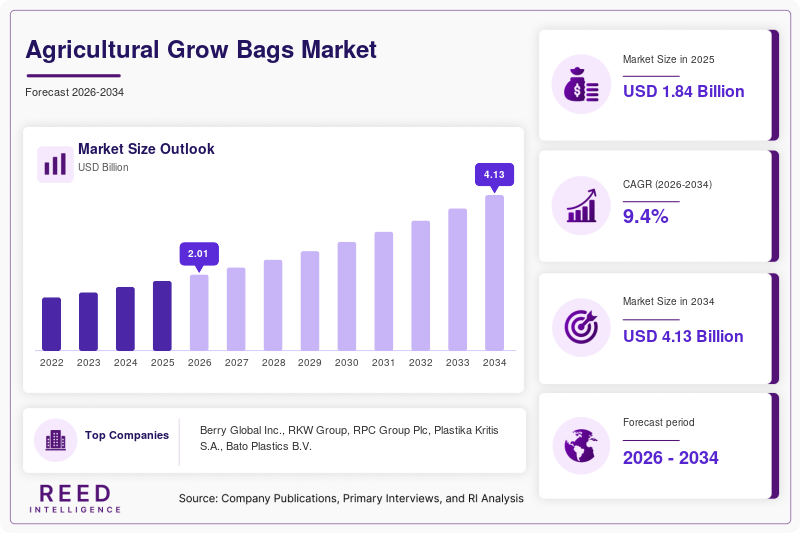
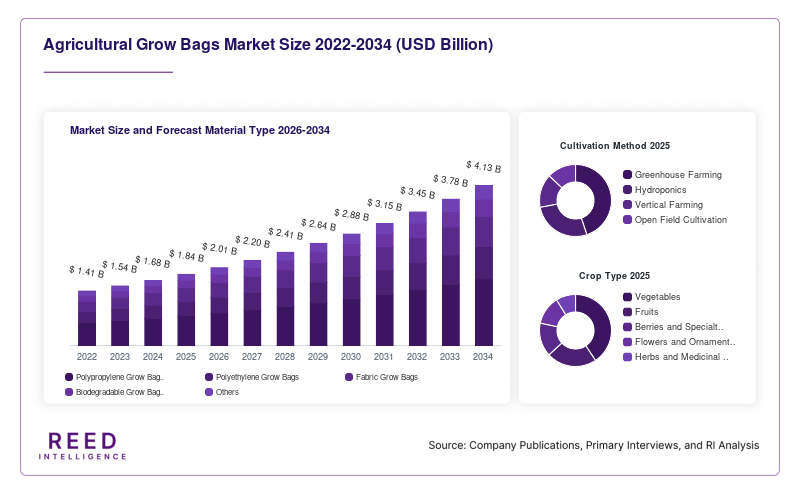
The global Agricultural Grow Bags Market size was valued at USD 1.84 billion in 2026 and is projected to reach USD 3.79 billion by 2034, expanding at a CAGR of 9.4% during 2026–2034. The market is witnessing steady expansion due to the increasing adoption of controlled-environment agriculture, greenhouse cultivation, and soilless farming systems across developed and emerging economies. Agricultural grow bags provide efficient root development, improved water retention, better nutrient management, and enhanced crop productivity, making them an increasingly preferred cultivation solution among commercial growers.
The growing pressure on agricultural land and the need to improve yield per square meter have encouraged farmers to adopt advanced cultivation techniques. Grow bags are widely utilized for vegetables, fruits, herbs, ornamental plants, and nursery crops because they support precision farming practices while reducing soil-borne diseases. Rapid urbanization, rising food demand, and increasing investments in protected agriculture have further strengthened market growth.
Key Highlights
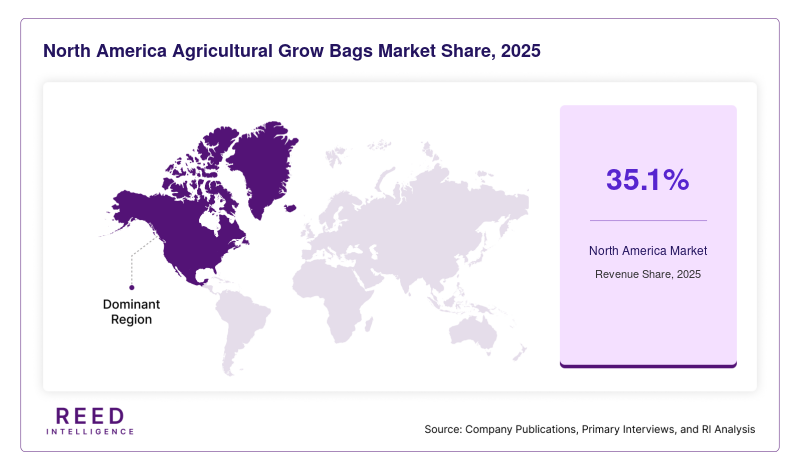
- North America dominated the market with a 35.1% share in 2025.
- while Asia Pacific is expected to grow at the fastest CAGR of 11.4% during 2026–2034.
- By material type, polypropylene grow bags accounted for the largest share of 42.8%.
- while biodegradable grow bags are projected to grow at a CAGR of 12.7%.
- By cultivation method, greenhouse farming led with a 46.5% share.
- whereas vertical farming is expected to expand at a CAGR of 13.2%.
- By crop type, vegetables represented the largest share of 49.3%.
- while berries and specialty fruits are anticipated to grow at a CAGR of 11.8%.
- The United States remained the dominant country, with market values of USD 468 million in 2024 and USD 519 million in 2025.
Market Trends
Growing Adoption of Sustainable and Biodegradable Grow Bags
Environmental sustainability has become an important consideration across the agricultural sector. Farmers, greenhouse operators, and commercial growers are increasingly seeking cultivation products that minimize environmental impact while maintaining crop productivity. This trend has accelerated the development of biodegradable grow bags manufactured from natural fibers, plant-based polymers, and compostable materials. These products help reduce plastic waste while supporting sustainable farming objectives. Governments and agricultural organizations are also encouraging environmentally responsible cultivation practices, creating favorable conditions for biodegradable alternatives. As sustainability becomes a core purchasing criterion, manufacturers are investing in innovative materials that improve durability, water management, and decomposition performance, making eco-friendly grow bags a significant market trend.
Expansion of Controlled-Environment Agriculture
Controlled-environment agriculture continues to expand rapidly across global farming systems. Greenhouses, hydroponic facilities, and vertical farms increasingly rely on grow bags to optimize root development and nutrient delivery. These systems allow year-round production, higher yields, and improved resource efficiency compared with traditional cultivation methods. Agricultural grow bags support precise irrigation management and provide flexibility in crop placement and rotation. Rising concerns regarding climate variability, land degradation, and water scarcity are encouraging growers to adopt protected cultivation methods. As investments in advanced farming infrastructure increase across urban and peri-urban regions, demand for specialized grow bags designed for intensive cultivation environments is expected to rise steadily throughout the forecast period.
Market Drivers
Increasing Demand for High-Yield Agricultural Production
Global food demand continues to rise due to population growth, urbanization, and changing dietary preferences. Farmers are under pressure to increase productivity without significantly expanding agricultural land. Agricultural grow bags offer an effective solution by enabling better root aeration, moisture control, and nutrient absorption. These advantages contribute to improved crop quality and higher yields. Commercial vegetable producers, greenhouse operators, and nursery businesses increasingly utilize grow bags to maximize output while maintaining efficient resource utilization. The ability to cultivate crops in areas with poor soil quality further enhances their value. Growing emphasis on food security and agricultural efficiency is therefore driving significant market expansion across multiple regions.
Growth of Greenhouse and Protected Cultivation Infrastructure
The continuous expansion of greenhouse farming is another major factor supporting market growth. Protected cultivation environments help farmers reduce weather-related risks, improve crop consistency, and optimize production cycles. Agricultural grow bags play a vital role in these systems by providing controlled root-zone conditions and facilitating efficient irrigation practices. Governments in several countries are supporting greenhouse development through subsidies, modernization programs, and agricultural technology initiatives. Large-scale commercial farms are also increasing investments in advanced cultivation infrastructure. As greenhouse acreage expands worldwide, the demand for durable and high-performance grow bags is expected to increase substantially, creating long-term growth opportunities for manufacturers and suppliers.
Market Restraint
Volatility in Raw Material Costs and Disposal Challenges
Fluctuations in the prices of raw materials used in agricultural grow bag production remain a notable challenge for market participants. Polypropylene, polyethylene, and other synthetic materials are often influenced by changes in petroleum prices, supply chain disruptions, and manufacturing costs. Rising input expenses can reduce profit margins for producers and increase product prices for end users. In addition, disposal concerns associated with conventional plastic grow bags continue to attract regulatory attention. Many growers face challenges related to collection, recycling, and waste management after product use. In regions where recycling infrastructure remains limited, disposal costs may discourage adoption among smaller farming operations. For example, commercial greenhouse facilities using large volumes of plastic-based grow bags must often invest additional resources in waste handling and environmental compliance. These factors can create operational complexities and moderate market growth despite strong demand fundamentals.
Market Opportunities
Rising Investment in Vertical Farming Projects
Vertical farming is emerging as a promising cultivation model for urban food production. These facilities require highly efficient growing systems capable of maximizing space utilization while maintaining consistent crop quality. Agricultural grow bags are increasingly incorporated into vertical farming designs because they support flexible crop management and optimized root development. Investors and agricultural technology companies are expanding vertical farming projects in major cities to address food security concerns and reduce transportation costs. As these projects scale commercially, demand for lightweight, durable, and customized grow bag solutions is expected to increase significantly. This trend creates substantial opportunities for manufacturers to develop products tailored specifically for intensive indoor cultivation environments.
Expansion of Commercial Horticulture and Export-Oriented Farming
Commercial horticulture continues to gain momentum as growers focus on high-value fruits, vegetables, herbs, and ornamental plants. Agricultural grow bags provide growers with improved control over growing conditions, making them particularly suitable for export-oriented farming operations. Increasing consumer demand for premium-quality produce has encouraged producers to adopt advanced cultivation methods that ensure consistency and quality standards. Grow bags help minimize soil contamination risks and support efficient nutrient management, both of which are critical for export markets. The expansion of horticultural production across Asia Pacific, Latin America, and the Middle East is creating favorable opportunities for market participants. Manufacturers offering specialized products for high-value crops are likely to benefit from this growing demand.
Segmental Analysis
By Material Type
Polypropylene grow bags represented the dominant subsegment and accounted for approximately 42.8% of market revenue in 2024. Their popularity stems from durability, affordability, and compatibility with a wide range of crops. Commercial greenhouse operators prefer polypropylene products because they provide excellent root aeration while maintaining structural integrity under varying environmental conditions. These grow bags are widely used for vegetables, fruits, and ornamental plants across large-scale cultivation systems. Their resistance to tearing and long service life reduce replacement frequency, improving operational efficiency for growers. The widespread availability of polypropylene products and established manufacturing capacity further support their leading position within the Agricultural Grow Bags Market.
Biodegradable grow bags are projected to be the fastest-growing subsegment, registering a CAGR of 12.7% between 2026 and 2034. Increasing environmental awareness and stricter regulations regarding plastic waste are encouraging adoption of sustainable alternatives. Growers seeking eco-friendly cultivation solutions are increasingly selecting biodegradable products capable of decomposing after use. Manufacturers continue investing in advanced materials that combine environmental benefits with strong performance characteristics. Improvements in durability, moisture retention, and nutrient management are making these products more attractive for commercial applications. As sustainability objectives become a higher priority across the agricultural sector, biodegradable grow bags are expected to experience accelerated adoption worldwide.
By Cultivation Method
Greenhouse farming held the largest market share and accounted for approximately 46.5% of total revenue in 2024. Agricultural grow bags are extensively used within greenhouse environments because they enable precise management of water, nutrients, and root conditions. Growers benefit from improved productivity, reduced disease risks, and greater crop consistency. The expansion of commercial greenhouse facilities across developed and emerging economies has strengthened demand for high-performance grow bag products. Greenhouse operators increasingly prioritize cultivation systems capable of supporting year-round production and maximizing resource efficiency. These factors have helped greenhouse farming maintain its dominant position within the market.
Vertical farming is anticipated to emerge as the fastest-growing cultivation method, advancing at a CAGR of 13.2% during the forecast period. Urban food production initiatives and technological advancements are driving investment in vertical farming infrastructure. Agricultural grow bags offer flexibility and space efficiency, making them well suited for stacked cultivation systems. They support optimized root development while enabling precise irrigation and nutrient delivery. Growing concerns regarding food security, transportation costs, and urban population growth are encouraging adoption of vertical farming solutions. As more cities invest in indoor agriculture projects, demand for specialized grow bags designed for intensive cultivation environments is expected to rise significantly.
By Crop Type
Vegetables constituted the largest crop-type subsegment and accounted for approximately 49.3% of market revenue in 2024. Tomatoes, cucumbers, peppers, leafy greens, and other vegetables are commonly cultivated using grow bag systems due to their high productivity and efficient resource utilization. Commercial growers rely on agricultural grow bags to improve crop quality, minimize soil-borne diseases, and optimize nutrient management. The increasing demand for fresh produce and year-round vegetable availability continues to support strong adoption. Greenhouse vegetable production has expanded considerably in recent years, further reinforcing the dominant position of this subsegment within the Agricultural Grow Bags Market.
Berries and specialty fruits are projected to register the fastest growth, with a CAGR of 11.8% through 2034. Consumer demand for premium fruits, functional foods, and healthy dietary options is increasing globally. Grow bags provide ideal cultivation conditions for strawberries, blueberries, raspberries, and other specialty fruits by improving drainage and root health. Export-oriented producers are particularly attracted to these systems because they help maintain consistent quality standards. Rising investments in protected cultivation and commercial horticulture are expected to drive substantial demand for grow bags within this crop category over the coming years.
Regional Analysis
North America
North America accounted for approximately 35.1% of the global Agricultural Grow Bags Market in 2025 and maintained its position as the largest regional market. The region is projected to expand at a CAGR of 8.7% through 2034, supported by widespread adoption of greenhouse farming and precision agriculture technologies. Commercial growers increasingly utilize grow bags to improve productivity and reduce water consumption. Strong agricultural infrastructure and high awareness of advanced cultivation practices continue to support market expansion across the region.
The United States remains the dominant country within North America. A major growth factor is the rapid expansion of protected cultivation systems for vegetables and berries. Commercial greenhouse operators are investing heavily in advanced irrigation systems and high-performance cultivation media. The increasing demand for locally grown produce and year-round crop production further strengthens adoption of agricultural grow bags throughout the country.
North America also benefits from a mature horticulture industry and strong research support for sustainable farming technologies. Agricultural institutions and private companies collaborate extensively to improve cultivation efficiency. These efforts encourage the use of specialized grow bags designed to enhance root health, improve nutrient uptake, and increase crop consistency in commercial farming operations.
The presence of leading manufacturers and distributors contributes to stable product availability and technological innovation. Companies continue introducing recyclable and UV-resistant grow bags to address environmental concerns and evolving grower requirements. Such developments are expected to sustain market growth throughout the forecast period.
Europe
Europe represented approximately 27.4% of global market revenue in 2025 and is expected to register a CAGR of 8.5% between 2026 and 2034. The region benefits from extensive greenhouse cultivation and growing demand for sustainable agricultural products. European growers increasingly adopt grow bags to improve crop quality and optimize resource management. Regulatory support for environmentally responsible farming practices also contributes to market expansion across several countries.
The Netherlands serves as the dominant country in the European market. A key growth factor is its highly advanced greenhouse industry, which relies heavily on controlled cultivation systems. Dutch growers continuously seek solutions that improve production efficiency and reduce environmental impact. Agricultural grow bags support these objectives through better water retention and enhanced root-zone management.
European agricultural policies increasingly emphasize resource efficiency and sustainability. Growers are adopting innovative cultivation techniques to meet environmental targets while maintaining productivity. This environment creates strong demand for biodegradable and recyclable grow bag solutions capable of supporting intensive crop production systems.
Growing investments in high-value horticultural crops, including tomatoes, peppers, and ornamental flowers, further strengthen regional demand. The increasing adoption of precision irrigation and fertigation technologies also complements the use of advanced grow bag systems, supporting long-term market growth.
Asia Pacific
Asia Pacific held nearly 22.8% of the Agricultural Grow Bags Market in 2025 and is projected to record the fastest CAGR of 11.4% through 2034. Rapid agricultural modernization, expanding greenhouse infrastructure, and rising food demand are major growth contributors. Farmers across the region increasingly utilize grow bags to improve productivity while addressing land and water constraints. The growing adoption of commercial horticulture further supports market expansion.
China dominates the regional market due to its extensive agricultural production and increasing investment in protected cultivation. A unique growth factor is the country's large-scale greenhouse development programs designed to improve food security and agricultural efficiency. These initiatives have significantly increased demand for cultivation products, including agricultural grow bags.
Rapid urbanization is encouraging the development of vertical farming and urban agriculture projects across major cities. These systems require flexible and efficient growing solutions capable of maximizing limited space. Agricultural grow bags are increasingly integrated into such facilities due to their adaptability and performance advantages.
Government support for modern farming technologies continues to accelerate market penetration. Training programs, agricultural modernization initiatives, and investments in controlled-environment agriculture are helping growers transition toward advanced cultivation systems, creating substantial growth opportunities across the region.
Middle East & Africa
The Middle East & Africa accounted for approximately 7.1% of global revenue in 2025 and is expected to expand at a CAGR of 9.2% during the forecast period. Water scarcity and challenging soil conditions have encouraged growers to adopt alternative cultivation techniques. Agricultural grow bags help improve resource efficiency and support crop production in controlled environments. These advantages are driving adoption across commercial farming operations.
The United Arab Emirates leads the regional market. A significant growth factor is the increasing focus on food security initiatives and indoor farming investments. Government-backed agricultural programs encourage the adoption of advanced cultivation technologies capable of reducing dependence on imported produce. Grow bags play a key role in supporting these modern farming systems.
Controlled-environment agriculture continues to gain importance across arid regions where traditional farming faces significant limitations. Greenhouses and hydroponic facilities increasingly rely on grow bags to improve water utilization and crop consistency. This trend supports steady market development throughout the region.
Rising private-sector investments in horticulture and greenhouse farming are further strengthening demand. As commercial growers seek efficient production methods capable of operating under challenging climatic conditions, agricultural grow bags are expected to experience broader adoption.
Latin America
Latin America captured around 7.6% of the global market in 2025 and is anticipated to grow at a CAGR of 8.9% through 2034. The region benefits from expanding horticultural production and increasing adoption of modern cultivation techniques. Commercial growers are utilizing agricultural grow bags to improve crop quality and reduce disease-related losses. Growing export opportunities for fruits and vegetables also support market growth.
Brazil remains the leading country in the regional market. A unique growth factor is the expansion of commercial horticulture aimed at supplying both domestic and international markets. Producers increasingly invest in cultivation technologies that improve productivity and product consistency, creating strong demand for grow bag solutions.
Agricultural diversification is encouraging growers to cultivate high-value crops using controlled growing systems. Grow bags provide flexibility and help optimize resource management, making them attractive for commercial farming operations seeking greater efficiency and profitability.
The region is also witnessing increased awareness of sustainable cultivation practices. Farmers are gradually adopting products that support efficient water usage and improved crop management. These developments are expected to create favorable conditions for continued market expansion over the forecast period.
Competitive Landscape
The Agricultural Grow Bags Market remains moderately fragmented, with international and regional manufacturers competing through product innovation, material advancements, and distribution network expansion. Companies are focusing on sustainable materials, enhanced durability, and customized solutions designed for greenhouse, hydroponic, and vertical farming applications. Strategic partnerships with agricultural distributors and greenhouse operators are becoming increasingly common as suppliers seek broader market reach.
Berry Global is recognized as a leading participant due to its extensive product portfolio and global manufacturing capabilities. The company has recently expanded its sustainable agricultural packaging and cultivation solutions portfolio to address growing demand for environmentally responsible products. Other major companies continue investing in biodegradable materials and advanced fabric technologies to strengthen competitive positioning.
Product differentiation remains an important strategy within the industry. Manufacturers are introducing UV-resistant grow bags, improved drainage designs, and crop-specific solutions that enhance cultivation efficiency. Continuous innovation and growing demand for controlled-environment agriculture are expected to intensify competition throughout the forecast period.
Key Players
- Berry Global Inc.
- RPC Group Plc
- RKW Group
- Plastika Kritis S.A.
- Bato Plastics B.V.
- Texel Industries Ltd.
- Rain Science Grow Bags
- Proptek LLC
- Dutch Plantin
- Flexituff Ventures International Ltd.
- Norseman Environmental Inc.
- Grow Bag India Pvt. Ltd.
- Visqueen Ltd.
- Polyweave Packaging Ltd.
Recent Developments
- Berry Global introduced a new range of recyclable agricultural grow bags designed for commercial greenhouse vegetable production in 2025.
- Several European manufacturers launched biodegradable grow bag solutions utilizing plant-based polymers to address sustainability requirements and reduce plastic waste.
- A major horticulture supplier in Asia Pacific expanded production capacity for UV-resistant grow bags to meet increasing demand from greenhouse and vertical farming projects.
- Multiple greenhouse operators in North America entered long-term supply agreements with grow bag manufacturers to support large-scale protected cultivation expansion programs.
- Agricultural technology companies partnered with grow bag producers to develop integrated cultivation systems optimized for hydroponic and indoor farming applications.
Agricultural Grow Bags Market Segments
Material Type
- Polypropylene Grow Bags
- Polyethylene Grow Bags
- Fabric Grow Bags
- Biodegradable Grow Bags
- Others
Cultivation Method
- Greenhouse Farming
- Hydroponics
- Vertical Farming
- Open Field Cultivation
Crop Type
- Vegetables
- Fruits
- Berries and Specialty Fruits
- Flowers and Ornamentals
- Herbs and Medicinal Plants
By Region
- North America
- Europe
- APAC
- Middle East and Africa
- LATAM