Agricultural Harvester Market Size, Share Demand Report By Type (Combine Harvesters, Forage Harvesters, Sugarcane Harvesters, Cotton Pickers, Others), By Power Source (Diesel, Electric, Hybrid), Regional Insights & Segment Forecasts, 2026–2034
USD 3950
Agricultural Harvester Market Size
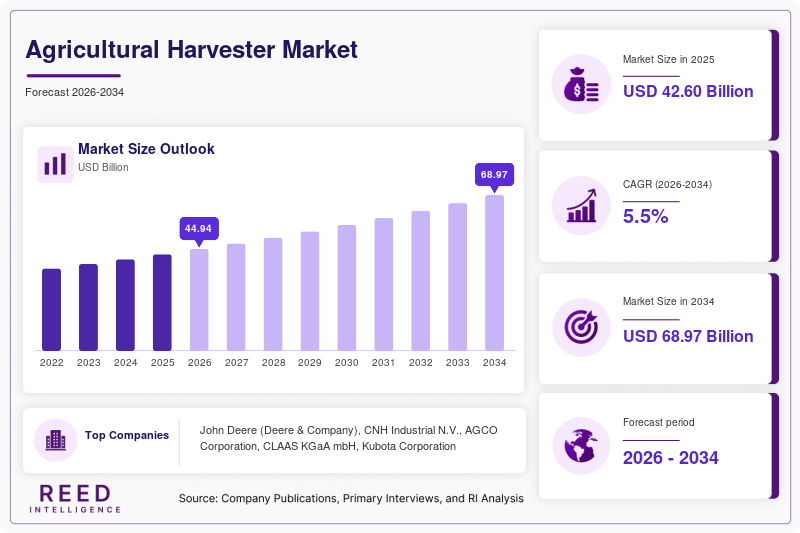
The Agricultural Harvester market size is projected at USD 28.5 billion in 2026 and is expected to hit USD 45.2 billion by 2034 with a CAGR of 5.9% during the forecast period. The increasing demand for food due to the rising global population, coupled with the need for higher agricultural productivity and efficiency, underpins market expansion. This report delivers a comprehensive analysis of the Agricultural Harvester market, including segmentation by type and power source, competitive dynamics, and regional growth patterns, equipping stakeholders with critical intelligence. The Agricultural Harvester market continues to demonstrate strong growth potential, fueled by the adoption of precision farming technologies, the increasing trend toward farm mechanization, and continuous innovation in harvester design and automation.
Agricultural harvesters are essential farm machines used to harvest a variety of crops, including grains, forage, sugarcane, cotton, and other produce. They are designed to perform multiple harvesting operations—cutting, threshing, separating, and cleaning—in a single pass, significantly reducing labor requirements and improving efficiency. The global Agricultural Harvester market is substantial, with over 500,000 units sold globally in 2025, reflecting a 6% increase from 2023, driven by the growing need to enhance agricultural productivity and address labor shortages. Adoption patterns reveal that the Combine Harvesters type dominates the market, accounting for 45% of total revenue, followed by Forage Harvesters at 18%, Sugarcane Harvesters at 15%, Cotton Pickers at 12%, and Others at 10%. The Agricultural Harvester market's trajectory is closely linked to the growth of the global agricultural machinery market, which is projected to reach USD 200 billion by 2028, and the increasing demand for food and agricultural commodities.
Agricultural Harvester Market Trends
Growing Adoption of Precision Farming and Smart Harvesters
The Agricultural Harvester market is witnessing a significant trend toward the adoption of precision farming and smart harvester technologies, driven by the need for increased efficiency, yield optimization, and reduced operational costs. The production of smart harvesters equipped with GPS, sensors, and automation increased by 15% in 2025, reaching 75,000 units, as 35% of new harvester purchases in 2025 specified advanced precision features. Adoption rates of precision farming technologies in large-scale farms reached 25%, with this figure projected to exceed 45% by 2030. The Agricultural Harvester market's trend toward precision farming is reinforced by the need for data-driven decision-making, the increasing availability of affordable technology, and the continuous innovation in automation and sensor technologies.
Increasing Focus on Sustainable and Electric/Hybrid Harvesters
The increasing focus on sustainability and reducing carbon emissions is a major trend shaping the Agricultural Harvester market, with the development of electric and hybrid harvesters that offer lower emissions, reduced noise, and lower operating costs. The market has seen a 12% increase in demand for electric and hybrid harvesters since 2022, with 20% of new product developments in 2025 focusing on alternative power sources. The use of electric and hybrid harvesters in environmentally sensitive and urban-adjacent farming areas has also gained significant traction. The Agricultural Harvester market's trend toward sustainability is reinforced by the growing regulatory pressure on emissions, the increasing cost of fossil fuels, and the continuous innovation in battery and hybrid powertrain technologies.
Agricultural Harvester Market Drivers
The Agricultural Harvester market's expansion is primarily driven by the increasing global demand for food, with the global population projected to reach 9.7 billion by 2050, requiring a 70% increase in food production. The need to enhance agricultural productivity and efficiency has been a major driver, with harvesters playing a critical role in reducing post-harvest losses and labor costs. The growing trend toward farm mechanization and the adoption of precision farming technologies have also fueled market demand. Additionally, the increasing labor shortage in agriculture has spurred growth. The Agricultural Harvester market's growth is further reinforced by the continuous innovation in harvester design, leading to improved performance, efficiency, and operator comfort.
Agricultural Harvester Market Restraints
Despite favorable growth prospects, the Agricultural Harvester market faces significant constraints, primarily related to the high capital cost of modern harvesters, which can be a barrier for smallholder farmers and farms in developing regions. The complexity of maintenance and the need for skilled operators can also be a limitation. The Agricultural Harvester market's growth is also tempered by the seasonality of agricultural operations and the impact of weather conditions on harvesting activities.
Agricultural Harvester Market Opportunities
The Agricultural Harvester market presents significant opportunities in the rapidly expanding market for autonomous and robotic harvesters, which can address labor shortages and improve operational efficiency. The development of harvesters for specialty crops and niche applications is expected to grow at a CAGR of 8% through 2034. Emerging opportunities also exist in the integration of data analytics and AI for predictive maintenance and yield optimization. The Agricultural Harvester market's opportunity profile is further enhanced by the growing trend of sustainable agriculture and the increasing focus on reducing the environmental impact of farming.
Challenges in Agricultural Harvester Market
The Agricultural Harvester market faces persistent challenges related to the need for continuous innovation to develop more efficient, sustainable, and user-friendly machines. The complexity of adapting harvesters to diverse crop types and field conditions can also be a challenge. The market is also contending with the challenge of managing the supply chain and ensuring the availability of spare parts and service support in remote areas. Additionally, the Agricultural Harvester market is challenged by the need to address the high cost of research and development and the long product development cycles.
Agricultural Harvester Market Segmentation
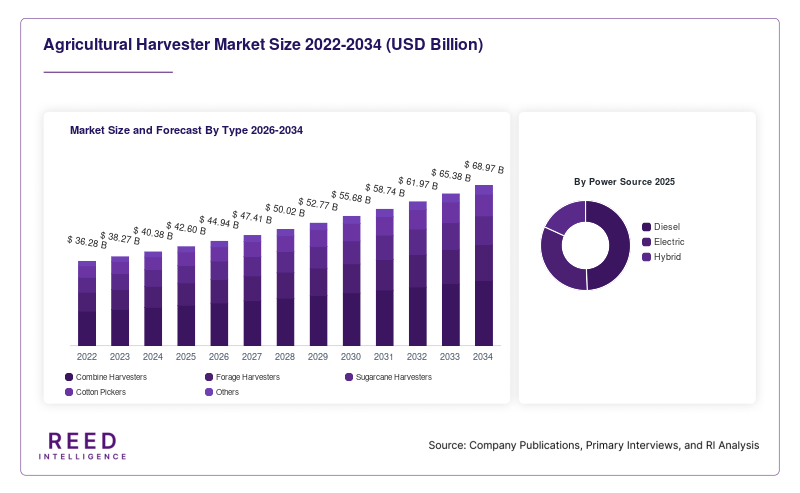
The Agricultural Harvester market is segmented by Type and Power Source to provide a comprehensive market perspective. By Type, Combine Harvesters dominate with a 45% market share, driven by their versatility and high efficiency in grain harvesting. The Power Source segment is led by Diesel, which accounts for 85% of the market, followed by Electric at 10%, and Hybrid at 5%.
By Type
Combine Harvesters represent the largest segment in the Agricultural Harvester market, commanding a 45% share, with revenue exceeding USD 12.8 billion in 2025. These are characterized by their use in harvesting a wide range of grain crops, including wheat, corn, soybeans, and rice, combining reaping, threshing, and winnowing. Technical specifications include cutting width, engine power, and grain tank capacity. The Agricultural Harvester market's Combine segment is driven by its use in large-scale grain farming.
Forage Harvesters capture an 18% share of the Agricultural Harvester market, with revenue of USD 5.1 billion in 2025. These are characterized by their use in harvesting forage crops for silage and animal feed. Technical specifications include throughput capacity, knife sharpening system, and crop processing design. The Agricultural Harvester market's Forage segment is driven by its use in livestock farming.
Sugarcane Harvesters represent 15% of the market, with revenue of USD 4.3 billion in 2025, characterized by their use in harvesting sugarcane, including cutting, cleaning, and chopping. Technical specifications include cutting capacity, hydraulic systems, and ground clearance. The Agricultural Harvester market's Sugarcane segment is driven by its use in sugar and ethanol production.
Cotton Pickers account for 12% of the market, with revenue of USD 3.4 billion in 2025, characterized by their use in harvesting cotton, including spindle and stripper types. Technical specifications include row spacing, picking capacity, and basket size. The Agricultural Harvester market's Cotton segment is driven by its use in the textile industry.
Others account for the remaining 10% of the market, with revenue of USD 2.9 billion in 2025, including harvesters for potatoes, sugar beets, peanuts, and other specialty crops. The Agricultural Harvester market's Others segment is driven by its use in niche and specialty crop production.
By Power Source
Diesel dominates the Agricultural Harvester market, accounting for 85% of sales, representing USD 24.2 billion in 2025. This segment includes use in traditional, high-power harvesters, offering reliability and high torque. Usage penetration exceeds 90% in the conventional harvester market. The Agricultural Harvester market's Diesel segment is characterized by its focus on power, durability, and established infrastructure.
Electric accounts for 10% of the Agricultural Harvester market, with revenue of USD 2.9 billion in 2025. This segment encompasses use in emerging electric and battery-powered harvesters for sustainable and low-emission farming. The segment is growing at a strong CAGR, driven by environmental concerns and technology advancements. The Agricultural Harvester market's Electric segment is characterized by its focus on zero emissions and low noise.
Hybrid represents 5% of the market, with revenue of USD 1.4 billion in 2025, involving use in harvesters combining diesel and electric power for optimal efficiency and reduced fuel consumption. The segment's growth is fueled by the need for improved fuel economy. The Agricultural Harvester market's Hybrid segment is characterized by its focus on efficiency and performance.
Agricultural Harvester Market Regional Outlook
North America Agricultural Harvester Market
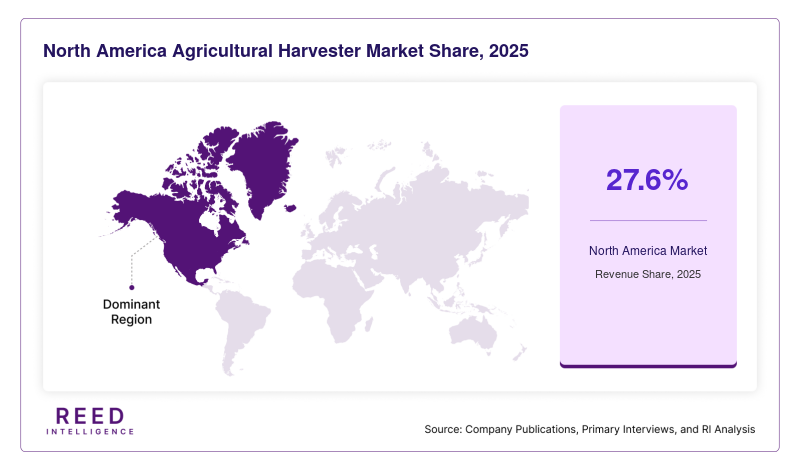
Leads the Agricultural Harvester market, commanding a 30% share, with a revenue of USD 8.6 billion in 2025. The United States is the primary driver, accounting for 85% of regional demand, driven by the large-scale farming operations, high adoption of advanced technology, and strong farm income. The North American Agricultural Harvester market is characterized by its focus on innovation and high-capacity machines.
Asia-Pacific Agricultural Harvester Market
Represents the second-largest market, capturing a 28% share with a revenue of USD 8.0 billion in 2025. China, India, and Japan are the primary drivers, together accounting for 65% of regional demand, driven by the large agricultural sector, growing population, and increasing mechanization. The Asia-Pacific Agricultural Harvester market is projected to grow at the fastest CAGR of 7% through 2034.
Europe Agricultural Harvester Market
Accounts for 22% of the global Agricultural Harvester market, with a revenue of USD 6.3 billion in 2025. Germany, France, and the UK are the primary drivers, together accounting for 55% of regional demand, driven by strong agricultural machinery industry, high-quality standards, and a focus on sustainable farming. The Europe Agricultural Harvester market is characterized by its focus on precision and sustainability.
Middle East & Africa and Latin America Agricultural Harvester Market
Together account for the remaining 20% of the Agricultural Harvester market, with Brazil and South Africa leading their respective regions. Both regions are projected to grow at CAGRs exceeding 6%, driven by the expansion of agricultural land and increasing mechanization.
Top players in Agricultural Harvester Market
- John Deere (Deere & Company)
- CNH Industrial N.V.
- AGCO Corporation
- CLAAS KGaA mbH
- Kubota Corporation
- Mahindra & Mahindra Ltd.
- Yanmar Co., Ltd.
- SDF Group
- Kverneland Group
- Amazone
- Buhler Industries Inc.
- Escorts Limited
- Lovol Heavy Industry Co., Ltd.
- ZOOMLION Heavy Industry Science and Technology Co., Ltd.
- Jiangsu World Agricultural Machinery Co., Ltd.
John Deere (Deere & Company)
John Deere holds a dominant position in the Agricultural Harvester market, with an estimated 18% global market share, particularly strong in the North American, European, and Asian large-scale farming segments. The company's portfolio of combine harvesters, forage harvesters, and other equipment, including the well-known S-Series combines, is widely recognized for its quality, innovation, and performance. John Deere's market leadership is reinforced by its significant investment in R&D and precision technology, its extensive global distribution and service network, and its strong brand reputation. John Deere commands over 22% of the North American market and 15% of the European market for agricultural harvesters, positioning it as a key player in the global market.
CNH Industrial N.V.
CNH Industrial is a leading player in the Agricultural Harvester market, commanding approximately 14% of the global market share through its comprehensive portfolio of agricultural equipment, including the Case IH and New Holland brands. The company's expertise in heavy machinery and its focus on technology have solidified its position. CNH Industrial's harvesters are known for their reliability, performance, and advanced features. The company's commitment to innovation and its strong presence in the North American, European, and Latin American markets have enhanced its competitive advantage.
AGCO Corporation holds a significant 12% market share, with particular strength in the global agricultural equipment market. CLAAS KGaA mbH is a major player in the European harvester market, holding a 10% share, known for its high-quality, premium products.
Recent Developments in Agricultural Harvester Market
- 2025: John Deere launched a new line of autonomous combine harvesters with AI-powered navigation and harvesting capabilities, significantly reducing labor requirements and improving efficiency.
- 2025: CNH Industrial introduced a new electric-powered forage harvester prototype, targeting the growing demand for sustainable and low-emission agricultural equipment.
Agricultural Harvester Market Segments
By Type
- Combine Harvesters
- Forage Harvesters
- Sugarcane Harvesters
- Cotton Pickers
- Others
By Power Source
- Diesel
- Electric
- Hybrid
By Region
- North America
- Europe
- APAC
- Middle East and Africa
- LATAM