Agricultural Pneumatic Integrated Equipment Market Size, Share & Trends Analysis Report By Equipment Type (Pneumatic Seeders, Pneumatic Sprayers, Pneumatic Harvesters), By Application (Crop Farming, Greenhouse Farming, Livestock Farming) Forecasts 2026–2034
USD 3950
Agricultural Pneumatic Integrated Equipment Market Size
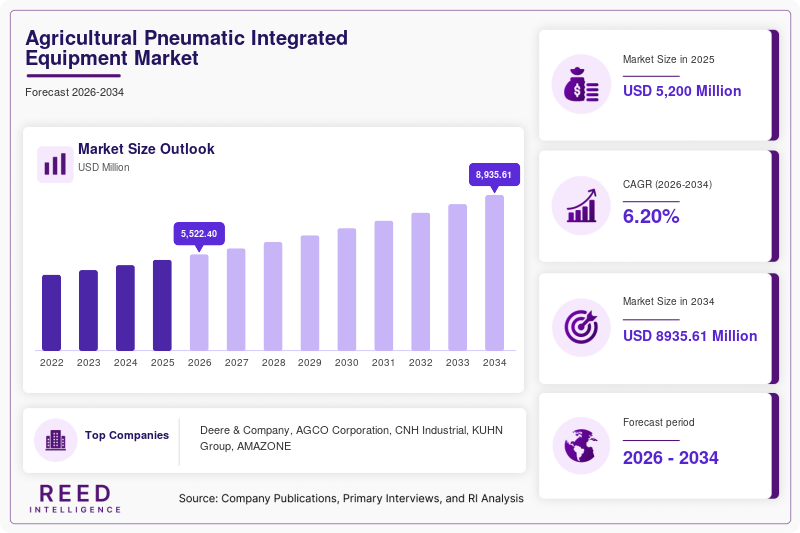
The global agricultural pneumatic integrated equipment market was valued at USD 5,200 million in 2025 and is projected to grow from USD 5,522 million in 2026 to USD 8,935.61 million by 2034, registering a CAGR of 6.20% during the forecast period from 2026 to 2034.
Agricultural Pneumatic Integrated Equipment combines compressed-air, vacuum, metering, conveying and control systems with agricultural implements to manage seeds, fertilizers, crop-protection products and, in some configurations, harvesting operations. Pneumatic seeders and planters use controlled airflow to move seeds from meters or hoppers to individual outlets, while pneumatic downforce systems regulate contact between row units and soil. Current equipment increasingly combines these functions with electric drives, sensors, GPS guidance and digital farm-management platforms.
Precision planting is an important market signal. John Deere's pneumatic planter systems provide continuously adjustable downforce and distribute air through individual row-unit air bags, while its newer integrated systems automate downforce based on target soil conditions.
Agricultural Pneumatic Integrated Equipment Market Drivers
Precision Seed Placement and Variable-Rate Application
Precision agriculture is shifting pneumatic equipment from simple air-delivery mechanisms toward electronically controlled systems. Pneumatic seeders can regulate seed flow through controlled airflow while sensors and variable-rate controls adjust application according to travel speed and field conditions. Commercial systems now combine radar speed sensing, blockage monitoring, electronic metering and operator displays. YongXiang, for example, describes pneumatic seeders with electric or hydraulic fan airflow, radar-based speed measurement, real-time camera monitoring and seed-blockage detection.
This creates a direct connection between pneumatic hardware and farm-level productivity metrics. More consistent seed spacing and placement can reduce skips, doubles and uneven emergence, while variable-rate systems can reduce unnecessary input application. John Deere's precision planter systems similarly combine electric metering, row-by-row control, seed monitoring and pneumatic options, making pneumatic equipment increasingly relevant to integrated precision farming rather than conventional machinery alone.
Expansion of Retrofit-Based Agricultural Technology
The retrofit model is widening adoption because farmers can upgrade existing equipment without replacing complete planters or air seeders. John Deere offers precision upgrades for existing planters and air seeders, including air-seeding metering upgrades, while AGCO's Precision Planting portfolio is explicitly designed around upgrading equipment already in operation.
The commercial mechanism is important for the agricultural pneumatic integrated equipment market because replacement cycles for large agricultural machines can be long and capital intensive. Retrofit-compatible pneumatic controls, meters, compressors, sensors and downforce systems allow manufacturers and dealers to monetize the installed equipment base. This also supports demand from farms seeking incremental improvements in seed placement and input efficiency without undertaking a complete machinery replacement.
Integration of Pneumatic Systems With Automation
Automation is increasingly being embedded into pneumatic equipment. John Deere's integrated pneumatic downforce system can automatically control downforce through a hydraulically driven compressor and G5 display, allowing the operator to establish a target margin while the system responds to changing field conditions.
The implication is that pneumatic components are becoming part of a broader control architecture. Instead of adjusting pressure manually, operators can combine air pressure, soil-resistance information, seed-placement data and machine controls. This integration supports higher operational consistency and creates additional demand for sensors, electronic controls, compressors, actuators and software-compatible pneumatic assemblies.
Agricultural Pneumatic Integrated Equipment Market Restraints
High Equipment and Technology Costs
Integrated pneumatic agricultural equipment requires more than the underlying implement. Fans, compressors, air lines, meters, sensors, electronic controllers and precision displays increase system complexity and acquisition costs. Smaller farms can therefore face a higher capital hurdle than large commercial operations, particularly when advanced pneumatic equipment is purchased as a complete new system rather than as a retrofit.
The economic calculation also depends on crop value, acreage, annual utilization and available financing. A high-capacity pneumatic planter can generate stronger economic justification when used across large acreage and narrow planting windows, whereas low-utilization equipment can extend the payback period. This creates a differentiated adoption pattern across farm sizes and agricultural regions.
Maintenance and System Complexity
Pneumatic equipment contains multiple air-management components that must maintain consistent pressure and airflow. Leaks, blocked delivery tubes, compressor wear, metering problems or sensor failures can affect seed distribution and application consistency. Modern systems add electronic and software dependencies, increasing the number of components that require calibration and technical support.
John Deere's equipment documentation illustrates this complexity through dedicated compressor assemblies, air-delivery lines, air bags, metering systems and monitoring technologies. In remote agricultural areas, limited access to trained service technicians and replacement components can therefore affect equipment uptime and adoption.
Agricultural Pneumatic Integrated Equipment Market Opportunities
Smart Pneumatic Systems and Sensor Integration
The combination of pneumatic hardware with sensors, cameras, GPS and automated controls provides an important opportunity for manufacturers. Modern seeders can monitor seed flow and blockage while electronic systems regulate application rates. John Deere's planter technology similarly combines seed monitoring, electric drives, downforce automation and in-cab displays.
The next stage is likely to involve increasingly closed-loop systems in which field measurements automatically influence pneumatic pressure, seed metering and application rates. Such architectures can increase equipment differentiation because the value shifts from individual mechanical components toward integrated machine performance.
Emerging-Market Mechanization and Precision Upgrades
Agricultural mechanization in developing farming regions creates an opportunity for manufacturers offering scalable pneumatic systems. Equipment designed for different crop types, row configurations and tractor capacities can broaden adoption beyond large-scale North American and European farms. Indian manufacturers already offer pneumatic planters using air-suction technology, high-performance fan systems and precision seed metering.
Retrofit products provide another route into these markets because farmers can upgrade existing machinery rather than purchase complete equipment fleets. The ability to combine pneumatic seed delivery with affordable electronic monitoring and variable-rate control can increase the relevance of integrated equipment across fragmented agricultural markets.
Agricultural Pneumatic Integrated Equipment Market Segmental Analysis
By Equipment Type
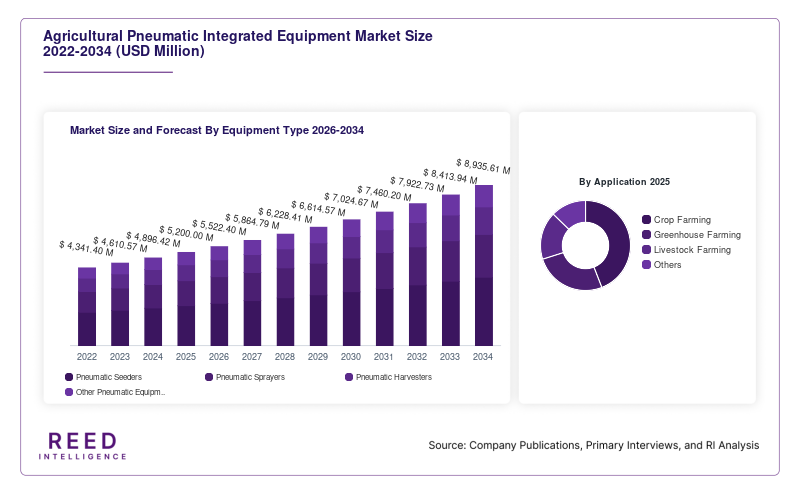
Pneumatic Seeders accounted for the largest segment with approximately 43% market share in 2025, supported by the widespread use of pneumatic seed metering, air-assisted seed delivery and precision planting systems. Pneumatic seeders are increasingly integrated with electronic metering, radar speed sensing, blockage monitoring and variable-rate controls, allowing operators to manage seed placement and application consistency across changing field conditions.
Pneumatic Sprayers represented approximately 29% share, while Pneumatic Harvesters accounted for around 15% and other pneumatic equipment for 13%. Pneumatic Harvesters are projected to record the fastest growth at approximately 7.0% CAGR, as air-assisted crop handling and automation technologies become more integrated into harvesting systems. Pneumatic Sprayers are estimated to expand at 6.3% CAGR, while Pneumatic Seeders and Other Pneumatic Equipment are expected to grow at approximately 6.1% and 5.4%, respectively.
By Application
Crop Farming dominated the application structure with approximately 67% market share in 2025, reflecting the extensive use of pneumatic seeders, planters, fertilizer systems and crop-protection equipment in row crops, cereals, oilseeds and other field crops. Pneumatic systems are particularly relevant where planting accuracy, field coverage and input placement directly influence production efficiency.
Greenhouse Farming accounted for approximately 15%, while Livestock Farming represented 10% and Other Applications approximately 8%. Greenhouse Farming is projected to be the fastest-growing application at around 7.1% CAGR, supported by controlled-environment production and increasing automation of seed, fertilizer and crop-care operations. Crop Farming is estimated to grow at 6.1% CAGR, Livestock Farming at 5.8%, and Other Applications at 5.2%.
Agricultural Pneumatic Integrated Equipment Market Regional Analysis
North America Agricultural Pneumatic Integrated Equipment Market
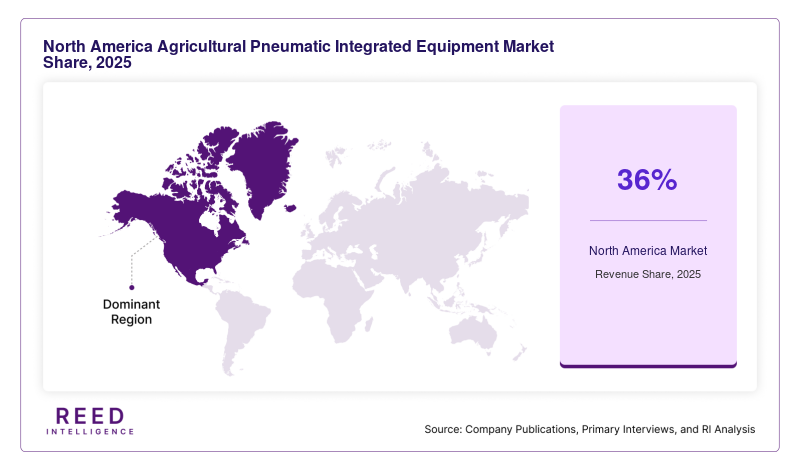
North America held the dominant regional position with approximately 36% market share in 2025. The region benefits from high farm mechanization, large-scale commercial agriculture and established adoption of precision planting technologies. John Deere and AGCO both offer integrated pneumatic and precision solutions, including pneumatic downforce, air-seeding systems and retrofit technologies for existing machinery.
The United States remains the primary demand center, supported by large row-crop acreage and strong adoption of precision agriculture. Canada also contributes through mechanized grain and oilseed production, where air drills and pneumatic seeding systems are widely applicable. North America is estimated to expand at approximately 5.8% CAGR through 2034 as replacement, retrofit and precision-upgrade demand develops.
Europe Agricultural Pneumatic Integrated Equipment Market
Europe is estimated to expand at approximately 5.7% CAGR during 2026–2034. Demand is supported by high machinery sophistication, precision farming adoption and the presence of established agricultural-equipment manufacturers. Pneumatic seeders and sprayers are particularly relevant to cereal, oilseed and specialty-crop production, where controlled seed placement and application efficiency are important.
Germany, France, Italy and the United Kingdom represent major equipment markets, while European manufacturers such as Horsch, Väderstad and Amazone contribute to the region's technological ecosystem. The region's equipment demand is increasingly connected with input efficiency, automated machine control and lower-input agricultural practices.
Asia Pacific Agricultural Pneumatic Integrated Equipment Market
Asia Pacific is projected to be the fastest-growing region at approximately 7.2% CAGR. Mechanization expansion, increasing farm productivity requirements and adoption of precision planting technologies are expanding the addressable market. India and China represent significant manufacturing and consumption bases, while Australia and Japan have more established mechanized farming systems.
India offers particular potential for pneumatic planters and seeders as manufacturers develop equipment adapted to different crops and farm sizes. Products available in the Indian market increasingly incorporate air-suction seed placement, fan systems and precision metering, while Chinese manufacturers are expanding pneumatic equipment production and international distribution.
Latin America Agricultural Pneumatic Integrated Equipment Market
Latin America is estimated to record approximately 6.5% CAGR through 2034. Brazil and Argentina are the principal demand centers because of their large-scale soybean, corn and other row-crop production. Pneumatic seeders and planters are particularly relevant in these systems because they support accurate seed distribution across large cultivated areas.
The region is also becoming a testing and commercialization market for international pneumatic-equipment suppliers. In 2026, Chinese manufacturer YongXiang reported demonstrations of its precision pneumatic seeder in Argentina and participation through its local distributor at AgroActiva, indicating continued localization of pneumatic seeding technologies.
Middle East & Africa Agricultural Pneumatic Integrated Equipment Market
Middle East & Africa is estimated to grow at approximately 6.7% CAGR during 2026–2034. Adoption varies considerably between countries because farm mechanization, irrigation infrastructure, farm sizes and access to agricultural financing differ across the region. Commercial farming operations provide the most immediate addressable market for integrated pneumatic machinery.
South Africa, Egypt and selected Gulf-region agricultural operations are expected to represent important demand centers. In water-constrained and input-sensitive agricultural systems, equipment that combines accurate application, controlled seed placement and automation can provide operational advantages, while dealer networks and maintenance infrastructure remain important factors in adoption.
Agricultural Pneumatic Integrated Equipment Market Competitive Landscape
The agricultural pneumatic integrated equipment market is characterized by competition between global agricultural-machinery manufacturers, specialized precision-agriculture suppliers and regional equipment producers. Major participants compete through planter and air-seeder design, pneumatic metering, downforce control, precision electronics, autonomous functions, aftermarket upgrades and dealer support.
John Deere has a broad integrated technology position spanning planters, air drills, pneumatic downforce and precision upgrades. Its systems combine pneumatic components with SeedStar controls, electric metering, sensors, displays and farm-management connectivity. Its N540F air drill, for example, incorporates separate fertilizer placement, seed-rate/depth control, blockage monitoring and closed-loop downforce pressure control.
Key Market Players
- Deere & Company
- AGCO Corporation
- CNH Industrial
- KUHN Group
- AMAZONE
- HORSCH
- Väderstad
- Kverneland Group
- Great Plains Manufacturing
- Kinze Manufacturing
- Monosem
- Maschio Gaspardo
- Shaktiman Farm Machinery
- Landforce
- YongXiang Agricultural Machinery
Recent Market Developments
- August 2026 – AGCO: AGCO announced its 2026 Farm Progress Show portfolio, including new equipment from Fendt and Massey Ferguson and mixed-fleet retrofit and autonomy solutions from PTx, reinforcing its focus on precision agriculture and equipment upgrades.
- 2026 – John Deere: John Deere expanded its precision-upgrade ecosystem for planters and air seeders, including the AccuRate metering system for air seeders and technologies for improving seed placement, spacing, downforce and nutrient placement on existing planters.
Agricultural Pneumatic Integrated Equipment Market Segments
By Equipment Type
- Pneumatic Seeders
- Pneumatic Sprayers
- Pneumatic Harvesters
- Other Pneumatic Equipment
By Application
- Crop Farming
- Greenhouse Farming
- Livestock Farming
- Others
By Region
- North America
- Europe
- APAC
- Middle East and Africa
- LATAM