Global Agricultural Robots and Drones Market Size, Share & Trends Analysis Report By Product Type (Drones (UAVs), Fixed-wing, Rotary-wing, Hybrid VTOL), By Component (Hardware Sensors (LIDAR, multispectral, thermal, cameras)GPS/GNSS ModulesActuators and ControllersFrames and Mobility Platforms, Software AI/ML for crop recognition, yield mappingFarm Management SystemsReal-time Decision Support Tools , ServicesDrone-as-a-Service (DaaS)Predictive MaintenanceData Processing and Analytics), By Cou
USD 3950
Agricultural Robots and Drones Market Size
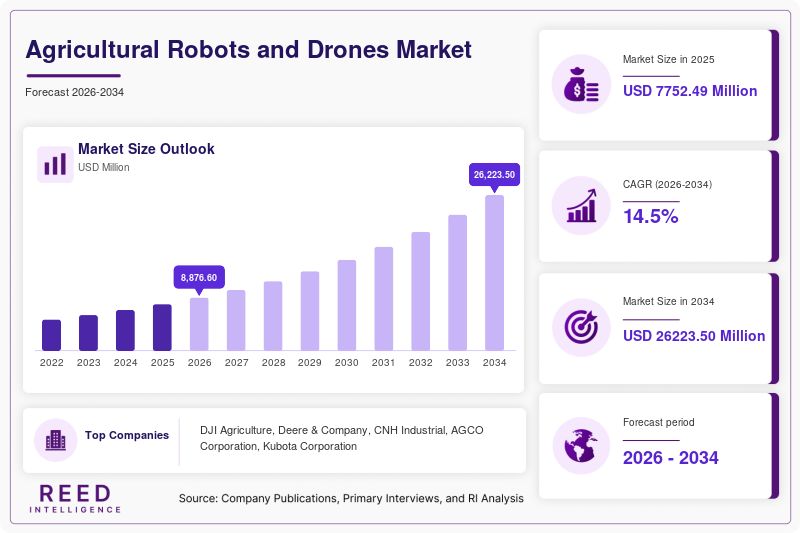
Global Agricultural Robots and Drones Market size is projected at USD 8,876.60 million in 2026 and is expected to hit USD 26,294.19 million by 2034 with a CAGR of 14.5%. The industry is advancing from stand-alone mechanization toward connected autonomous systems combining AI, computer vision, GNSS, LiDAR, multispectral sensing and robotic actuation. Detailed product, component, application, farm-type and geographic segmentation is increasingly important for evaluating adoption patterns and the competitive landscape.
Key Takeaways
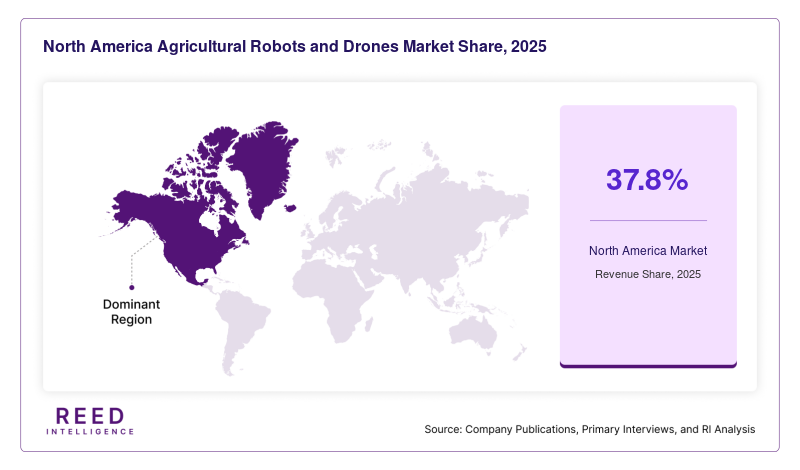
- Dominant region: North America accounts for approximately 37.76% of 2026 revenue and reaches USD 9,839.79 million by 2034 at a 14.41% CAGR.
- Fastest-growing region: Europe advances at the highest regional CAGR of 15.08%, reaching USD 7,319.86 million in 2034.
- Dominant product: Drones (UAVs) represent approximately 20.25% of the product-type total in 2026, valued at USD 1,796.80 million, and expand at 14.60% CAGR.
- Fastest-growing product: Rotary-wing systems record the highest product CAGR at 15.02%, increasing from USD 1,195.43 million in 2026 to USD 3,661.93 million by 2034.
- Emerging geographic opportunity: Latin America increases from USD 702.61 million in 2026 to USD 2,134.40 million in 2034 at a 14.90% CAGR.
The agricultural robots and drones industry comprises aerial UAVs, autonomous tractors, harvesting platforms, milking systems, crop-care robots, robotic manipulators and livestock-monitoring equipment integrated with sensing, navigation and analytics. In 2026, UAVs contribute 20.25%, fixed-wing platforms 16.19%, and rotary-wing systems 13.47% of the supplied product-type total. North America contributes 37.76% of global 2026 revenue, Europe 26.81%, and Asia Pacific 15.75%. Commercial penetration is supported by an installed base exceeding 600,000 DJI agricultural drones operated by more than 600,000 trained operators across over 100 countries and regions by the end of 2025.
Agricultural Robots and Drones Market Trends
AI-Enabled Autonomy and Precision Application Accelerate Technology Transition
Agricultural automation is moving toward AI-assisted perception, edge processing and increasingly autonomous field operations. More than 600,000 DJI agricultural drones were deployed globally by end-2025, compared with approximately 400,000 at end-2024 and more than 300,000 reported during the preceding reporting cycle. Deployed systems serve over 300 crop types across more than 100 countries and regions, illustrating rapid commercialization beyond experimental precision-agriculture programs.
Technology is simultaneously shifting toward higher sensor density and machine autonomy. Deere's second-generation autonomous 9RX architecture employs 16 cameras for 360-degree perception, while orchard systems add LiDAR for dense-canopy navigation. Agricultural drone deployment has generated cumulative savings estimated at 410 million tons of water and approximately 51 million tons of carbon emissions, reinforcing demand for precision spraying, mapping and input optimization.
Agricultural Robots and Drones Market Drivers
Persistent Agricultural Labor Constraints Accelerate Automation Investment
Labor availability is pushing growers toward autonomous tractors, drones and robotic crop-care equipment. Deere cited approximately 2.4 million U.S. farm jobs requiring filling annually, while autonomous platforms can perform time-sensitive operations without a continuously seated operator. Precision UAV adoption also expanded from roughly 400,000 units globally at end-2024 to more than 600,000 DJI units at end-2025, a substantial installed-base increase. Combined with 16-camera tractor perception systems and increasingly automated spraying, these conditions strengthen the business case for substituting repetitive, hazardous and labor-intensive activities with autonomous equipment.
Agricultural Robots and Drones Market Restraints
High Capital Requirements and Operational Complexity Restrict Agricultural Robots and Drones Market Growth
Robotic equipment remains capital intensive relative to conventional machinery, particularly for smaller farms requiring short utilization windows. Research on lower-cost alternatives illustrates this barrier: the experimental AgriCruiser platform still carries a hardware bill of approximately USD 5,000–6,000, despite being specifically designed around commodity components. Field configurations require navigation, sensing, power and maintenance integration, while agricultural UAV fleets can demand repeated charging, payload handling and trained operation. These constraints create a pronounced affordability divide between large commercial farms and smaller producers despite potential labor and input savings.
Agricultural Robots and Drones Market Opportunities
Drone Services and Precision Input Management Expand Commercialization Pathways
Service-based deployment can reduce ownership barriers while expanding access to spraying, mapping and analytics. Agricultural drones had treated more than 500 million hectares globally by 2024, with reported cumulative savings of 210 million metric tons of water, 47,000 metric tons of pesticides, and 25.72 million metric tons of carbon emissions. By end-2025, DJI reported water savings rising to approximately 410 million tons and carbon reductions reaching 51 million tons. These operating benefits support Drone-as-a-Service, fleet management, predictive maintenance and data-processing opportunities.
Challenges in Global Agricultural Robots and Drones Market
Reliability Across Unstructured Agricultural Environments Remains a Commercialization Challenge
Open-field and horticultural environments combine variable terrain, weather, foliage and moving obstacles, increasing perception and manipulation complexity. Deere's autonomous 9RX requires 16 cameras, while orchard autonomy incorporates LiDAR specifically for dense-canopy conditions. Experimental robotic weed-control research reported 24- to 42-fold reductions in weed populations following a robotic spray pass, yet dependable operation across concrete, gravel, grass, wet soil and dry soil required extensive mobility validation. Robustness, interoperability and field-level ROI therefore remain critical commercialization requirements.
Agricultural Robots and Drones Market Segmentation
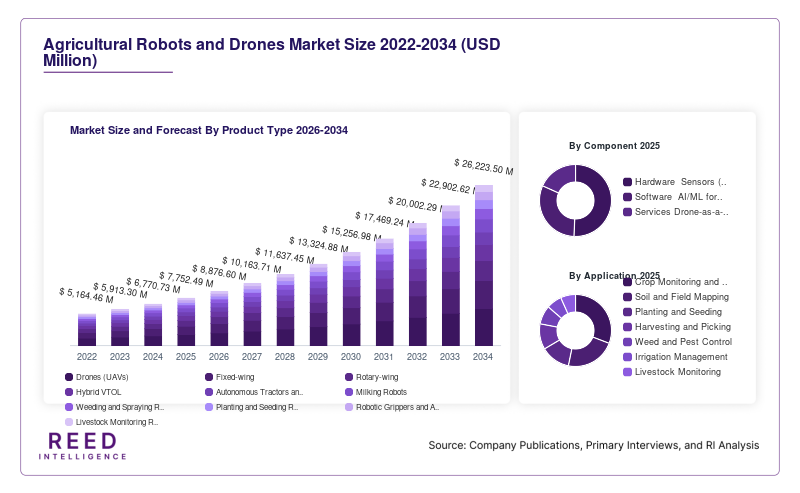
The industry is segmented by product type, component, application, farm type, mobility and end-user. Product data indicate drones lead with 20.25% of 2026 product revenue, followed by fixed-wing platforms at 16.19%, while rotary-wing platforms show the fastest CAGR at 15.02%.
By Product Type
Drones (UAVs) constitute the largest supplied product category, increasing from USD 1,567.89 million in 2025 to USD 1,796.80 million in 2026 and USD 5,345.36 million by 2034 at 14.60% CAGR. Their advantage reflects multi-purpose monitoring, mapping, spraying and seeding capabilities.
Rotary-wing platforms are the fastest-growing product category at 15.02% CAGR, ahead of robotic grippers and arms at 14.74% and livestock-monitoring robots at 14.79%. Fixed-wing, hybrid VTOL, autonomous tractors, milking robots, spraying robots, planting robots and livestock systems broaden the addressable automation base.
By Component
Hardware remains central to deployed systems because sensors, GPS/GNSS modules, actuators, controllers and mobility platforms enable autonomous perception and movement. The leading product category associated with these technology stacks—UAVs—is valued at USD 1,796.80 million in 2026 and grows at 14.60% CAGR.
Software and services are increasingly embedded around AI/ML recognition, yield mapping, farm management, real-time decision support, DaaS and analytics. Within the supplied product benchmark, rotary-wing systems provide the fastest expansion reference at 15.02% CAGR, highlighting increasing demand for software-intensive aerial automation.
By Application
Crop monitoring and analysis represents a core deployment area because UAV imaging, multispectral sensing and AI analytics permit rapid field assessment. Drones, the largest supplied technology category, reach USD 5,345.36 million by 2034 from USD 1,796.80 million in 2026 at 14.60% CAGR.
Soil mapping, planting, harvesting, pest control, irrigation and livestock monitoring diversify application demand. Rotary-wing systems, particularly suitable for localized observation and spraying, register the fastest product CAGR of 15.02%.
By Farm Type
Field crops provide extensive operating areas for autonomous tractors, mapping UAVs and precision sprayers. The leading UAV category stands at USD 1,796.80 million in 2026 and USD 5,345.36 million by 2034, expanding at 14.60% CAGR.
Horticulture, dairy, greenhouses and specialty crops support task-specific robots requiring precise maneuverability. Rotary-wing systems record the fastest product CAGR at 15.02%, benefiting applications requiring hovering and targeted treatment.
By Mobility Type
Aerial robots form a major mobility class, reflected by UAV revenue of USD 1,796.80 million in 2026 and USD 5,345.36 million in 2034 at 14.60% CAGR. Ground platforms include wheeled and tracked machines for tillage, harvesting and crop care.
Hybrid systems integrate aerial intelligence with ground execution. Rotary-wing technology expands at the fastest supplied product CAGR of 15.02%, while hybrid VTOL platforms advance at 14.33%.
By End-User
Large commercial farms represent a primary automation customer group because fleet utilization improves equipment economics. UAVs, the largest product category, generate USD 1,796.80 million in 2026 and expand at 14.60% CAGR.
Medium, small and family farms increasingly access automation through contracting and service models. Rotary-wing systems show the strongest supplied product trajectory at 15.02% CAGR, supporting scalable monitoring and precision-treatment services.
Agricultural Robots and Drones Market Regional Outlook
North America
North America leads with approximately 37.76% of 2026 global revenue, rising from USD 3,351.77 million to USD 9,839.79 million by 2034 at 14.41% CAGR. The United States anchors regional deployment through large-scale field crops, autonomous tractors, precision spraying and technology-intensive commercial farming.
Europe
Europe represents approximately 26.81% of 2026 revenue and records the fastest regional CAGR of 15.08%, reaching USD 7,319.86 million by 2034 from USD 2,379.60 million. Germany, France, the Netherlands, Italy and Spain support adoption across arable crops, dairy, horticulture and specialty farming.
APAC
Asia Pacific contributes approximately 15.75% in 2026, with revenue rising from USD 1,398.46 million to USD 4,025.76 million by 2034 at 14.13% CAGR. China, Japan, India and Australia support demand across rice, grains, horticulture and large-scale precision farming.
Middle East and Africa
Middle East and Africa accounts for approximately 11.76% of 2026 revenue, expanding from USD 1,044.16 million to USD 2,974.38 million by 2034 at 13.98% CAGR. Water-efficient crop monitoring, irrigation management and precision application are important adoption areas.
Latin America
Latin America represents approximately 7.92% of 2026 revenue but expands at a strong 14.90% CAGR, reaching USD 2,134.40 million in 2034 from USD 702.61 million. Brazil and Argentina are major deployment centers, particularly for grains, oilseeds, sugarcane and large commercial farms.
Top players in Global Agricultural Robots and Drones Market
- DJI Agriculture
- Deere & Company
- CNH Industrial
- AGCO Corporation
- Kubota Corporation
- Yanmar Holdings
- Trimble Inc.
- Naïo Technologies
- Carbon Robotics
- Lely
- GEA Group
- BouMatic
- AgEagle Aerial Systems
- Ecorobotix
- Agrobot
Top Two Companies
-
DJI Agriculture: DJI holds a leading competitive position in agricultural UAV deployment, with more than 600,000 DJI agricultural drones operating across over 100 countries and regions by end-2025 and a service and repair network of approximately 3,500 locations. Its installed-base scale makes the company a major participant in the aerial agricultural automation segment, although a reliable percentage of total industry revenue share cannot be derived from the supplied market tables or public deployment statistics.
-
Deere & Company: Deere occupies a leading position in autonomous ground machinery through its tractor, perception and precision-agriculture ecosystem. Its second-generation autonomous 9RX uses 16 cameras arranged for 360-degree field perception, while autonomous orchard equipment adds LiDAR-based navigation. Public disclosures establish strong technological positioning but do not provide directly comparable revenue data sufficient to calculate an audited percentage of the total market.
Recent Developments in Global Agricultural Robots and Drones Market
- 2026: DJI reported more than 600,000 agricultural drones deployed globally, supported by 3,500 service and repair centers.
- 2025: John Deere unveiled second-generation autonomous equipment at CES, including the autonomous 9RX with 16-camera perception and an autonomous 5ML orchard tractor.
- 2025: Kubota unveiled its Type: V versatile autonomous platform concept, designed with adjustable dimensions and automatic implement replacement for multiple agricultural operations.
- 2025: Kubota expanded GNSS-assisted straight-driving functionality into 80–105 horsepower tractors, 5-row and 6-row combines and vegetable-transplanting equipment.
- 2025: DJI reported approximately 400,000 agricultural drones operating with 400,000 trained operators across 100 countries, demonstrating the increasing commercial scale of aerial precision agriculture.
Agricultural Robots and Drones Market Segments
By Product Type
- Drones (UAVs)
- Fixed-wing
- Rotary-wing
- Hybrid VTOL
- Autonomous Tractors and Harvesters
- Milking Robots
- Weeding and Spraying Robots
- Planting and Seeding Robots
- Robotic Grippers and Arms
- Livestock Monitoring Robots
By Component
-
Hardware
- Sensors (LIDAR, multispectral, thermal, cameras)
- GPS/GNSS Modules
- Actuators and Controllers
- Frames and Mobility Platforms
-
Software
- AI/ML for crop recognition, yield mapping
- Farm Management Systems
- Real-time Decision Support Tools
-
Services
- Drone-as-a-Service (DaaS)
- Predictive Maintenance
- Data Processing and Analytics
By Application
- Crop Monitoring and Analysis
- Soil and Field Mapping
- Planting and Seeding
- Harvesting and Picking
- Weed and Pest Control
- Irrigation Management
- Livestock Monitoring
By Farm Type
- Field Crops
- Horticulture
- Dairy Farms
- Greenhouses
- Specialty Crops (e.g., vineyards, floriculture)
By Mobility Type
- Aerial Robots (Drones)
-
Ground Robots
- Wheeled
- Tracked
- Hybrid Systems
By End-User
- Large Commercial Farms
- Medium Farms
- Small and Family Farms
By Region
- North America
- Europe
- APAC
- Middle East and Africa
- LATAM