Agricultural Rollers Market Size, Share & Demand Report By Product Type (Cambridge Rollers, Flat Rollers, Packer Rollers, Ring Rollers, Land Rollers), By Application (Seedbed Preparation, Grassland Maintenance, Soil Compaction Control, Residue Management, Post-Seeding Operations), By Farm Size (Small-Scale Farms, Medium-Scale Farms, Large-Scale Commercial Farms), By Region & Segment Forecasts, 2026–2034
USD 3950
Market Overview
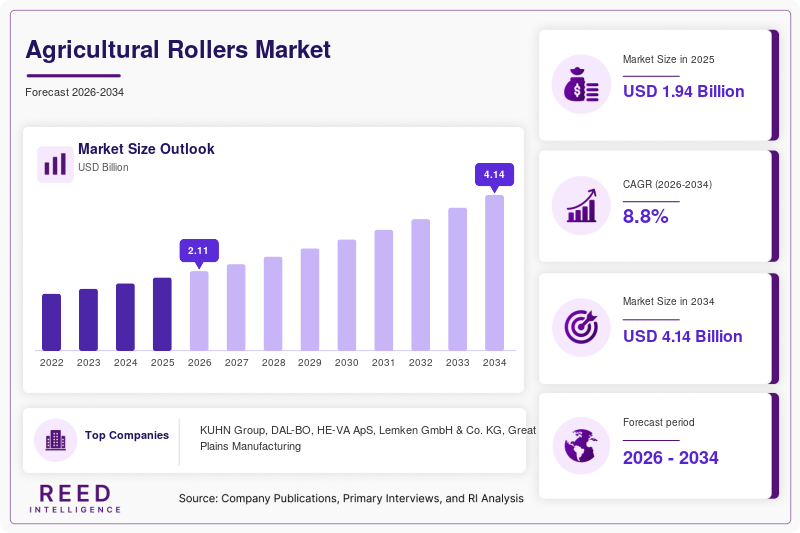
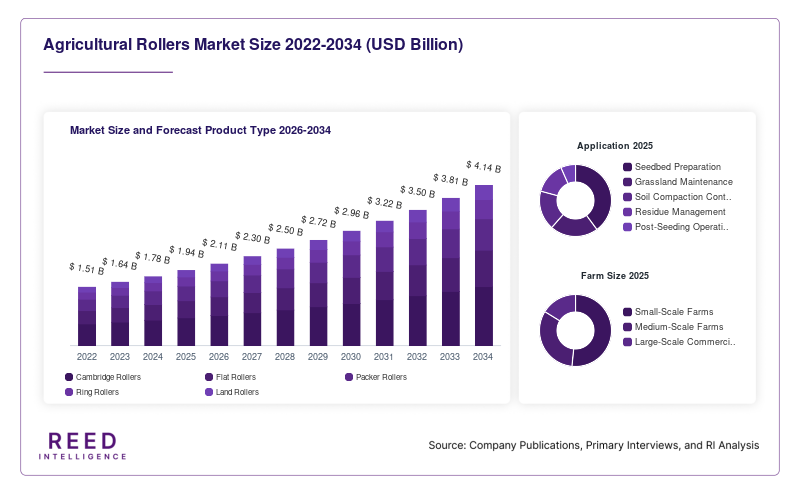
The global Agricultural Rollers Market size was valued at USD 1.94 billion in 2026 and is projected to reach USD 3.82 billion by 2034, expanding at a CAGR of 8.8% during the forecast period from 2026 to 2034. Agricultural rollers are increasingly used across modern farming operations to improve soil structure, support seedbed preparation, reduce moisture loss, and enhance crop establishment efficiency. The growing adoption of mechanized farming equipment in both developed and emerging agricultural economies continues to support steady market expansion. Farmers are also investing in equipment that improves operational efficiency while reducing labor dependency, particularly in regions experiencing labor shortages and rising cultivation costs.
One of the major global factors supporting market growth is the rapid expansion of precision farming practices. Agricultural producers are focusing on improving crop yield consistency and optimizing soil conditions to achieve higher productivity per hectare. Rollers equipped with advanced hydraulic systems, adjustable pressure configurations, and durable steel drum technologies are becoming essential components within integrated farm machinery systems. In addition, increasing government initiatives supporting agricultural mechanization, combined with the rising need for sustainable soil management practices, are accelerating equipment demand across commercial farming operations.
Key Highlights
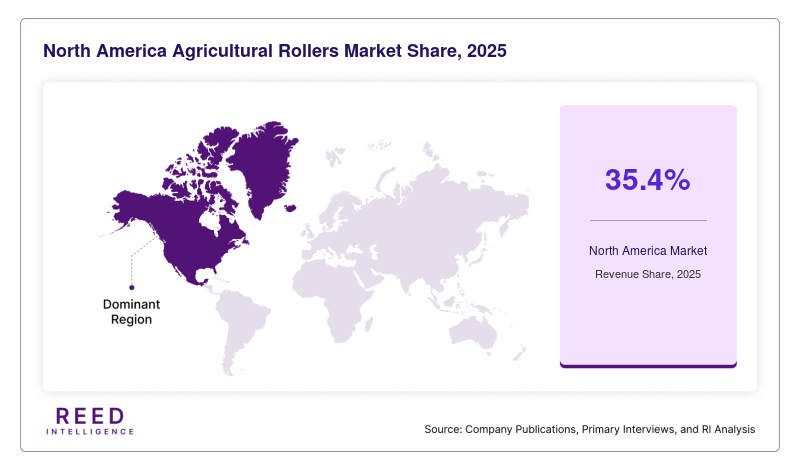
- North America dominated the market with a 35.4% share in 2025, while Asia Pacific is expected to grow at the fastest CAGR of 10.9% during 2026–2034.
- By product type, Cambridge rollers accounted for the largest share of 39.1%, while flat rollers are projected to grow at a CAGR of 11.4%.
- By application, seedbed preparation led with a 43.8% share, whereas grassland maintenance is expected to expand at a CAGR of 10.7%.
- By farm size, large-scale commercial farms accounted for the highest share of 48.6%, while medium-scale farms are anticipated to grow at a CAGR of 11.1%.
- The United States remained the dominant country, with market values of USD 468 million in 2024 and USD 512 million in 2025.
Market Trends
Integration of Precision Farming Technologies with Roller Equipment
Agricultural equipment manufacturers are increasingly integrating precision farming technologies into agricultural rollers to improve operational efficiency and field accuracy. GPS-enabled roller systems, automated depth adjustment features, and real-time soil pressure monitoring solutions are gaining popularity among commercial farming operations. Farmers are adopting connected equipment platforms that allow operators to monitor rolling performance, soil conditions, and field coverage through digital dashboards. This trend is especially visible in North America and Europe, where large farms prioritize fuel optimization and data-driven cultivation practices. Precision-enabled rollers help reduce overlaps during field operations and improve soil consistency across planting zones. Equipment suppliers are also developing smart hydraulic systems that automatically adjust pressure according to terrain variation and crop requirements. The demand for technology-integrated rollers is expected to increase further as precision agriculture adoption expands across emerging agricultural economies.
Rising Preference for Sustainable Soil Management Practices
The increasing focus on sustainable farming practices is influencing purchasing decisions across the Agricultural Rollers Market. Farmers are prioritizing equipment that improves soil structure without causing excessive compaction or moisture imbalance. Agricultural rollers are being designed with improved drum configurations and lighter frame structures to support reduced environmental impact during cultivation activities. Conservation agriculture programs in several countries are encouraging the use of rollers to enhance residue management and improve moisture retention after planting. Demand for eco-efficient farm machinery is also increasing due to rising awareness regarding long-term soil fertility preservation. Manufacturers are responding by introducing modular roller systems with replaceable components, lower maintenance requirements, and improved fuel efficiency. The trend toward sustainable soil preparation is expected to strengthen as governments and agricultural organizations continue promoting regenerative farming practices and environmentally responsible cultivation methods.
Market Drivers
Expansion of Farm Mechanization Across Developing Agricultural Economies
The growing adoption of mechanized farming equipment across developing agricultural economies is supporting strong demand for agricultural rollers. Countries across Asia Pacific, Latin America, and parts of Africa are witnessing increasing investments in tractors, tillage equipment, and soil management machinery to improve agricultural productivity. Rising labor shortages in rural farming communities are accelerating the shift toward mechanized cultivation practices. Agricultural rollers help farmers reduce manual field preparation efforts while improving planting consistency and crop emergence rates. Governments are also introducing subsidy programs and agricultural modernization initiatives that encourage the adoption of advanced farming equipment among small and medium-scale producers. The availability of affordable financing options through agricultural cooperatives and rural banks further supports equipment purchases. As commercial farming activities expand and producers focus on improving operational efficiency, the adoption of agricultural rollers is expected to increase steadily across emerging markets.
Growing Demand for Improved Seedbed Preparation and Crop Yield Optimization
Farmers are increasingly focusing on seedbed preparation techniques that improve germination rates, moisture retention, and soil uniformity. Agricultural rollers play a critical role in creating firm seedbeds that support better seed-to-soil contact and consistent crop establishment. The rising demand for high-yield crop production is encouraging farmers to invest in equipment that enhances planting outcomes while reducing soil moisture loss. Rollers are widely used after seeding operations to break soil clumps, improve root penetration conditions, and minimize air pockets within cultivated fields. Commercial grain producers, forage crop cultivators, and horticulture farms are particularly adopting advanced roller systems to improve overall cultivation efficiency. In regions experiencing unpredictable weather conditions, properly rolled fields also help retain moisture and reduce soil erosion risks. These agronomic advantages continue to strengthen the demand for agricultural rollers across diversified farming operations worldwide.
Market Restraint
High Initial Equipment Costs and Maintenance Challenges
The relatively high initial investment associated with advanced agricultural rollers remains a significant challenge for market expansion, particularly among small-scale farmers in developing economies. Modern roller systems equipped with hydraulic controls, adjustable pressure mechanisms, and precision farming compatibility often require substantial capital expenditure. Many farmers operating on limited budgets prioritize essential machinery such as tractors and seeders before investing in specialized soil management equipment. In addition, maintenance costs associated with roller bearings, drum replacements, hydraulic systems, and transport wheels can create financial pressure for equipment owners over the long term. Seasonal usage patterns also reduce equipment utilization rates, making some farmers hesitant to purchase standalone roller systems.
The restraint is more visible in regions with fragmented land ownership and low farm profitability. Smaller farms may depend on rental equipment or shared machinery services instead of direct purchases. Limited technical support infrastructure in rural markets can also increase repair downtime and operating expenses. For example, farmers using heavy-duty rollers in rocky or uneven field conditions frequently experience higher maintenance requirements due to structural wear and drum damage. These factors may slow adoption rates in price-sensitive agricultural regions despite the operational benefits associated with agricultural rollers.
Market Opportunities
Increasing Adoption of Multi-Purpose and Modular Roller Systems
The growing preference for multi-purpose agricultural machinery is creating significant opportunities for manufacturers operating in the Agricultural Rollers Market. Farmers increasingly seek equipment capable of performing multiple field operations to reduce machinery ownership costs and improve operational flexibility. As a result, demand is rising for modular roller systems that can be combined with seeders, harrows, cultivators, and tillage equipment. Multi-functional rollers allow farmers to complete soil preparation and rolling operations within a single field pass, reducing fuel consumption and labor requirements. Manufacturers are investing in product innovation to develop interchangeable roller components suitable for varying soil conditions and crop types. Demand for compact and transport-friendly roller designs is also increasing among medium-scale farms with diverse cultivation needs. The expansion of modular agricultural machinery solutions is expected to generate new revenue opportunities for equipment suppliers during the forecast period.
Expansion of Agricultural Equipment Rental and Leasing Services
The rapid development of agricultural equipment rental and leasing services is opening new growth opportunities across emerging markets. Many small and medium-scale farmers prefer renting specialized equipment instead of making high upfront capital investments. Agricultural cooperatives, machinery-sharing platforms, and rural equipment service providers are expanding their fleets to include agricultural rollers alongside tractors and tillage machinery. This trend is particularly strong in Asia Pacific and Latin America, where farm fragmentation and seasonal cultivation patterns influence purchasing behavior. Equipment rental models allow farmers to access modern roller systems during peak cultivation periods without bearing full ownership costs. Digital platforms offering on-demand machinery booking services are further improving equipment accessibility in rural areas. As agricultural service ecosystems become more organized and technology-driven, rental-based access to agricultural rollers is expected to contribute significantly to overall market penetration.
Segmental Analysis
By Product Type
Cambridge rollers accounted for the largest share of the Agricultural Rollers Market in 2024, representing 39.1% of global revenue. The segment maintains a strong market position due to its effectiveness in seedbed preparation and soil consolidation across a wide range of crop cultivation activities. Cambridge rollers are widely preferred by grain producers because they provide efficient clod breaking, moisture retention support, and improved seed-to-soil contact. Their durable construction and compatibility with varying soil textures further contribute to extensive adoption across commercial farming operations. Farmers also favor these rollers because they can operate efficiently under different field conditions while reducing surface roughness before planting activities. The availability of multiple width configurations and hydraulic folding mechanisms has improved operational convenience for large-scale farms. Manufacturers continue introducing reinforced steel designs and improved transport features to increase equipment durability and field productivity.
Flat rollers are projected to register the fastest CAGR of 11.4% during the forecast period due to rising adoption across pasture management and grassland maintenance applications. These rollers are increasingly used to level uneven field surfaces, improve seed coverage, and support moisture conservation practices. Demand is particularly strong among livestock farming operations where maintaining pasture quality remains essential for feed productivity. Manufacturers are developing lightweight flat roller systems that reduce tractor power requirements and improve fuel efficiency during field operations. The segment is also benefiting from increasing use in sports turf maintenance and specialty crop farming activities. Growing awareness regarding the advantages of uniform surface compaction in improving crop establishment is further supporting adoption. In emerging agricultural markets, flat rollers are gaining popularity because of their relatively simple design, lower maintenance requirements, and suitability for small and medium-scale farming operations.
By Application
Seedbed preparation emerged as the dominant application segment in 2024, accounting for 43.8% of the global Agricultural Rollers Market share. Farmers across major agricultural economies increasingly rely on rollers to create firm and uniform seedbeds that enhance germination rates and support consistent crop emergence. Proper seedbed preparation helps improve moisture retention and minimizes air gaps around seeds, resulting in better root establishment and early plant growth. Commercial grain producers particularly utilize rollers following tillage and seeding operations to improve field uniformity before crop emergence. The increasing focus on yield optimization and precision farming practices continues to strengthen demand for roller systems within this application category. Equipment manufacturers are introducing wider and more durable roller configurations to support efficient operations across extensive agricultural fields. Growing adoption of conservation tillage practices has also reinforced the importance of effective seedbed preparation equipment.
Grassland maintenance is anticipated to witness the fastest CAGR of 10.7% during the forecast period due to increasing investments in livestock farming and forage crop management. Agricultural rollers are widely used in pasture management to flatten molehills, improve grass growth conditions, and maintain even grazing surfaces. Livestock producers are increasingly focusing on pasture productivity to support efficient feed management and improve animal health outcomes. Demand for rollers in grassland applications is also increasing due to expanding dairy farming activities across several agricultural regions. Manufacturers are introducing specialized roller systems designed for low ground pressure operations to prevent excessive pasture damage during maintenance activities. The segment is further supported by rising awareness regarding the importance of pasture quality in sustainable livestock production systems. Government programs promoting efficient forage management are also contributing to increased adoption of grassland maintenance equipment.
By Farm Size
Large-scale commercial farms held the dominant share of 48.6% in the Agricultural Rollers Market in 2024 due to extensive use of mechanized farming equipment across high-volume agricultural operations. These farms typically operate across large cultivation areas where efficient soil management and field preparation are essential for maximizing productivity. Commercial agricultural enterprises frequently invest in advanced roller systems integrated with precision farming technologies to improve operational accuracy and reduce cultivation costs. The adoption of heavy-duty and wide-width rollers is especially high among grain producers cultivating wheat, corn, and soybean crops. Large-scale farms also benefit from stronger financial capacity, allowing them to adopt technologically advanced equipment with hydraulic folding systems and automated pressure controls. Manufacturers prioritize this customer segment by introducing high-capacity roller models designed to improve field coverage efficiency and minimize downtime during peak cultivation seasons.
Medium-scale farms are expected to register the fastest CAGR of 11.1% between 2026 and 2034 as mechanization adoption expands across developing agricultural economies. Farmers operating medium-sized agricultural businesses are increasingly investing in affordable and multi-functional roller systems to improve cultivation efficiency while managing operational costs. Government subsidy programs and easier access to agricultural financing are supporting machinery purchases among this farm category. Demand for compact and modular roller systems is particularly strong because these farms often cultivate diverse crop varieties requiring flexible field preparation solutions. Manufacturers are responding by offering mid-range roller models with simplified maintenance requirements and improved transport convenience. The increasing availability of rental and leasing services is also helping medium-scale farms gain access to advanced roller technologies without making significant capital investments. These factors are expected to support steady growth across the segment during the forecast period.
Regional Analysis
North America
North America accounted for 35.4% of the global Agricultural Rollers Market share in 2025 and is expected to maintain a stable growth trajectory during the forecast period. The regional market is projected to expand at a CAGR of 7.9% between 2026 and 2034 due to strong farm mechanization levels and advanced agricultural infrastructure. Commercial grain producers across the United States and Canada continue investing in soil management equipment to improve field efficiency and crop productivity. The widespread adoption of precision agriculture technologies also supports the integration of advanced roller systems across large-scale farming operations.
The United States remains the dominant country within the regional market due to extensive cultivation of corn, soybean, and wheat crops across mechanized farming regions. A major growth factor supporting demand is the increasing use of conservation tillage practices aimed at improving soil moisture retention and reducing erosion risks. Farmers are increasingly adopting heavy-duty and precision-compatible rollers that support uniform seedbed preparation across large agricultural fields. Equipment manufacturers are also strengthening dealer networks and after-sales service capabilities across rural farming communities.
Europe
Europe represented 27.1% of the global Agricultural Rollers Market in 2025 and is forecast to expand at a CAGR of 8.1% through 2034. Demand for agricultural rollers in the region is supported by strong adoption of sustainable farming practices and high utilization of mechanized cultivation systems. Farmers across Western and Central Europe increasingly prioritize soil structure management and crop establishment efficiency. Regulatory emphasis on environmentally responsible agricultural practices is encouraging the use of equipment that minimizes soil degradation while supporting higher productivity levels.
Germany remains the leading country in the European market due to its technologically advanced agricultural sector and extensive use of precision farming systems. One unique growth factor driving regional demand is the expansion of regenerative agriculture programs aimed at improving long-term soil fertility. Farmers are adopting advanced rollers to support residue management, moisture preservation, and reduced tillage operations. In addition, agricultural machinery manufacturers across Germany, France, and Italy continue investing in lightweight and fuel-efficient roller technologies designed for diverse soil conditions.
Asia Pacific
Asia Pacific held 22.8% of the global Agricultural Rollers Market share in 2025 and is projected to register the fastest CAGR of 10.9% during the forecast period. Rapid agricultural modernization, increasing mechanization rates, and expanding commercial farming activities are driving strong regional demand. Governments across China, India, and Southeast Asian countries are introducing subsidy programs that encourage the adoption of advanced farm machinery. Rising labor shortages in agricultural communities are also accelerating the transition toward mechanized field operations.
China dominates the Asia Pacific market due to large-scale agricultural production and growing investments in modern cultivation technologies. A unique factor supporting market expansion is the increasing development of high-efficiency farming zones focused on improving national food security. Farmers are investing in rollers to enhance crop emergence consistency and optimize planting efficiency across extensive cultivation areas. Local manufacturers are also expanding production capabilities to offer cost-effective roller systems tailored to regional crop patterns and farm sizes.
Middle East & Africa
The Middle East & Africa region accounted for 7.2% of the global Agricultural Rollers Market in 2025 and is anticipated to grow at a CAGR of 8.5% from 2026 to 2034. Agricultural modernization initiatives and expanding irrigation-based farming activities are supporting market development across several countries. Governments are investing in mechanized farming equipment to improve food production efficiency and reduce reliance on imported agricultural products. Demand for durable and low-maintenance roller systems is increasing in regions characterized by challenging soil and climate conditions.
South Africa remains the dominant country within the regional market due to its comparatively developed commercial farming sector and higher machinery adoption rates. One distinctive growth factor is the rising investment in climate-resilient agriculture aimed at improving productivity under variable weather conditions. Farmers are increasingly using rollers to improve soil moisture retention and reduce surface evaporation in dry cultivation environments. Agricultural development programs across Gulf countries are also supporting the expansion of mechanized farming infrastructure.
Latin America
Latin America captured 7.5% of the global Agricultural Rollers Market share in 2025 and is projected to grow at a CAGR of 8.7% during the forecast period. The region benefits from extensive cultivation of soybean, sugarcane, maize, and forage crops across large commercial farming areas. Agricultural producers are investing in mechanized soil preparation equipment to improve planting efficiency and support export-oriented crop production. Increasing adoption of no-till farming systems is also contributing to growing demand for advanced roller technologies.
Brazil dominates the Latin American market due to its large agricultural economy and strong focus on productivity improvement across commercial farming operations. A unique growth factor supporting regional demand is the rapid expansion of integrated crop-livestock farming systems that require efficient soil conditioning practices. Farmers are adopting rollers to support pasture maintenance and improve crop establishment across rotational farming systems. Regional equipment distributors are also expanding financing programs that improve machinery accessibility for medium-scale agricultural producers.
Competitive Landscape
The Agricultural Rollers Market remains moderately fragmented, with global and regional manufacturers competing through product innovation, distribution expansion, and strategic partnerships. Leading companies focus on developing durable and fuel-efficient roller systems capable of operating under diverse agricultural conditions. Manufacturers are increasingly integrating precision agriculture compatibility, hydraulic folding systems, and modular configurations into their product portfolios to strengthen market competitiveness.
One of the leading participants in the market is entity["company","KUHN Group","Agricultural machinery manufacturer"], which continues expanding its agricultural roller portfolio through advanced soil management technologies and wider equipment compatibility. The company recently introduced an upgraded roller series featuring reinforced frame structures and improved transport systems aimed at large-scale farming operations.
Key Players
- KUHN Group
- DAL-BO
- HE-VA ApS
- Lemken GmbH & Co. KG
- Great Plains Manufacturing
- Degelman Industries
- Väderstad AB
- Kverneland Group
- Mandako Agricultural Equipment
- Rite Way Manufacturing
- HORSCH Maschinen GmbH
- Landoll Corporation
- McFarlane Ag Manufacturing
- Bourgault Industries
- Agri-Fab Inc.
Recent Developments
- In February 2026, KUHN Group launched an upgraded agricultural roller series with enhanced hydraulic folding systems designed for large-scale grain farming applications.
- In September 2025, DAL-BO expanded its manufacturing capacity in Europe to support increasing demand for precision-compatible agricultural rollers.
- In June 2025, HE-VA ApS introduced lightweight roller models developed for reduced soil compaction and improved fuel efficiency during field operations.
- In March 2026, Väderstad AB announced a strategic dealer expansion initiative across Asia Pacific to strengthen regional agricultural equipment distribution capabilities.
- In November 2025, Great Plains Manufacturing released a modular roller attachment system designed to improve compatibility with multi-purpose cultivation equipment.
Agricultural Rollers Market Segments
Product Type
- Cambridge Rollers
- Flat Rollers
- Packer Rollers
- Ring Rollers
- Land Rollers
Application
- Seedbed Preparation
- Grassland Maintenance
- Soil Compaction Control
- Residue Management
- Post-Seeding Operations
Farm Size
- Small-Scale Farms
- Medium-Scale Farms
- Large-Scale Commercial Farms
Region
- North America
- Europe
- Asia Pacific
- Middle East & Africa
- Latin America
By Region
- North America
- Europe
- APAC
- Middle East and Africa
- LATAM