Agricultural Ventilation Fans Market Size, Share Demand Report By Type (Axial Fans, Centrifugal Fans), By Application (Livestock Housing, Greenhouse Ventilation), By End-Use (Commercial Farms, Small & Medium Farms) By Region & Segment Forecasts, 2026–2034
USD 3950
Market Overview
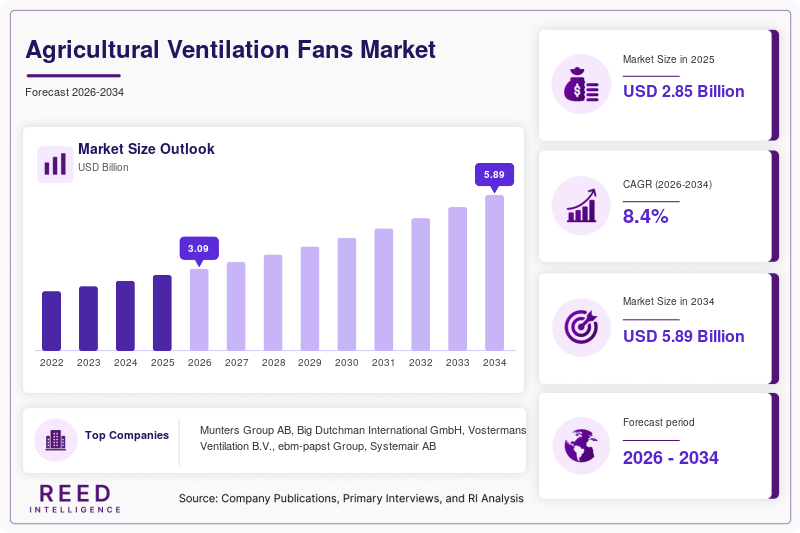
The Agricultural Ventilation Fans Market was valued at approximately USD 2.85 billion in 2026 and is projected to reach USD 5.42 billion by 2034, expanding at a CAGR of 8.4% during 2026–2034. The market is experiencing steady expansion due to the increasing adoption of controlled-environment agriculture and the growing need to maintain optimal air circulation in livestock housing and greenhouse structures. Efficient ventilation systems are essential to regulate temperature, humidity, and air quality, directly influencing crop yield and animal health.
One of the primary global factors supporting market growth is the rising demand for high-efficiency farming systems amid climate variability. As weather patterns become less predictable, farmers are investing in advanced ventilation technologies to ensure stable production environments. Additionally, government support for modern agricultural practices and increased awareness about livestock welfare are further driving the adoption of energy-efficient ventilation fans.
Key Highlights
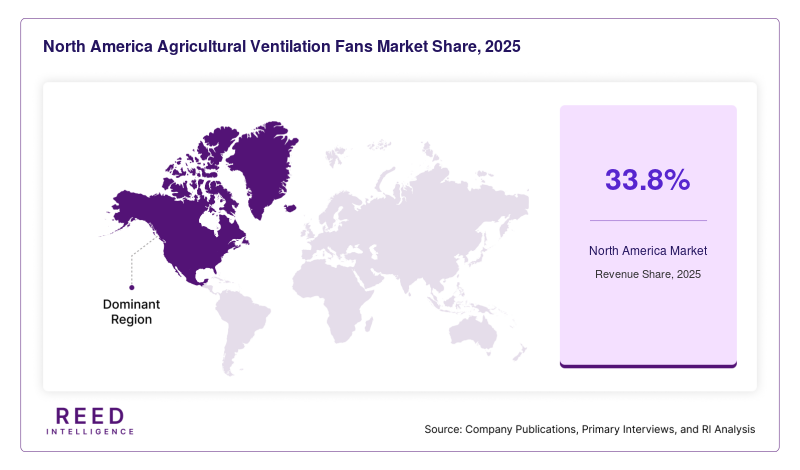
- North America dominated the market with a 33.8% share in 2025.
- Asia Pacific is expected to grow at the fastest CAGR of 9.6% during 2026–2034.
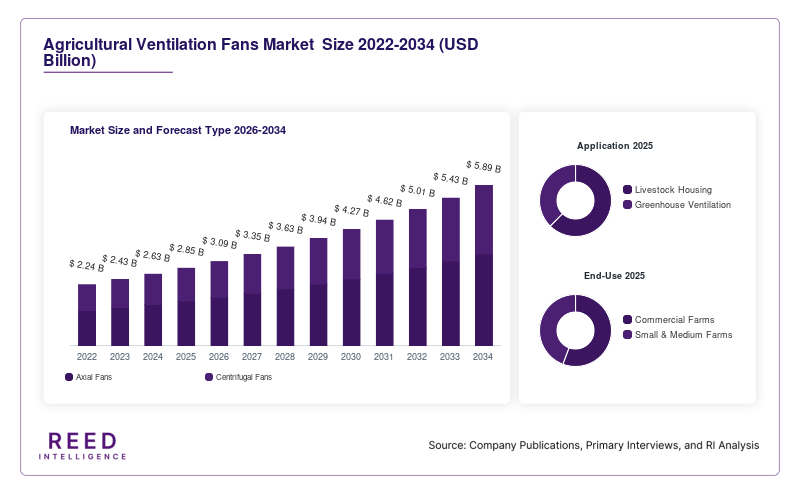
- By type, axial fans accounted for the largest share of 42.3%, while centrifugal fans are projected to grow at a CAGR of 9.2%.
- By application, livestock housing led with a 47.6% share, whereas greenhouse ventilation is expected to expand at a CAGR of 9.8%.
- The United States remained the dominant country, with market values of USD 620 million in 2024 and USD 670 million in 2025.
Market Trends
Integration of Smart and IoT-Enabled Ventilation Systems
The integration of smart technologies into agricultural ventilation systems is gaining momentum across developed and emerging markets. Farmers are increasingly adopting IoT-enabled ventilation fans that allow real-time monitoring of environmental parameters such as temperature, humidity, and ammonia levels. These systems automatically adjust fan speed and airflow, ensuring optimal conditions for livestock and crops. The use of cloud-based platforms and mobile applications further enhances control and accessibility, allowing farm managers to monitor operations remotely. This trend is particularly prominent in large-scale poultry and dairy farms where precision farming practices are critical. As digital agriculture continues to evolve, the demand for intelligent ventilation solutions is expected to rise significantly.
Shift Toward Energy-Efficient and Sustainable Fan Solutions
Energy efficiency has become a key focus area in the Agricultural Ventilation Fans Market. Manufacturers are developing fans with improved motor efficiency, aerodynamic blade designs, and low energy consumption. The adoption of EC (electronically commutated) motors and solar-powered ventilation systems is also increasing, especially in regions with high electricity costs. Sustainability concerns and environmental regulations are pushing farms to reduce their carbon footprint, leading to greater investment in energy-efficient equipment. Additionally, lifecycle cost analysis is influencing purchasing decisions, with farmers prioritizing long-term savings over initial costs. This trend is expected to drive innovation and create competitive differentiation among manufacturers.
Market Drivers
Rising Demand for Livestock Productivity and Animal Welfare
The increasing focus on livestock productivity and animal welfare is a major driver of the Agricultural Ventilation Fans Market. Proper ventilation is critical in maintaining air quality and reducing heat stress in animal housing facilities. Poor ventilation can lead to respiratory diseases, reduced feed efficiency, and lower productivity. As global demand for meat, dairy, and poultry products continues to grow, farmers are investing in advanced ventilation systems to improve output and ensure compliance with animal welfare standards. Government regulations and industry guidelines are also encouraging the adoption of efficient ventilation systems, particularly in developed markets.
Expansion of Greenhouse Farming and Controlled Environment Agriculture
The rapid growth of greenhouse farming and controlled environment agriculture is another key factor driving market expansion. These farming methods rely heavily on precise climate control to optimize crop growth and yield. Ventilation fans play a crucial role in maintaining temperature and humidity levels, preventing fungal diseases, and ensuring uniform air distribution. With increasing urbanization and limited arable land, greenhouse farming is becoming a preferred solution for food production. This trend is particularly strong in Asia Pacific and Europe, where governments are promoting sustainable agricultural practices. As a result, the demand for advanced ventilation systems is expected to increase steadily.
Market Restraint
High Initial Investment and Maintenance Costs
One of the major challenges facing the Agricultural Ventilation Fans Market is the high initial investment required for advanced ventilation systems. While basic fans are relatively affordable, modern systems equipped with automation, sensors, and energy-efficient motors can be costly. Small and medium-scale farmers, especially in developing regions, often face budget constraints that limit their ability to invest in such technologies. Additionally, maintenance costs associated with these systems, including repairs, replacements, and periodic servicing, can further increase the financial burden.
The impact of this restraint is particularly evident in regions with limited access to financing and government support. For example, farmers in rural areas may rely on traditional ventilation methods due to cost concerns, despite the long-term benefits of advanced systems. This slows down market penetration and adoption rates. Furthermore, lack of technical expertise for installation and maintenance can discourage farmers from upgrading their systems. Addressing these challenges through subsidies, financing options, and awareness programs will be crucial for sustained market growth.
Market Opportunities
Growing Adoption of Precision Agriculture Technologies
The increasing adoption of precision agriculture presents significant growth opportunities for the Agricultural Ventilation Fans Market. Precision farming techniques rely on data-driven decision-making to optimize resource utilization and improve productivity. Ventilation systems integrated with sensors and analytics platforms can provide valuable insights into environmental conditions, enabling farmers to make informed decisions. This integration enhances efficiency and reduces operational costs, making it an attractive option for modern farms. As digital agriculture continues to expand, the demand for smart ventilation solutions is expected to increase, creating new revenue streams for manufacturers.
Emerging Markets and Government Support Initiatives
Emerging markets in Asia Pacific, Latin America, and Africa offer substantial growth potential for the Agricultural Ventilation Fans Market. Governments in these regions are investing in agricultural modernization and providing subsidies for advanced farming equipment. Initiatives aimed at improving food security and increasing agricultural productivity are driving the adoption of ventilation systems. Additionally, rising awareness about the benefits of proper ventilation in livestock farming is encouraging farmers to upgrade their infrastructure. Manufacturers can capitalize on these opportunities by offering cost-effective solutions tailored to local needs and expanding their distribution networks.
Segmental Analysis
By Type
Axial fans dominated the Agricultural Ventilation Fans Market, accounting for approximately 42.3% of the total share in 2024. These fans are widely used due to their cost-effectiveness, simple design, and ability to move large volumes of air efficiently. They are particularly suitable for livestock housing and greenhouse applications where consistent airflow is essential. The demand for axial fans is driven by their ease of installation and low maintenance requirements. Additionally, advancements in blade design and motor efficiency have improved their performance, making them a preferred choice among farmers. Their widespread availability and affordability further contribute to their dominance in the market.
Centrifugal fans are expected to be the fastest-growing subsegment, with a CAGR of 9.2% during the forecast period. These fans are known for their ability to generate high pressure, making them suitable for applications requiring precise airflow control. The growing adoption of advanced ventilation systems in large-scale farms is driving demand for centrifugal fans. Their ability to operate efficiently in challenging conditions and handle air with high moisture or dust content is a key growth factor. As farms become more technologically advanced, the demand for high-performance ventilation solutions is expected to increase.
By Application
Livestock housing emerged as the dominant application segment, holding a 47.6% share in 2024. Proper ventilation is critical in maintaining air quality, reducing heat stress, and preventing disease outbreaks in animal housing facilities. The increasing demand for meat and dairy products is driving the adoption of advanced ventilation systems in this segment. Farmers are focusing on improving animal welfare and productivity, leading to higher investment in efficient ventilation solutions. Additionally, regulatory requirements related to animal welfare are encouraging the use of advanced systems, further supporting segment growth.
Greenhouse ventilation is projected to be the fastest-growing application segment, with a CAGR of 9.8%. The increasing adoption of greenhouse farming for high-value crops is driving demand for ventilation systems. These systems help maintain optimal temperature and humidity levels, ensuring healthy crop growth. The rise of urban farming and controlled environment agriculture is also contributing to segment growth. As farmers seek to maximize yield and reduce environmental impact, the demand for advanced greenhouse ventilation solutions is expected to increase significantly.
By End-Use
Commercial farms dominated the end-use segment, accounting for a significant share in 2024. These farms operate on a large scale and require efficient ventilation systems to maintain optimal conditions. The adoption of automated and energy-efficient solutions is higher in this segment due to the need for consistent performance and cost savings. Commercial farms are also more likely to invest in advanced technologies, driving demand for high-quality ventilation systems. The increasing focus on productivity and sustainability further supports the growth of this segment.
Small and medium farms are expected to be the fastest-growing end-use segment, with a CAGR of 8.9%. The growing awareness about the benefits of proper ventilation and the availability of cost-effective solutions are driving adoption in this segment. Government support and financing options are also encouraging small farmers to invest in modern equipment. As these farms transition to more advanced practices, the demand for efficient ventilation systems is expected to increase, contributing to overall market growth.
Regional Analysis
North America
North America held a significant share of the Agricultural Ventilation Fans Market, accounting for approximately 33.8% in 2025. The region is expected to grow at a CAGR of 7.5% during the forecast period. The presence of large-scale commercial farms and advanced agricultural practices supports market growth. High adoption of automated ventilation systems and strong regulatory frameworks related to animal welfare further contribute to the region’s dominance.
The United States is the leading country in this region, driven by its well-established livestock industry. A key growth factor is the increasing focus on sustainable farming practices and energy-efficient equipment. Farmers are investing in modern ventilation systems to reduce operational costs and improve productivity. Additionally, technological advancements and strong distribution networks are supporting market expansion.
Europe
Europe accounted for a notable share of the Agricultural Ventilation Fans Market in 2025 and is projected to grow at a CAGR of 7.9%. The region’s emphasis on environmental sustainability and strict regulations related to emissions and animal welfare are key drivers. The adoption of energy-efficient ventilation systems is increasing as farmers aim to comply with these regulations.
Germany is the dominant country in Europe, supported by its advanced agricultural infrastructure. A unique growth factor is the strong focus on renewable energy integration in farming operations. The use of solar-powered ventilation systems is gaining traction, reducing dependency on conventional energy sources and lowering operational costs.
Asia Pacific
Asia Pacific is expected to be the fastest-growing region, with a CAGR of 9.6% during 2026–2034. The region’s rapid population growth and increasing demand for food are driving the adoption of modern agricultural practices. Expanding greenhouse farming and livestock production are key contributors to market growth.
China leads the market in Asia Pacific, driven by large-scale agricultural production. A significant growth factor is government support for agricultural modernization. Subsidies and incentives for advanced farming equipment are encouraging farmers to adopt efficient ventilation systems, boosting market demand.
Middle East & Africa
The Middle East & Africa region is experiencing steady growth, with a projected CAGR of 8.1%. The need for efficient climate control in harsh environmental conditions is a major driver. Ventilation systems are essential for maintaining suitable conditions in greenhouses and livestock facilities.
Saudi Arabia is the dominant country in this region. A key growth factor is the increasing investment in controlled environment agriculture to enhance food security. Government initiatives aimed at reducing dependency on food imports are supporting the adoption of advanced ventilation technologies.
Latin America
Latin America holds a moderate share of the Agricultural Ventilation Fans Market and is expected to grow at a CAGR of 8.3%. The region’s expanding livestock industry and increasing focus on productivity are driving demand for ventilation systems. Farmers are gradually adopting modern technologies to improve efficiency.
Brazil is the leading country in Latin America, supported by its large agricultural sector. A unique growth factor is the rising demand for poultry and beef exports. To meet international standards, farmers are investing in advanced ventilation systems, enhancing market growth.
Competitive Landscape
The Agricultural Ventilation Fans Market is moderately fragmented, with several global and regional players competing on product quality, innovation, and pricing. Leading companies are focusing on developing energy-efficient and technologically advanced ventilation solutions to gain a competitive edge. Strategic partnerships, product launches, and expansion into emerging markets are common strategies adopted by key players.
Munters Group AB is considered a leading player in the market, known for its advanced climate control solutions. The company recently introduced a new range of energy-efficient ventilation fans designed for large-scale agricultural applications. Other major companies are also investing in research and development to enhance product performance and meet evolving customer needs. The competitive landscape is expected to remain dynamic, with increasing emphasis on sustainability and digital integration.
Key Players
- Munters Group AB
- Big Dutchman International GmbH
- Vostermans Ventilation B.V.
- ebm-papst Group
- Systemair AB
- Multi-Wing Group
- Schaefer Ventilation Equipment
- QC Supply
- American Coolair Corporation
- Osborne Industries Inc.
- IL Med Ventilation
- J&D Manufacturing
- Termotecnica Pericoli Srl
- Canarm AgSystems
- Abbi-Aerotech
Recent Developments
- In 2025, Munters Group AB launched a new series of IoT-enabled ventilation systems for smart farming applications.
- In 2024, Big Dutchman International expanded its product portfolio with energy-efficient axial fans for poultry farms.
- In 2025, ebm-papst Group introduced advanced EC motor-based fans aimed at reducing energy consumption in agricultural operations.
Agricultural Ventilation Fans Market Segments
Type
- Axial Fans
- Centrifugal Fans
Application
- Livestock Housing
- Greenhouse Ventilation
End-Use
- Commercial Farms
- Small & Medium Farms
By Region
- North America
- Europe
- APAC
- Middle East and Africa
- LATAM