Agrifiber Products Market Size, Share & Trends Analysis Report By Product Type (Particleboard & Fiberboard, Molded Fiber Products, Natural Fibers & Textiles, Composite Panels, Insulation Materials), By Material Source (Straw, Bagasse, Rice Husk, Bamboo, Coir), By Application (Construction & Furniture, Packaging, Automotive, Textiles, Consumer Products), By End Use (Residential, Commercial, Industrial, Agriculture & Horticulture) Forecasts, 2026–2034
USD 3950
Agrifiber Products Market Size
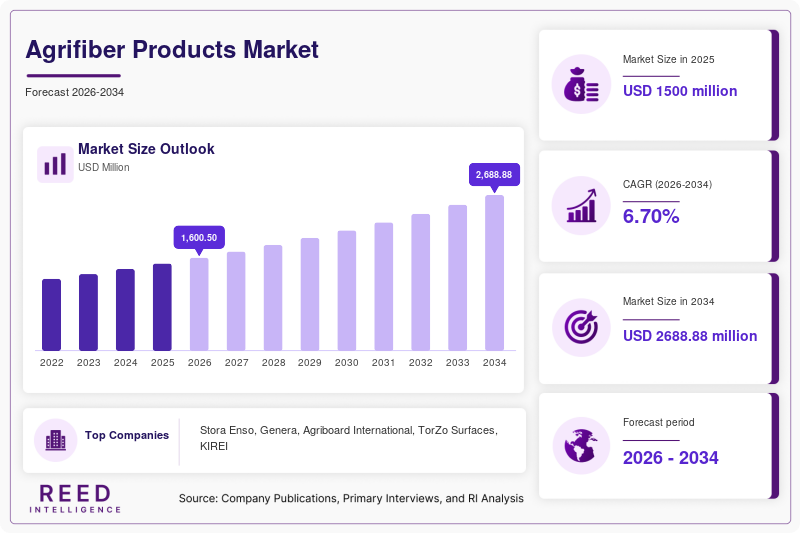
The global agrifiber products market size was valued at USD 1,500 million in 2025 and is projected to grow from USD 1,590 million in 2026 to USD 2,688.88 million by 2034, registering a CAGR of 6.70% during the forecast period from 2026 to 2034.
Agrifiber products are moving from waste-management applications toward higher-value material markets, including packaging, building panels, composites, textiles and molded products. The underlying feedstock pool is substantial: FAO reports that agrifood systems generate more than 5 billion tonnes of crop residues annually, while its crop-sector analysis says global primary crop production reached 9.9 billion tonnes in 2023 and around 450 million tonnes of crop residues are burned annually.
The commercial opportunity comes from converting this residual biomass into materials that can replace or reduce conventional wood, plastic and synthetic-fiber inputs. USDA research specifically identifies agricultural fibers as feedstocks for biodegradable packaging, building materials, molded products and nanocomposites.
The agrifiber products market covers materials produced from agricultural residues and plant fibers such as straw, rice husk, bagasse, bamboo, coir, banana fiber and other lignocellulosic feedstocks. These materials can be mechanically processed, pulped, molded, compounded or chemically refined into boards, panels, packaging, textiles, composites and other products.
The market is increasingly linked to circular-economy procurement rather than agricultural-waste disposal alone. FAO identifies crop residues as a feedstock for construction materials, textiles, bioplastics, bioenergy and other bio-based value chains. The European Commission similarly identifies agricultural residues as a source of bio-based products and notes ongoing development of packaging from agricultural waste.
Agrifiber Products Market Drivers
Increasing Utilization of Agricultural Residues as Industrial Feedstock
The fundamental market driver is the shift from treating agricultural residues as low-value waste toward using them as industrial feedstocks. FAO estimates that more than 5 billion tonnes of crop residues are generated each year, while around 450 million tonnes are burned annually. Converting even a small portion of this biomass into commercial materials creates a supply source for fiber products without depending entirely on virgin wood or fossil-based materials.
The value proposition differs by feedstock. Rice husk can be incorporated into composite panels, wheat straw can be converted into boards or molded packaging, and banana stems can provide textile-grade fibers. ICAR has documented banana-fiber wall panels and cotton-stalk composite seedling trays, showing that agricultural residues can already move into commercial product categories beyond energy recovery.
This creates additional revenue opportunities for farmers, processors, rural enterprises and material manufacturers while reducing the volume of residue requiring disposal or burning.
Plastic Reduction and Circular Packaging Requirements
Packaging is becoming a major commercialization route because brands are under pressure to reduce fossil-based plastic while maintaining strength, food safety, shelf life and machinability. The EU PPWR began applying in August 2026, with requirements focused on packaging circularity, recyclability and resource efficiency.
Agricultural residues provide another fiber source for molded packaging, paper, boards and bio-composites. A 2025 peer-reviewed study investigated sugarcane bagasse for molded-fiber packaging and highlighted the need to improve fiber strength, moldability and drying efficiency for wider adoption.
Commercial partnerships are also moving in this direction. In June 2025, Stora Enso and Matrix Pack announced a strategic partnership to accelerate formed-fiber packaging and integrate fiber sourcing, manufacturing and supply-chain capabilities.
Expansion of Bio-Based Construction and Composite Materials
Construction provides a longer-life application for agricultural fibers because residues can be converted into particleboards, fiberboards, insulation and composite panels. The material can replace part of the wood-fiber input in applications where mechanical strength, dimensional stability, moisture resistance and fire performance meet customer specifications.
India's IWST documents rice-husk particleboard technology that was transferred from research to industry and notes its potential to widen the raw-material base for particleboard while adding value to agricultural waste.
New companies are also positioning agricultural fibers as engineered construction materials. INARI Agritech, for example, develops building panels from rice-husk agricultural by-products with an emphasis on lightweight construction and thermal and acoustic insulation.
The market mechanism is therefore broader than sustainability positioning: manufacturers can use locally available agricultural residues to diversify fiber supply while developing products for construction, furniture and interior applications.
Agrifiber Products Market Restraints
Feedstock Collection, Storage and Quality Variability
Agricultural residues are geographically dispersed and seasonal, creating a different supply-chain problem from conventional industrial raw materials. Straw, husks, stalks and other residues must be collected, transported, dried and stored before processing. Moisture, contamination, particle size and fiber composition can also vary by crop, location and harvesting method.
The EU CAP Network notes that reliable local cooperation between farmers, processors and packaging producers is important for agricultural-residue packaging supply chains.
This affects manufacturing economics because the nominal availability of agricultural waste does not automatically translate into usable industrial feedstock. Companies must establish aggregation networks, quality controls and preprocessing capabilities.
Performance and Manufacturing Compatibility
Agrifiber materials must compete against established wood, plastic and synthetic-fiber products on more than environmental characteristics. Packaging must run on existing high-speed machinery, while construction products must satisfy mechanical, moisture, fire and dimensional requirements.
The EU's BIO-LUSH project specifically identifies flexibility, mechanical strength, folding, sealing and compatibility with existing packaging machinery as important commercialization requirements for agricultural-residue materials.
Similarly, research into bagasse molded fiber packaging continues to address strength, moldability and drying energy. These technical requirements can increase processing costs and slow adoption when agrifiber products require customers to modify existing production lines.
Agrifiber Products Market Opportunities
Agricultural-Residue Packaging
Packaging provides one of the clearest opportunities because agrifiber materials can directly replace or reduce plastic, expanded foam and conventional fiber inputs. IIT Madras researchers demonstrated mycelium-based composites grown on agricultural and paper waste for biodegradable packaging, while IIT Roorkee developed molded tableware from wheat straw in collaboration with Parason Machinery.
The commercial opportunity extends across foodservice, fresh produce, consumer goods, electronics protection and personal-care packaging. The EU's BIO-LUSH work is specifically testing agricultural-residue materials on industrial packaging equipment, while current European projects are developing bio-based polymers from agro-food residues for cosmetics, healthcare, retail and consumer-goods packaging.
Natural-Fiber Textiles and Specialty Materials
Agricultural residues can also become higher-value textile and specialty fibers. ICAR's work with okra stems demonstrates conversion of agricultural residues into usable fiber for yarn, textiles, handicrafts and household products. The project trained rural artisans while developing processing and market pathways.
Banana-fiber companies are pursuing similar models, converting banana pseudostems into textile fibers, paper feedstock, packaging and other materials. This creates opportunities for regions with large banana, plantain, coconut, hemp or other agricultural production bases to build localized fiber-processing industries.
Segmental Analysis
By Product Type
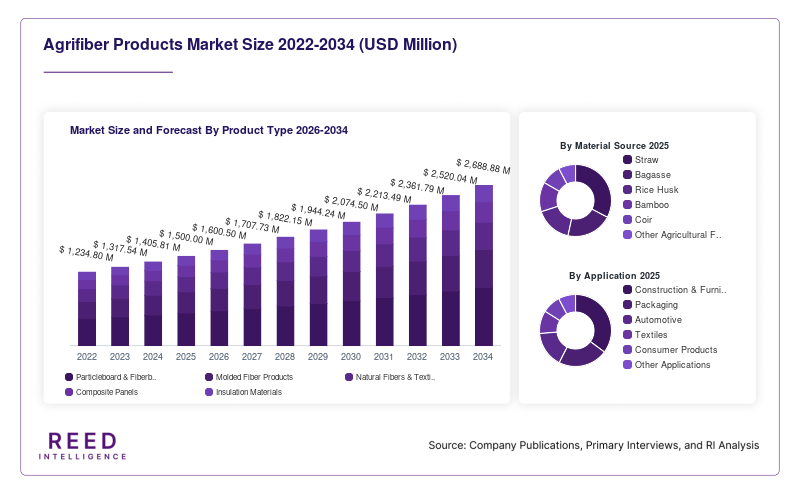
Particleboard & Fiberboard represent approximately 34% of the global agrifiber products market in 2025, making this the dominant product category. Agricultural fibers can substitute part of conventional wood fiber in panels used for furniture, interiors, doors, walls and other building applications. IWST documents technologies for rice-husk particleboard, wheat-straw fiberboard and bagasse particleboard, confirming the technical pathway from agricultural residue to panel products.
Molded Fiber Products account for approximately 25%, supported by foodservice packaging, protective packaging and disposable-product substitution. IIT Roorkee's wheat-straw tableware project and commercial bagasse packaging demonstrate the expanding range of molded applications.
Natural Fibers & Textiles represent approximately 17%, covering banana, coir, hemp, flax and other fibers.
Composite Panels account for approximately 15%, while Insulation Materials represent approximately 9%.
Molded Fiber Products are the fastest-growing product category, with a CAGR of approximately 8.4%, supported by plastic-reduction policies and investment in fiber-based food, consumer and protective packaging.
By Material Source
Straw represents approximately 29% of the global market in 2025, supported by broad agricultural availability and applications in boards, packaging, insulation and composites. Wheat straw is being investigated for nanocellulose-based packaging films, while wheat-straw molded products have progressed toward commercial development.
Bagasse accounts for approximately 24%, with its established position as a sugar-industry by-product supporting molded food packaging and tableware.
Rice Husk represents approximately 19%, particularly in composite panels and construction materials. IWST has documented rice-husk particleboard technology and its industrial transfer history.
Bamboo represents approximately 12%, while Coir accounts for approximately 8% and Other Agricultural Fibers approximately 8%.
Rice Husk is the fastest-growing major material source, with a CAGR of approximately 8.0%, supported by its availability in major rice-producing economies and expanding use in boards, composites and construction materials.
By Application
Construction & Furniture account for approximately 35% market share in 2025, making this the largest application. Agrifiber panels can be incorporated into furniture, interior panels, wall systems, doors and other construction products where manufacturers seek alternative fiber sources. IWST's rice-husk particleboard technology illustrates the established pathway from agricultural residue to panel manufacturing.
Packaging represents approximately 30% and is the fastest-growing application, with a CAGR of approximately 8.6%. Packaging demand is supported by plastic-reduction requirements and development of molded fiber, paper, bio-composite and agricultural-residue packaging.
Automotive accounts for approximately 12%, with natural-fiber composites offering potential for lightweight interior and structural applications.
Textiles represent approximately 11%, while Consumer Products and Other Applications account for approximately 7% and 5%, respectively.
By End Use
Industrial end use represents approximately 38% of the global market in 2025, supported by packaging manufacturers, construction-material producers, automotive suppliers, composite manufacturers and other industrial processors.
Commercial end use accounts for approximately 27%, particularly in foodservice, retail, commercial interiors and packaging.
Residential applications represent approximately 23%, mainly through furniture, flooring, wall products and insulation.
Agriculture & Horticulture represents approximately 12% and is the fastest-growing end-use segment, with a CAGR of approximately 8.1%. Applications include seedling trays, crop covers, mulch materials and other products that can use agricultural fibers within agricultural value chains. ICAR-CIRCOT has developed cotton-stalk composite seedling trays and other agro-residue products for horticultural applications.
Regional Analysis
APAC Agrifiber Products Market
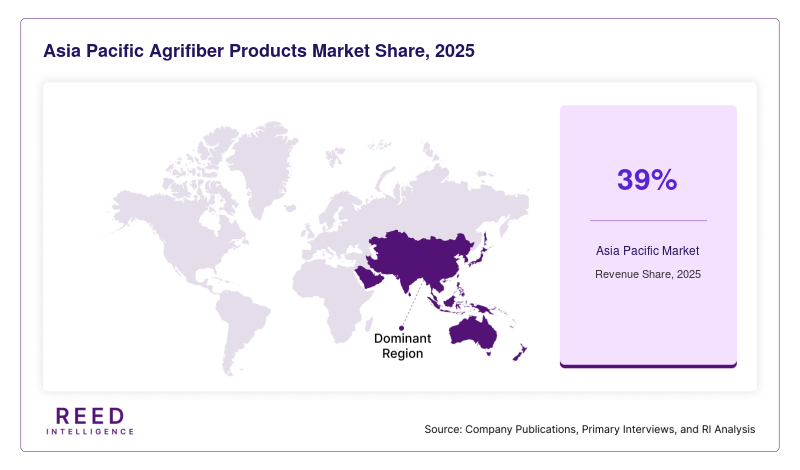
APAC represents approximately 39% of the global agrifiber products market in 2025 and is the fastest-growing region, with an estimated CAGR of 8.1%.
The region combines a large agricultural residue base with expanding manufacturing industries, making local feedstock conversion commercially relevant. India, China, Indonesia, Thailand, Vietnam and other agricultural economies generate substantial volumes of crop residues that can be converted into panels, packaging, fibers and composites.
India provides particularly strong evidence of technology development. ICAR-CIRCOT has commercialized or transferred technologies involving banana-fiber wall panels and cotton-stalk composite seedling trays, while Indian research institutions have developed rice-husk particleboard and wheat-straw packaging applications.
The region also has an expanding packaging industry. ICAR reported in July 2026 that India's packaging sector had become the country's fifth-largest sector and highlighted smart and intelligent packaging as an emerging area of development.
China, India and Southeast Asia provide substantial agricultural feedstock, while Japan, South Korea and Australia provide higher-value markets for engineered materials and sustainable packaging.
The principal constraint is supply-chain consistency. Agricultural residues are dispersed and seasonal, requiring collection, drying, preprocessing and storage infrastructure.
Europe Agrifiber Products Market
Europe accounts for approximately 27% of the global market in 2025 and is projected to grow at approximately 6.8% CAGR.
European demand is strongly influenced by circular-economy policy and packaging regulation. The PPWR began applying in August 2026, creating additional requirements around packaging circularity, recyclability and resource efficiency.
Agricultural-residue utilization is being investigated across several European countries. The BIO-LUSH project covers Sweden, Finland, France, Germany, the Netherlands and Italy and is examining whether agricultural-residue materials can operate on high-speed packaging lines.
The region is also developing bio-based packaging polymers from agro-food residues, with current Horizon Europe activity seeking industrial users and packaging converters in cosmetics, healthcare, retail and consumer goods.
The commercial market therefore extends beyond traditional agrifiber boards into engineered packaging and bio-composite materials.
Europe's primary constraint is the performance-cost balance. New materials must compete with highly optimized paper, board, plastic and composite manufacturing systems while meeting strict food-contact, chemical-safety and recyclability requirements.
North America Agrifiber Products Market
North America represents approximately 20% of the global market in 2025 and is projected to grow at approximately 5.9% CAGR.
The region benefits from established agricultural production, advanced materials research and developed packaging and construction industries. USDA's Agricultural Research Service actively researches agricultural fibers for biodegradable packaging, building materials, molded products and high-performance nanocomposites.
USDA research is also examining nanofibrillated cellulose from agricultural residues, with applications spanning packaging, automotive, construction and other industries.
The U.S. market is therefore moving toward higher-performance agrifiber materials rather than relying only on basic agricultural-waste products. Research into hemp residues, cellulose nanomaterials and bio-based packaging supports this shift.
Construction and furniture remain relevant applications, while packaging provides an additional growth route as brands pursue renewable and lower-fossil-content materials.
North America's principal constraint is feedstock economics. Large agricultural areas can produce substantial residues, but transportation and preprocessing costs can reduce competitiveness when feedstock is bulky and low-value.
Middle East and Africa Agrifiber Products Market
Middle East and Africa represents approximately 7% of the market in 2025 and is projected to grow at approximately 6.6% CAGR.
Agricultural-fiber opportunities differ substantially between the two subregions. Africa has significant opportunities in banana, plantain, coconut, cereal residues and other agricultural fibers, while Gulf markets provide downstream demand for sustainable packaging, construction materials and consumer products.
The Banana Fiber Company in Ghana illustrates the emerging value-chain model: banana and plantain stems are collected through local micro-hubs and converted into fibers for textiles, packaging and other products.
FAO's bioeconomy work also emphasizes the role of agricultural residues and natural fibers in creating new rural value chains.
The region's opportunity is strongest where feedstock can be processed near farms, reducing transport costs and generating local value addition. The main constraints are processing infrastructure, quality standardization, financing and access to export markets.
LATAM Agrifiber Products Market
LATAM represents approximately 7% of the global agrifiber products market in 2025 and is projected to grow at approximately 7.0% CAGR.
The region has a strong agricultural base and significant availability of sugarcane bagasse, rice residues, coffee residues, banana fibers and other plant materials. Sugarcane-processing regions are particularly relevant for molded fiber because bagasse is already generated as a concentrated industrial by-product.
Bagasse-based molded products are commercially established in foodservice and packaging, with suppliers producing plates, trays, clamshells and containers from sugarcane fiber.
Brazil provides a substantial agricultural and food-processing base, while Mexico, Argentina, Colombia and other markets create opportunities for packaging, construction materials and natural fibers.
The region's main challenge is converting agricultural-resource availability into reliable industrial supply chains. Collection, preprocessing and transport infrastructure determine whether residues can compete with conventional fiber and plastic materials on delivered cost.
Competitive Landscape
The agrifiber products market is fragmented across panel manufacturers, fiber processors, packaging producers, natural-fiber companies, material-science firms, and agricultural-residue technology developers. Competitive differentiation increasingly depends on feedstock security, processing efficiency, material consistency, product performance and downstream customer integration.
Panel manufacturers compete through density, strength, moisture resistance, fire performance, surface quality and compatibility with existing furniture and construction manufacturing. IWST's work on rice-husk particleboard demonstrates how agricultural residues can be engineered to meet panel specifications while expanding the raw-material base.
Packaging companies compete on machinability, food safety, moisture resistance, compostability or recyclability, weight and cost. Stora Enso and Matrix Pack's June 2025 partnership illustrates the importance of combining renewable-material expertise with packaging manufacturing scale.
Key Market Players
- Stora Enso
- Genera
- Agriboard International
- TorZo Surfaces
- KIREI
- Lambton Doors
- Masonite
- Wanhua Ecoboard
- Strawcture Eco
- Kelheim Fibres
- Lenzing
- The Banana Fiber Company
Recent Market Developments
September 2026 – Stora Enso Received Recognition for Fiber-Based Packaging. Stora Enso received two ScanStar awards in September 2026 for fiber-based packaging solutions developed with customers. The awards covered functionality, innovation and reusable packaging design, illustrating the continuing movement toward higher-performance fiber packaging rather than simple material substitution.
August 2026 – EU Packaging Regulation Guidance Was Updated. The European Commission published its PPWR FAQ in August 2026 as the regulation began applying. The regulatory framework increases the importance of recyclability, reuse, material efficiency and circularity in packaging design, creating a policy environment favorable to qualifying bio-based and fiber-based alternatives.
Agrifiber Products Market Segments
By Product Type
- Particleboard & Fiberboard
- Molded Fiber Products
- Natural Fibers & Textiles
- Composite Panels
- Insulation Materials
By Material Source
- Straw
- Bagasse
- Rice Husk
- Bamboo
- Coir
- Other Agricultural Fibers
By Application
- Construction & Furniture
- Packaging
- Automotive
- Textiles
- Consumer Products
- Other Applications
By End Use
- Residential
- Commercial
- Industrial
- Agriculture & Horticulture
By Region
- North America
- Europe
- APAC
- Middle East and Africa
- LATAM