AGV AMR Market Size, Share & Trends Analysis Report By Robot Type (Automated Guided Vehicles, Autonomous Mobile Robots), By Navigation Technology (Laser/LiDAR Navigation, Vision-Based Navigation, Magnetic & Inductive Guidance, SLAM & Hybrid Navigation), By Application (Warehouse & Distribution, Manufacturing & Production, Automotive, E-Commerce & Retail, Food & Beverage, Healthcare & Pharmaceuticals) and By Region (North America, Europe, APAC, Middle East and Africa, LATAM) Forecasts, 2026–2034
USD 3950
AGV AMR Market Size
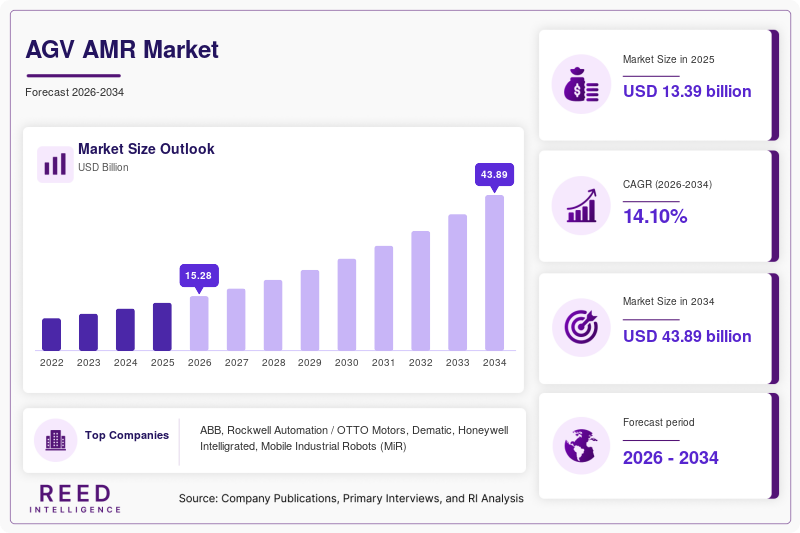
The global AGV AMR Market size was valued at USD 13.39 billion in 2025 and is projected to grow from USD 15.28 billion in 2026 to USD 43.89 billion by 2034, registering a CAGR of 14.10% during the forecast period from 2026 to 2034.
The AGV AMR Market covers automated guided vehicles (AGVs) and autonomous mobile robots (AMRs) used to transport materials, pallets, totes, components and finished goods across warehouses, distribution centers and industrial facilities. The market is moving from fixed-path transport toward software-managed mobile fleets that can dynamically respond to production schedules, warehouse congestion and changing order patterns.
The demand signal is particularly strong in transportation and logistics. The International Federation of Robotics (IFR) reported that professional service-robot sales reached almost 200,000 units in 2024, with transportation and logistics accounting for 102,900 units, up 14%. IFR also reported that robot-as-a-service fleets grew 31% in 2024, indicating greater acceptance of flexible deployment models.
Manufacturing is another major adoption base. IFR reported that global industrial-robot installations exceeded 600,000 units in 2025, while Asia accounted for the majority of new deployments.
The technology distinction is becoming commercially important. AGVs generally operate along predefined routes or guidance infrastructure, whereas AMRs use sensors, mapping, perception, and software to navigate dynamically. Honeywell describes AMRs as systems that can operate without tape, markers or wires and reroute when paths are blocked.
AGV AMR Market Drivers
Labor Constraints Are Increasing the Economic Case for Mobile Automation
Labor availability remains one of the clearest commercial reasons for deploying AGVs and AMRs. IFR identified staff shortages as a key driver of professional service-robot adoption, while transportation and logistics remained the largest professional service-robot application by units sold.
The market mechanism is not simply replacing workers. Mobile robots automate repetitive transportation activities such as pallet movement, line-side replenishment, tote movement, returns handling and machine tending. This allows employees to concentrate on picking, quality control, maintenance and other tasks that require judgment.
Dematic's AGV and AMR solutions illustrate the model. Its systems automate pallet movement between receiving, production, storage and dispatch, while execution software coordinates the vehicles and warehouse workflows.
The economics become more attractive in facilities operating multiple shifts. Robots can continuously perform transport missions without the scheduling limitations associated with manual forklift labor. Rockwell's OTTO portfolio similarly targets material movement in manufacturing environments, including pallet and work-in-process transportation.
The counterbalance is the initial investment in robots, fleet-management software, safety systems and integration. Consequently, customers increasingly evaluate automation on total operating cost and payback rather than robot purchase price alone.
E-Commerce and Warehouse Complexity Favor Flexible AMRs
Modern warehouses handle larger SKU assortments, shorter delivery windows and more variable order profiles. Fixed conveyors and traditional AGVs can efficiently handle predictable flows, but they become harder to reconfigure when warehouse layouts or order patterns change.
AMRs address this issue by navigating dynamically. Honeywell's AMRs use cameras, sensors and machine learning for path planning, obstacle detection and route adjustment.
The commercial impact is strongest in e-commerce fulfillment, micro-fulfillment and omnichannel distribution. Honeywell's micro-fulfillment architecture combines AS/RS, AMRs and execution software so mobile robots can move products between workstations while fixed automation handles high-density storage.
Dematic also reports a goods-to-person application in which nearly 300 AMRs operate in an integrated fulfillment system and produced a reported fourfold increase in picking performance for Radial Europe.
This creates demand for robots that can be added incrementally rather than requiring a complete facility redesign. The result is a shift toward modular automation that can scale with order volume.
AI, Vision and Software Are Expanding AMR Capabilities
The competitive boundary is moving from mechanical transportation toward intelligent fleet orchestration. Modern AMRs increasingly combine LiDAR, cameras, computer vision, SLAM, machine learning and fleet-management software.
ABB's mobile-robot portfolio combines AMRs with Visual SLAM and AI-enabled 3D vision, allowing robots to create maps and operate in changing environments. ABB acquired Sevensense to strengthen this capability.
Rockwell is similarly integrating OTTO AMRs with broader manufacturing automation and AI technologies. The company has demonstrated autonomous mobile robots connected to FactoryTalk and other industrial software, allowing material movement to become part of the production-control layer.
The commercial mechanism is higher utilization. Better perception and fleet orchestration can reduce idle time, optimize routes, avoid congestion and coordinate robot missions with production events.
This is also expanding the role of software revenue, creating opportunities for fleet management, simulation, digital twins, predictive maintenance and robot-as-a-service models.
AGV AMR Market Restraints
Integration Complexity Can Delay Deployment
AMR and AGV projects are rarely standalone equipment purchases. They typically need integration with warehouse-management systems, warehouse-execution systems, manufacturing systems, conveyors, AS/RS, robotic arms, safety infrastructure and enterprise software.
Dematic's solutions explicitly combine mobile robots with WES and WMS interfaces, illustrating the degree of software integration required for production deployment.
A facility may therefore require process mapping, digital simulation, route planning, safety assessment, network configuration, fleet management and employee training before commercial operation begins.
The challenge is especially relevant for brownfield facilities where aisles, machines and workflows were designed around human-operated equipment. Although AMRs generally require less infrastructure than traditional AGVs, the software and operational integration burden remains significant.
Safety, Payload and Operating-Environment Constraints Limit Universal Adoption
AGVs and AMRs must operate safely around people, forklifts, machinery and other vehicles. Dynamic environments can create unpredictable obstacles, while heavy-payload applications require more sophisticated sensing, braking and navigation systems.
Robot capabilities also vary substantially by payload. Rockwell's OTTO portfolio, for example, ranges from the 150 kg OTTO 100 to the 1,900 kg OTTO 1500, showing that payload requirements directly influence vehicle architecture.
Outdoor environments, uneven floors, extreme temperatures, dust, narrow aisles and high-speed traffic can further complicate deployment.
The market therefore favors application-specific solutions rather than one universal AMR platform. Manufacturers must balance payload, speed, battery life, navigation accuracy and safety certification against the customer's operating environment.
AGV AMR Market Opportunities
Robot-as-a-Service and Flexible Automation Models
Robot-as-a-service (RaaS) is lowering the capital barrier for smaller facilities and customers uncertain about long-term automation requirements. IFR reported that professional service-robot RaaS fleets increased 31% in 2024, while RaaS sales within transportation and logistics increased 42%.
The commercial mechanism is similar to leasing: customers can acquire robotic capacity without paying the full equipment cost upfront. Vendors can generate recurring revenue from software, maintenance, fleet monitoring and robot replacement.
This model is particularly relevant to seasonal warehouses, third-party logistics providers and fast-growing e-commerce operations where capacity requirements change quickly.
Integrated AMR Fleets Across Manufacturing and Warehousing
A major opportunity is the coordination of mobile robots with fixed automation. Rather than deploying an isolated robot, manufacturers can combine AMRs with conveyors, robotic arms, AS/RS, palletizers, machine tools and warehouse software.
Dematic's 2026 partnership with GreyOrange is designed to coordinate fixed automation, AMRs and human workflows through a unified software orchestration environment.
This creates a larger addressable market because mobile robots become part of the facility's overall automation architecture. It also increases software and integration revenue per deployment.
AI-Based Navigation and Fleet Optimization
AI-enabled navigation is creating opportunities for higher-density robot operations. ABB's Visual SLAM technology combines 3D vision and AI to allow AMRs to operate in changing environments, while Rockwell is integrating mobile robotics with industrial AI and digital-twin technologies.
Future fleet software can optimize routes based on congestion, battery state, workload, order priority and production schedules.
The commercial value is increased robot utilization rather than simply improved navigation. If software can coordinate hundreds of vehicles efficiently, customers can expand fleets without proportionally increasing manual supervision.
Segmental Analysis
By Robot Type
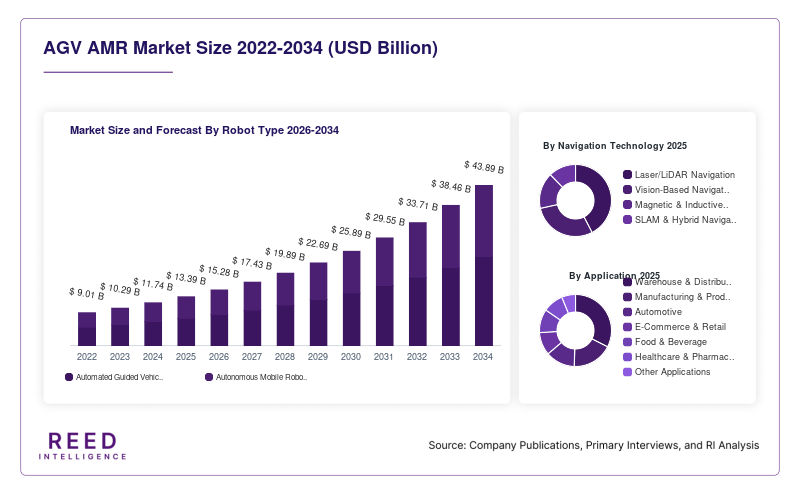
Autonomous Mobile Robots represent approximately 62% of the global market in 2025, supported by their ability to operate in changing environments without extensive fixed infrastructure. AMRs are increasingly used for pallet movement, picking-cart transport, machine tending and goods-to-person applications. Honeywell describes AMRs as requiring minimal infrastructure and being able to reroute around obstacles.
Automated Guided Vehicles account for approximately 38% and remain important for predictable, high-volume transportation where fixed routes provide consistent throughput.
AMRs are the fastest-growing robot type, with a CAGR of approximately 17.2%. The shift toward dynamic navigation, flexible factory layouts and warehouse automation is increasing the addressable range of mobile-robot applications.
AGVs remain commercially relevant because they can deliver reliable transport in standardized environments. However, AMRs increasingly capture projects where layouts and material flows change frequently.
By Navigation Technology
Laser/LiDAR Navigation represents approximately 34% of the market in 2025, supported by its use in industrial and warehouse navigation where precise localization and obstacle detection are required.
SLAM & Hybrid Navigation account for approximately 29%, while Vision-Based Navigation represents 23%. Magnetic and inductive guidance account for approximately 14%.
SLAM & Hybrid Navigation are the fastest-growing technology category, with approximately 18.5% CAGR. ABB's Visual SLAM platform demonstrates the shift toward vision, AI and dynamic mapping, allowing AMRs to operate without extensive fixed navigation infrastructure.
The shift also benefits brownfield facilities because robots can adapt to layouts rather than requiring extensive floor modifications.
By Application
Warehouse & Distribution represents approximately 39% of the market in 2025, making it the largest application segment. Warehouses use AGVs and AMRs for pallet transportation, goods-to-person picking, replenishment, staging and returns.
IFR recorded 102,900 professional service robots sold for transportation and logistics in 2024, representing more than half of professional service-robot sales in its sample.
Manufacturing & Production accounts for approximately 25%, followed by automotive at 14%, e-commerce & retail at 10%, food & beverage at 5%, healthcare & pharmaceuticals at 4% and other applications at 3%.
E-Commerce & Retail is the fastest-growing application at approximately 18.2% CAGR, driven by omnichannel fulfillment, micro-fulfillment and shorter delivery windows. Honeywell's micro-fulfillment solutions combine AMRs with AS/RS and warehouse-execution software.
By Payload Capacity
Up to 500 kg represents approximately 43% of the market in 2025, supported by tote, cart, component and lightweight goods transportation.
500–1,000 kg accounts for approximately 31%, while Above 1,000 kg represents approximately 26%.
Above 1,000 kg is the fastest-growing payload category, with approximately 16.4% CAGR. Heavy-payload AMRs are increasingly used for pallet transport and industrial material handling. Rockwell's OTTO 1200 and OTTO 1500 support payloads up to 1,200 kg and 1,900 kg respectively.
This segment also competes directly with forklifts, tugger trains and conventional AGVs, making safety, route flexibility and total operating cost important purchasing criteria.
Regional Analysis
North America AGV AMR Market
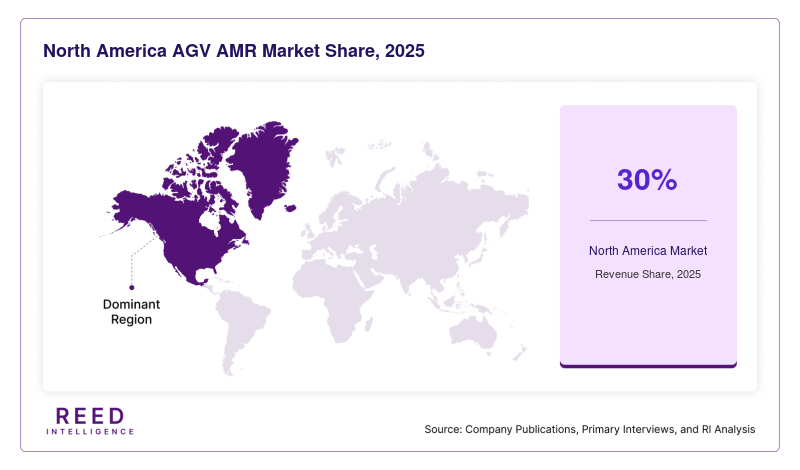
North America represents approximately 30% of the global AGV AMR Market in 2025. The region benefits from advanced warehouse automation, large e-commerce operations, extensive manufacturing capacity and strong investment in industrial software.
The U.S. industrial-robot market also provides a broader automation foundation. IFR reported that U.S. industrial-robot installations increased 11% in 2025 to 38,000 units, with automotive remaining the largest adopting industry.
Rockwell Automation has expanded AMR production in the United States. Its Milwaukee facility began producing OTTO 600 and OTTO 1200 robots, adding U.S. manufacturing capacity to existing Canadian production.
North American customers are also adopting AMRs as part of integrated manufacturing systems. Rockwell's OTTO Fleet Manager connects AMR fleets with existing software and manufacturing controls, while Honeywell integrates mobile robots with warehouse-execution and micro-fulfillment systems.
North America is projected to grow at approximately 12.9% CAGR through 2034. The principal constraints are integration cost, facility complexity and the need to demonstrate clear return on investment for brownfield installations.
Europe AGV AMR Market
Europe accounts for approximately 25% of the global market in 2025. The region has strong automotive, manufacturing, logistics and warehouse-automation industries, alongside a dense network of robotics suppliers and integrators.
IFR's 2026 data shows that Europe continues to expand its industrial-robot installed base, although deployment growth has been slower than Asia.
AMR adoption is particularly relevant to European manufacturers facing labor constraints and high operating costs. Dematic's January 2026 agreement with Hai Robotics expanded access to flexible AMR solutions across European warehouse and logistics markets.
The European market also emphasizes integrated automation. Dematic combines AMRs and AGVs with warehouse-execution software, while its newer GreyOrange relationship supports coordination between fixed automation, AMRs and human workflows.
Europe is projected to expand at approximately 12.7% CAGR through 2034. Adoption is supported by labor-cost economics and advanced manufacturing, while fragmented brownfield infrastructure can make integration more complex.
APAC AGV AMR Market
APAC represents approximately 35% of the global AGV AMR Market in 2025 and is the largest and fastest-growing region, with a CAGR of approximately 17.6%.
The region's position is supported by its dominant share of global industrial-robot deployment. IFR reported that Asia accounted for 74% of new industrial-robot deployments in 2024, while China alone represented 59% of global industrial-robot deployments in 2025.
China's manufacturing scale creates substantial demand for automated material movement, particularly in automotive, electronics, batteries, machinery and warehouse operations. Japan and South Korea provide additional demand through advanced manufacturing and logistics automation.
India is also increasing its robotics adoption. IFR reported that Indian industrial-robot installations reached approximately 10,500 units in 2025, up 15%.
The region's commercial mechanism is therefore two-sided: high manufacturing output creates internal material-handling demand, while expanding e-commerce increases warehouse automation requirements.
APAC is projected to maintain the fastest regional growth through 2034. Key constraints include varying automation maturity, integration skills, cybersecurity requirements and differences in labor costs across individual markets.
Middle East and Africa AGV AMR Market
Middle East and Africa represents approximately 6% of the global market in 2025 and is projected to grow at approximately 13.8% CAGR.
Warehouse modernization, e-commerce, food distribution, airport logistics and manufacturing diversification are the principal adoption areas. Gulf markets are investing in automated distribution centers as retailers and logistics operators seek faster fulfillment and higher warehouse utilization.
The region's logistics investments can favor AMRs because new facilities can be designed around automated workflows from the beginning rather than retrofitted around existing manual processes.
AMRs are also relevant to cold-chain and food-distribution facilities where repetitive movement and controlled workflows can benefit from automation.
The main constraints include a smaller local robotics-manufacturing ecosystem, dependence on imported equipment and integration expertise, and uneven adoption across African markets.
LATAM AGV AMR Market
LATAM accounts for approximately 4% of the global market in 2025 and is expected to grow at approximately 14.7% CAGR.
Brazil and Mexico are the region's major automation centers, supported by automotive manufacturing, food and beverage production, consumer goods and expanding logistics networks.
The commercial case is particularly strong where companies need to improve warehouse productivity without proportionally increasing labor requirements. AMRs can also support brownfield facilities because they generally require less fixed infrastructure than traditional guided systems.
The region remains at an earlier stage of adoption than North America, Europe and APAC. Upfront investment, financing availability, integration expertise and relatively fragmented logistics operations remain constraints.
Competitive Landscape
The AGV AMR Market is becoming increasingly concentrated around companies capable of supplying both robotic hardware and the software layer required to coordinate fleets. Traditional AGV providers are expanding into AMRs, while industrial-automation companies are adding mobile robots to broader factory-automation portfolios.
ABB combines AMRs, industrial robots, automation controls and AI-enabled Visual SLAM technology. Its acquisition of Sevensense strengthened its autonomous-navigation capabilities and allows ABB to offer mobile robots across automotive, logistics, industrial and consumer-goods applications.
Rockwell Automation has positioned OTTO Motors as part of its connected manufacturing strategy. Its AMR portfolio spans lightweight material movement through heavy pallet transport, while OTTO Fleet Manager provides centralized fleet control.
Key Market Players
- ABB
- Rockwell Automation / OTTO Motors
- Dematic
- Honeywell Intelligrated
- Mobile Industrial Robots (MiR)
- KUKA
- Daifuku
- JBT Marel
- Toyota Material Handling
- Jungheinrich
- Seegrid
- Geek+
- GreyOrange
- HAI Robotics
- Quicktron
- OMRON
- Mitsubishi Logisnext
- Fetch Robotics technology portfolio
Recent Market Developments
- September 2026 – IFR reported five million industrial robots operating globally. The World Robotics 2026 report showed the global operational industrial-robot stock increased 9% in 2025, while annual installations exceeded 600,000 units. Asia remained the leading deployment region.
- April 2026 – Rockwell and AWS demonstrated cloud-connected autonomous production logistics. OTTO AMRs were shown operating within a connected production environment where robot, factory and workforce data can be aggregated for analytics and optimization.
AGV AMR Market Segments
By Robot Type
- Automated Guided Vehicles
- Autonomous Mobile Robots
By Navigation Technology
- Laser/LiDAR Navigation
- Vision-Based Navigation
- Magnetic & Inductive Guidance
- SLAM & Hybrid Navigation
By Application
- Warehouse & Distribution
- Manufacturing & Production
- Automotive
- E-Commerce & Retail
- Food & Beverage
- Healthcare & Pharmaceuticals
- Other Applications
By Payload Capacity
- Up to 500 kg
- 500–1,000 kg
- Above 1,000 kg
By Region
- North America
- Europe
- APAC
- Middle East and Africa
- LATAM