AI Deepfake Detector Tool Market Size, Share, Growth Demand Report By Deployment Mode (Cloud-Based, On-Premise), By Component (Software Platforms, Services), By Media Type (Video Detection, Audio Detection), By Application (Social Media Monitoring, Digital Identity Verification), By End Use Industry (Government & Defense, Banking & Financial Services), By Region & Segment Forecasts, 2026–2034
USD 3950
Market Overview
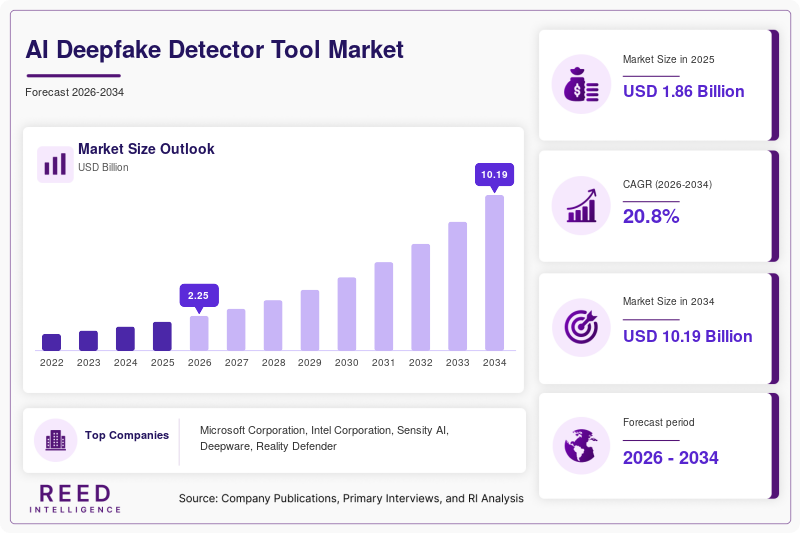
The AI Deepfake Detector Tool Market Size was valued at approximately USD 1.86 billion in 2026 and is projected to reach USD 8.42 billion by 2034, expanding at a CAGR of 20.8% during the forecast period (2026–2034). The market is witnessing strong expansion due to increasing concerns regarding digital misinformation, identity fraud, manipulated multimedia content, and cyber-enabled social engineering attacks. AI deepfake detector tools are increasingly being adopted by governments, media organizations, financial institutions, cybersecurity providers, and social media platforms to identify manipulated audio, video, and image content generated using artificial intelligence technologies. These solutions help organizations maintain content authenticity, improve digital trust, and strengthen cybersecurity frameworks against emerging AI-driven threats.
A major global factor supporting the growth of the AI Deepfake Detector Tool Market size is the rapid increase in synthetic media generation across online platforms and enterprise communication channels. As AI-generated content becomes more sophisticated and accessible, organizations are investing heavily in real-time detection systems capable of identifying manipulated digital assets before they impact brand reputation, political communication, financial security, or public trust. Rising awareness regarding misinformation risks and regulatory pressure related to digital content transparency are further accelerating market expansion across multiple industries.
Key Highlights
- Dominant Region (2025): North America held 38% share, supported by advanced cybersecurity infrastructure and strong AI adoption
- Fastest-Growing Region: Asia Pacific is projected to grow at 22.4% CAGR (2026–2034)
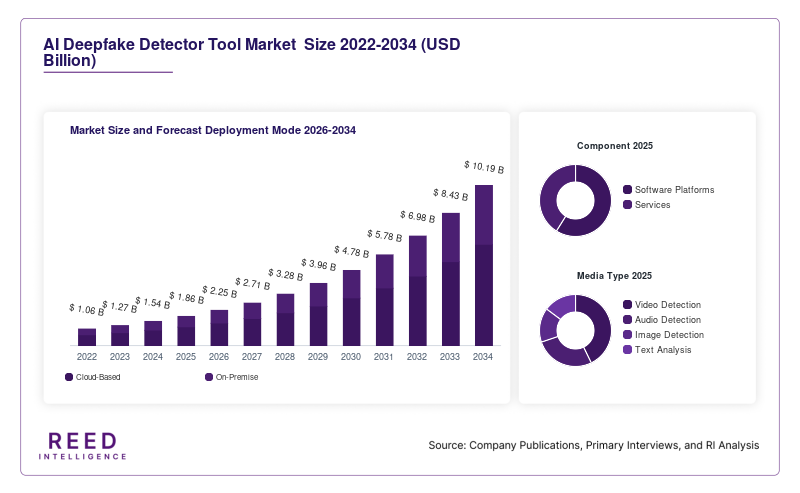
- Leading Subsegment (Deployment): Cloud-based solutions accounted for 61% share in 2025
- Fastest-Growing Subsegment (Application): Social media monitoring tools are projected to grow at 23.1% CAGR
- Dominant Country (2024): United States accounted for approximately USD 0.58 billion
- Dominant Country (2025): United States increased to USD 0.71 billion, driven by enterprise cybersecurity investments and rising digital verification requirements
Market Trends
Increasing Integration of Real-Time AI Verification Systems
The AI Deepfake Detector Tool Market is witnessing growing integration of real-time verification technologies across social media platforms, enterprise communication systems, and digital broadcasting networks. Organizations are increasingly deploying AI-powered detection systems capable of analyzing facial movements, voice patterns, metadata inconsistencies, and image manipulation indicators instantly during content uploads and digital communication activities. Real-time verification capabilities are becoming essential for media companies and financial institutions seeking to prevent fraudulent activity and misinformation distribution before it reaches public audiences.
Rising Adoption of Multimodal Deepfake Detection Platforms
Another important trend shaping the AI Deepfake Detector Tool Market is the shift toward multimodal detection platforms capable of simultaneously analyzing video, audio, text, and image manipulation patterns. Traditional detection systems focused primarily on video analysis, while newer AI-based solutions now incorporate cross-media verification capabilities to improve detection accuracy. Vendors are increasingly developing advanced neural network architectures and machine learning frameworks that can identify evolving synthetic content generation methods across diverse digital environments.
Market Drivers
Growing Cybersecurity Threats and Identity Fraud Cases
The increasing number of cyber fraud incidents involving synthetic media and AI-generated impersonation attacks is a major driver for the AI Deepfake Detector Tool Market. Financial institutions, government agencies, and enterprises are experiencing rising threats from manipulated voice recordings, fake executive communications, and fraudulent digital identities. Organizations are investing in deepfake detection technologies to strengthen fraud prevention systems, improve identity authentication, and secure digital communication channels against sophisticated cyber threats.
Rising Regulatory Focus on Digital Content Transparency
Governments and regulatory authorities worldwide are introducing policies focused on digital content authenticity, misinformation control, and AI accountability. This regulatory environment is encouraging enterprises and online platforms to deploy AI detection tools capable of identifying manipulated media content and maintaining compliance with evolving digital governance frameworks. Increased pressure on technology platforms to detect and remove misleading content is significantly supporting market growth.
Market Restraint
High Complexity of Evolving Deepfake Technologies
The AI Deepfake Detector Tool Market faces challenges due to the rapid advancement of deepfake generation technologies that continuously evolve to bypass existing detection algorithms. Maintaining detection accuracy requires continuous model training, infrastructure upgrades, and large-scale data analysis capabilities, increasing operational complexity and development costs for solution providers.
Market Opportunities
Expansion of AI Verification Solutions in Media and Entertainment
The growing need for content authenticity verification across digital entertainment, broadcasting, and online streaming industries is creating substantial opportunities for the AI Deepfake Detector Tool Market. Media companies are increasingly adopting verification tools to prevent manipulated celebrity content, unauthorized synthetic media production, and misinformation campaigns targeting public audiences.
Increasing Adoption in Financial Services and Digital Banking
Banks and financial institutions are emerging as key growth opportunities due to rising concerns regarding biometric fraud and AI-generated impersonation attacks. Deepfake detection tools are increasingly being integrated into video verification systems, customer onboarding platforms, and digital authentication frameworks to improve financial security and reduce fraud risks.
Segmental Analysis
By Deployment Mode
The AI Deepfake Detector Tool Market is segmented into cloud-based and on-premise solutions. Cloud-based deployment dominated with 61% share in 2025 due to scalability, real-time processing capabilities, and lower infrastructure costs. Organizations increasingly prefer cloud-based AI detection systems because they support rapid deployment, centralized monitoring, and continuous software updates. On-premise deployment is projected to grow at a 19.6% CAGR, supported by increasing demand from government agencies and defense organizations requiring enhanced data security and local infrastructure control.
By Component
Based on component, the market includes software platforms and services. Software platforms accounted for 68% share in 2025 because enterprises require advanced AI algorithms, media analysis engines, and automated verification systems for digital content monitoring. Services are projected to grow at a 21.3% CAGR, driven by increasing demand for consulting, system integration, model training, and managed cybersecurity support services.
By Media Type
The market is segmented into video detection, audio detection, image detection, and text analysis. Video detection dominated with 42% share in 2025 due to rising use of manipulated video content across social media, political communication, and entertainment platforms. Audio detection is expected to grow at a 22.7% CAGR, supported by increasing concerns regarding AI-generated voice cloning and synthetic audio fraud attacks targeting financial institutions and enterprises.
By Application
Applications include social media monitoring, digital identity verification, media authentication, fraud detection, and law enforcement. Social media monitoring accounted for 35% share in 2025 because digital platforms are increasingly investing in automated systems capable of identifying manipulated content before public distribution. Digital identity verification is projected to grow at a 23.4% CAGR, supported by increasing adoption of AI-based authentication systems across banking, fintech, and enterprise communication platforms.
By End Use Industry
The market includes government & defense, banking & financial services, media & entertainment, healthcare, and enterprise IT sectors. Government & defense accounted for 31% share in 2025 due to rising concerns regarding misinformation campaigns and cyber-enabled influence operations. Banking & financial services are projected to grow at a 22.1% CAGR, supported by increasing investment in biometric fraud prevention and secure customer verification technologies.
Regional Analysis
North America
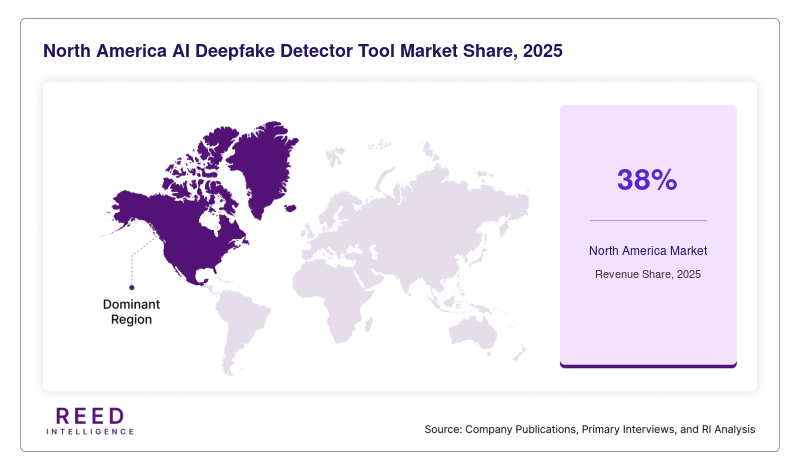
North America accounted for 38% share of the AI Deepfake Detector Tool Market in 2025 and is projected to grow at a 20.1% CAGR (2026–2034). The region benefits from advanced cybersecurity infrastructure, strong AI adoption, and increasing enterprise investment in fraud prevention technologies. The United States dominates the regional market due to rising concerns related to digital misinformation, election security, and enterprise cyber risk management.
Europe
Europe held 27% share in 2025 and is expected to grow at a 19.3% CAGR (2026–2034). Market growth is supported by stringent digital governance regulations and increasing focus on online content transparency. Germany remains a key contributor due to strong cybersecurity investment and rising deployment of AI monitoring systems across media and public sector organizations.
Asia Pacific
Asia Pacific accounted for 24% share in 2025 and is projected to grow at a 22.4% CAGR (2026–2034). The region is experiencing rapid digitalization, increasing online media consumption, and growing cybersecurity concerns across enterprise environments. China dominates regional demand due to rising AI adoption, expanding digital platforms, and increasing investment in online content regulation technologies.
Middle East & Africa
Middle East & Africa held 6% share in 2025 and is expected to grow at a 18.7% CAGR (2026–2034). Governments across the region are increasing investments in digital security infrastructure and cyber defense systems to address online misinformation and identity fraud concerns. The United Arab Emirates leads the region due to rapid smart city initiatives and growing AI implementation across public services.
Latin America
Latin America accounted for 5% share in 2025 and is projected to grow at a 18.9% CAGR (2026–2034). Brazil dominates the regional market due to rising digital banking adoption, increasing cybersecurity awareness, and expanding online media ecosystems. Growing investment in fraud prevention technologies is supporting regional market expansion.
Competitive Landscape
The AI Deepfake Detector Tool Market is highly competitive, with technology providers focusing on AI model innovation, real-time detection capabilities, and strategic partnerships with cybersecurity and media organizations. Companies are investing in advanced machine learning frameworks and multimodal analysis technologies to improve detection accuracy against rapidly evolving synthetic media threats.
Microsoft Corporation remains one of the leading participants in the market due to its strong AI infrastructure and cybersecurity ecosystem. The company recently enhanced its synthetic media detection capabilities by integrating advanced AI verification tools into enterprise security solutions and cloud-based digital trust platforms.
Intel Corporation continues to expand its real-time fake video analysis technologies, while Sensity AI focuses on enterprise-grade deepfake monitoring systems for governments and financial institutions. Deepware and Reality Defender are strengthening their market presence through scalable cloud-based verification platforms and API-driven media authentication tools. DuckDuckGoose AI specializes in multimodal detection technologies for enterprise cybersecurity and media verification applications.
Key Players List
- Microsoft Corporation
- Intel Corporation
- Sensity AI
- Deepware
- Reality Defender
- DuckDuckGoose AI
- Truepic
- Sentinel
- Hive AI
- BioID GmbH
- Pindrop Security
- OpenAI Security Solutions
- Adobe Inc.
- CyberArk Software Ltd.
- Resemble AI
Recent Developments
- In 2024, Microsoft Corporation expanded its AI-powered synthetic media detection tools across enterprise cloud security platforms.
- In 2024, Intel Corporation introduced upgraded real-time video deepfake analysis technology for digital verification applications.
- In 2025, Sensity AI launched advanced multimodal detection systems capable of identifying manipulated audio, video, and image content simultaneously.
- In 2025, Reality Defender expanded its cloud-based deepfake detection platform for banking and enterprise cybersecurity applications.
- In 2025, Adobe Inc. integrated AI content authenticity verification features into its digital media editing ecosystem.
AI Deepfake Detector Tool Market Segments
Deployment Mode
- Cloud-Based
- On-Premise
Component
- Software Platforms
- Services
Media Type
- Video Detection
- Audio Detection
- Image Detection
- Text Analysis
Application
- Social Media Monitoring
- Digital Identity Verification
- Media Authentication
- Fraud Detection
- Law Enforcement
End Use Industry
- Government & Defense
- Banking & Financial Services
- Media & Entertainment
- Healthcare
- Enterprise IT
Region
- North America
- Europe
- Asia Pacific
- Middle East & Africa
- Latin America
By Region
- North America
- Europe
- APAC
- Middle East and Africa
- LATAM