AI in Pathology Market Size, Share Demand Report By Component (Software, Hardware, Services), By Application (Cancer Diagnosis, Drug Discovery & Research, Disease Detection & Classification), By End-Use (Hospitals & Diagnostic Laboratories, Biotechnology & Pharmaceutical Companies, Research Institutes) By Region & Segment Forecasts, 2025–2033
USD 3950
Market Overview
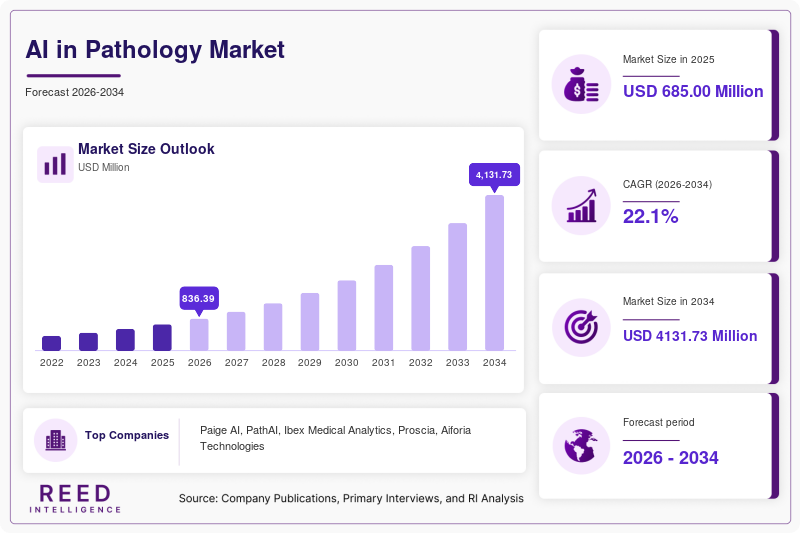
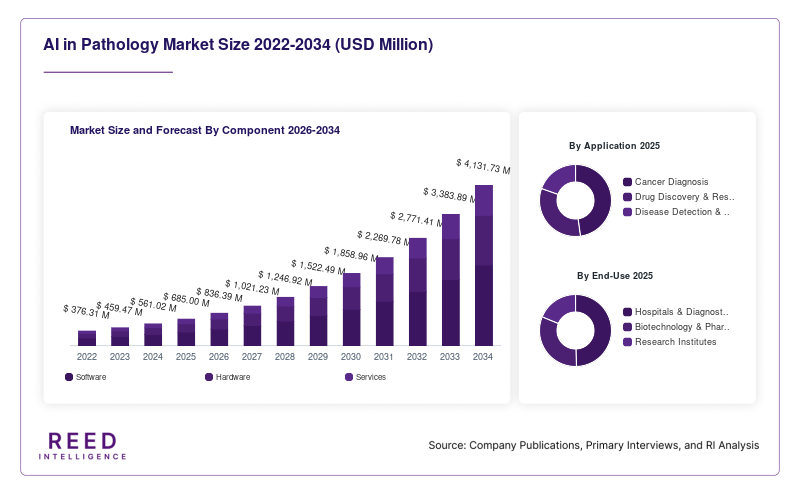
The Ai In Pathology Market size was valued at USD 685 million in 2024 and is projected to reach USD 4.12 billion by 2033, expanding at a CAGR of 22.1% from 2025 to 2033. The increasing integration of artificial intelligence technologies into digital pathology workflows has accelerated adoption across healthcare institutions, diagnostic laboratories, and research organizations. AI-enabled pathology systems assist pathologists in analyzing complex tissue samples, improving diagnostic efficiency and enabling early disease detection. These technologies support automated image analysis, pattern recognition, and predictive analytics, enabling healthcare professionals to process high volumes of pathology data with enhanced precision.
A major global factor supporting the growth of the Ai In Pathology Market is the increasing digital transformation of healthcare infrastructure. Hospitals and diagnostic laboratories are adopting digital pathology platforms that generate high-resolution slide images. Artificial intelligence algorithms are being integrated with these digital systems to enable automated disease classification, tumor detection, and clinical decision support. As healthcare providers continue to modernize pathology laboratories and implement data-driven diagnostics, the demand for AI-based pathology solutions is expected to grow steadily throughout the forecast period.
Key Highlights
- North America accounted for the largest regional share of 38.4% in 2025, while Asia Pacific is projected to grow at the fastest CAGR of 25.6% (2025–2033).
- By component, software solutions dominated with 54.7% share in 2024, while AI-enabled analytics platforms are projected to grow at 24.3% CAGR.
- By application, cancer diagnosis held the largest share of 47.2% in 2024, while drug discovery applications are projected to grow at 23.8% CAGR.
- The United States remained the dominant country, with a market value of USD 242 million in 2024 and USD 287 million in 2025.
Market Trends
Integration of AI with Digital Pathology Platforms
A significant trend shaping the Ai In Pathology Market is the integration of artificial intelligence with digital pathology platforms. Traditional pathology workflows relied heavily on manual slide examination, which could be time-consuming and susceptible to variability. Digital pathology solutions convert glass slides into high-resolution digital images that can be analyzed using AI algorithms. These algorithms assist in identifying patterns associated with diseases such as cancer, inflammatory conditions, and infectious diseases.
Healthcare institutions are increasingly deploying AI-enabled diagnostic systems to support pathologists in clinical decision-making. These platforms enable automated cell counting, tumor grading, and tissue segmentation, improving diagnostic consistency. The growing availability of cloud-based digital pathology infrastructure is also supporting this trend by enabling remote slide analysis and collaborative diagnostics.
Growing Use of AI for Precision Oncology
The rising application of artificial intelligence in precision oncology is another trend driving the Ai In Pathology Market. AI models are being used to analyze complex histopathological data and identify molecular patterns linked to tumor behavior and treatment response. These insights help clinicians select personalized treatment strategies for patients.
AI-based pathology tools can analyze tissue morphology alongside genomic and clinical data, enabling comprehensive cancer profiling. As healthcare providers focus more on personalized medicine and targeted therapies, AI-enabled pathology systems are expected to become an essential component of oncology diagnostics.
Market Drivers
Increasing Adoption of Digital Pathology Infrastructure
The growing implementation of digital pathology systems in hospitals and diagnostic laboratories is a key driver of the Ai In Pathology Market. Digital scanners convert pathology slides into digital images that can be stored, shared, and analyzed electronically. When combined with AI algorithms, these digital images allow automated detection of disease markers and abnormal tissue structures.
Healthcare providers are increasingly investing in digital pathology infrastructure to improve workflow efficiency and reduce diagnostic turnaround time. The ability of AI-enabled pathology platforms to process large volumes of imaging data supports high-throughput diagnostics, making them valuable tools in modern pathology laboratories.
Rising Demand for Efficient Diagnostic Workflows
The growing global demand for faster and more accurate diagnostic processes is also driving the Ai In Pathology Market. Pathologists often face increasing workloads due to the rising prevalence of chronic diseases and cancer cases. AI technologies assist by automating routine analysis tasks, allowing pathologists to focus on complex cases.
Advanced AI systems can analyze histopathology images within minutes, significantly reducing manual review time. As healthcare systems continue to emphasize efficiency and diagnostic accuracy, the adoption of AI-driven pathology tools is expected to expand across clinical settings.
Market Restraint
Regulatory and Validation Challenges
Despite the rapid technological progress, regulatory and validation challenges remain a major restraint for the Ai In Pathology Market. AI-based medical software must undergo rigorous validation to ensure diagnostic reliability and patient safety. Regulatory agencies require extensive clinical evidence before approving AI algorithms for routine medical use.
These approval processes can be time-consuming and resource-intensive, which may delay product commercialization. Additionally, variations in regulatory frameworks across countries create complexities for companies attempting to launch AI pathology solutions in multiple markets. Ensuring interoperability with existing hospital information systems also presents technical challenges that may slow adoption in some healthcare facilities.
Market Opportunities
Expansion of AI-Driven Drug Discovery Applications
An emerging opportunity in the Ai In Pathology Market is the use of artificial intelligence in pharmaceutical research and drug discovery. AI-powered pathology platforms can analyze tissue samples from clinical trials and research studies, helping scientists identify disease biomarkers and evaluate treatment responses.
Pharmaceutical companies are increasingly adopting AI-driven pathology analytics to accelerate drug development processes. These technologies enable faster interpretation of histological data, reducing the time required for preclinical and clinical research.
Growth of Cloud-Based Pathology Platforms
The development of cloud-based pathology platforms presents another growth opportunity for the Ai In Pathology Market. Cloud infrastructure allows healthcare institutions to store large volumes of digital pathology images and access them remotely for AI analysis.
These platforms enable collaboration among pathologists across different locations and facilitate telepathology services. As healthcare providers expand digital health ecosystems, cloud-based AI pathology systems are expected to gain increasing adoption.
Segmental Analysis
By Component
Software solutions dominated the Ai In Pathology Market in 2024, accounting for 54.7% of the total market share. These solutions include AI algorithms, image analysis software, and diagnostic support platforms used to analyze digital pathology slides. Healthcare providers increasingly relied on software-based AI tools to automate tissue image analysis and assist pathologists in identifying abnormal cellular patterns.
The AI-enabled analytics platforms segment will expand at the fastest CAGR of 24.3% during the forecast period. Growth will be driven by the increasing demand for advanced data analytics in pathology laboratories. These platforms enable large-scale image processing and predictive analysis, allowing healthcare providers to extract valuable insights from complex pathology datasets.
By Application
The cancer diagnosis segment accounted for the largest share of the Ai In Pathology Market in 2024, representing 47.2% of the total market. AI technologies have been widely applied in oncology diagnostics to analyze histopathology slides and identify tumor characteristics. These tools support pathologists in detecting cancer cells and evaluating tumor grades more efficiently.
The drug discovery and research segment will register the fastest CAGR of 23.8% during 2025–2033. Pharmaceutical companies are increasingly using AI-driven pathology tools to analyze tissue samples during preclinical and clinical studies. These technologies help researchers identify disease biomarkers and evaluate treatment responses.
By End-Use
Hospitals and diagnostic laboratories dominated the Ai In Pathology Market in 2024 with a 62.5% share. These healthcare facilities rely on pathology diagnostics for disease identification and treatment planning. The integration of AI tools into hospital pathology departments has improved diagnostic workflow efficiency and data management.
The biotechnology and pharmaceutical companies segment will grow at the fastest CAGR of 24.1% during the forecast period. Growth will be driven by the increasing use of AI-enabled pathology platforms in clinical research and drug development. These organizations use AI tools to analyze histopathological data from clinical trials and research studies.
Regional Analysis
North America
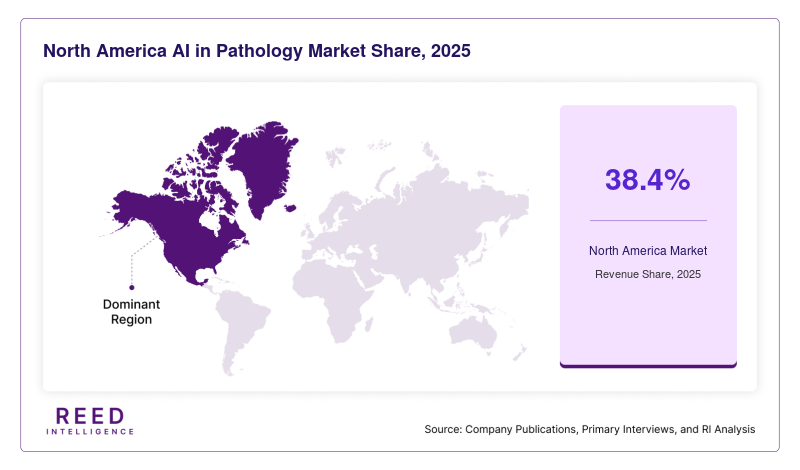
North America accounted for 38.4% of the global Ai In Pathology Market share in 2025 and will expand at a CAGR of 21.5% during 2025–2033. The region’s growth has been supported by the widespread adoption of digital pathology infrastructure and advanced healthcare technologies. Hospitals and research laboratories in the region have integrated AI-driven diagnostic platforms into routine pathology workflows to improve efficiency and data management.
The United States remained the dominant country in the regional market. The country’s growth has been supported by strong investments in healthcare technology and the presence of advanced medical research institutions. Many hospitals and academic research centers have deployed AI-enabled pathology tools for cancer diagnostics and clinical research applications.
Europe
Europe represented 27.6% of the global Ai In Pathology Market share in 2025 and will grow at a CAGR of 20.4% through 2033. The region has been witnessing steady adoption of digital pathology systems across hospitals and diagnostic laboratories. Healthcare providers have increasingly integrated AI-based pathology tools to enhance diagnostic accuracy and support pathology research initiatives.
Germany dominated the regional market due to its advanced healthcare infrastructure and strong biomedical research ecosystem. The country has supported the integration of AI technologies into pathology laboratories through government-funded research programs and collaborations between universities and medical technology companies.
Asia Pacific
Asia Pacific held 21.8% of the global Ai In Pathology Market share in 2025 and will grow at the fastest CAGR of 25.6% during the forecast period. The region’s growth is attributed to the increasing adoption of digital healthcare technologies and expanding diagnostic laboratory networks.
China emerged as the dominant country in the regional market. Rapid expansion of healthcare infrastructure and strong investments in artificial intelligence technologies have supported the adoption of AI-driven pathology platforms across hospitals and diagnostic centers. The country has also seen the emergence of domestic technology companies developing AI-based medical imaging solutions.
Middle East & Africa
The Middle East & Africa accounted for 6.5% of the global Ai In Pathology Market share in 2025 and will expand at a CAGR of 19.3% through 2033. Healthcare providers in the region have gradually adopted digital pathology solutions as part of broader healthcare modernization initiatives.
The United Arab Emirates remained the dominant country in the regional market. The government has invested significantly in digital healthcare infrastructure and AI-enabled medical technologies. Hospitals and diagnostic centers in the country have started implementing AI-based diagnostic tools to support clinical decision-making.
Latin America
Latin America represented 5.7% of the global Ai In Pathology Market share in 2025 and will grow at a CAGR of 18.9% during the forecast period. The adoption of digital pathology solutions has been increasing as healthcare providers modernize laboratory systems.
Brazil remained the leading country in the regional market. The country’s growth has been supported by expanding diagnostic laboratory networks and increasing investments in healthcare technology. Hospitals and private diagnostic laboratories have begun integrating AI-based pathology platforms to improve diagnostic workflows and data analysis.
Competitive Landscape
The Ai In Pathology Market is characterized by the presence of several technology providers, digital pathology companies, and healthcare analytics firms. Market participants are focusing on developing advanced AI algorithms, expanding digital pathology platforms, and forming strategic collaborations with healthcare institutions.
Among the leading companies, Paige AI has emerged as a prominent market leader due to its specialized AI models for cancer pathology diagnostics. The company has recently expanded its AI-based pathology platform to support additional tumor detection applications and collaborative pathology workflows.
Other companies in the market are investing in research and development to improve AI algorithm accuracy and enhance integration with digital pathology scanners and laboratory information systems.
Key Players
- Paige AI
- PathAI
- Ibex Medical Analytics
- Proscia
- Aiforia Technologies
- Indica Labs
- Visiopharm
- Roche Diagnostics
- Philips Healthcare
- Inspirata
Recent Developments
- 2024: Paige AI introduced an updated AI pathology model designed to improve tumor detection accuracy in digital pathology workflows.
- 2024: Proscia launched a cloud-based pathology analytics platform to support remote diagnostics and collaborative research.
- 2023: Aiforia Technologies expanded its AI-based pathology solutions portfolio for clinical oncology applications.
- 2023: Ibex Medical Analytics partnered with healthcare institutions to deploy AI-powered diagnostic tools in hospital pathology laboratories.
AI in Pathology Market Segments
By Component
- Software
- Hardware
- Services
By Application
- Cancer Diagnosis
- Drug Discovery & Research
- Disease Detection & Classification
By End-Use
- Hospitals & Diagnostic Laboratories
- Biotechnology & Pharmaceutical Companies
- Research Institutes
By Region
- North America
- Europe
- APAC
- Middle East and Africa
- LATAM