AI Medical Writing Market Size, Share & Demand Report By Type (Software, Services), By Application (Clinical Documentation, Scientific Content Writing, Regulatory Writing), By End-Use (Pharmaceutical & Biotechnology Companies, Contract Research Organizations, Healthcare Providers) By Region & Segment Forecasts, 2025–2034
USD 3950
Market Overview
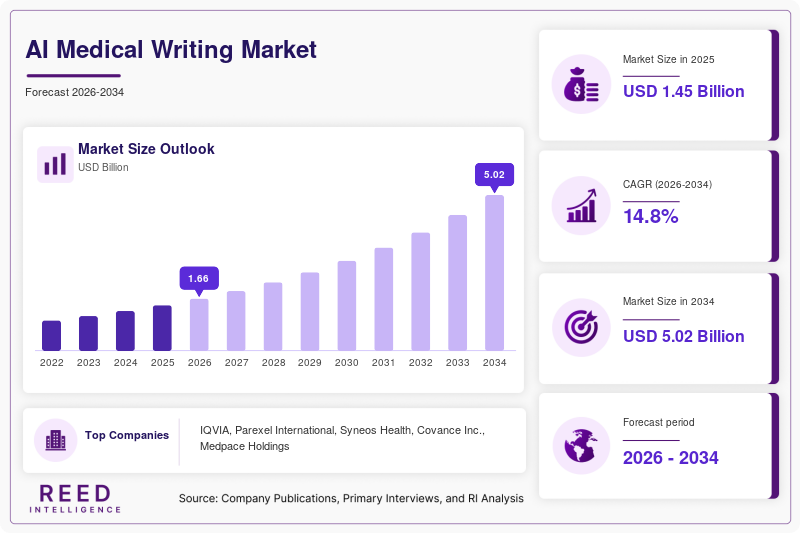
The AI Medical Writing Market size is experiencing notable expansion as healthcare organizations increasingly adopt artificial intelligence tools to streamline documentation, regulatory submissions, and clinical content creation. In 2025, the global AI medical writing market size is estimated at USD 1.45 billion, growing to approximately USD 1.72 billion in 2026. The market is projected to reach USD 5.96 billion by 2034, registering a compound annual growth rate (CAGR) of 14.8% during the forecast period (2025–2034).
The growth trajectory is driven by the rising complexity of clinical trials and regulatory documentation, which demand faster turnaround times and higher accuracy. AI-powered medical writing platforms are increasingly used to automate repetitive tasks such as clinical study reports (CSRs), regulatory submissions, and patient narratives. Additionally, the growing volume of healthcare data, including electronic health records (EHRs), is encouraging the adoption of AI tools capable of extracting insights and generating structured medical documents.
Key Highlights
- Market size estimated at USD 1.45 billion in 2025
- Expected to reach USD 5.96 billion by 2034
- CAGR of 14.8% from 2025 to 2034
- Increasing adoption of AI in clinical documentation and regulatory writing
- Growing demand for cost-efficient and scalable medical writing solutions
Market Trends
Integration of Generative AI in Clinical Documentation
One of the most significant trends shaping the AI medical writing market is the integration of generative AI technologies into clinical documentation workflows. These tools are capable of drafting structured documents such as clinical study reports, regulatory submissions, and scientific publications with minimal human intervention. Generative AI models are trained on large datasets of medical literature and regulatory guidelines, enabling them to produce coherent and compliant content. This trend is reducing turnaround times and improving efficiency across pharmaceutical and contract research organizations. As regulatory authorities increasingly accept AI-assisted documentation, the adoption of generative AI is expected to expand further.
Growing Adoption of AI in Real-World Evidence (RWE) Analysis
Another emerging trend is the use of AI medical writing tools in real-world evidence analysis. Healthcare organizations are leveraging AI to process large volumes of real-world data, including patient records, insurance claims, and wearable device data. AI-driven writing tools can convert this data into meaningful reports and publications, supporting post-market surveillance and health economics studies. This trend is particularly relevant as regulators and payers emphasize real-world evidence in decision-making. The ability to quickly generate high-quality reports from complex datasets is positioning AI medical writing solutions as essential tools in modern healthcare research.
Market Drivers
Increasing Volume of Clinical Trials and Regulatory Requirements
The rising number of clinical trials globally is a major driver of the AI medical writing market. Pharmaceutical and biotechnology companies are conducting more trials to develop innovative therapies, resulting in a significant increase in documentation requirements. Each trial generates extensive data that must be compiled into regulatory-compliant reports. AI medical writing tools help streamline this process by automating data extraction, analysis, and document generation. This reduces the workload on human writers and ensures consistency in reporting. Additionally, stricter regulatory requirements are pushing organizations to adopt advanced tools that minimize errors and improve compliance.
Demand for Operational Efficiency and Cost Reduction
Healthcare organizations are under constant pressure to reduce costs while maintaining high-quality outputs. Traditional medical writing processes are resource-intensive and time-consuming, often involving multiple revisions and quality checks. AI-driven solutions address these challenges by automating repetitive tasks and reducing the need for manual intervention. This leads to faster document generation and lower operational costs. Moreover, AI tools can work continuously without fatigue, improving productivity and turnaround times. As organizations seek to optimize their operations, the demand for AI medical writing solutions is expected to grow significantly.
Market Restraint
Concerns Related to Data Privacy and Regulatory Compliance
Despite the growing adoption of AI medical writing tools, concerns related to data privacy and regulatory compliance remain a significant restraint. Medical writing involves handling sensitive patient data and confidential clinical trial information. Any breach or misuse of this data can have serious legal and ethical implications. AI systems must comply with strict data protection regulations, which vary across regions. Ensuring compliance with these regulations can be challenging and may limit the adoption of AI solutions. Additionally, there is skepticism regarding the accuracy and reliability of AI-generated content, particularly in highly regulated environments. Organizations often require extensive validation and human oversight, which can slow down the implementation of AI technologies. For example, pharmaceutical companies may hesitate to rely fully on AI-generated regulatory submissions without thorough review, increasing the time and cost of adoption.
Market Opportunities
Expansion in Emerging Markets
Emerging markets present significant growth opportunities for the AI medical writing market. Countries in Asia Pacific, Latin America, and the Middle East are witnessing rapid growth in healthcare infrastructure and clinical research activities. These regions are increasingly adopting digital technologies to improve healthcare delivery and research capabilities. AI medical writing tools can help organizations in these markets overcome resource constraints and improve efficiency. Additionally, the growing presence of global pharmaceutical companies in emerging markets is driving the demand for advanced documentation solutions. As awareness of AI technologies increases, these regions are expected to become key contributors to market growth.
Development of Customized AI Solutions for Specialized Writing
Another promising opportunity lies in the development of customized AI solutions tailored to specific medical writing needs. Different segments of the healthcare industry require specialized documentation, such as regulatory writing, scientific publications, and patient education materials. AI vendors can develop targeted solutions that address these specific requirements, enhancing their value proposition. For instance, AI tools designed for oncology research can incorporate domain-specific knowledge to generate more accurate and relevant content. This level of customization can improve user adoption and open new revenue streams for solution providers. As the demand for specialized content increases, customized AI medical writing solutions are expected to gain traction.
Segmental Analysis
By Type
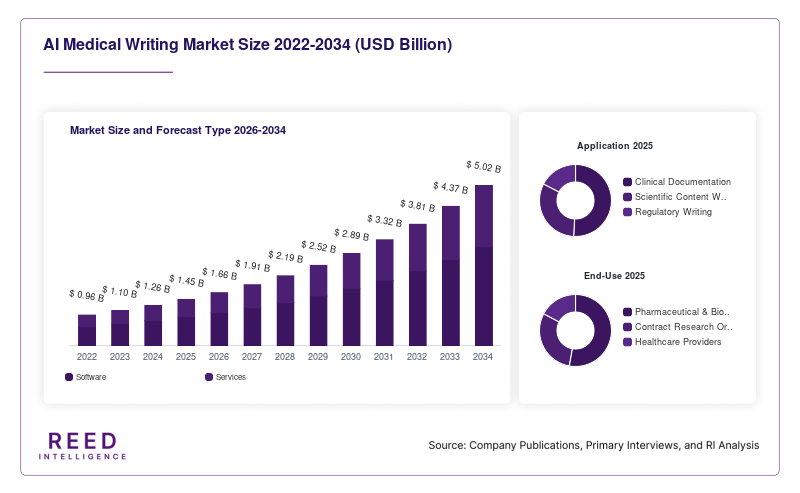
The software segment dominated the AI medical writing market in 2024, accounting for approximately 62% of the total market share. This dominance is attributed to the widespread adoption of AI-based platforms that automate document generation and data analysis. These software solutions are designed to handle large volumes of medical data and produce structured reports with high accuracy. They are widely used by pharmaceutical companies, contract research organizations, and healthcare providers. The integration of advanced features such as natural language processing and machine learning is further enhancing the capabilities of these tools. As organizations continue to prioritize efficiency and accuracy, the demand for AI medical writing software is expected to remain strong.
The services segment is expected to be the fastest-growing subsegment, with a CAGR of 15.6% during the forecast period. This growth is driven by the increasing need for implementation, training, and support services associated with AI medical writing solutions. Organizations often require expert guidance to integrate AI tools into their existing workflows and ensure compliance with regulatory requirements. Additionally, the complexity of AI technologies necessitates ongoing maintenance and updates. Service providers are offering customized solutions to meet the specific needs of clients, which is driving the growth of this segment. As adoption increases, the demand for professional services is expected to rise significantly.
By Application
The clinical documentation segment held the largest share in 2024, accounting for approximately 55% of the market. This segment includes the generation of clinical study reports, patient narratives, and regulatory submissions. The high volume of documentation required in clinical trials is driving the adoption of AI tools in this segment. These tools help streamline the documentation process, reduce errors, and ensure compliance with regulatory standards. The ability to quickly generate high-quality reports is a key factor contributing to the dominance of this segment. As clinical trials become more complex, the demand for AI-driven documentation solutions is expected to increase.
The scientific content writing segment is projected to be the fastest-growing, with a CAGR of 16.2% during the forecast period. This growth is driven by the increasing demand for research publications, medical articles, and educational content. AI tools are enabling researchers and healthcare professionals to generate high-quality content more efficiently. These tools can analyze large volumes of data and produce well-structured articles, reducing the time required for manual writing. The growing emphasis on knowledge dissemination and evidence-based medicine is further driving the demand for AI-powered scientific writing solutions.
By End-Use
Pharmaceutical and biotechnology companies dominated the market in 2024, accounting for approximately 48% of the total share. These organizations generate a large volume of documentation related to drug development, clinical trials, and regulatory submissions. AI medical writing tools help streamline these processes, reducing the time and cost associated with manual writing. The adoption of AI solutions is particularly high in large pharmaceutical companies, which have the resources to invest in advanced technologies. As the pharmaceutical industry continues to grow, the demand for AI medical writing tools is expected to remain strong.
Contract research organizations (CROs) are expected to be the fastest-growing end-use segment, with a CAGR of 15.9%. CROs provide outsourced research services to pharmaceutical and biotechnology companies, including clinical trial management and documentation. The increasing outsourcing of clinical research activities is driving the demand for AI medical writing tools in this segment. These tools help CROs manage large volumes of data and deliver high-quality documentation within tight timelines. As the trend of outsourcing continues, the adoption of AI solutions in CROs is expected to increase significantly.
Regional Analysis
North America
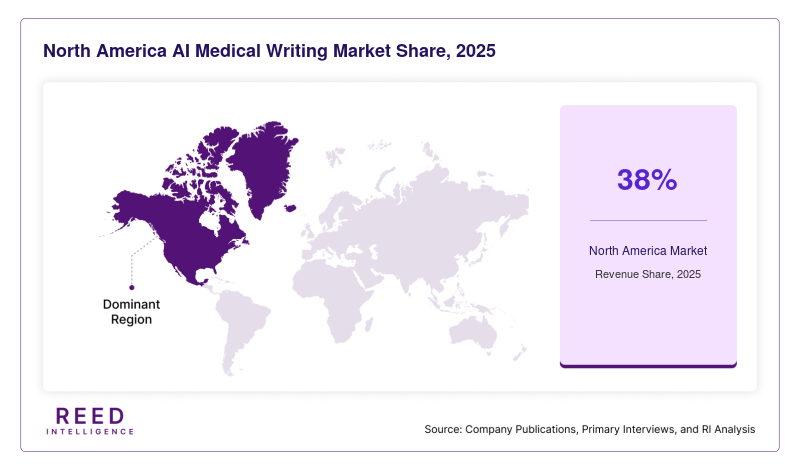
North America held the largest share of the AI medical writing market in 2025, accounting for approximately 38% of the global revenue. The region is expected to maintain its dominance throughout the forecast period, with a CAGR of around 13.9%. The presence of advanced healthcare infrastructure, strong regulatory frameworks, and high adoption of digital technologies are key factors supporting market growth. Additionally, the region benefits from significant investments in AI research and development.
The United States is the dominant country in North America, driven by its large pharmaceutical industry and extensive clinical research activities. A unique growth factor in the country is the widespread adoption of electronic health records, which provide a rich data source for AI-driven medical writing tools. This integration enables faster and more efficient document generation, supporting the overall growth of the market.
Europe
Europe accounted for approximately 26% of the global market share in 2025 and is expected to grow at a CAGR of 14.2% during the forecast period. The region's growth is driven by increasing investments in healthcare digitization and the adoption of AI technologies in clinical research. Regulatory bodies in Europe are also encouraging the use of advanced technologies to improve efficiency and compliance.
Germany is the leading country in the European market, supported by its strong pharmaceutical sector and focus on innovation. A unique growth factor in Germany is the increasing collaboration between academic institutions and industry players, which is fostering the development of AI-based medical writing solutions. These collaborations are enhancing research capabilities and driving market growth.
Asia Pacific
Asia Pacific is expected to witness the fastest growth, with a CAGR of 16.5% from 2025 to 2034, and held a market share of around 20% in 2025. The region's growth is fueled by the rapid expansion of healthcare infrastructure and increasing clinical trial activities. Governments are also promoting the adoption of digital technologies to improve healthcare outcomes.
China is the dominant country in the Asia Pacific region, driven by its large population and growing healthcare investments. A unique growth factor in China is the increasing focus on domestic pharmaceutical innovation, which is generating a high demand for medical writing services. AI tools are helping companies manage large volumes of data and documentation efficiently.
Middle East & Africa
The Middle East & Africa region accounted for approximately 8% of the global market share in 2025 and is expected to grow at a CAGR of 13.5%. The market is gradually expanding due to improvements in healthcare infrastructure and increasing awareness of AI technologies. Governments are investing in digital health initiatives to enhance service delivery.
The United Arab Emirates is a key country in this region, driven by its focus on becoming a hub for healthcare innovation. A unique growth factor is the government's emphasis on smart healthcare systems, which include AI-driven solutions. This focus is encouraging the adoption of AI medical writing tools in clinical and research settings.
Latin America
Latin America held around 8% of the market share in 2025 and is projected to grow at a CAGR of 14.0% during the forecast period. The region is experiencing steady growth due to increasing healthcare investments and the expansion of clinical research activities. Adoption of AI technologies is gradually increasing across the region.
Brazil is the leading country in Latin America, supported by its large healthcare system and growing pharmaceutical industry. A unique growth factor in Brazil is the increasing participation in global clinical trials, which requires efficient documentation processes. AI medical writing tools are helping organizations meet these requirements, driving market growth.
Competitive Landscape
The AI medical writing market is moderately competitive, with several global and regional players offering a range of solutions. Companies are focusing on innovation, strategic partnerships, and product development to strengthen their market position. The market is characterized by the presence of both established technology providers and emerging startups specializing in AI-driven healthcare solutions.
One of the leading players in the market is IQVIA, which offers advanced AI-based medical writing solutions integrated with its clinical research services. The company has been actively investing in AI technologies to enhance its capabilities and expand its service offerings. A recent development includes the launch of an AI-powered platform designed to automate clinical documentation and improve efficiency. Other companies are also focusing on expanding their product portfolios and entering new markets to capitalize on the growing demand for AI medical writing solutions.
Key Players
- IQVIA
- Parexel International
- Syneos Health
- Covance Inc.
- Medpace Holdings
- Freyr Solutions
- Certara
- ArisGlobal
- Indegene
- Cactus Communications
- Trilogy Writing & Consulting
- ICON plc
- Labcorp Drug Development
- Accenture
- Cognizant
Recent Developments
- In 2024, IQVIA launched an AI-driven clinical documentation platform to enhance regulatory writing efficiency.
- In 2023, Parexel expanded its AI capabilities by integrating machine learning tools into its medical writing services.
- In 2024, Indegene introduced a generative AI solution for scientific content creation, targeting pharmaceutical clients.
AI Medical Writing Market Segments
Type
- Software
- Services
Application
- Clinical Documentation
- Scientific Content Writing
- Regulatory Writing
End-Use
- Pharmaceutical & Biotechnology Companies
- Contract Research Organizations
- Healthcare Providers
By Region
- North America
- Europe
- APAC
- Middle East and Africa
- LATAM