Air and Water Pollution Control Equipment Market Size, Share & Trends Analysis Report By Equipment Type (Air Pollution Control Equipment, Water Pollution Control Equipment and Integrated Pollution Control Systems), By Application (Industrial, Municipal, Commercial and Residential) and By Region (North America, Europe, Asia Pacific, Latin America, Middle East & Africa) Forecasts, 2026–2034
USD 3950
Air and Water Pollution Control Equipment Market Size
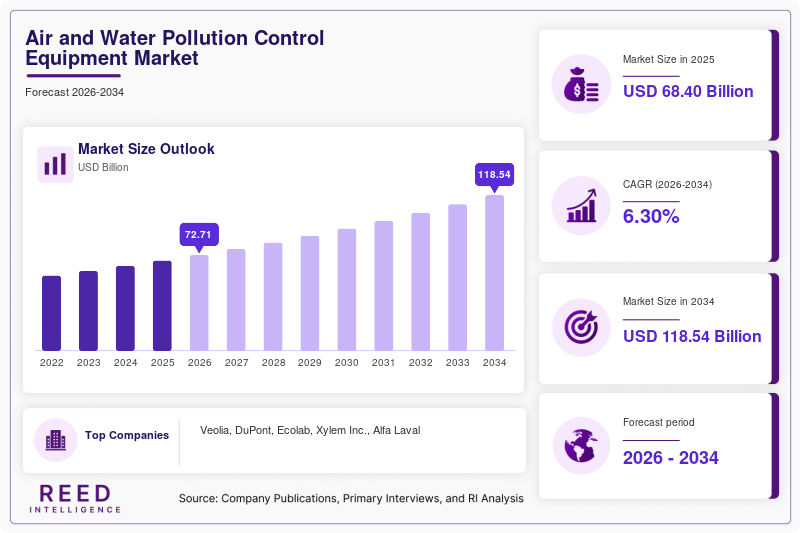
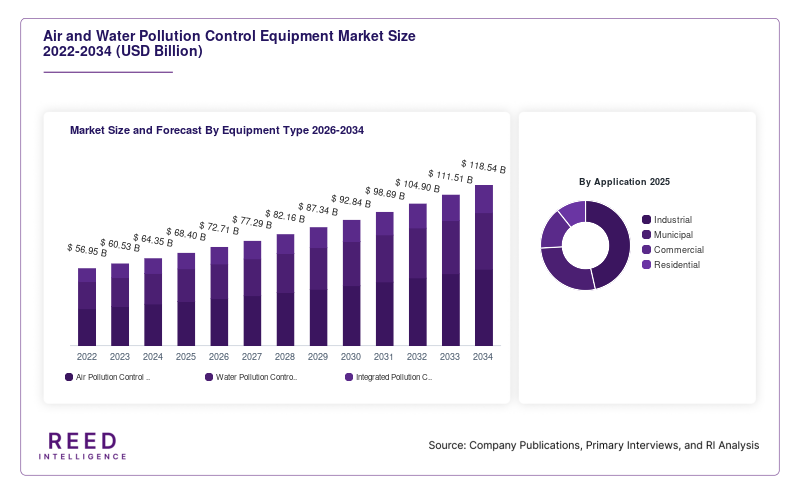
The global air and water pollution control equipment market was valued at USD 68.40 billion in 2025 and is projected to grow from USD 72.71 billion in 2026 to USD 118.54 billion by 2034, registering a CAGR of 6.30% during the forecast period from 2026 to 2034.
Air and water pollution control equipment is shifting from standalone end-of-pipe hardware toward integrated treatment systems that combine filtration, separation, chemical treatment, membranes, sensors, automation and digital monitoring. On the air side, the technology mix spans particulate capture, gaseous pollutant removal and VOC control. EPA identifies electrostatic precipitators, fabric filters, cyclones, wet scrubbers, thermal oxidizers, condensers, absorbers and adsorbers among established control approaches.
Water treatment is becoming more technology-intensive as industrial users address contaminants, water scarcity and discharge requirements simultaneously. Reverse osmosis, nanofiltration, ultrafiltration, ion exchange, activated carbon and advanced oxidation can be configured in different treatment trains depending on the contaminant profile and required water quality. EPA's drinking-water technology guidance includes granular activated carbon, ion exchange, biological treatment, reverse osmosis/nanofiltration and ultraviolet/advanced oxidation processes.
Air and Water Pollution Control Equipment Market Drivers
Tightening Emission and Discharge Requirements
Regulatory requirements remain a fundamental demand mechanism for pollution-control equipment. Air-control systems are required to meet pollutant-specific emission limits, while wastewater-treatment systems must satisfy discharge, reuse and water-quality requirements. EPA's RACT/BACT/LAER clearinghouse documents air-pollution control technologies incorporated into permitting decisions for stationary sources, demonstrating how technology selection is linked directly to regulatory compliance.
For industrial operators, the consequence is a continuing need to upgrade or replace treatment equipment when production capacity changes, regulations tighten or existing systems become inadequate. Pollution-control expenditure is therefore influenced not only by new plant construction but also by retrofit and modernization projects across power generation, chemicals, metals, manufacturing, food processing, pharmaceuticals and municipal infrastructure.
Rising Industrial Water Reuse and Resource Recovery
Water scarcity and the cost of freshwater are increasing the economic value of advanced treatment. Industrial users are increasingly evaluating wastewater as a recoverable resource rather than solely as a disposal stream. EPA's Clean Water Technology Center specifically identifies water reuse, nutrient recovery, energy generation and treatment of emerging contaminants among its technology priorities.
Membrane technologies are particularly relevant because they can be configured for high-purity water production, wastewater reuse, desalination and concentration. DuPont's 2026 membrane launches target industrial water recovery and ZLD/MLD applications, illustrating the movement toward treatment systems designed around both pollutant removal and resource efficiency.
Industrialization and Expansion of Treatment Infrastructure
Expansion of manufacturing, utilities, municipalities and infrastructure increases the number of facilities requiring air and water pollution-control systems. New production plants require compliant treatment systems at commissioning, while existing facilities require upgrades as production volumes and environmental requirements change.
The equipment opportunity extends across both centralized and decentralized installations. EPA's wastewater technology clearinghouse covers technologies for centralized and decentralized systems and emphasizes solutions suitable for communities of different sizes. This supports demand for packaged, modular and mobile systems alongside large engineered treatment plants.
Air and Water Pollution Control Equipment Market Restraints
High Capital and Operating Costs
Advanced pollution-control equipment can require substantial capital investment because complete installations may include treatment vessels, pumps, fans, blowers, membranes, filters, electrical controls, monitoring systems and supporting infrastructure. Operating costs can also include energy, chemicals, replacement membranes, filter media and maintenance.
The economics vary substantially by pollutant and treatment objective. EPA documentation notes that some air-control technologies have materially different capital and operating requirements, while water-treatment processes can also face costs related to fouling, scaling, residual disposal and energy consumption.
Complex Maintenance and Treatment Residuals
Pollution-control equipment operates under demanding conditions, including particulate loading, corrosive gases, contaminated water, variable flow and changing pollutant concentrations. Filters can become loaded, membranes can foul, scrubber systems can accumulate solids and treatment processes can generate concentrated residual streams.
For example, EPA notes that packed-tower aeration can encounter scaling or fouling of packing media under certain water conditions, while large-scale aeration systems can require substantial airflow and infrastructure. These maintenance requirements create demand for monitoring, replacement parts, service contracts and predictive-maintenance capabilities.
Air and Water Pollution Control Equipment Market Opportunities
Digitalization and Intelligent Pollution-Control Systems
Digital monitoring provides an opportunity to improve equipment utilization and reduce unnecessary operating expenditure. Sensors can monitor pressure, flow, pollutant concentration, membrane performance, filter loading and equipment health, allowing operators to identify deviations before they result in treatment failure.
DuPont's 2026 RO Operations Advisor illustrates this direction by using historical operating data and AI-based analytics to support reverse-osmosis maintenance, cleaning and membrane-replacement decisions. The commercial opportunity extends beyond equipment sales into recurring software, monitoring and optimization services.
Modular Treatment and Industrial Water Circularity
Modular and integrated systems can address customers that need treatment capacity without constructing large conventional facilities. Packaged water-treatment systems, mobile treatment units, modular membranes and integrated filtration systems can reduce installation complexity and accommodate changing capacity requirements.
The opportunity is particularly relevant to industrial facilities seeking water reuse or reduced wastewater discharge. DuPont's integrated ultrafiltration module launched in 2026 combines pre-filtration and ultrafiltration in one housing, potentially reducing plant footprint and the capital associated with separate pre-filtration infrastructure.
Air and Water Pollution Control Equipment Market Segmental Analysis
By Equipment Type
Water Pollution Control Equipment accounted for the largest segment with approximately 48% market share in 2025, supported by municipal wastewater treatment, industrial water reuse, desalination, drinking-water treatment and increasingly stringent discharge requirements. The equipment category includes membrane systems, filtration, biological treatment, disinfection and advanced treatment technologies. EPA's wastewater technology resources cover treatment approaches ranging from UV and ozone disinfection to wetlands and package plants.
Air Pollution Control Equipment represented approximately 43% share, while Integrated Pollution Control Systems accounted for about 9%. Integrated Pollution Control Systems are projected to be the fastest-growing equipment category at approximately 7.1% CAGR, reflecting greater adoption of multi-stage systems combining pollutant capture, treatment, monitoring and automated controls. Water Pollution Control Equipment is estimated to grow at 6.5% CAGR, while Air Pollution Control Equipment is expected to expand at 5.9% CAGR.
By Application
Industrial applications dominated with approximately 58% market share in 2025, reflecting pollution-control requirements across power generation, chemicals, metals, pharmaceuticals, food processing, manufacturing and other process industries. Industrial facilities frequently require both air and water treatment because production processes can generate particulate matter, VOCs, wastewater contaminants, hazardous substances and concentrated residual streams.
Municipal applications represented approximately 27%, while Commercial and Residential applications accounted for approximately 10% and 5%, respectively. Municipal applications are projected to record the fastest growth at approximately 6.8% CAGR, supported by wastewater infrastructure modernization, water reuse, drinking-water treatment and pollutant-removal requirements. Industrial applications are estimated to grow at 6.2% CAGR, Commercial at 5.8%, and Residential at 5.1%.
Air and Water Pollution Control Equipment Market Regional Analysis
North America Air and Water Pollution Control Equipment Market
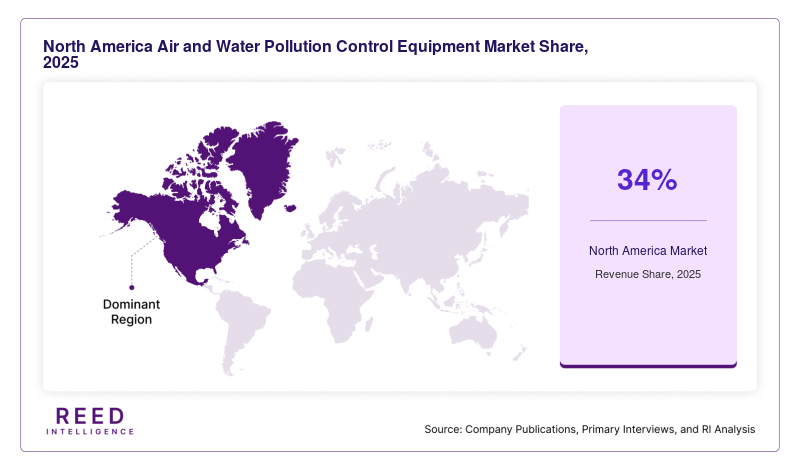
North America held the dominant regional position with approximately 34% market share in 2025. The region benefits from mature environmental regulations, extensive industrial infrastructure and established municipal wastewater systems. The U.S. EPA maintains dedicated technical resources covering air pollution-control technologies, permitting requirements and wastewater-treatment performance, supporting continued investment in compliant treatment systems.
The United States represents the principal demand center, with Canada providing additional demand across municipal infrastructure, energy, mining, manufacturing and resource industries. North America is estimated to expand at approximately 5.8% CAGR through 2034, with replacement, retrofit and digital optimization projects supplementing new equipment installations.
Europe Air and Water Pollution Control Equipment Market
Europe is estimated to register approximately 6.0% CAGR during 2026–2034. Environmental regulation, industrial decarbonization, wastewater reuse and resource-efficiency programs support investment in advanced treatment equipment. European customers increasingly evaluate treatment technologies according to energy consumption, chemical use, water recovery and lifecycle performance.
Germany, France, the United Kingdom, Italy and the Netherlands represent important demand centers. Industrial water reuse and advanced wastewater treatment are particularly relevant where water resources are constrained or industrial discharge standards require additional treatment stages.
Asia Pacific Air and Water Pollution Control Equipment Market
Asia Pacific is projected to be the fastest-growing region at approximately 7.2% CAGR. Rapid industrialization, urbanization, manufacturing expansion and water-stress conditions are increasing demand for treatment infrastructure. China, India, Japan, South Korea and Southeast Asian economies represent different stages of pollution-control deployment, creating opportunities across both basic and advanced treatment technologies.
Industrial facilities in the region increasingly require high-quality process water and wastewater-reuse systems. The expansion of semiconductor, electronics, pharmaceutical and advanced manufacturing capacity is particularly relevant because these industries require specialized water-treatment systems. Ecolab's acquisition of Ovivo's electronics ultrapure-water business demonstrates the increasing commercial importance of water-management technologies in semiconductor manufacturing.
Latin America Air and Water Pollution Control Equipment Market
Latin America is estimated to grow at approximately 6.4% CAGR through 2034. Demand is supported by mining, food processing, chemicals, oil and gas, municipal wastewater infrastructure and water-stressed urban areas. Industrial operators increasingly require treatment systems capable of meeting discharge requirements while recovering water for additional production cycles.
Brazil and Mexico represent major demand centers, while Chile, Argentina, Colombia and Peru contribute through mining, agriculture, industrial processing and municipal projects. The combination of industrial wastewater treatment and water reuse creates demand for membranes, filtration, biological treatment and modular systems.
Middle East & Africa Air and Water Pollution Control Equipment Market
Middle East & Africa is estimated to expand at approximately 6.7% CAGR during 2026–2034. Water scarcity, desalination requirements, industrial diversification and municipal infrastructure development support investment in advanced water-treatment technologies. Oil and gas, petrochemicals and mining also create demand for industrial wastewater and air-emission control systems.
Saudi Arabia, the United Arab Emirates, Qatar and other Gulf economies remain important markets for advanced water treatment, while South Africa and other African economies provide demand through mining, municipal infrastructure and industrial applications. Treatment systems that maximize water recovery and reduce disposal requirements have particular relevance in water-constrained environments.
Air and Water Pollution Control Equipment Market Competitive Landscape
The competitive environment combines environmental-services companies, filtration specialists, membrane manufacturers and diversified industrial-technology suppliers. Competition is increasingly based on complete treatment performance rather than individual equipment components, with suppliers combining hardware, engineering, digital monitoring, maintenance and lifecycle services.
Veolia has a broad environmental-services position spanning water technologies, wastewater treatment, hazardous waste and pollution-management services. In 2026, the company reported continued integration of its Water Technologies business and highlighted digital and AI-driven efficiency initiatives. Its Water Technologies activities also address industrial applications where water treatment, reuse and pollutant removal are integrated into production infrastructure.
Key Market Players
- Veolia
- DuPont
- Ecolab
- Xylem Inc.
- Alfa Laval
- Pentair
- Donaldson Company, Inc.
- Parker Hannifin Corporation
- 3M
- SUEZ
- Kurita Water Industries
- Evoqua Water Technologies
- Calgon Carbon Corporation
- ANDRITZ
- Toray Industries
- Mitsubishi Chemical Group
- Honeywell
Air and Water Pollution Control Equipment Market Recent Developments
-
July 2026 - DuPont: DuPont launched an upgraded WAVE PRO water-treatment design platform integrating ultrafiltration, ion exchange, reverse osmosis and nanofiltration modeling in one system for drinking water, industrial water, wastewater and desalination applications.
-
March 2026 - Veolia: Veolia announced the acquisition of Australian environmental-services company Enviropacific for approximately AUD 220 million, strengthening its capabilities in PFAS treatment, remediation, water treatment and hazardous-waste management.
Air and Water Pollution Control Equipment Market Segments
By Equipment Type
- Air Pollution Control Equipment
- Water Pollution Control Equipment
- Integrated Pollution Control Systems
By Application
- Industrial
- Municipal
- Commercial
- Residential
By Region
- North America
- Europe
- APAC
- Middle East and Africa
- LATAM