Air Based Remote Weapon Stations Market Size, Share & Demand Report By Platform (Fixed-Wing Aircraft, Rotary-Wing Aircraft, Unmanned Aerial Vehicles), By Weapon Type (Machine Guns, Cannons, Missiles), By Component (Sensors, Fire Control Systems, Actuators), By Application (Combat, Surveillance & Reconnaissance) By Region & Segment Forecasts, 2025–2034
USD 3950
Market Overview
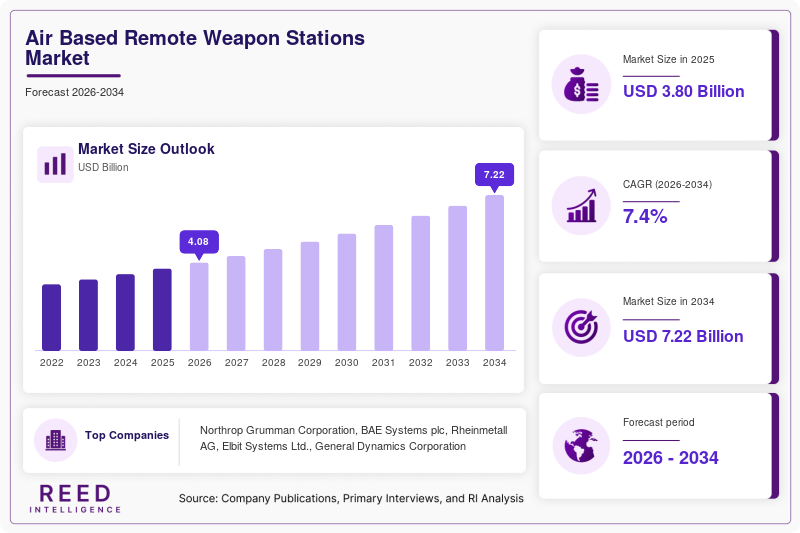
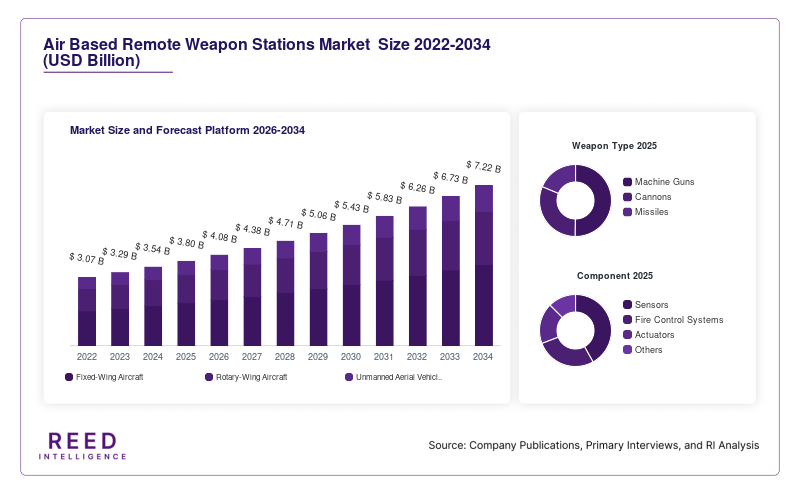
The global Air Based Remote Weapon Stations Market size was valued at approximately USD 3.8 billion in 2025 and is projected to reach USD 7.2 billion by 2034, expanding at a CAGR of 7.4% during the forecast period (2025–2034). The market has experienced steady expansion due to the increasing integration of advanced defense technologies in airborne platforms, including helicopters, unmanned aerial vehicles (UAVs), and fixed-wing aircraft. These systems enable precision targeting, enhanced operational safety, and reduced human intervention, making them critical for modern warfare environments.
A key global factor supporting market growth has been the rising emphasis on force protection and situational awareness in aerial missions. Governments across major economies have increased investments in advanced airborne weapon systems to strengthen defense capabilities while minimizing pilot exposure to hostile threats. The adoption of remote weapon stations (RWS) equipped with artificial intelligence, thermal imaging, and automated targeting has significantly enhanced mission effectiveness.
Key Highlights
- North America dominated the market with a share of 36.5% in 2025, while Asia Pacific is projected to register the fastest CAGR of 8.6% during the forecast period.
- By platform, rotary-wing aircraft emerged as the leading subsegment with a 41.2% share, whereas UAV-based systems are anticipated to grow fastest at a CAGR of 9.3%.
- By weapon type, machine gun-based RWS led the segment with a 44.7% share, while missile-based systems are expected to witness the fastest growth at 8.9% CAGR.
- The U.S. remained the dominant country with a market value of USD 1.2 billion in 2025 and is estimated to reach USD 1.28 billion in 2026.
Market Trends
Integration of AI and Autonomous Targeting Systems
One of the most notable trends shaping the Air Based Remote Weapon Stations Market is the integration of artificial intelligence (AI) and autonomous targeting capabilities. Modern RWS platforms are increasingly equipped with AI-powered algorithms that can identify, track, and engage targets with minimal human intervention. These advancements improve targeting accuracy and reduce reaction times during critical missions. The incorporation of machine learning also enables systems to adapt to dynamic combat scenarios, enhancing operational efficiency. As defense agencies prioritize automation and digital warfare, the demand for intelligent weapon stations is expected to rise significantly.
Growing Adoption of UAV-Based Weapon Stations
Another significant trend is the rapid adoption of remote weapon stations in unmanned aerial vehicles (UAVs). UAVs have become essential assets in surveillance, reconnaissance, and combat missions due to their cost-effectiveness and reduced risk to personnel. The integration of lightweight and modular RWS into UAV platforms allows for precision strikes and extended mission endurance. This trend is particularly evident in emerging economies, where defense modernization programs focus on scalable and flexible solutions. As UAV deployment expands globally, the demand for compatible air-based weapon stations is expected to increase, driving overall market growth.
Market Drivers
Increasing Defense Expenditure and Modernization Programs
The steady rise in global defense budgets has been a key driver for the Air Based Remote Weapon Stations Market. Governments are investing heavily in modernizing their military capabilities to address evolving security threats. Airborne platforms equipped with remote weapon stations offer enhanced combat readiness and operational flexibility. These systems enable precise targeting and improved situational awareness, making them indispensable in modern defense strategies. The focus on upgrading legacy aircraft with advanced RWS solutions further supports market expansion.
Rising Demand for Enhanced Crew Safety and Operational Efficiency
Another major driver is the growing need to enhance crew safety during combat operations. Remote weapon stations allow operators to control weapons from protected environments, significantly reducing exposure to enemy fire. This capability is particularly important in high-risk missions such as counterinsurgency and border surveillance. Additionally, RWS systems improve operational efficiency by enabling faster response times and reducing manual intervention. The combination of safety and efficiency benefits has led to increased adoption across various airborne platforms, contributing to sustained market growth.
Market Restraint
High Development and Integration Costs
The Air Based Remote Weapon Stations Market faces a significant challenge in the form of high development and integration costs. Designing advanced RWS systems requires substantial investment in research, testing, and certification processes. The integration of these systems into existing aircraft platforms also involves complex engineering modifications, which can increase overall project costs. Smaller defense organizations and emerging economies may find it difficult to allocate sufficient budgets for such advanced technologies. Additionally, maintenance and training requirements add to the total cost of ownership, limiting widespread adoption. These financial constraints may slow down market growth, particularly in cost-sensitive regions.
Market Opportunities
Expansion of Defense Capabilities in Emerging Economies
Emerging economies present significant growth opportunities for the Air Based Remote Weapon Stations Market. Countries in Asia Pacific, Latin America, and the Middle East are increasing their defense budgets to strengthen national security. These nations are actively investing in advanced airborne systems to modernize their military infrastructure. The adoption of remote weapon stations offers a cost-effective way to enhance combat capabilities without extensive personnel deployment. As these regions continue to prioritize defense upgrades, manufacturers can tap into new markets and expand their global presence.
Technological Advancements in Lightweight and Modular Systems
Advancements in lightweight materials and modular design are creating new opportunities for market growth. Modern RWS systems are being developed with reduced weight and enhanced flexibility, making them suitable for a wide range of airborne platforms, including UAVs and light helicopters. Modular systems allow for easy customization and upgrades, enabling defense forces to adapt to changing mission requirements. This flexibility not only reduces operational costs but also extends the lifecycle of existing equipment. As technology continues to evolve, the demand for innovative and adaptable weapon stations is expected to increase.
Segmental Analysis
By Platform
Rotary-wing aircraft dominated the platform segment with a market share of 41.2% in 2025. These aircraft are widely used in combat and surveillance missions, making them ideal for the integration of remote weapon stations. Their versatility and ability to operate in diverse environments have supported their dominance.
UAV-based platforms are projected to witness the fastest growth, with a CAGR of 9.3% during the forecast period. The increasing use of UAVs for reconnaissance and combat missions will drive demand for lightweight and efficient weapon stations.
By Weapon Type
Machine gun-based systems held the largest share of 44.7% in 2025 due to their widespread use in airborne platforms. These systems offer reliability and effectiveness in various combat scenarios, making them a preferred choice.
Missile-based systems are expected to grow at the fastest CAGR of 8.9%. The increasing demand for precision targeting and long-range capabilities will drive the adoption of these advanced systems.
By Component
Sensors and targeting systems dominated the component segment with a share of 38.5% in 2025. These components play a critical role in ensuring accuracy and efficiency in weapon operations.
Fire control systems are anticipated to grow at the fastest CAGR of 8.2%, driven by advancements in automation and digital technologies that enhance operational performance.
By Application
Combat operations accounted for the largest share of 52.6% in 2025. The use of remote weapon stations in combat missions has increased due to their ability to improve precision and reduce risk to personnel.
Surveillance and reconnaissance applications are expected to grow at the fastest CAGR of 8.7%, supported by the rising demand for real-time intelligence and monitoring capabilities.
Regional Analysis
North America
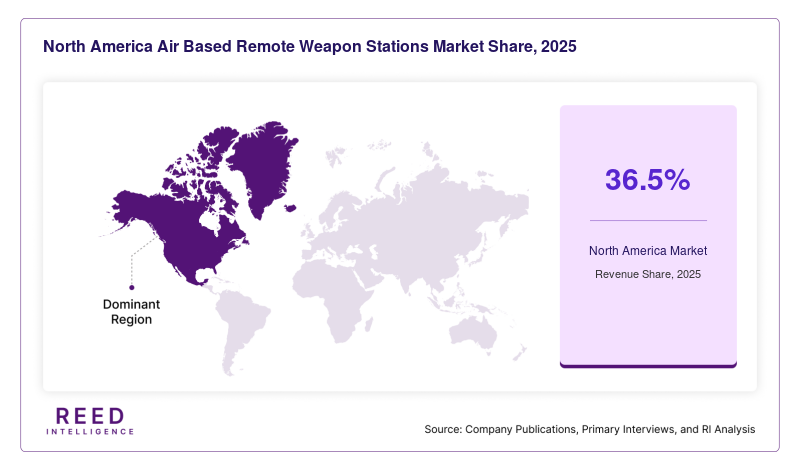
North America accounted for a dominant market share of 36.5% in 2025 and will continue to grow at a CAGR of 6.9% during the forecast period. The region’s strong defense infrastructure and high investment in advanced military technologies have supported its leading position.
The United States dominated the regional market due to its extensive defense modernization programs. The country’s focus on integrating advanced weapon systems into airborne platforms has driven demand for remote weapon stations. Continuous innovation and strong defense funding have further strengthened its market position.
Europe
Europe held a significant share of 24.3% in 2025 and is expected to grow at a CAGR of 7.1% through 2034. The region has shown steady growth due to increasing collaboration among defense agencies and technological advancements.
Germany emerged as the dominant country, driven by its focus on developing advanced defense technologies. The country’s emphasis on enhancing military capabilities and investing in research and development has supported market growth.
Asia Pacific
Asia Pacific captured 21.7% of the market share in 2025 and is projected to register the fastest CAGR of 8.6% during the forecast period. Rapid economic growth and rising defense expenditures have fueled market expansion in the region.
China led the regional market, supported by its large-scale defense modernization initiatives. The country’s focus on strengthening its military capabilities through advanced technologies has driven the adoption of remote weapon stations.
Middle East & Africa
The Middle East & Africa region accounted for 10.2% of the market share in 2025 and is anticipated to grow at a CAGR of 7.8%. The region’s increasing focus on security and defense has contributed to market growth.
Saudi Arabia dominated the region due to its significant investments in defense infrastructure. The country’s efforts to enhance military capabilities and adopt advanced technologies have supported the demand for remote weapon stations.
Latin America
Latin America held a market share of 7.3% in 2025 and is expected to grow at a CAGR of 6.5% during the forecast period. The region’s growth has been driven by gradual improvements in defense capabilities.
Brazil emerged as the leading country, supported by its focus on strengthening military operations. The country’s investment in modern defense systems has contributed to the adoption of remote weapon stations.
Competitive Landscape
The Air Based Remote Weapon Stations Market is moderately competitive, with key players focusing on innovation and strategic partnerships to strengthen their market position. Leading companies are investing in research and development to introduce advanced systems with improved targeting capabilities and operational efficiency.
A prominent market leader, Northrop Grumman Corporation, has maintained its position through continuous innovation and strong defense contracts. The company recently introduced an upgraded remote weapon station with enhanced AI-based targeting features, reflecting its focus on technological advancement.
Other major players are also expanding their product portfolios and entering new markets to capitalize on emerging opportunities. The competitive environment is expected to intensify as companies strive to develop cost-effective and advanced solutions.
Key Players
- Northrop Grumman Corporation
- BAE Systems plc
- Rheinmetall AG
- Elbit Systems Ltd.
- General Dynamics Corporation
- Leonardo S.p.A.
- Saab AB
- Thales Group
- Aselsan A.S.
- FN Herstal
- Kongsberg Gruppen ASA
- Moog Inc.
- Israel Aerospace Industries Ltd.
- ST Engineering
- L3Harris Technologies, Inc.
Recent Developments
- 2024: A leading defense manufacturer launched a next-generation lightweight remote weapon station designed for UAV integration.
- 2024: Strategic partnerships between defense companies and government agencies increased to enhance system capabilities.
- 2025: Advancements in AI-based targeting systems improved operational efficiency and accuracy.
- 2025: Increased investments in defense modernization programs boosted the adoption of remote weapon stations globally.
Air Based Remote Weapon Stations Market Segments
Platform
- Fixed-Wing Aircraft
- Rotary-Wing Aircraft
- Unmanned Aerial Vehicles (UAVs)
Weapon Type
- Machine Guns
- Cannons
- Missiles
Component
- Sensors
- Fire Control Systems
- Actuators
- Others
Application
- Combat
- Surveillance & Reconnaissance
Region
- North America
- Europe
- Asia Pacific
- Middle East & Africa
- Latin America
By Region
- North America
- Europe
- APAC
- Middle East and Africa
- LATAM