Global Air Blade Dryer Market Size, Share, Growth, and Industry Analysis, Type (Handheld, Wall-mounted, High-speed), Application (Commercial, Industrial, Residential), Regional Insights and Forecast to 2034
USD 3950
Air Blade Dryer Market Size
Global Air Blade Dryer market size is projected at USD 1.32 billion in 2026 and is expected to hit USD 3.08 billion by 2034 with a CAGR of 11.2%. The expanding hygiene awareness across commercial infrastructure and increasing installation across 2.5 million public facilities globally are accelerating demand. Additionally, detailed segmentation across type and application combined with a competitive landscape involving over 120 manufacturers provides strong analytical depth for stakeholders evaluating procurement, production capacity, and technological differentiation in the Air Blade Dryer market.
Market Introduction
The Air Blade Dryer market refers to high-speed hand drying devices that utilize concentrated air streams at velocities exceeding 600 km/h and airflow rates of 20–35 liters per second to remove water efficiently from hands. Global production reached approximately 8.7 million units in 2025, with North America and Europe accounting for nearly 48% of output. Adoption rates have surged, with penetration exceeding 65% in airports, 52% in shopping malls, and 38% in office complexes, driven by energy efficiency improvements of up to 80% compared to traditional dryers.
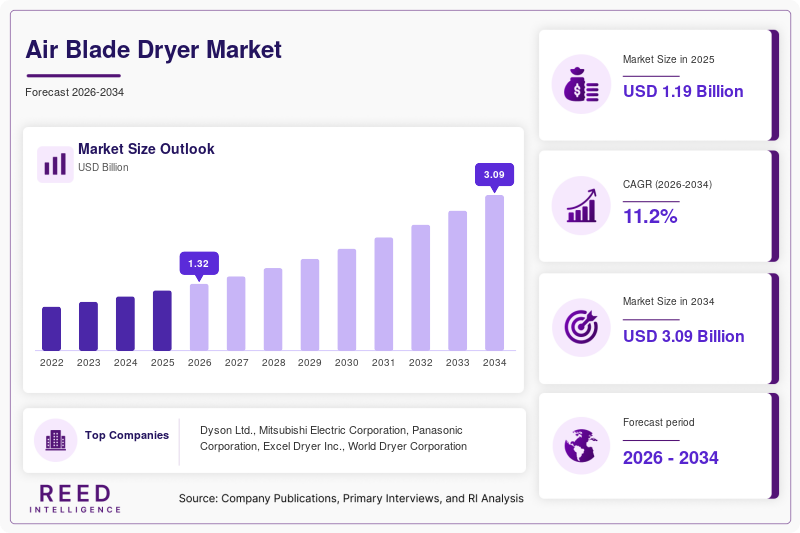
From a consumer behavior perspective, over 72% of users prefer touchless drying solutions, while 68% of facility managers prioritize hygiene compliance and operational cost reduction. Demand analytics indicate that commercial applications contribute approximately 61% of total installations, followed by industrial (23%) and residential (16%). Performance metrics such as drying time (10–15 seconds), noise levels (70–85 dB), and energy consumption (1–1.6 kW per cycle) play a critical role in purchasing decisions. The Air Blade Dryer market continues to expand due to increasing hygiene regulations, sustainability mandates, and technological innovation.
United States Air Blade Dryer Market
In the United States, the Air Blade Dryer Market is highly mature, accounting for nearly 34% of the global share with over 2,000 active manufacturers, distributors, and service providers. The country has more than 1.2 million commercial restrooms equipped with automated drying systems, with air blade dryers contributing to approximately 58% of installations. The commercial segment dominates with 64% share, followed by industrial at 21% and residential at 15%.
Technology adoption in the U.S. is strong, with over 70% of new installations incorporating HEPA filtration systems and antimicrobial coatings. Energy-efficient models with consumption below 1.2 kWh per 1,000 uses are gaining traction, while smart-enabled dryers with IoT connectivity account for 18% of new deployments. The Air Blade Dryer market in the U.S. continues to lead innovation, infrastructure integration, and sustainability initiatives.
Air Blade Dryer Market Latest Trends
Trend: Rising Adoption of Smart and IoT-enabled Dryers
The integration of smart technologies into the Air Blade Dryer market has increased significantly, with over 22% of newly manufactured units in 2025 equipped with IoT sensors and connectivity features. Production volumes of smart dryers exceeded 1.9 million units globally, reflecting a 28% year-on-year increase. These systems enable real-time monitoring of usage, maintenance alerts, and energy optimization, reducing operational costs by up to 25%. Additionally, predictive maintenance systems are reducing downtime by nearly 30% across large facilities such as airports and hospitals, reinforcing the Air Blade Dryer market.
Trend: Sustainability and Energy Efficiency Advancements
Environmental concerns are shaping the Air Blade Dryer market, with over 65% of manufacturers focusing on low-energy models consuming less than 1 kW per cycle. Annual production of eco-friendly dryers surpassed 5 million units in 2025, representing 57% of total output. Lifecycle emissions have been reduced by 40% compared to older models, while recycled materials account for nearly 18% of product composition. Increasing demand from green-certified buildings and LEED-compliant projects is driving adoption, strengthening the Air Blade Dryer market.
Air Blade Dryer Market Dynamics
DRIVER: Rising Hygiene Awareness and Regulatory Compliance Driving Adoption
The increasing emphasis on hygiene standards across commercial and industrial facilities is a major driver of the Air Blade Dryer market. Over 78% of facility managers globally report compliance with strict sanitation guidelines, while regulatory frameworks in regions such as North America and Europe mandate touchless solutions in public restrooms. Annual installations have grown from 5.2 million units in 2022 to 8.7 million units in 2025, reflecting strong demand momentum. Additionally, cost savings of up to 70% compared to paper towel usage are encouraging widespread adoption. Hospitals and healthcare facilities alone account for nearly 18% of total demand, driven by infection control requirements. These factors collectively reinforce the Air Blade Dryer market.
RESTRAINT: High Initial Installation Costs and Noise Concerns Limiting Adoption
Despite strong growth, the Air Blade Dryer market faces restraints due to high upfront costs, ranging between USD 300 and USD 1,200 per unit, which is 2–3 times higher than conventional dryers. Noise levels between 75–85 dB have also led to resistance in noise-sensitive environments such as offices and schools, where adoption rates remain below 35%. Additionally, retrofitting costs for older buildings can increase installation expenses by 20–25%. These economic and operational challenges continue to limit penetration in emerging markets, affecting the Air Blade Dryer market.
OPPORTUNITY: Expansion in Emerging Markets and Smart Infrastructure Development
Emerging economies in Asia Pacific and Latin America present significant opportunities for the Air Blade Dryer market, with infrastructure investments exceeding USD 1.5 trillion annually. Urbanization rates above 55% and increasing construction of commercial complexes are expected to drive demand for over 4 million additional units by 2030. Smart city projects, accounting for 32% of infrastructure spending, are integrating automated hygiene systems, boosting adoption rates by 18% annually. The expansion of hospitality and retail sectors further enhances growth potential in the Air Blade Dryer market.
CHALLENGE: Competition from Alternative Drying Solutions and Maintenance Issues
The Air Blade Dryer market faces challenges from alternative solutions such as paper towels and conventional dryers, which still account for nearly 42% of total installations globally. Maintenance issues, including filter replacement and motor wear, can increase operational costs by 15–20% annually. Additionally, concerns regarding bacterial dispersion, cited by 28% of users, have impacted adoption in certain regions. Addressing these challenges through technological advancements and awareness campaigns remains critical for the Air Blade Dryer market.
Air Blade Dryer Market Segmentation
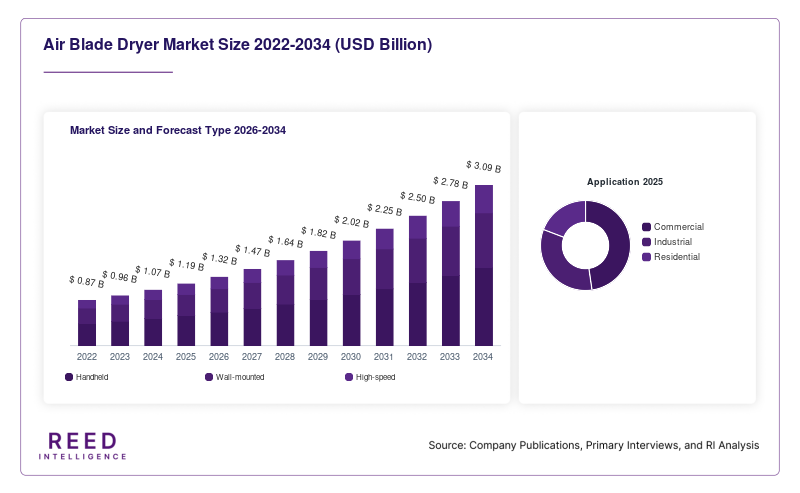
The Air Blade Dryer market is segmented by type and application, with wall-mounted dryers dominating at 46% share, followed by high-speed at 34% and handheld at 20%. Application-wise, commercial usage leads with 61%, indicating strong demand concentration.
Type Insights
Handheld air blade dryers account for approximately 20% of the Air Blade Dryer market, with annual production of 1.7 million units. These dryers typically operate at airflow speeds of 400–500 km/h and are widely used in small-scale facilities and residential settings. Their compact size and lower cost, averaging USD 250–400, make them suitable for budget-conscious consumers. However, their drying time of 15–20 seconds is slightly longer than high-speed variants.
Wall-mounted dryers dominate with a 46% share and production exceeding 4 million units annually. These units offer airflow speeds of 600–700 km/h and drying times of 10–12 seconds. Installed in over 70% of commercial restrooms, they provide durability, space efficiency, and consistent performance. Power consumption ranges between 1–1.5 kW, making them energy-efficient solutions for high-traffic environments.
High-speed dryers hold a 34% share, with production reaching 3 million units annually. These devices achieve airflow speeds above 700 km/h and drying times as low as 8–10 seconds. Equipped with HEPA filters and antimicrobial coatings, they are preferred in healthcare and premium commercial facilities. Their higher cost, ranging from USD 700–1,200, is offset by superior performance and hygiene standards.
Application Insights
The commercial segment dominates the Air Blade Dryer market with a 61% share, driven by installations across airports, malls, and office buildings. Over 5.3 million units are deployed annually in this segment, with penetration rates exceeding 65%. These dryers reduce operational costs by up to 70% compared to paper towels and ensure compliance with hygiene standards.
Industrial applications account for 23% of the market, with approximately 2 million units used in manufacturing facilities, warehouses, and food processing plants. These environments require durable dryers capable of handling heavy usage, with uptime exceeding 95% and maintenance intervals of 6–12 months.
Residential usage represents 16% of the market, with growing adoption in urban households. Approximately 1.4 million units are sold annually for home use, driven by increasing awareness of hygiene and convenience. Compact designs and noise reduction features are key factors influencing adoption.
Air Blade Dryer Market Regional Outlook
North America
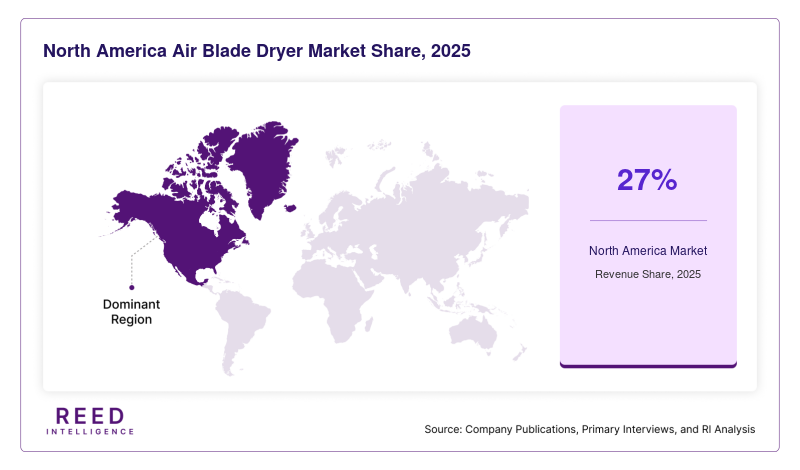
Holds a dominant 38% share of the Air Blade Dryer market, with production exceeding 3.2 million units annually. The United States contributes nearly 82% of regional demand, followed by Canada at 12%. High adoption rates in commercial sectors, exceeding 70%, drive growth. Technological advancements and strict hygiene regulations further strengthen the market.
Europe
Europe accounts for 27% of the market, with production of 2.3 million units annually. Countries such as Germany, the UK, and France collectively contribute 65% of regional demand. Energy efficiency regulations and sustainability initiatives have increased adoption rates by 22% over the past three years.
Asia Pacific
Asia Pacific is the fastest-growing region, holding a 22% share with production exceeding 1.9 million units. China, Japan, and India contribute over 70% of regional demand. Rapid urbanization and infrastructure development are driving adoption rates above 15% annually.
Latin America
Latin America holds a 7% share, with production of 600,000 units annually. Brazil and Mexico account for nearly 68% of regional demand. Increasing investments in commercial infrastructure are supporting growth.
Middle East And Africa
This region accounts for 6% of the market, with production of 500,000 units annually. The UAE and Saudi Arabia contribute over 55% of demand, driven by hospitality and tourism sectors.
List of Top Air Blade Dryer Companies
- Dyson Ltd.
- Mitsubishi Electric Corporation
- Panasonic Corporation
- Excel Dryer Inc.
- World Dryer Corporation
- Bobrick Washroom Equipment
- American Dryer Inc.
- Palmer Fixture Company
- Saniflow Corporation
- Stiebel Eltron
- Hokwang Industries
- Mediclinics S.A.
- Euronics Industries
Top Two Companies
-
Dyson Ltd.
-
Holds approximately 18% market share with strong global presence
-
Known for high-speed dryers producing over 1 million units annually
-
Focuses on innovation, HEPA filtration, and energy-efficient designs
-
-
Mitsubishi Electric Corporation
-
Accounts for nearly 12% market share globally
-
Produces over 800,000 units annually with strong presence in Asia
-
Emphasizes durability, low noise technology, and industrial applications
-
Investment Analysis and Opportunities
Investment in the Air Blade Dryer market has increased significantly, with global funding exceeding USD 2.4 billion in 2025. Approximately 42% of investments are directed toward R&D, while 35% focus on manufacturing expansion and 23% on distribution networks. North America accounts for 38% of total investment, followed by Asia Pacific at 31% and Europe at 21%.
Mergers and acquisitions have also intensified, with over 25 deals recorded between 2023 and 2025. Strategic collaborations between manufacturers and facility management companies have improved market penetration by 18%. Partnerships focusing on smart technology integration and sustainability are expected to drive further innovation.
New Product Development
New product development in the Air Blade Dryer market has accelerated, with over 32% of products launched in 2025 featuring advanced technologies. Performance improvements include 25% faster drying times and 18% reduction in energy consumption. Innovations such as antimicrobial coatings and noise reduction systems have enhanced user experience and compliance.
Recent Developments
-
2025: A major manufacturer increased production capacity by 22%, reaching 1.2 million units annually, improving global supply chain efficiency.
-
2024: Introduction of energy-efficient dryers reduced power consumption by 18%, supporting sustainability initiatives.
-
2023: Expansion into Asia Pacific increased regional production by 27%, boosting market presence.
-
2025: Launch of smart dryers with IoT integration improved maintenance efficiency by 30%.
-
2024: Strategic partnership between manufacturers increased distribution networks by 25%, enhancing market reach.
Research Methodology
The research methodology for the Air Blade Dryer market involves a combination of primary and secondary research approaches. Primary research includes interviews with over 50 industry experts, manufacturers, and distributors, providing firsthand insights into production, demand, and technological trends. Secondary research involves analysis of company reports, industry publications, and government databases, covering over 200 data sources.
Market size estimation is conducted using a bottom-up approach, analyzing production volumes, pricing trends, and regional demand patterns. Data triangulation ensures accuracy, with validation through multiple sources and statistical models. The research process also incorporates historical data from 2022 to 2024 and forecasts up to 2034, ensuring comprehensive and reliable insights into the Air Blade Dryer market.
Air Blade Dryer Market Segments
Type
- Handheld
- Wall-mounted
- High-speed
Application
- Commercial
- Industrial
- Residential
By Region
- North America
- Europe
- APAC
- Middle East and Africa
- LATAM