Air Classifying Mill Market Size, Share Demand Report By Type (Horizontal Air Classifying Mills, Vertical Air Classifying Mills), By Capacity (Low Capacity, Medium Capacity, High Capacity), By Application (Food Processing, Pharmaceuticals, Chemicals, Minerals, Plastics), By Distribution Channel (Direct Sales, Industrial Equipment Distributors, OEM Partnerships, Online B2B Platforms), By Region & Segment Forecasts, 2026–2034
USD 3950
Market Overview
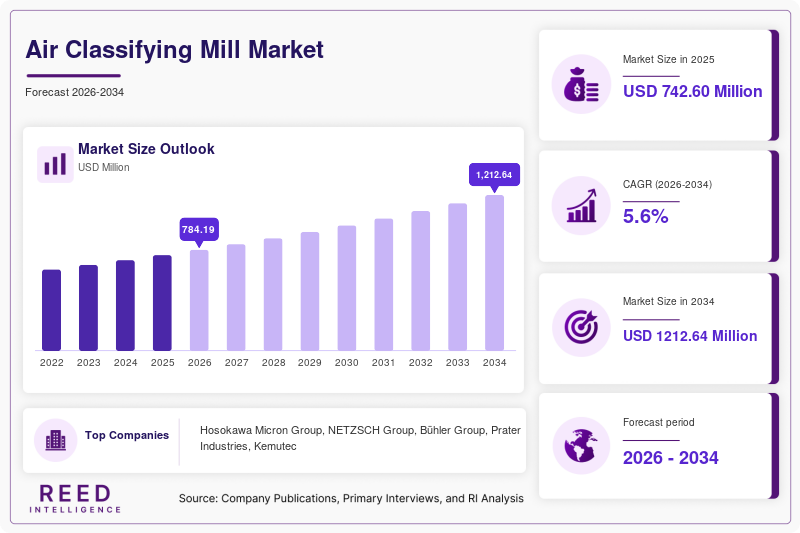
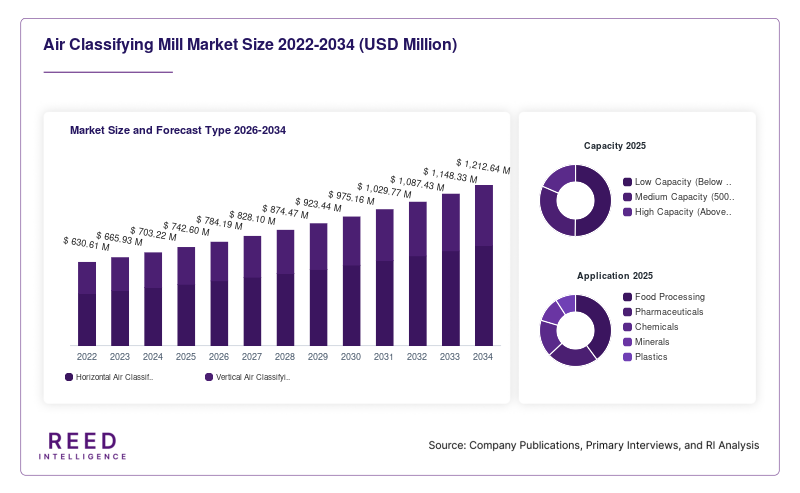
The global Air Classifying Mill Market size was valued at USD 742.6 million in 2026 and is projected to reach USD 1,146.8 million by 2034, expanding at a CAGR of 5.6% during 2026–2034. The market is gaining steady momentum as manufacturers across food processing, chemicals, pharmaceuticals, minerals, and plastics industries continue to seek advanced particle size reduction systems that deliver precision milling with integrated classification. Air classifying mills combine grinding and particle separation in a single machine, making them attractive for plants focused on productivity, energy efficiency, and compact processing layouts.
A major global factor supporting growth has been the rising demand for ultra-fine powders used in high-value manufacturing applications. Industries now require consistent particle distribution, contamination control, and efficient throughput. Air classifying mills meet these needs by enabling tighter particle size control compared with conventional grinding systems.
Key Highlights
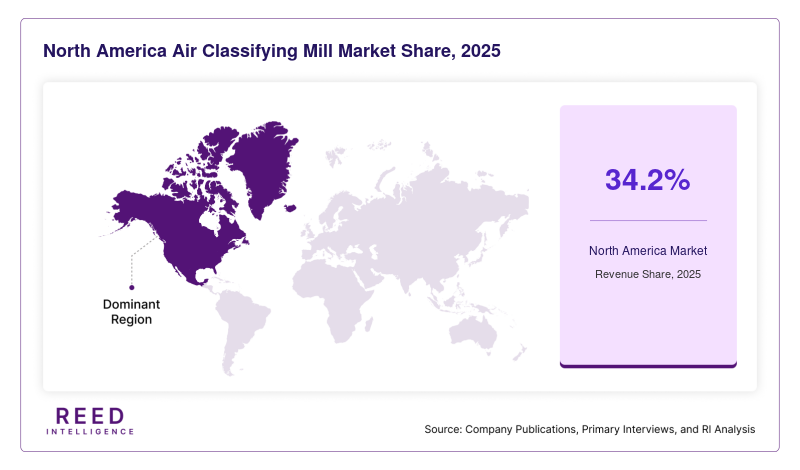
- North America held the dominant regional share of 34.2% in 2025.
- Asia Pacific is expected to register the fastest regional CAGR of 6.9% through 2034.
- By type, Horizontal Air Classifying Mills led with 58.4% share in 2025.
- By type, Vertical Air Classifying Mills will be the fastest-growing segment at 6.3% CAGR.
- By application, Food Processing accounted for the largest share at 27.8% in 2025.
- By application, Pharmaceutical Processing is forecast to grow fastest at 6.8% CAGR.
- By capacity, Medium Capacity Mills (500–2000 kg/hr) led with 46.7% share in 2025.
- High Capacity Mills will grow fastest at 6.5% CAGR.
- The United States remained the dominant country market, valued at USD 182.4 million in 2024 and USD 189.6 million in 2025.
Market Trends
Integration of Smart Automation Systems
Manufacturers are increasingly adopting digitally enabled air classifying mills equipped with sensors, automated feed controls, temperature monitoring, and remote diagnostics. These systems improve uptime, reduce manual intervention, and maintain consistent output quality. Smart automation is becoming a preferred feature in large industrial plants.
Growing Demand for Fine and Clean Label Powders
Food, nutraceutical, and specialty chemical producers are demanding ultra-fine powders with minimal heat exposure and contamination. Air classifying mills are being selected because they support hygienic processing and preserve product properties while achieving narrow particle size ranges.
Market Drivers
Rising Need for Precision Particle Size Reduction
Industries such as pharmaceuticals, coatings, and specialty chemicals rely on uniform particle size for product performance. Air classifying mills offer simultaneous grinding and separation, which reduces reprocessing and improves yield. This advantage continues to support the Air Classifying Mill Market.
Expansion of Process Industries in Emerging Economies
Rapid industrialization in Asia, Latin America, and parts of the Middle East is driving investments in food ingredients, chemicals, and minerals processing plants. New production facilities often install compact and efficient milling systems, increasing demand for air classifying mills.
Market Restraint
High Initial Equipment and Installation Cost
Advanced air classifying mills require precision components, wear-resistant materials, and control systems. The upfront capital requirement can limit adoption among small manufacturers, especially in price-sensitive markets.
Market Opportunities
Growth in Battery and Advanced Materials Processing
The shift toward electric vehicles and energy storage is increasing demand for finely milled cathode, anode, and additive materials. Air classifying mills can support controlled particle size reduction for these specialty materials, creating new revenue opportunities.
Retrofit Demand in Aging Manufacturing Plants
Many legacy processing plants use multi-stage grinding systems. Replacing older setups with integrated air classifying mills can reduce energy use and floor space. Retrofit projects are expected to create additional opportunities over the forecast period.
Segmental Analysis
By Type
Horizontal Air Classifying Mills: Horizontal systems held the largest 58.4% share in 2025 due to their suitability for continuous industrial operations, easier maintenance access, and high throughput capability.
Vertical Air Classifying Mills: Vertical mills will expand at a 6.3% CAGR through 2034. Their compact footprint and efficient airflow design will support adoption in facilities with limited production space.
By Capacity
Medium Capacity Mills (500–2000 kg/hr): This segment accounted for 46.7% share in 2025 because it fits the needs of mid-sized food, chemical, and mineral processors.
High Capacity Mills (Above 2000 kg/hr): This segment will grow at 6.5% CAGR as large integrated plants increase investment in bulk powder production and centralized milling systems.
By Application
Food Processing: Food processing led the Air Classifying Mill Market with 27.8% share in 2025. Manufacturers used these mills for spices, sugar, flour blends, starches, and protein powders requiring uniform particle size.
Pharmaceutical Processing: Pharmaceutical applications will grow fastest at 6.8% CAGR through 2034. Rising demand for fine active ingredients and excipients with tight particle distribution will support expansion.
By Material Processed
Chemicals: Chemical materials accounted for 31.5% share in 2025 due to large usage in pigments, resins, fillers, and industrial compounds.
Minerals: Mineral processing will rise at 6.1% CAGR as producers seek finer grades for ceramics, fillers, and specialty industrial uses.
By End Use
Industrial Manufacturing: Industrial manufacturing held 39.2% share in 2025, driven by widespread deployment across multiple sectors.
Contract Processing Services: Contract processing will register 6.4% CAGR as smaller brands outsource milling requirements to specialized toll manufacturers.
Regional Analysis
North America
North America accounted for 34.2% of the Air Classifying Mill Market in 2025. Demand was supported by modernization in food processing and specialty chemicals manufacturing. The region will grow at a 5.1% CAGR through 2034. The United States led the region due to strong investment in automated powder handling systems and strict quality standards.
Europe
Europe represented 27.6% market share in 2025. Demand was driven by advanced pharmaceutical processing and engineered materials manufacturing. The market will expand at a 5.0% CAGR through 2034. Germany dominated the region because of its strong industrial machinery base and adoption of precision milling technologies.
Asia Pacific
Asia Pacific held 24.1% share in 2025 and will record the fastest 6.9% CAGR through 2034. Growth will be supported by expanding food ingredient production, chemicals processing, and contract manufacturing. China led the region due to large-scale industrial output and capacity additions in powder processing sectors.
Middle East & Africa
Middle East & Africa captured 7.1% share in 2025. The market will grow at a 5.4% CAGR through 2034 as regional manufacturing diversification programs increase demand for processing equipment. Saudi Arabia led the region with investments in chemicals and industrial downstream manufacturing.
Latin America
Latin America accounted for 7.0% share in 2025. The region will grow at a 5.7% CAGR through 2034, supported by food processing expansion and mineral beneficiation activities. Brazil remained the leading country due to its broad industrial base and growing processed food sector.
Competitive Landscape
The Air Classifying Mill Market is moderately fragmented, with global engineering firms and regional processing equipment suppliers competing on efficiency, durability, throughput, and customization. Leading companies focus on product upgrades, automation features, and service networks to strengthen market presence. Hosokawa Micron Group remains a leading participant due to its broad milling portfolio, global installations, and strong aftermarket support.
The company recently introduced upgraded control interfaces for powder processing systems aimed at improving monitoring and process repeatability. Other notable participants include Prater Industries, NETZSCH Group, Bühler Group, and Kemutec, all of which maintain strong positions in food, chemical, and pharmaceutical applications. Several mid-sized manufacturers are expanding into Asia Pacific through distributor partnerships and localized assembly operations. Competitive pricing, application engineering expertise, and faster maintenance response are becoming important differentiators. Market participants are also investing in wear-resistant components and hygienic designs to meet customer expectations for long equipment life and clean processing environments.
Key Players List
- Hosokawa Micron Group
- NETZSCH Group
- Bühler Group
- Prater Industries
- Kemutec
- Sturtevant Inc.
- Munson Machinery Company
- Mikro Pulverizer
- Rieco Industries Ltd.
- Classifier Milling Systems Inc.
- Mill Powder Tech Solutions
- PPS Air Classifier Mills Ltd.
- Bepex International LLC
- British Rema Processing Ltd.
- Zhejiang LEAP Pulverization Equipment Co. Ltd.
Recent Developments
- Hosokawa Micron Group launched upgraded control software for selected milling systems to improve process monitoring.
- NETZSCH Group expanded testing services for fine grinding and classification applications.
- Bühler Group introduced hygienic design enhancements for food powder processing equipment.
- Prater Industries expanded spare parts and technical support capacity in North America.
- Kemutec developed modular air classifying mill configurations for faster customer installation.
Air Classifying Mill Market Segments
Type
- Horizontal Air Classifying Mills
- Vertical Air Classifying Mills
Capacity
- Low Capacity (Below 500 kg/hr)
- Medium Capacity (500–2000 kg/hr)
- High Capacity (Above 2000 kg/hr)
Application
- Food Processing
- Pharmaceuticals
- Chemicals
- Minerals
- Plastics
Distribution Channel
- Direct Sales
- Industrial Equipment Distributors
- OEM Partnerships
- Online B2B Platforms
By Region
- North America
- Europe
- APAC
- Middle East and Africa
- LATAM