Air Cooled Cube Ice Machine Market Size, Share & Demand Report By Product Type (Modular Air Cooled Cube Ice Machines, Countertop Air Cooled Cube Ice Machines, Undercounter Air Cooled Cube Ice Machines), By Capacity (Below 100 kg/day, 100–300 kg/day, Above 300 kg/day), By End Use (Restaurants and Hotels, Healthcare Facilities, Convenience Stores, Corporate Cafeterias, Entertainment Venues, Others), By Region & Segment Forecasts, 2026–2034
USD 3950
Market Overview
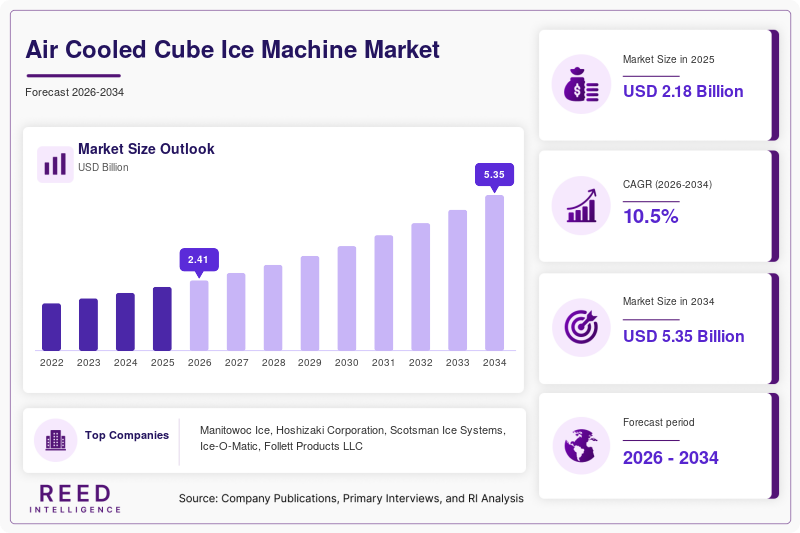
The global Air Cooled Cube Ice Machine Market size was valued at USD 2.18 billion in 2026 and is projected to reach USD 4.87 billion by 2034, expanding at a CAGR of 10.5% during the forecast period from 2026 to 2034. The market continues to grow steadily due to increasing demand for commercial refrigeration equipment across restaurants, hotels, healthcare facilities, convenience stores, and foodservice chains. Air cooled cube ice machines are widely preferred because they consume less water than water-cooled systems and offer simplified installation processes for commercial operators. The rapid expansion of quick-service restaurants and organized retail outlets has also increased the adoption of high-capacity cube ice production systems across developed and emerging economies.
A major global factor supporting market expansion is the growth of the hospitality and tourism industry. Increasing international travel, rising hotel construction activities, and the development of entertainment venues have created sustained demand for hygienic and energy-efficient ice production equipment. Commercial kitchens and beverage outlets are increasingly investing in automated cube ice machines with smart monitoring features, antimicrobial surfaces, and lower power consumption. Manufacturers are also integrating IoT-enabled diagnostics and eco-friendly refrigerants to comply with changing environmental standards and operational efficiency targets.
Key Highlights
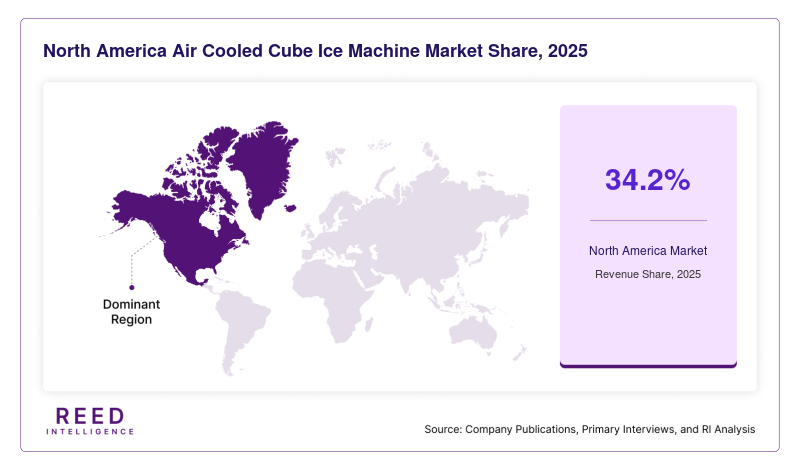
- North America dominated the market with a 34.2% share in 2025, while Asia Pacific is expected to grow at the fastest CAGR of 11.8% during 2026–2034.
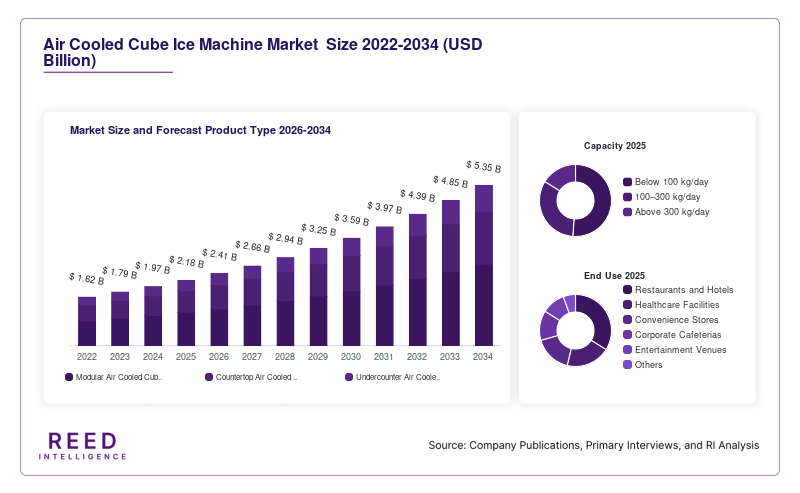
- By product type, modular air cooled cube ice machines accounted for the largest share of 42.6%, while countertop air cooled cube ice machines are projected to grow at a CAGR of 12.1%.
- By capacity, machines with 100–300 kg/day production capacity led with a 39.4% share, whereas above 300 kg/day systems are expected to expand at a CAGR of 11.7%.
- By end use, restaurants and hotels held a leading share of 44.8%, while healthcare facilities are expected to grow at a CAGR of 12.4%.
- The United States remained the dominant country, with market values of USD 620 million in 2024 and USD 682 million in 2025.
Market Trends
Integration of smart monitoring and automation technologies
The Air Cooled Cube Ice Machine Market is witnessing increasing integration of smart monitoring systems and connected automation technologies across commercial and industrial applications. Manufacturers are developing advanced machines equipped with touch-screen controls, remote monitoring software, and predictive maintenance systems to improve operational efficiency. These systems allow operators to monitor ice production volume, energy usage, cleaning cycles, and equipment performance in real time. Restaurants, hotels, and healthcare facilities are adopting connected cube ice machines to reduce maintenance costs and improve hygiene compliance. Growing labor shortages in foodservice operations have also encouraged businesses to invest in automated ice management solutions that require limited manual supervision. The adoption of cloud-based maintenance alerts and mobile application controls is expected to become more common during the forecast period.
Rising demand for energy-efficient and eco-friendly refrigeration systems
Sustainability initiatives and energy-efficiency regulations are significantly influencing product development strategies in the Air Cooled Cube Ice Machine Market. Commercial buyers are increasingly prioritizing equipment that lowers electricity consumption and reduces environmental impact. Manufacturers are responding by introducing systems that use environmentally friendly refrigerants, improved heat exchange technologies, and variable-speed compressors. Energy-efficient models are gaining traction across restaurants, supermarkets, and institutional kitchens because they reduce long-term operating expenses. Governments in several countries are also implementing regulations encouraging the adoption of low-emission refrigeration equipment. In addition, companies are focusing on recyclable materials and water-saving technologies to strengthen sustainability positioning. The growing preference for green commercial kitchen equipment is expected to create long-term growth opportunities for advanced air cooled cube ice machine manufacturers.
Market Drivers
Expansion of quick-service restaurants and beverage chains
The rapid expansion of quick-service restaurants, cafés, bars, and beverage chains is a major driver supporting growth in the Air Cooled Cube Ice Machine Market. Consumer preference for cold beverages, packaged drinks, smoothies, and iced coffee products has increased the requirement for consistent ice production in foodservice establishments. International restaurant franchises are expanding aggressively across Asia Pacific, Latin America, and the Middle East, creating demand for reliable commercial ice equipment. Air cooled cube ice machines are preferred due to easier installation, reduced water usage, and operational convenience compared to water-cooled alternatives. The rising popularity of takeaway beverages and online food delivery services has also increased the need for compact and high-capacity cube ice machines in urban commercial kitchens. These factors continue to strengthen equipment replacement cycles and new installations worldwide.
Growth in healthcare and institutional infrastructure
Healthcare facilities and institutional establishments are increasingly adopting advanced cube ice machines to maintain hygiene and operational efficiency. Hospitals, diagnostic centers, nursing homes, and rehabilitation facilities use cube ice for patient care, medical cooling, and foodservice applications. The growing healthcare infrastructure in emerging economies has expanded procurement activities for commercial refrigeration equipment, including air cooled cube ice machines. Manufacturers are introducing antimicrobial surfaces, touchless dispensing systems, and self-cleaning functions to meet stringent hygiene requirements in healthcare environments. Educational institutions, corporate cafeterias, and government facilities are also investing in energy-efficient ice production systems to support large-scale foodservice operations. Rising awareness regarding food safety standards and sanitation compliance is further accelerating demand for technologically advanced cube ice equipment.
Market Restraint
High maintenance requirements and sensitivity to ambient temperature conditions
One of the primary restraints affecting the Air Cooled Cube Ice Machine Market is the higher maintenance requirement associated with air-cooled refrigeration systems operating in hot environments. These machines depend on adequate airflow for heat dissipation, and performance can decline significantly in kitchens, outdoor areas, or facilities with limited ventilation. In regions with high ambient temperatures, the machines may consume more energy and experience lower ice production efficiency, increasing operational costs for commercial users. Restaurants and hospitality operators often face additional expenses related to condenser cleaning, airflow management, and preventive maintenance.
The issue becomes more significant in densely populated urban locations where kitchen spaces are limited and ventilation systems are inadequate. Dust accumulation and grease buildup can reduce equipment lifespan and increase downtime, particularly in busy foodservice operations. Small businesses with limited technical support may delay maintenance activities, resulting in reduced efficiency and unexpected repair costs. Some end users also hesitate to replace existing water-cooled systems due to the upfront investment associated with advanced energy-efficient air cooled cube ice machines. These operational limitations may restrict adoption among cost-sensitive buyers in certain developing markets.
Market Opportunities
Increasing demand for compact countertop ice machines in small commercial spaces
The growing number of compact cafés, food trucks, convenience stores, and small-format restaurants is creating strong opportunities for countertop air cooled cube ice machines. Urban commercial establishments increasingly prefer space-saving equipment that delivers efficient ice production without requiring extensive installation infrastructure. Countertop systems provide operational flexibility, reduced maintenance complexity, and lower energy consumption, making them attractive for small businesses and independent foodservice operators. Manufacturers are introducing compact machines with enhanced storage capacity, quiet operation, and modern digital controls to meet changing customer preferences. The rising penetration of specialty coffee chains and quick beverage outlets in metropolitan regions is expected to support strong demand for portable and modular cube ice production equipment over the forecast period.
Expansion of hospitality infrastructure in emerging economies
Emerging economies across Asia Pacific, the Middle East, and Latin America are witnessing rapid growth in tourism and hospitality infrastructure, creating substantial opportunities for the Air Cooled Cube Ice Machine Market. Governments and private investors are increasing spending on hotels, resorts, airports, entertainment venues, and convention centers to support rising tourism activity. These facilities require high-capacity and energy-efficient ice production systems for foodservice and beverage operations. International hotel brands are also expanding their regional presence, increasing procurement of standardized commercial kitchen equipment. In addition, rising disposable income and urbanization are driving the establishment of premium restaurants and recreational venues. Manufacturers that provide durable, energy-efficient, and easy-to-maintain cube ice machines are expected to benefit significantly from the expansion of hospitality infrastructure across developing economies.
Segmental Analysis
By Product Type
Modular air cooled cube ice machines accounted for the largest share of the Air Cooled Cube Ice Machine Market in 2024, representing 42.6% of total revenue. These systems are widely used across hotels, restaurants, hospitals, and institutional kitchens because they provide high-volume ice production and flexible storage integration. Commercial operators prefer modular units due to their scalability, durability, and ability to support continuous ice production in high-demand environments. Large foodservice establishments often integrate modular systems with separate storage bins to optimize operational efficiency. Manufacturers are increasingly focusing on energy-efficient compressor systems, antimicrobial components, and automated cleaning technologies to improve product reliability. The segment also benefits from rising replacement demand among hospitality operators seeking modern refrigeration equipment with reduced energy consumption.
Countertop air cooled cube ice machines are projected to register the fastest CAGR of 12.1% during the forecast period. The rapid expansion of compact cafés, food trucks, convenience stores, and beverage kiosks is driving demand for space-efficient ice production equipment. Countertop units offer operational convenience, easier installation, and lower maintenance costs, making them attractive for small businesses and urban commercial establishments. Manufacturers are introducing models with digital displays, noise reduction features, and enhanced ice storage capacity to improve user experience. The growing popularity of specialty coffee beverages and cold drink outlets is further accelerating product demand. In addition, the increasing trend toward small-format retail spaces and mobile foodservice operations continues to support growth in this segment across emerging and developed markets.
By Capacity
Air cooled cube ice machines with production capacities ranging between 100–300 kg/day dominated the market in 2024 with a share of 39.4%. These systems are commonly used across mid-sized restaurants, cafés, hotels, and institutional kitchens because they provide balanced output capacity and operational efficiency. Commercial buyers prefer this capacity range due to its ability to support moderate to high customer volumes without significantly increasing energy consumption. Manufacturers are focusing on advanced compressor technologies and optimized airflow systems to improve production efficiency and reduce operating costs. The segment also benefits from strong replacement demand as hospitality operators upgrade aging refrigeration equipment. Increasing demand for cold beverages and packaged drinks across urban markets continues to strengthen adoption of medium-capacity cube ice machines globally.
Machines with production capacities above 300 kg/day are expected to grow at the fastest CAGR of 11.7% during the forecast period. The expansion of large hotels, airport catering services, hospitals, and entertainment venues is creating strong demand for high-capacity ice production systems. These facilities require uninterrupted cube ice supply for foodservice and beverage operations, encouraging investment in industrial-scale refrigeration equipment. Manufacturers are introducing advanced systems with smart diagnostics, automated sanitation cycles, and energy-efficient refrigerants to improve operational performance. Rapid tourism growth and rising investments in hospitality infrastructure across emerging economies are also supporting adoption of high-capacity air cooled cube ice machines. The increasing scale of event management and catering services further contributes to long-term segment growth.
By End Use
Restaurants and hotels represented the largest end-use segment in the Air Cooled Cube Ice Machine Market in 2024, accounting for 44.8% of total revenue. The hospitality sector relies heavily on cube ice machines for beverage preparation, food preservation, and customer service operations. Rapid growth in quick-service restaurants, cafés, bars, and premium dining establishments has increased demand for reliable and energy-efficient ice production equipment. Hotels are also upgrading commercial kitchen infrastructure to improve operational efficiency and guest experience. Manufacturers are responding by offering compact, high-output, and low-maintenance systems tailored for hospitality applications. The growing popularity of cold beverages, cocktails, and specialty drinks continues to strengthen installation rates across foodservice establishments worldwide.
Healthcare facilities are projected to witness the fastest CAGR of 12.4% through 2034 due to increasing hygiene standards and expanding healthcare infrastructure. Hospitals, nursing homes, and rehabilitation centers require hygienic cube ice production for patient care, medical cooling, and foodservice applications. Healthcare operators are increasingly adopting machines equipped with antimicrobial surfaces, self-cleaning systems, and touchless dispensing technologies to improve sanitation compliance. Government investments in healthcare infrastructure across emerging economies are also contributing to rising procurement of advanced refrigeration equipment. In addition, the growing number of specialized medical centers and diagnostic facilities is increasing demand for energy-efficient and compact cube ice systems designed for controlled healthcare environments.
Regional Analysis
North America
North America accounted for the largest share of the Air Cooled Cube Ice Machine Market in 2025, representing 34.2% of global revenue. The region is expected to maintain steady growth at a CAGR of 9.4% during the forecast period. High adoption of commercial refrigeration equipment across restaurants, hotels, and healthcare facilities continues to support market expansion. Foodservice operators in the United States and Canada are increasingly replacing conventional refrigeration systems with energy-efficient and connected ice production equipment. The strong presence of established manufacturers and commercial kitchen equipment distributors further contributes to market stability.
The United States remains the dominant country within North America due to its large hospitality sector and advanced foodservice infrastructure. A major growth factor supporting demand is the expansion of quick-service restaurant chains and premium beverage outlets across urban areas. Businesses are increasingly investing in compact cube ice machines equipped with remote diagnostics and sanitation technologies to improve operational efficiency. Rising consumer preference for cold beverages and packaged drinks also supports higher installation rates across convenience stores and entertainment venues.
Europe
Europe held a significant share of the Air Cooled Cube Ice Machine Market in 2025 and is projected to grow at a CAGR of 8.8% through 2034. Demand for energy-efficient refrigeration systems and environmentally compliant equipment continues to shape market trends across the region. European countries are implementing stricter regulations regarding refrigerant emissions and commercial energy consumption, encouraging businesses to upgrade aging refrigeration infrastructure. Hotels, restaurants, and institutional kitchens are increasingly adopting advanced cube ice machines with lower electricity usage and reduced environmental impact.
Germany emerged as the leading country in the European market due to its strong foodservice equipment manufacturing ecosystem and organized hospitality sector. A unique growth factor driving demand is the increasing modernization of institutional kitchens and healthcare facilities. Hospitals, universities, and corporate cafeterias are investing in automated ice production systems to maintain hygiene standards and improve operational consistency. The presence of premium café chains and expanding tourism activity across Western Europe also contributes to rising equipment replacement demand.
Asia Pacific
Asia Pacific is expected to register the fastest CAGR of 11.8% during the forecast period due to rapid urbanization and expanding commercial foodservice industries. The region continues to experience strong growth in restaurant chains, shopping malls, hotels, and convenience retail stores. Countries such as China, India, Japan, and South Korea are witnessing increasing installation of energy-efficient refrigeration systems to support rising consumer demand for cold beverages and processed food products. Manufacturers are also targeting the region with competitively priced compact cube ice machines tailored for small and medium-sized commercial establishments.
China remains the dominant country in the Asia Pacific market due to its large hospitality sector and rapidly growing urban population. One unique growth factor is the rapid expansion of bubble tea chains, cafés, and modern beverage franchises throughout metropolitan cities. These businesses require continuous and hygienic ice production for high-volume beverage preparation. In addition, government investments in tourism infrastructure and commercial real estate development continue to support the installation of advanced refrigeration equipment across airports, hotels, and entertainment venues.
Middle East & Africa
The Middle East & Africa region is witnessing stable growth in the Air Cooled Cube Ice Machine Market and is expected to expand at a CAGR of 9.9% through 2034. Rising tourism investments, increasing hotel development, and expanding foodservice operations are supporting regional demand for commercial ice machines. Gulf countries are investing heavily in hospitality infrastructure, including luxury hotels, resorts, and entertainment complexes. Air cooled cube ice machines are preferred in many commercial settings because they offer easier installation and lower water usage compared to water-cooled alternatives.
Saudi Arabia remains the leading country in the regional market due to rapid tourism development and large-scale infrastructure projects. A unique growth factor is the increasing number of international sporting events, entertainment festivals, and tourism initiatives that require extensive hospitality services. Restaurants, event venues, and catering companies are investing in high-capacity cube ice systems to meet rising consumer demand. In addition, healthcare expansion projects and airport modernization activities are contributing to increased procurement of commercial refrigeration equipment.
Latin America
Latin America accounted for a moderate share of the Air Cooled Cube Ice Machine Market in 2025 and is anticipated to grow at a CAGR of 9.1% during the forecast period. The expansion of fast-food chains, supermarkets, and organized retail stores is supporting demand for commercial refrigeration systems across the region. Businesses are increasingly investing in energy-efficient kitchen equipment to reduce operational expenses and improve service quality. Growing urbanization and changing consumer lifestyles are also contributing to higher consumption of cold beverages and ready-to-serve food products.
Brazil remains the dominant country within the Latin American market due to its large foodservice industry and expanding hospitality infrastructure. One important growth factor is the rising number of shopping centers and entertainment venues across major urban cities. These facilities require reliable cube ice production systems for restaurants, cinemas, and beverage outlets. The growth of tourism-related businesses and café culture in metropolitan regions is also supporting increasing adoption of compact and modular air cooled cube ice machines.
Competitive Landscape
The Air Cooled Cube Ice Machine Market remains moderately consolidated, with leading manufacturers focusing on product innovation, energy efficiency, and expansion of distribution networks. Companies are investing in advanced refrigeration technologies, smart monitoring systems, and eco-friendly refrigerants to strengthen competitive positioning. Strategic partnerships with hospitality equipment distributors and commercial kitchen solution providers continue to influence market competition. Several manufacturers are also expanding production facilities in Asia Pacific and Latin America to address growing regional demand.
Manitowoc Ice continues to maintain a leading market position due to its extensive commercial refrigeration portfolio and strong presence across North America and Europe. The company recently introduced upgraded energy-efficient cube ice systems with improved remote monitoring capabilities and automated sanitation functions for hospitality applications. Other major players are focusing on compact product designs, reduced maintenance requirements, and sustainable refrigeration technologies to capture market share among restaurants, healthcare facilities, and convenience retail operators.
Key Players
- Manitowoc Ice
- Hoshizaki Corporation
- Scotsman Ice Systems
- Ice-O-Matic
- Follett Products LLC
- Brema Ice Makers
- Cornelius Inc.
- Whynter LLC
- Snooker Refrigeration
- North Star Ice Equipment
- ITV Ice Makers
- Koolaire
- MAJA-Maschinenfabrik
- Electrolux Professional
- Ali Group
Recent Developments
- Manitowoc Ice launched a new range of smart-enabled air cooled cube ice machines in 2025 featuring predictive maintenance alerts and energy optimization controls for commercial kitchens.
- Hoshizaki Corporation expanded its manufacturing capacity in Southeast Asia during 2024 to address increasing demand from hospitality and healthcare sectors.
- Scotsman Ice Systems introduced environmentally friendly refrigerant technology across selected cube ice machine models in 2025 to support sustainability compliance and lower energy consumption.
- Ice-O-Matic partnered with regional foodservice distributors in Latin America in 2024 to strengthen commercial equipment availability and after-sales support services.
- Electrolux Professional announced upgraded antimicrobial interior components for its premium cube ice machine portfolio in 2025 to improve hygiene performance in healthcare applications.
Air Cooled Cube Ice Machine Market Segments
Product Type
- Modular Air Cooled Cube Ice Machines
- Countertop Air Cooled Cube Ice Machines
- Undercounter Air Cooled Cube Ice Machines
Capacity
- Below 100 kg/day
- 100–300 kg/day
- Above 300 kg/day
End Use
- Restaurants and Hotels
- Healthcare Facilities
- Convenience Stores
- Corporate Cafeterias
- Entertainment Venues
- Others
By Region
- North America
- Europe
- APAC
- Middle East and Africa
- LATAM