Air-Cooled Home Standby Genset Market Size, Share Demand Report By Product Type (Gas-Powered, Diesel-Powered), By Application (Residential, Commercial), By Power Rating (Below 10 kW, 10-20 kW, Above 20 kW) & Segment Forecasts, 2026–2034
USD 3950
Air-Cooled Home Standby Genset Market Size
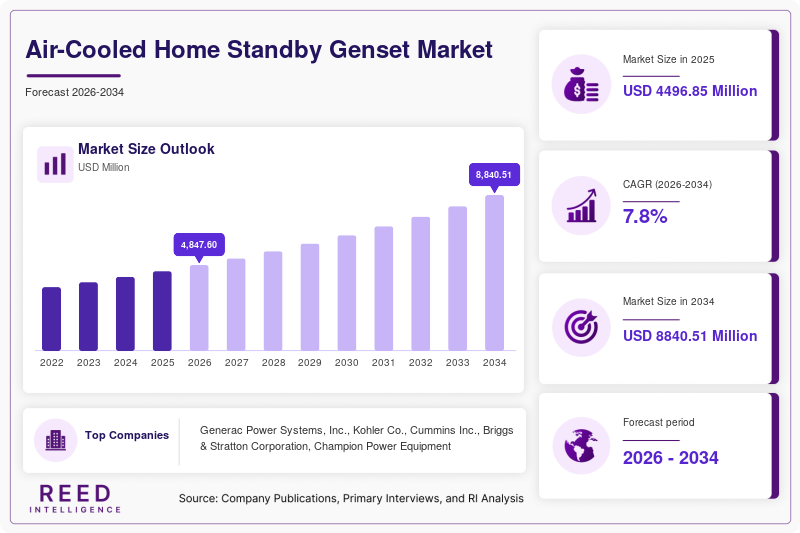
Air-Cooled Home Standby Genset market size is projected at USD 4,847.6 million in 2026 and is expected to hit USD 8,847.5 million by 2034 with a CAGR of 7.8% during the forecast period. The increasing demand for reliable backup power solutions in residential and small commercial settings, coupled with the rising frequency of power outages due to extreme weather events and grid instability, underpins market expansion. This report delivers a comprehensive analysis of the Air-Cooled Home Standby Genset market, including segmentation by type and application, competitive dynamics, and regional growth patterns, equipping stakeholders with critical intelligence. The Air-Cooled Home Standby Genset market continues to demonstrate strong growth potential, fueled by the growing homeowner awareness of power resilience, the increasing adoption of home automation and smart technologies, and continuous innovation in generator efficiency and noise reduction.
Air-cooled home standby gensets are backup power systems designed for residential and light commercial use. They utilize an air-cooled engine, which is simpler and more cost-effective than liquid-cooled systems, making them ideal for smaller power needs and home installations. The global production volume of air-cooled home standby gensets exceeded 1.2 million units in 2025, reflecting a 8% increase from 2023, driven by the growing demand for backup power in homes. Adoption patterns reveal that the Gas-Powered type dominates the market, accounting for 65% of total demand, followed by Diesel-Powered at 35%. The Air-Cooled Home Standby Genset market's trajectory is closely linked to the growth of the global backup power market, which is projected to reach USD 25 billion by 2028, and the increasing need for power resilience in residential and commercial settings.
Air-Cooled Home Standby Genset Market Trends
Adoption of Smart and Connected Generator Technologies
The Air-Cooled Home Standby Genset market is witnessing a significant trend toward the adoption of smart and connected technologies, driven by the need for remote monitoring, automated operation, and enhanced user convenience. The revenue from smart generators with connectivity features grew to USD 1.8 billion in 2025, a year-on-year increase of 18%, as 40% of new product launches in 2025 specified IoT-enabled connectivity and smartphone control. Adoption rates of smart generators in residential applications reached 30%, with this figure projected to exceed 60% by 2030. The Air-Cooled Home Standby Genset market's trend toward smart technology is reinforced by the need for convenience, the increasing adoption of smart home ecosystems, and the continuous innovation in control and communication technologies.
Growing Focus on Fuel Efficiency and Emission Reduction
The increasing focus on fuel efficiency and emission reduction is a major trend shaping the Air-Cooled Home Standby Genset market, with the development of generators that offer lower fuel consumption and cleaner operation. The market has seen a 12% increase in the demand for fuel-efficient generators since 2022, with 25% of new products in 2025 featuring advanced engine technology and electronic fuel injection. The use of generators with improved emissions compliance and quieter operation has also gained significant traction. The Air-Cooled Home Standby Genset market's trend toward efficiency is reinforced by the need to reduce operational costs, the increasing environmental awareness, and the continuous innovation in engine and fuel system technologies.
Air-Cooled Home Standby Genset Market Drivers
The Air-Cooled Home Standby Genset market's expansion is primarily driven by the increasing frequency of power outages due to extreme weather events and aging grid infrastructure, with the U.S. experiencing over 3,000 power outages affecting millions of customers in 2025. The need for reliable backup power to protect homes and businesses from disruptions has been a major driver, with air-cooled gensets offering a cost-effective solution. The rising awareness of power resilience and the increasing adoption of home automation have also fueled market growth. Additionally, the growing trend of remote work has spurred demand. The Air-Cooled Home Standby Genset market's growth is further reinforced by the continuous improvement in generator technology, leading to better performance and lower costs.
Air-Cooled Home Standby Genset Market Restraints
Despite favorable growth prospects, the Air-Cooled Home Standby Genset market faces significant constraints, primarily related to the high initial cost of purchasing and installing a home standby generator, which can range from USD 3,000 to over USD 10,000. The ongoing fuel and maintenance costs can also be a limitation. The Air-Cooled Home Standby Genset market's growth is also tempered by the noise and emissions concerns, and the challenges of installation in some residential settings.
Air-Cooled Home Standby Genset Market Opportunities
The Air-Cooled Home Standby Genset market presents significant opportunities in the rapidly expanding market for home energy management and solar-plus-storage integration, where generators can act as backup for renewable systems. The development of generators with improved fuel efficiency and lower emissions is expected to grow at a CAGR of 9% through 2034. Emerging opportunities also exist in the use of generators for peak shaving and grid support services in residential settings. The Air-Cooled Home Standby Genset market's opportunity profile is further enhanced by the growing trend of home automation and the increasing focus on energy resilience.
Challenges in Air-Cooled Home Standby Genset Market
The Air-Cooled Home Standby Genset market faces persistent challenges related to the need for continuous innovation to reduce noise and emissions while improving efficiency. The complexity of ensuring reliable operation and proper maintenance for homeowners can also be a challenge. The market is also contending with the challenge of competing with battery storage systems and the need to address the regulatory requirements for emissions. Additionally, the Air-Cooled Home Standby Genset market is challenged by the need to educate consumers about the benefits and proper use of standby generators.
Air-Cooled Home Standby Genset Market Segmentation
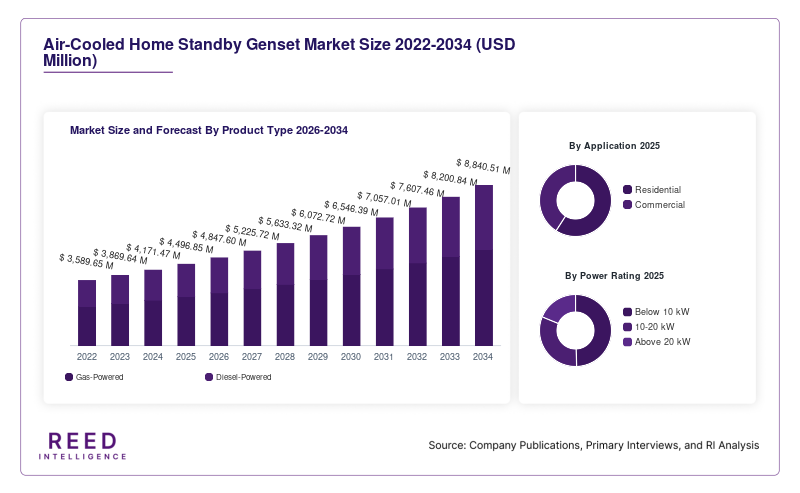
The Air-Cooled Home Standby Genset market is segmented by Type and Application to provide a comprehensive market perspective. By Type, Gas-Powered dominates with a 65% market share, driven by its lower cost and cleaner operation. The Application segment is led by Residential, which accounts for 78% of the market, followed by Commercial at 22%.
By Type
Gas-Powered represent the largest segment in the Air-Cooled Home Standby Genset market, commanding a 65% share, with production exceeding 0.78 million units in 2025. These are characterized by their use of natural gas or propane, offering lower emissions and fuel costs. Technical specifications include power output, fuel consumption, and noise level. The Air-Cooled Home Standby Genset market's Gas-Powered segment is driven by its use in residential applications.
Diesel-Powered capture a 35% share of the Air-Cooled Home Standby Genset market, with production of 0.42 million units in 2025. These are characterized by their higher fuel efficiency and durability, often used in commercial and larger residential applications. Technical specifications include power output, fuel efficiency, and durability. The Air-Cooled Home Standby Genset market's Diesel-Powered segment is driven by its use in commercial and heavy-duty applications.
By Application
Residential dominates the Air-Cooled Home Standby Genset market, accounting for 78% of sales, representing 0.936 million units in 2025. This segment includes use in single-family homes, townhouses, and multi-family dwellings. Usage penetration exceeds 5% in the sector. The Air-Cooled Home Standby Genset market's Residential segment is characterized by its focus on ease of use, quiet operation, and reliability.
Commercial accounts for 22% of the Air-Cooled Home Standby Genset market, with sales of 0.264 million units in 2025. This segment encompasses use in small businesses, retail, and light commercial facilities. The segment is growing at a steady CAGR, driven by the need for business continuity. The Air-Cooled Home Standby Genset market's Commercial segment is characterized by its focus on higher power output and durability.
Air-Cooled Home Standby Genset Market Regional Outlook
North America Air-Cooled Home Standby Genset Market
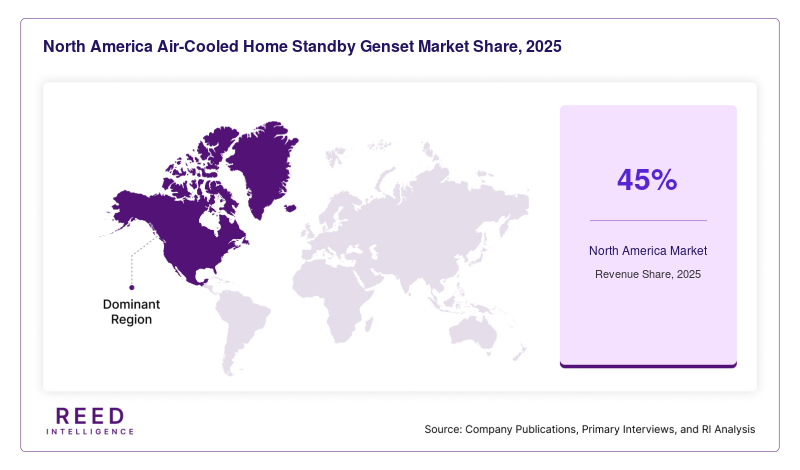
Leads the Air-Cooled Home Standby Genset market, commanding a 45% share, with a revenue of USD 2,181.4 million in 2025. The United States is the primary driver, accounting for 85% of regional demand, driven by the high frequency of power outages, strong consumer awareness of backup power, and a well-established distribution network. The North American Air-Cooled Home Standby Genset market is characterized by its focus on innovation and premium products.
Europe Air-Cooled Home Standby Genset Market
Represents the second-largest market, capturing a 25% share with a revenue of USD 1,211.9 million in 2025. The UK, Germany, and France are the primary drivers, collectively accounting for 60% of regional demand, driven by the focus on energy security and the growing adoption of home automation. The European Air-Cooled Home Standby Genset market is characterized by its focus on quality and efficiency.
Asia-Pacific Air-Cooled Home Standby Genset Market
Accounts for 20% of the global Air-Cooled Home Standby Genset market, with a revenue of USD 969.5 million in 2025. China, Australia, and Japan are the primary drivers, together accounting for 70% of regional demand, driven by rapid urbanization, increasing disposable incomes, and growing awareness of power backup solutions. The Asia-Pacific Air-Cooled Home Standby Genset market is projected to grow at the fastest CAGR of 10% through 2034.
Middle East & Africa and Latin America Air-Cooled Home Standby Genset Market
Together account for the remaining 10% of the Air-Cooled Home Standby Genset market, with the UAE leading the Middle East market and Brazil leading the Latin American market. Both regions are projected to grow at CAGRs exceeding 8%, driven by infrastructure development and increasing demand for reliable power.
Top players in Air-Cooled Home Standby Genset Market
- Generac Power Systems, Inc.
- Kohler Co.
- Cummins Inc.
- Briggs & Stratton Corporation
- Champion Power Equipment
- Honda Motor Co., Ltd.
- Yamaha Motor Co., Ltd.
- Himoinsa
- Atlas Copco
- Doosan Portable Power
- Wacker Neuson SE
- Multiquip Inc.
- Mitsubishi Heavy Industries, Ltd.
- Cat (Caterpillar Inc.)
- Pramac S.p.A.
Generac Power Systems, Inc.
Generac Power Systems holds a dominant position in the Air-Cooled Home Standby Genset market, with an estimated 25% global market share, particularly strong in the North American residential segment. The company's portfolio of home standby generators is widely recognized for its quality, reliability, and innovation. Generac's market leadership is reinforced by its significant R&D investment, its strong brand reputation, and its extensive distribution network. Generac commands over 30% of the North American market and 15% of the European market, positioning it as a key player in the Air-Cooled Home Standby Genset market.
Kohler Co.
Kohler Co. is a leading player in the Air-Cooled Home Standby Genset market, commanding approximately 15% of the global market share through its comprehensive portfolio of power generation solutions. The company's expertise in engine and generator technology and its focus on quality have solidified its position. Kohler's home standby generators are known for their reliability, performance, and quiet operation. The company's commitment to innovation and its strong presence in the North American and European markets have enhanced its competitive advantage.
Cummins Inc. holds a significant 12% market share, with particular strength in the commercial and high-power residential segments. Briggs & Stratton Corporation is a major player in the North American market, holding a 10% share.
Recent Developments in Air-Cooled Home Standby Genset Market
- 2025: Generac launched a new line of smart home standby generators with enhanced IoT connectivity and integration with home automation systems.
- 2025: Kohler introduced a new series of air-cooled generators with improved fuel efficiency and reduced emissions for residential applications.
Air-Cooled Home Standby Genset Market Segments
By Product Type
- Gas-Powered
- Diesel-Powered
By Application
- Residential
- Commercial
By Power Rating
- Below 10 kW
- 10-20 kW
- Above 20 kW
By Region
- North America
- Europe
- APAC
- Middle East and Africa
- LATAM