Air Core Fixed Shunt Reactor Market Size, Share Demand Report By Voltage Rating (Medium Voltage, High Voltage, Extra High Voltage, Ultra High Voltage), By Application (Transmission Systems, Distribution Systems, Renewable Energy Integration, Industrial Applications), By End-Use Industry (Utilities, Industrial, Commercial), By Insulation Type (Dry-Type, Oil-Immersed), By Region & Segment Forecasts, 2026–2034
USD 3950
Market Overview
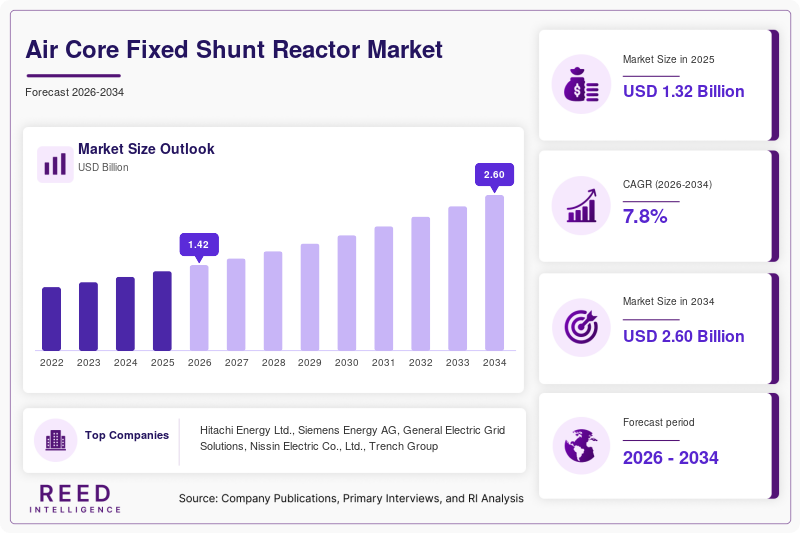
The Air Core Fixed Shunt Reactor Market size was valued at approximately USD 1.32 billion in 2026 and is projected to reach USD 2.41 billion by 2034, expanding at a CAGR of 7.8% during the forecast period (2026–2034). The market is witnessing consistent growth due to the increasing demand for reactive power compensation in high-voltage transmission systems, particularly in rapidly expanding power grids.
A major global factor supporting market expansion is the rising integration of renewable energy into national grids, which creates voltage instability challenges. Air core fixed shunt reactors are widely deployed to manage voltage fluctuations without the risk of core saturation, making them suitable for modern grid infrastructures with intermittent energy sources such as solar and wind.
Key Highlights
- Asia Pacific dominated the market with a share of 38.6% in 2025, while the Middle East & Africa is expected to register the fastest growth at a CAGR of 9.1%.
- By voltage rating, the Extra High Voltage (EHV) segment led with 44.2% share in 2025, whereas the Ultra High Voltage (UHV) segment is projected to grow at a CAGR of 8.6%.
- By application, Transmission Systems held the dominant share of 61.8% in 2025, while Renewable Integration Applications are expected to expand at a CAGR of 9.4%.
- China, the dominant country, recorded a market value of USD 312 million in 2024, which increased to USD 338 million in 2025 due to extensive grid modernization programs.
Market Trends
Increasing Deployment in Renewable Energy Infrastructure
The transition toward renewable energy sources is reshaping grid architecture globally. Air core fixed shunt reactors are gaining traction in solar and wind farms where voltage regulation is critical due to fluctuating generation patterns. Their ability to operate without magnetic saturation enhances reliability in renewable-rich networks.
Advancements in High-Voltage Transmission Technologies
The development of ultra-high voltage (UHV) transmission lines is influencing the Air Core Fixed Shunt Reactor Market. Utilities are increasingly investing in advanced reactor designs with improved thermal stability and lower losses. These innovations are enabling efficient long-distance electricity transmission while maintaining grid stability.
Market Drivers
Expansion of High-Voltage Transmission Networks
The continuous expansion of high-voltage and extra-high-voltage transmission systems is driving demand for air core fixed shunt reactors. As countries invest in cross-border electricity trade and grid interconnections, the need for voltage stabilization equipment has increased significantly.
Growing Need for Grid Reliability and Stability
Power system operators are focusing on minimizing transmission losses and maintaining stable voltage levels. Air core fixed shunt reactors provide consistent reactive power compensation, making them essential components in modern grids that require high reliability and operational efficiency.
Market Restraint
High Initial Installation Costs
One of the primary restraints in the Air Core Fixed Shunt Reactor Market is the relatively high upfront cost associated with installation and integration. This can limit adoption in cost-sensitive markets, especially in developing regions with constrained utility budgets.
Market Opportunities
Expansion in Emerging Economies
Emerging economies are investing heavily in electricity infrastructure to meet growing energy demand. This creates opportunities for manufacturers to expand their presence by offering cost-effective and scalable reactor solutions tailored to regional needs.
Technological Integration with Smart Grids
The evolution of smart grids presents new opportunities for the Air Core Fixed Shunt Reactor Market. Integration with digital monitoring systems and IoT-enabled devices allows real-time performance tracking and predictive maintenance, enhancing operational efficiency.
Segmental Analysis
By Voltage Rating
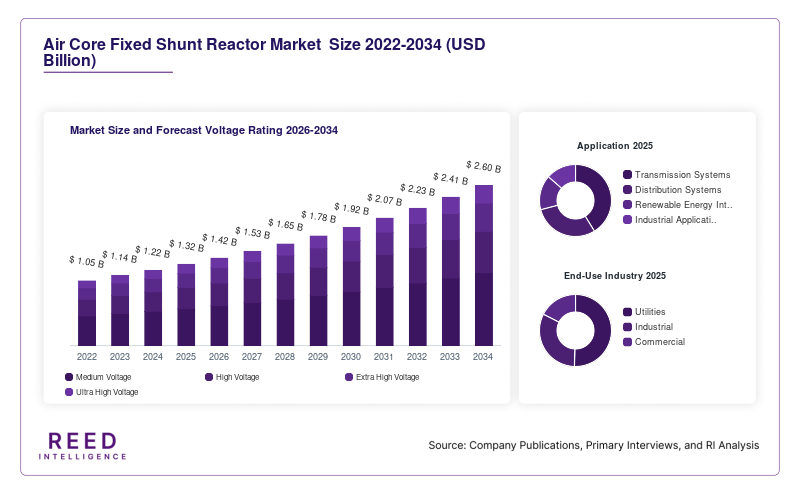
The Extra High Voltage (EHV) segment dominated the Air Core Fixed Shunt Reactor Market with a 44.2% share in 2025, driven by its widespread application in large-scale transmission systems.
The Ultra High Voltage (UHV) segment is projected to grow at a CAGR of 8.6%, supported by increasing investments in long-distance power transmission networks requiring advanced voltage control solutions.
By Application
Transmission systems accounted for the largest share of 61.8% in 2025, as utilities continue to prioritize grid stability in high-load networks.
Renewable integration applications are expected to grow at a CAGR of 9.4%, fueled by the rising need for voltage regulation in solar and wind energy projects.
By End-Use Industry
The utilities sector dominated with a 68.5% share in 2025, reflecting the extensive deployment of shunt reactors in public power infrastructure.
The industrial sector is anticipated to grow at a CAGR of 8.1%, driven by increasing demand for stable power supply in energy-intensive industries such as manufacturing and mining.
By Insulation Type
Dry-type insulation led the market with a 57.3% share in 2025, owing to its lower maintenance requirements and environmental safety benefits.
Oil-immersed reactors are expected to grow at a CAGR of 7.9%, supported by their higher efficiency in specific high-load applications.
Regional Analysis
North America
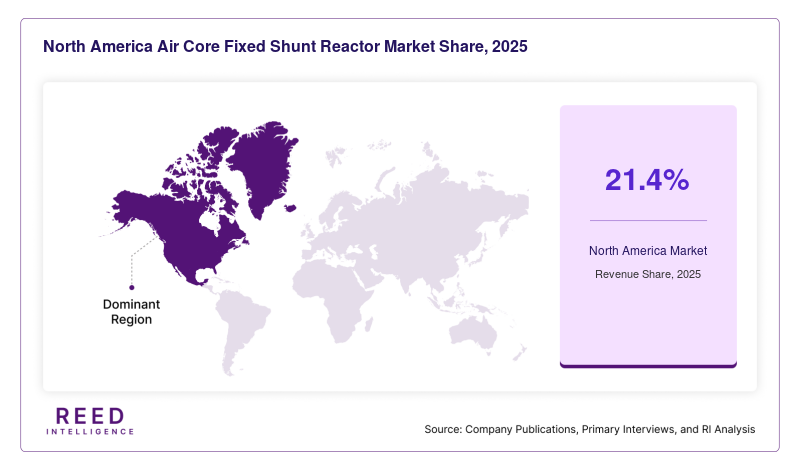
North America accounted for 21.4% of the market share in 2025 and is expected to grow at a CAGR of 6.9% during the forecast period. The United States dominated the regional market due to its aging grid infrastructure requiring modernization. Investments in grid resilience and the replacement of legacy systems have contributed to increased adoption of air core fixed shunt reactors.
Europe
Europe held a 19.7% market share in 2025 and is projected to grow at a CAGR of 7.2%. Germany emerged as the dominant country, driven by its strong focus on energy transition initiatives. The integration of offshore wind farms has necessitated advanced voltage control solutions, boosting demand in the region.
Asia Pacific
Asia Pacific led the Air Core Fixed Shunt Reactor Market with a 38.6% share in 2025 and will expand at a CAGR of 8.4%. China dominated the region due to its extensive ultra-high voltage transmission network development. The country's focus on long-distance power transmission from renewable energy hubs has significantly increased the deployment of air core reactors.
Middle East & Africa
The Middle East & Africa region captured 10.3% of the market share in 2025 and is anticipated to grow at the fastest CAGR of 9.1%. Saudi Arabia led the region, supported by large-scale power infrastructure projects and investments in grid expansion to support industrial growth.
Latin America
Latin America accounted for 10.0% of the market share in 2025 and is expected to grow at a CAGR of 7.5%. Brazil dominated the region due to its expanding hydropower capacity and the need for efficient transmission systems to connect remote generation sites with urban demand centers.
Competitive Landscape
The Air Core Fixed Shunt Reactor Market is moderately competitive, with several global and regional players focusing on product innovation and strategic partnerships. Key companies are investing in advanced reactor designs to improve efficiency and reduce operational losses. The market leader, Hitachi Energy, has strengthened its position through continuous technological advancements and recent contracts for ultra-high voltage projects.
Siemens Energy and GE Grid Solutions are also prominent players, leveraging their strong global presence and engineering expertise. Nissin Electric and Trench Group contribute significantly through specialized reactor solutions tailored for high-voltage applications. Companies are increasingly focusing on expanding their footprint in emerging markets to capitalize on infrastructure development opportunities. Strategic collaborations with utilities and government agencies remain a key growth strategy for market participants.
Key Players List
- Hitachi Energy Ltd.
- Siemens Energy AG
- General Electric Grid Solutions
- Nissin Electric Co., Ltd.
- Trench Group
- Fuji Electric Co., Ltd.
- TBEA Co., Ltd.
- Hyosung Heavy Industries
- CG Power and Industrial Solutions Ltd.
- Toshiba Energy Systems & Solutions Corporation
- SGB-SMIT Group
- Zaporozhtransformator PJSC
- ABB Power Grids (legacy operations)
- Wilson Transformer Company
- Bharat Heavy Electricals Limited (BHEL)
Recent Developments
- In 2025, Hitachi Energy secured a major contract for supplying air core fixed shunt reactors for a UHV transmission project in Asia.
- Siemens Energy introduced an upgraded reactor design with enhanced thermal performance for high-load applications.
- GE Grid Solutions expanded its manufacturing capacity to meet increasing demand from renewable energy projects.
- Nissin Electric developed compact air core reactors aimed at urban grid installations.
- CG Power announced a strategic partnership with a regional utility provider to deploy advanced voltage control solutions.
Air Core Fixed Shunt Reactor Market Segments
Voltage Rating
- Medium Voltage
- High Voltage
- Extra High Voltage
- Ultra High Voltage
Application
- Transmission Systems
- Distribution Systems
- Renewable Energy Integration
- Industrial Applications
End-Use Industry
- Utilities
- Industrial
- Commercial
Insulation Type
- Dry-Type
- Oil-Immersed
By Region
- North America
- Europe
- APAC
- Middle East and Africa
- LATAM