Air Duct Cleaning Service Market Size, Share & Trends Analysis Report By Service Type (Residential Air Duct Cleaning, Commercial Air Duct Cleaning, Industrial Air Duct Cleaning), By Cleaning Method (Source Removal, Power Vacuuming, Air Washing), By Application (HVAC Ducts, Supply & Return Ducts, Dryer Exhaust Ducts, Air Handling Units), By End User (Residential, Commercial Buildings, Healthcare & Institutional), By Service Provider (Independent Contractors, HVAC Service Companies) and By Region
USD 3950
Air Duct Cleaning Service Market Size
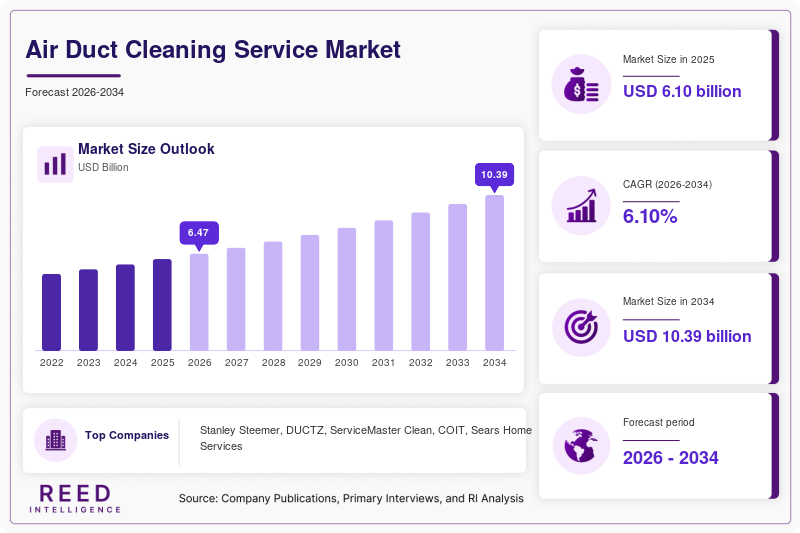
The global Air Duct Cleaning Service Market size was valued at USD 6.10 billion in 2025 and is projected to grow from USD 6.47 billion in 2026 to USD 10.39 billion by 2034, registering a CAGR of 6.10% during the forecast period from 2026 to 2034.
The Air Duct Cleaning Service Market is shifting from a largely residential maintenance activity toward a broader building-maintenance service that includes commercial HVAC systems, healthcare facilities, schools, hospitality properties and industrial buildings. The underlying demand is connected to HVAC maintenance, indoor environmental quality, building renovation and contamination control rather than routine cleaning alone.
The U.S. EPA does not recommend routine air-duct cleaning for every home, but identifies situations such as substantial mold growth, vermin infestation and excessive dust or debris as circumstances where cleaning may be appropriate. EPA also notes that complete HVAC-system cleaning can involve supply and return ducts, coils, fans, heat exchangers, drain pans and air-handler housings.
Commercial demand has a stronger maintenance basis. GSA guidance identifies periodic filter replacement and duct cleaning as part of HVAC maintenance and commissioning programs that can support indoor air quality and HVAC performance.
The standards environment is also becoming more structured. NADCA released the 2025 edition of ACR, The NADCA Standard, covering assessment, containment, cleaning procedures, equipment, safety and cleanliness verification.
Air Duct Cleaning Service Market Drivers
Greater Focus on Indoor Air Quality Is Increasing HVAC Maintenance Demand
Indoor air quality has become a more formal building-management issue, particularly in offices, schools, healthcare buildings and other occupied facilities. ASHRAE Standard 62.1-2025 includes requirements covering filtration, controls, air-cleaning systems and building operations and maintenance, while Standard 62.2-2025 updates residential ventilation and filtration requirements.
The commercial mechanism is broader than duct cleaning itself. Facility managers increasingly need documented HVAC inspection, maintenance and cleanliness programs. Duct cleaning can therefore become one component of a larger service package that includes inspection, filter replacement, coil cleaning, air-handler maintenance and indoor-air-quality assessment.
GSA guidance similarly identifies HVAC commissioning and maintenance, including regular filter replacement and duct cleaning, as activities supporting indoor environmental quality.
This creates recurring opportunities for professional service companies because building operators can contract HVAC hygiene work as part of planned maintenance rather than relying entirely on one-time consumer demand.
Aging HVAC Systems and Building Renovations Create Cleaning Requirements
Older buildings and renovated properties can accumulate dust, construction debris and other contaminants inside HVAC systems. EPA recommends protecting duct systems during construction and renovation because construction dust can enter supply and return registers and subsequently circulate through the system.
The mechanism is particularly relevant to commercial properties undergoing refurbishment. When buildings change tenants, layouts or HVAC configurations, facility managers may combine duct inspection and cleaning with air-handler servicing, filter replacement and system commissioning.
Schools provide another example. EPA identifies ductwork, air-handling units, filters, exhaust fans and other HVAC components as part of school ventilation systems, with HVAC design and operation affecting ventilation, thermal comfort and contaminant removal.
Consequently, renovation activity can create project-based demand while aging HVAC infrastructure creates recurring maintenance requirements.
Professional Standards Are Raising the Value of Qualified Service Providers
The air-duct cleaning industry is becoming more standardized. NADCA's 2025 ACR Standard provides procedures for HVAC inspections, engineering controls, containment, cleaning, equipment use, safety plans and cleanliness verification.
This matters commercially because building owners increasingly need evidence that contractors performed the work correctly. The 2025 standard includes cleanliness-verification methods and procedures for different cleaning approaches, including source removal, ambient air cleaning, wet cleaning, power washing and steam cleaning.
The result is greater differentiation between qualified contractors and low-cost providers. Companies able to provide inspection reports, before-and-after documentation, contamination evidence and standardized procedures can compete for larger commercial contracts.
The same trend supports facility-management companies and HVAC contractors that bundle duct cleaning with broader mechanical-system maintenance.
Air Duct Cleaning Service Market Restraints
Cleaning Is Not Required Routinely in Every Building
The market faces an important demand limitation: duct cleaning is not universally required as routine maintenance. EPA explicitly states that it does not recommend routine air-duct cleaning and instead recommends cleaning when specific contamination conditions exist.
This creates a distinction between commercial HVAC maintenance and consumer marketing claims. Demand can be strong where ducts are contaminated, buildings undergo renovation or facility managers require documented HVAC hygiene, but weaker where systems are clean and properly maintained.
EPA also notes that there is limited evidence that cleaning ducts alone improves energy efficiency and cautions against unsupported claims about health benefits.
Consequently, professional providers increasingly need to sell measurable system-maintenance outcomes rather than broad claims about health or energy savings.
Service Quality and Contractor Differentiation Remain Uneven
Air-duct cleaning requires specialized equipment and knowledge, but service quality can vary substantially. EPA warns that improper cleaning can release additional dust and contaminants or damage ductwork and HVAC equipment. It recommends evaluating provider competence and obtaining written estimates.
The industry standardization response is visible through NADCA's certification and procedural framework. NADCA's 2025 standard establishes detailed expectations around assessment, containment, equipment, safety and cleanliness verification.
For customers, this creates a qualification problem; for reputable contractors, it creates an opportunity to differentiate. The market therefore remains sensitive to reputation, certification, insurance, equipment quality, technician training and the ability to document completed work.
Air Duct Cleaning Service Market Opportunities
Commercial HVAC Hygiene and Facility Management Contracts
Commercial buildings provide a more predictable service opportunity than purely residential duct cleaning because HVAC systems are managed as building assets. Offices, schools, healthcare facilities, hotels, retail properties and industrial sites can incorporate duct inspection and cleaning into wider preventive-maintenance programs.
GSA specifically identifies duct cleaning and filter replacement as components of regular HVAC maintenance and commissioning.
The opportunity is therefore shifting toward bundled contracts covering ductwork, air handlers, coils, filters, exhaust systems and indoor-air-quality assessment. Facility-management companies can use these services to consolidate multiple HVAC maintenance requirements under one contract.
Healthcare, Education and Institutional Buildings
Healthcare and institutional buildings have particularly structured HVAC requirements because ventilation, filtration and air-cleaning performance directly affect building operations. ASHRAE Standard 241 establishes requirements for infection-risk management modes in existing buildings and major renovations, including HVAC and air-cleaning system operation and maintenance.
Schools are another important application because EPA identifies HVAC systems as central to maintaining adequate ventilation and controlling indoor contaminants.
This creates opportunities for service companies capable of working within documented maintenance schedules, providing cleanliness verification and coordinating cleaning with facility operations.
Inspection, Documentation and Technology-Enabled Services
The service model is becoming more evidence-based. EPA recommends visual inspection before cleaning and notes that remote photography can be used to document conditions inside ducts.
This creates room for companies to combine inspection cameras, digital reports, airflow measurements, contamination documentation and maintenance records with physical cleaning.
The commercial benefit is a move away from a simple "cleaning visit" toward a documented HVAC hygiene service. Digital records can also support facility managers managing multiple properties and help contractors demonstrate completed work.
Segmental Analysis
By Service Type
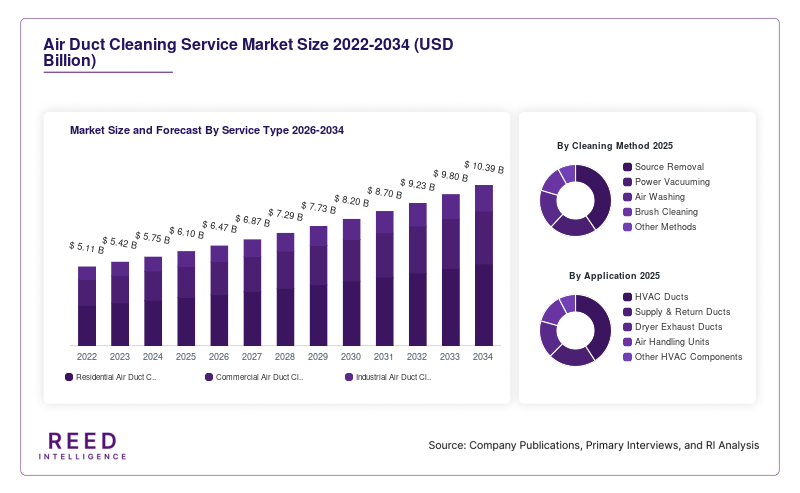
Residential Air Duct Cleaning represents approximately 52% of the global market in 2025, supported by the large installed base of forced-air HVAC systems and consumer demand related to visible contamination, remodeling and HVAC maintenance.
Commercial Air Duct Cleaning accounts for approximately 34%, while Industrial Air Duct Cleaning represents approximately 14%.
Commercial Air Duct Cleaning is the fastest-growing service category, with approximately 7.2% CAGR, supported by facility-maintenance programs, indoor-air-quality requirements and greater use of documented HVAC hygiene procedures. GSA guidance specifically incorporates duct cleaning into regular HVAC maintenance and commissioning programs.
By Cleaning Method
Source Removal holds approximately 42% of the market in 2025, reflecting its broad use for physically removing accumulated dust and debris from HVAC systems. NADCA's 2025 ACR Standard includes source removal among recognized HVAC cleaning approaches.
Power Vacuuming accounts for approximately 27%, Brush Cleaning 16%, Air Washing 9%, and other methods 6%.
Power Vacuuming is the fastest-growing method at approximately 7.0% CAGR, supported by demand for controlled contaminant removal and the increasing emphasis on professional equipment and containment.
EPA recommends vacuum equipment that exhausts particles outside the building or uses HEPA filtration when exhaust remains indoors.
By Application
HVAC Ducts represent approximately 38% of the market in 2025, making them the largest application. The segment includes supply and return air pathways that distribute conditioned air through residential and commercial buildings.
Supply & Return Ducts account for 27%, Air Handling Units 15%, Dryer Exhaust Ducts 12%, and other HVAC components 8%.
Air Handling Units are the fastest-growing application at approximately 7.4% CAGR. Building operators increasingly treat cleaning as part of complete HVAC maintenance rather than focusing only on visible duct surfaces. EPA defines duct cleaning broadly to include air-handler housings, fans, coils, heat exchangers and drain pans.
By End User
Residential customers represent approximately 48% of the market in 2025, supported by the large installed base of residential HVAC systems and consumer-led maintenance.
Commercial Buildings account for 27%, Healthcare & Institutional 11%, Industrial Facilities 8%, and Hospitality 6%.
Healthcare & Institutional is the fastest-growing end-user category, with approximately 7.5% CAGR. These facilities operate under more structured ventilation and indoor-environment requirements, while ASHRAE standards increasingly emphasize ventilation, filtration, air cleaning and maintenance.
By Service Provider
Specialized Duct Cleaning Companies represent approximately 39% of the market in 2025, supported by their dedicated equipment, trained technicians and ability to handle full-system cleaning projects.
HVAC Service Companies account for 31%, Independent Contractors 20%, and Facility Management Companies 10%.
Facility Management Companies are the fastest-growing provider category at approximately 8.0% CAGR, reflecting the increasing bundling of HVAC cleaning with broader building-maintenance contracts.
The shift is supported by commercial standards that require greater coordination between building owners, facility managers and contractors. NADCA's general specification specifically addresses coordination of commercial HVAC cleaning projects.
Regional Analysis
North America Air Duct Cleaning Service Market
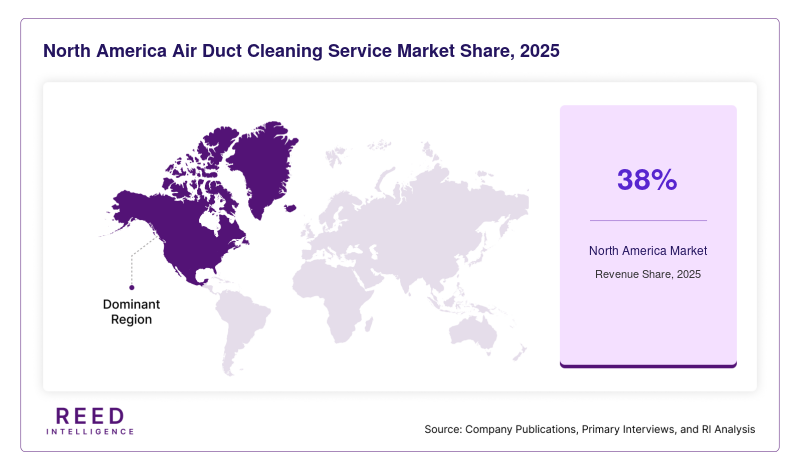
North America represents approximately 38% of the global Air Duct Cleaning Service Market in 2025, making it the largest regional market. The region benefits from a large installed HVAC base, established professional cleaning companies and a mature standards environment.
The U.S. market is strongly influenced by EPA guidance on appropriate duct-cleaning circumstances and professional service quality. EPA recommends cleaning when substantial mold growth, vermin infestation or excessive dust and debris are present, while discouraging routine cleaning without a specific need.
The region also has a developed professional standard through NADCA. Its 2025 ACR Standard provides procedures for assessment, containment, cleaning, safety and cleanliness verification. NADCA reports more than 1,700 member companies across more than 30 countries, demonstrating the industry's established professional network.
North America is projected to grow at approximately 5.6% CAGR through 2034. Commercial facility maintenance, healthcare buildings, schools and renovation projects provide recurring demand, while the main limitation is EPA's position that routine duct cleaning is not necessary in every building.
Europe Air Duct Cleaning Service Market
Europe accounts for approximately 28% of the global market in 2025 and is projected to grow at approximately 5.7% CAGR.
The region's demand is closely connected to energy efficiency, building renovation, HVAC modernization and indoor-environment management. Building owners increasingly need to maintain ventilation and air-conditioning systems as buildings become more energy efficient and tightly controlled.
ASHRAE is not a European regulator, but its international standards illustrate the broader direction of the HVAC sector toward documented ventilation, filtration, air cleaning and maintenance practices. Europe's own building-performance and ventilation requirements similarly create a technical environment in which HVAC maintenance becomes more structured.
Commercial offices, healthcare facilities, hospitality properties and public buildings form important demand pools. Renovation of older European building stock creates additional opportunities because HVAC systems can require inspection and cleaning after construction work.
The primary constraint is fragmentation across national building codes, service practices and certification requirements.
APAC Air Duct Cleaning Service Market
APAC represents approximately 22% of the global Air Duct Cleaning Service Market in 2025 and is the fastest-growing region, with approximately 8.2% CAGR.
The region's growth is supported by rapid commercial construction, urbanization, expansion of shopping centers and hotels, healthcare infrastructure and increasing adoption of centralized HVAC systems.
Japan, South Korea, China, India, Singapore and Australia represent important demand centers, although the maturity of professional duct-cleaning services differs significantly among markets.
India provides a particularly large long-term opportunity because commercial real estate, hospitals, hotels, airports and modern retail facilities increasingly use centralized HVAC systems. Singapore and other Southeast Asian markets have similarly high reliance on mechanical ventilation and air-conditioning because of climate conditions.
The market is also benefiting from greater awareness of indoor environmental quality. ASHRAE's ventilation and indoor-air-quality standards provide an international technical reference increasingly used by building professionals.
The principal constraints are uneven certification standards, fragmented service markets and lower penetration of professional duct-cleaning services in smaller cities.
Middle East and Africa Air Duct Cleaning Service Market
Middle East and Africa represents approximately 7% of the global market in 2025 and is projected to grow at approximately 7.4% CAGR.
The region's hot climate creates substantial reliance on air-conditioning systems, particularly in the Gulf states. Large commercial buildings, hotels, airports, shopping centers and healthcare facilities operate extensive HVAC networks where cleaning and maintenance can be integrated into facility-management contracts.
The strongest demand is concentrated in Saudi Arabia, the UAE and Qatar, where large-scale commercial and hospitality developments require centralized cooling infrastructure.
The market opportunity is increasingly tied to planned facility maintenance rather than household cleaning. Large buildings require documented service schedules, and facility managers can bundle duct cleaning with filter replacement, coil cleaning, air-handler maintenance and other HVAC services.
The major constraints are dependence on specialized service equipment and imported technical expertise, together with uneven market development across African countries.
LATAM Air Duct Cleaning Service Market
LATAM represents approximately 5% of the global market in 2025 and is projected to grow at approximately 7.0% CAGR.
Brazil and Mexico are the principal markets, supported by commercial buildings, hospitals, hospitality, retail properties and industrial facilities using centralized HVAC systems.
The expansion of modern commercial buildings and increased attention to indoor environmental quality create opportunities for professional duct-cleaning providers. The market also benefits from facility-management outsourcing, where HVAC cleaning can be incorporated into multi-service maintenance contracts.
However, residential demand remains fragmented and price-sensitive in several markets. The relatively smaller installed base of centralized HVAC systems compared with North America also limits the addressable market.
Competitive Landscape
The Air Duct Cleaning Service Market is fragmented compared with equipment-oriented HVAC industries because services are delivered locally and customer relationships depend heavily on geographic coverage, technician availability, reputation, and service quality.
Competition is increasingly shifting toward bundled HVAC maintenance rather than standalone duct cleaning. HVAC service companies can combine duct cleaning with filter replacement, coil cleaning, air-handler maintenance, and HVAC inspection, giving them recurring customer relationships.
NADCA has an important industry-standardization role through its ACR Standard, which provides procedures for assessment, cleaning, restoration, containment and cleanliness verification. The 2025 edition strengthened the procedural framework for professional contractors.
Key Market Players
- Stanley Steemer
- DUCTZ
- ServiceMaster Clean
- COIT
- Sears Home Services
- AdvantaClean
- The Duct Kings
- Air-Care
- National Air Duct Cleaners Association (NADCA) member companies
- HVAC service and facility-management providers
- Local independent duct-cleaning contractors
Recent Market Developments
- September 2025 – NADCA released the 2025 edition of ACR, The NADCA Standard. The updated standard added or refined procedures covering engineering controls, containment, HVAC inspections, safety plans, equipment use, cleaning methods and cleanliness verification.
- 2025 – ASHRAE Standards 62.1-2025 and 62.2-2025 established updated ventilation and indoor-air-quality requirements. The revisions include filtration, controls, air cleaning, humidity and ventilation provisions that increase the technical importance of HVAC system maintenance.
Air Duct Cleaning Service Market Segments
By Service Type
- Residential Air Duct Cleaning
- Commercial Air Duct Cleaning
- Industrial Air Duct Cleaning
By Cleaning Method
- Source Removal
- Power Vacuuming
- Air Washing
- Brush Cleaning
- Other Methods
By Application
- HVAC Ducts
- Supply & Return Ducts
- Dryer Exhaust Ducts
- Air Handling Units
- Other HVAC Components
By End User
- Residential
- Commercial Buildings
- Healthcare & Institutional
- Industrial Facilities
- Hospitality
By Service Provider
- Independent Contractors
- HVAC Service Companies
- Specialized Duct Cleaning Companies
- Facility Management Companies
By Region
- North America
- Europe
- APAC
- Middle East and Africa
- LATAM