Air Freight And Cargo Market Size, Share & Demand Report By Service Type (Domestic Air Freight, International Air Freight, Express Cargo Services, Charter Cargo Services), By Cargo Type (General Cargo, Pharmaceutical and Healthcare Cargo, Perishable Cargo, Hazardous Cargo, High-Value Cargo), By End User (Retail and E-commerce, Healthcare and Pharmaceuticals, Automotive, Aerospace and Defense, Consumer Electronics, Food and Beverage), By Region & Segment Forecasts, 2026–2034
USD 3950
Market Overview
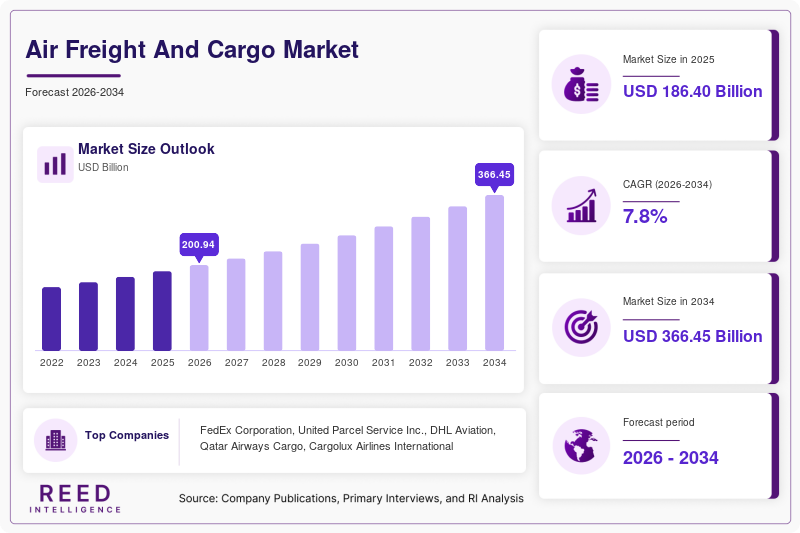
The global Air Freight And Cargo Market size was valued at USD 186.4 billion in 2026 and is projected to reach USD 338.7 billion by 2034, expanding at a CAGR of 7.8% during the forecast period from 2026 to 2034. The market continues to evolve as international trade volumes increase, cross-border e-commerce expands, and manufacturers demand shorter delivery cycles for high-value goods. Air cargo operators are investing in digital freight management systems, route optimization technologies, and temperature-controlled logistics networks to improve operational efficiency and meet changing customer expectations.
One of the major factors supporting market growth is the continued expansion of global e-commerce and rapid retail fulfillment models. Retailers and online marketplaces increasingly depend on air freight services to ensure fast delivery of electronics, pharmaceuticals, apparel, and automotive components across continents. Demand for same-day and next-day international shipping has encouraged airlines and logistics providers to increase cargo capacity and modernize fleet infrastructure. In addition, rising pharmaceutical exports and demand for cold-chain transportation have accelerated investments in specialized cargo handling systems at airports worldwide.
Key Highlights
- North America dominated the market with a 35.1% share in 2025, while Asia Pacific is expected to grow at the fastest CAGR of 9.4% during 2026–2034.
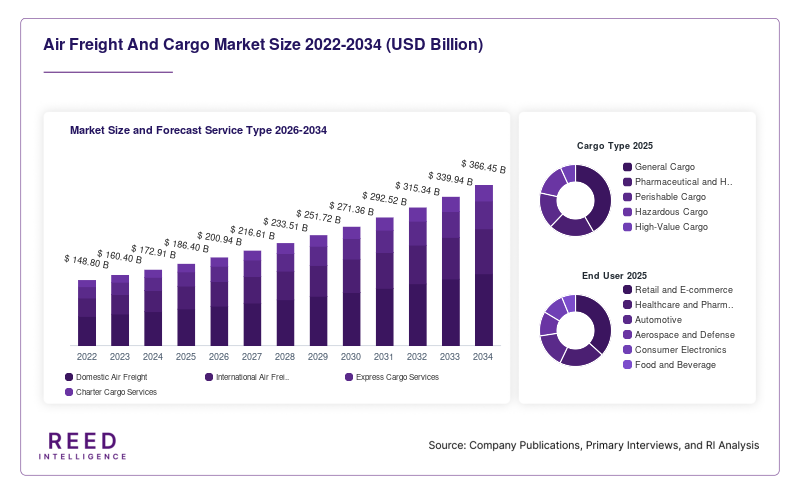
- By service type, international air freight accounted for the largest share of 58.3%, while express cargo services are projected to grow at a CAGR of 10.1%.
- By cargo type, general cargo led with a 46.8% share, whereas pharmaceutical and healthcare cargo is expected to expand at a CAGR of 11.3%.
- The United States remained the dominant country, with market values of USD 41.2 billion in 2024 and USD 44.8 billion in 2025.
Market Trends
Expansion of Digital Freight Platforms and Automated Cargo Operations
The Air Freight And Cargo Market is witnessing a strong shift toward digital freight platforms and automated cargo management systems. Airlines, freight forwarders, and logistics providers are increasingly adopting cloud-based booking solutions, AI-powered shipment tracking, and automated customs documentation systems to improve operational efficiency. These technologies reduce manual processing time, improve shipment visibility, and support faster cargo clearance procedures. Several airport operators are investing in robotic cargo handling systems and automated storage facilities to minimize delays and improve warehouse productivity. Digital transformation is also helping logistics companies optimize aircraft utilization and reduce fuel-related operating costs. As global trade volumes rise, automated freight ecosystems are expected to become essential for maintaining delivery reliability and cost efficiency across international cargo networks.
Rising Demand for Temperature-Controlled and Pharmaceutical Cargo Transport
Demand for temperature-sensitive transportation services has increased significantly across the global air cargo industry. Pharmaceutical manufacturers, biotechnology companies, and healthcare distributors increasingly rely on air freight networks for rapid transportation of vaccines, biologics, and medical products. Cargo operators are expanding cold-chain infrastructure, including refrigerated containers, thermal packaging systems, and temperature-monitoring technologies. Airlines are also partnering with airport authorities to establish certified pharmaceutical handling zones that meet international compliance standards. The growth of healthcare exports from Asia Pacific and Europe is accelerating demand for specialized air freight services. In addition, rising global consumption of perishable food products, including seafood, fruits, and dairy products, is encouraging cargo providers to strengthen refrigerated logistics capabilities across major international trade routes.
Market Drivers
Growth of Cross-Border E-Commerce and Rapid Delivery Expectations
The rapid expansion of global e-commerce platforms continues to drive growth in the Air Freight And Cargo Market. Consumers increasingly expect fast international delivery for electronics, fashion products, cosmetics, and consumer goods, encouraging retailers to rely on air freight transportation. Online marketplaces are expanding fulfillment centers and cross-border distribution networks to support same-day and next-day delivery services. This trend is increasing cargo volumes at major international airports and creating demand for dedicated cargo aircraft. Logistics providers are strengthening partnerships with airlines to secure freight capacity during peak shopping seasons. The rise of digital commerce in emerging economies such as India, Indonesia, Brazil, and Vietnam is further contributing to long-term air cargo demand and encouraging investments in airport cargo infrastructure expansion projects.
Increasing Global Trade in High-Value and Time-Sensitive Goods
The transportation of high-value and time-sensitive products has become a major growth driver for the market. Semiconductor components, automotive electronics, aerospace equipment, luxury goods, and medical products require secure and rapid transportation solutions that air freight can provide efficiently. Manufacturers are reducing inventory holding periods and adopting just-in-time production models, increasing dependence on fast logistics services. Pharmaceutical exports and clinical trial shipments also require precise delivery timelines and temperature-controlled transportation systems. Additionally, geopolitical trade diversification strategies are encouraging businesses to establish multi-country sourcing operations, leading to higher international cargo movement. The growing importance of supply chain resilience is expected to sustain demand for reliable air cargo services during the forecast period.
Market Restraint
Rising Fuel Costs and Regulatory Pressure on Carbon Emissions
The Air Freight And Cargo Market faces significant challenges from rising aviation fuel prices and increasing environmental regulations. Fuel expenses account for a substantial portion of airline operating costs, and fluctuations in crude oil prices directly affect cargo transportation pricing. Higher freight costs can reduce profitability for logistics providers and increase transportation expenses for manufacturers and retailers. In addition, governments and international aviation organizations are implementing stricter carbon emission standards for airlines. Cargo operators are under pressure to modernize aircraft fleets, adopt sustainable aviation fuel, and improve fuel efficiency to comply with environmental targets.
These regulatory changes require substantial capital investment, particularly for smaller freight carriers with limited financial resources. Airlines operating older cargo aircraft may face operational restrictions or higher compliance costs in several regions. Environmental taxes and emission-related charges can also increase overall transportation costs for customers. For example, European carbon reduction initiatives are encouraging airlines to accelerate investments in sustainable aviation technologies, creating financial pressure across the industry. These factors may limit market expansion in cost-sensitive trade routes and reduce short-term profitability for cargo service providers.
Market Opportunities
Expansion of Air Cargo Infrastructure in Emerging Economies
Emerging economies are creating substantial growth opportunities for the Air Freight And Cargo Market through airport modernization and logistics infrastructure development. Governments across Asia Pacific, the Middle East, and Latin America are investing in cargo terminals, free trade zones, and multimodal logistics hubs to support export-oriented industries. India, Vietnam, Saudi Arabia, and Mexico are strengthening international trade connectivity through airport expansion projects and cargo corridor development. These initiatives are improving cargo handling capacity and reducing transit times for exporters.
The increasing presence of electronics manufacturing, pharmaceutical production, and automotive assembly operations in emerging economies is expected to generate long-term air freight demand. Logistics providers are also expanding regional warehousing and fulfillment networks to support international e-commerce growth. Enhanced trade agreements and industrial diversification strategies are likely to strengthen cargo movement across emerging markets. As supply chains become more geographically distributed, international cargo operators are expected to benefit from rising demand for rapid transportation services and specialized logistics solutions.
Adoption of Sustainable Aviation Fuel and Green Logistics Solutions
The transition toward sustainable aviation fuel and environmentally efficient logistics operations presents significant opportunities for cargo airlines and freight companies. Airlines are increasingly investing in fuel-efficient aircraft and carbon reduction technologies to meet sustainability targets and improve operational efficiency. Sustainable aviation fuel adoption can help reduce greenhouse gas emissions while supporting compliance with international environmental regulations. Cargo operators that implement greener logistics models may gain competitive advantages among multinational customers prioritizing sustainability goals.
Several logistics companies are also integrating electric ground support equipment, digital route optimization tools, and carbon tracking platforms into cargo operations. These initiatives improve fuel efficiency and reduce operational waste across supply chains. Growing customer demand for environmentally responsible shipping solutions is encouraging freight providers to develop low-emission transportation strategies. Partnerships between airlines, energy companies, and airport authorities are expected to accelerate sustainable aviation fuel production and infrastructure development, creating additional growth opportunities for the industry over the forecast period.
Segmental Analysis
By Service Type
International air freight emerged as the dominant subsegment within the service type category, accounting for 58.3% of the market share in 2024. Strong growth in global trade, high-value manufacturing exports, and cross-border supply chain operations contributed significantly to segment expansion. Industries such as electronics, automotive, pharmaceuticals, and aerospace increasingly depend on international air freight for rapid transportation of time-sensitive goods. Freight forwarders and logistics providers are strengthening partnerships with airlines to secure stable cargo capacity across major trade routes. In addition, the increasing use of digital freight booking platforms and customs automation systems is improving shipment visibility and reducing transit delays. Major international cargo hubs continue to invest in warehouse automation and cargo handling technologies to support rising shipment volumes and enhance operational efficiency.
Express cargo services are projected to register the fastest CAGR of 10.1% during the forecast period due to rising demand for rapid delivery solutions across e-commerce and healthcare industries. Online retailers increasingly require same-day and next-day international delivery services to meet customer expectations. Logistics providers are expanding dedicated express cargo fleets and regional distribution centers to support fast shipment movement. Pharmaceutical and medical product transportation is also contributing to segment growth because these shipments often require urgent delivery timelines. Advances in route optimization software, AI-driven shipment tracking, and automated sorting systems are further improving delivery speed and operational performance. Expanding cross-border digital commerce activity in emerging economies is expected to sustain long-term demand for express cargo services.
By Cargo Type
General cargo accounted for the largest share of 46.8% in 2024 within the cargo type segment. This category includes electronics, machinery, automotive components, apparel, and consumer goods transported through standard freight services. Growth in international manufacturing trade and rising demand for high-value product transportation supported segment dominance. Retailers and industrial manufacturers increasingly rely on air cargo transportation to maintain inventory efficiency and reduce supply chain disruptions. Freight carriers are also improving cargo security systems and warehouse automation technologies to enhance operational reliability. The continued growth of global trade agreements and multinational sourcing operations is further increasing demand for general cargo transportation across international routes and regional logistics networks.
Pharmaceutical and healthcare cargo is anticipated to witness the fastest CAGR of 11.3% through 2034 due to increasing global demand for temperature-sensitive transportation solutions. Vaccines, biologics, specialty medicines, and clinical trial materials require precise environmental controls and rapid delivery timelines. Cargo operators are investing heavily in refrigerated containers, thermal packaging systems, and real-time temperature monitoring technologies. Airports are also establishing certified pharmaceutical handling zones to comply with international healthcare logistics standards. Growth in biotechnology research, aging populations, and international pharmaceutical trade is expected to strengthen long-term segment expansion. Increasing healthcare exports from Asia Pacific and Europe are additionally supporting demand for specialized pharmaceutical air cargo services worldwide.
By End User
The retail and e-commerce segment held the largest market share of 39.4% in 2024 within the end-user category. Rapid expansion of international online shopping platforms and digital marketplaces significantly increased demand for air cargo transportation services. Consumers increasingly expect fast delivery for electronics, fashion products, and household goods purchased through global e-commerce channels. Retail companies are expanding fulfillment centers and distribution networks to improve delivery speed and customer satisfaction. Air freight operators are responding by increasing cargo aircraft capacity and strengthening regional logistics partnerships. Growth in mobile commerce adoption and rising internet penetration across emerging economies continue to support long-term cargo transportation demand within the retail and e-commerce sector.
The healthcare and pharmaceutical segment is forecast to grow at the fastest CAGR of 10.8% during the forecast period due to rising global healthcare expenditure and increasing pharmaceutical trade activity. Medical products, vaccines, and laboratory materials often require rapid and secure transportation to maintain product quality and regulatory compliance. Pharmaceutical companies are increasingly partnering with cargo airlines that provide certified cold-chain logistics services and advanced shipment monitoring systems. Expanding biotechnology research activities and international clinical trials are further contributing to segment growth. Additionally, increasing healthcare demand in emerging economies is encouraging pharmaceutical manufacturers to expand export operations, creating sustained demand for specialized air cargo transportation services.
Regional Analysis
North America
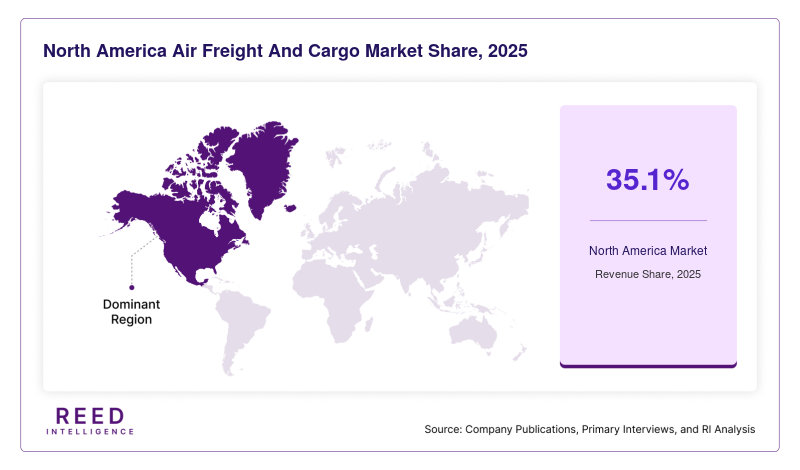
North America accounted for 35.1% of the global Air Freight And Cargo Market share in 2025 and is expected to maintain a stable growth trajectory with a CAGR of 6.9% through 2034. The region benefits from extensive cargo airport infrastructure, strong international trade activity, and high adoption of express delivery services. The United States and Canada continue to invest in advanced cargo handling systems and automated warehouse technologies. Rising cross-border e-commerce demand and pharmaceutical exports are also supporting regional cargo traffic growth across major airports.
The United States remains the dominant country in the regional market due to its strong logistics ecosystem and large international trade volume. A key growth factor is the expansion of integrated express delivery networks by major logistics companies. Cargo operators are increasing investments in dedicated freighter fleets and temperature-controlled logistics facilities. Growth in semiconductor imports, medical shipments, and aerospace component transportation continues to strengthen air cargo demand across the country. Increasing use of AI-powered cargo management systems is further improving operational efficiency and shipment visibility.
Europe
Europe represented 24.6% of the global Air Freight And Cargo Market in 2025 and is forecast to expand at a CAGR of 6.5% during the forecast period. The region benefits from strong pharmaceutical exports, high-value industrial manufacturing, and advanced transportation infrastructure. Germany, France, and the Netherlands remain key cargo hubs for intra-European and international freight movement. Increasing investment in sustainable aviation fuel infrastructure and low-emission cargo operations is influencing regional market development. E-commerce expansion and automotive component trade are also supporting air freight demand across Europe.
Germany remains the leading country in the European market due to its strong industrial base and export-driven economy. A major growth factor is the country’s advanced automotive and machinery manufacturing sector, which depends on rapid transportation of precision components and high-value equipment. German airports are investing in automated cargo terminals and digital customs processing technologies to improve freight efficiency. Increasing pharmaceutical exports and expansion of regional distribution centers are also strengthening cargo transportation demand throughout the country.
Asia Pacific
Asia Pacific accounted for 27.8% of the global Air Freight And Cargo Market share in 2025 and is projected to register the fastest CAGR of 9.4% between 2026 and 2034. The region is experiencing strong growth due to manufacturing expansion, export-oriented industries, and rising international e-commerce activity. China, India, Japan, South Korea, and Southeast Asian countries are increasing investments in airport infrastructure and cargo handling capacity. The rapid growth of electronics manufacturing and online retail platforms continues to create substantial cargo transportation demand throughout the region.
China remains the dominant country within Asia Pacific because of its large manufacturing sector and extensive export network. One major growth factor is the expansion of cross-border e-commerce trade supported by digital retail platforms and global fulfillment networks. Chinese logistics providers are investing heavily in smart cargo facilities, automated sorting systems, and dedicated cargo aircraft fleets. In addition, government initiatives focused on trade connectivity and airport expansion are improving international freight movement and strengthening regional cargo competitiveness.
Middle East & Africa
The Middle East & Africa region held 7.3% of the global Air Freight And Cargo Market in 2025 and is anticipated to grow at a CAGR of 7.6% during the forecast period. Strategic geographic positioning between Asia, Europe, and Africa supports regional cargo transit operations. Gulf countries continue to invest in airport modernization, logistics free zones, and integrated transportation corridors. The increasing movement of pharmaceuticals, perishables, and industrial goods through regional hubs is supporting cargo market expansion. Rising trade diversification efforts are also contributing to regional logistics development.
The United Arab Emirates remains the leading country in the regional market due to its strong aviation infrastructure and international cargo connectivity. A key growth factor is the country’s role as a global re-export and logistics hub linking international trade routes. Cargo airports in Dubai and Abu Dhabi continue to expand warehouse capacity and temperature-controlled logistics services. Investments in smart customs systems and digital cargo processing technologies are improving operational efficiency and supporting long-term freight market growth across the country.
Latin America
Latin America accounted for 5.2% of the global Air Freight And Cargo Market share in 2025 and is expected to grow at a CAGR of 6.8% through 2034. Regional growth is supported by increasing exports of agricultural products, seafood, pharmaceuticals, and industrial goods. Countries across the region are modernizing airport cargo terminals and improving logistics infrastructure to strengthen international trade connectivity. Rising e-commerce penetration and expansion of regional retail supply chains are also creating demand for express air cargo transportation services.
Brazil remains the dominant country in the Latin American market due to its large domestic economy and growing export sector. A major growth factor is the country’s strong agricultural and perishable goods export industry, which relies heavily on rapid transportation to international markets. Cargo operators are expanding refrigerated logistics infrastructure and dedicated freight routes for fresh produce exports. Increasing industrial production and rising international trade partnerships are also supporting long-term cargo transportation demand across Brazil.
Competitive Landscape
The Air Freight And Cargo Market is moderately consolidated, with major international logistics companies and cargo airlines competing through network expansion, fleet modernization, and digital logistics integration. Leading market participants are focusing on automated cargo handling systems, sustainable aviation fuel adoption, and strategic partnerships to improve operational efficiency and customer service capabilities. Companies are also expanding cold-chain logistics infrastructure to strengthen pharmaceutical cargo transportation services.
United Parcel Service Inc. remains one of the leading companies in the market due to its extensive global logistics network and integrated express delivery operations. The company recently expanded its healthcare logistics infrastructure and introduced additional temperature-controlled cargo facilities to strengthen pharmaceutical shipment capabilities. Other major players, including FedEx Corporation, DHL Aviation, Qatar Airways Cargo, and Cargolux Airlines International, continue investing in cargo aircraft modernization and digital freight management technologies. Strategic acquisitions, airport infrastructure partnerships, and expansion into emerging markets remain key competitive strategies adopted across the industry.
Key Players
- FedEx Corporation
- United Parcel Service Inc.
- DHL Aviation
- Qatar Airways Cargo
- Cargolux Airlines International
- Emirates SkyCargo
- Cathay Cargo
- Singapore Airlines Cargo
- Air France KLM Martinair Cargo
- Lufthansa Cargo
- DB Schenker
- Kuehne+Nagel
- Nippon Express
- Expeditors International
- Atlas Air Worldwide
Recent Developments
- In February 2026, FedEx Corporation announced the expansion of its Asia Pacific air cargo operations through additional regional cargo hubs and automated sorting facilities.
- In August 2025, Qatar Airways Cargo introduced advanced pharmaceutical handling solutions and expanded temperature-controlled cargo capacity across European trade routes.
- In November 2025, DHL Aviation partnered with sustainable fuel suppliers to accelerate sustainable aviation fuel adoption for long-haul cargo operations.
Air Freight And Cargo Market Segments
Service Type
- Domestic Air Freight
- International Air Freight
- Express Cargo Services
- Charter Cargo Services
Cargo Type
- General Cargo
- Pharmaceutical and Healthcare Cargo
- Perishable Cargo
- Hazardous Cargo
- High-Value Cargo
End User
- Retail and E-commerce
- Healthcare and Pharmaceuticals
- Automotive
- Aerospace and Defense
- Consumer Electronics
- Food and Beverage
By Region
- North America
- Europe
- APAC
- Middle East and Africa
- LATAM