Air Plasma Spray Market Size, Share Demand Report By Material Type (Ceramic Coatings, Metallic Coatings, Composite Coatings, Polymer Coatings), By Application (Aerospace Components, Medical Implants, Industrial Machinery, Energy Equipment, Automotive Components), By End-Use Industry (Aerospace & Defense, Healthcare, Automotive, Energy & Power, Industrial Manufacturing, Oil & Gas) By Region & Segment Forecasts, 2026–2034
USD 3950
Market Overview
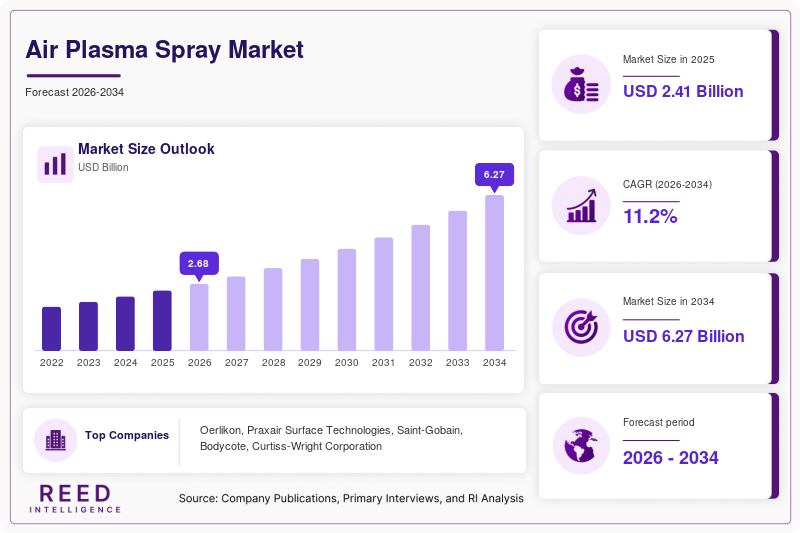
The global Air Plasma Spray Market size was valued at USD 2.41 billion in 2026 and is projected to reach USD 5.63 billion by 2034, expanding at a CAGR of 11.2% during the forecast period from 2026 to 2034. Air plasma spray technology is increasingly used for surface enhancement, thermal barrier coatings, wear resistance, corrosion protection, and biomedical coatings across aerospace, automotive, healthcare, power generation, and industrial manufacturing sectors. The market continues to witness stable growth due to rising demand for high-performance coating technologies that improve component durability and operational efficiency in harsh industrial environments.
A major global factor supporting market expansion is the increasing adoption of lightweight and fuel-efficient aerospace engines. Aircraft manufacturers and maintenance providers are investing in advanced thermal spray technologies to improve turbine performance, reduce oxidation, and extend component life cycles. Air plasma spray systems provide precise coating deposition with strong adhesion properties, making them suitable for turbine blades, combustion chambers, landing gear systems, and industrial gas turbines. In addition, the growing transition toward renewable energy infrastructure and industrial automation is accelerating demand for protective coating applications in energy equipment and manufacturing tools.
Key Highlights
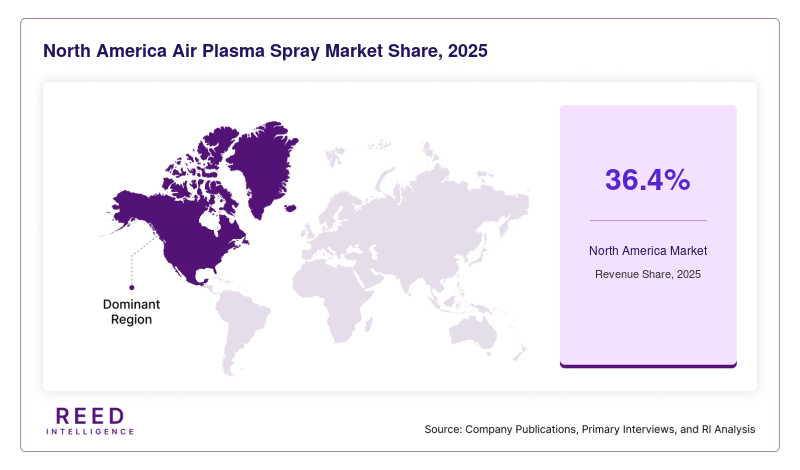
- North America dominated the market with a 36.4% share in 2025, while Asia Pacific is expected to grow at the fastest CAGR of 12.1% during 2026–2034.
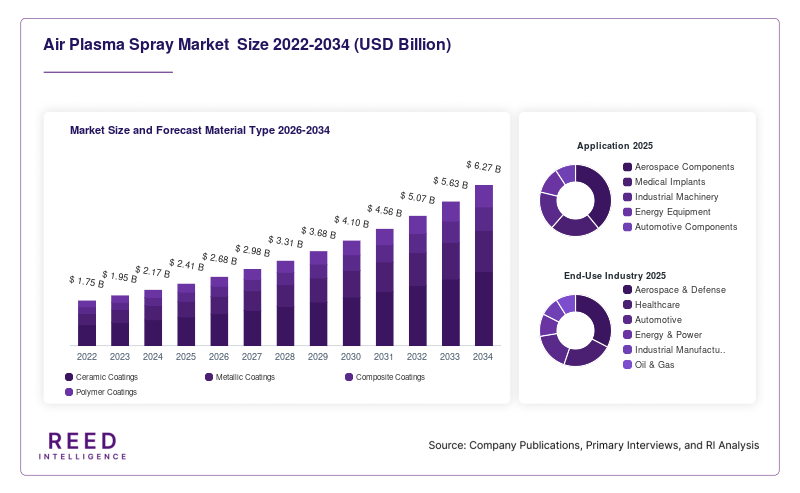
- By material type, ceramic coatings accounted for the largest share of 42.7%, while composite coatings are projected to grow at a CAGR of 12.9%.
- By application, aerospace components led with a 39.3% share, whereas medical implants are expected to expand at a CAGR of 12.5%.
- The United States remained the dominant country, with market values of USD 690 million in 2024 and USD 760 million in 2025.
Market Trends
Growing Integration of Automation in Thermal Spray Operations
Manufacturers operating in the Air Plasma Spray Market are increasingly integrating robotic systems and automated monitoring technologies into coating operations. Automated plasma spray equipment improves coating precision, enhances production speed, and reduces human error in high-volume industrial applications. Aerospace and automotive manufacturers are particularly adopting robotic plasma spraying to ensure consistent coating thickness and improved quality control across complex component geometries. Automated systems also help companies reduce production downtime and optimize powder utilization, leading to lower operational costs and improved manufacturing efficiency.
The use of digital sensors and process control software is becoming more common in thermal spray facilities. These systems provide real-time monitoring of temperature, particle velocity, and coating deposition parameters. As industries prioritize repeatable manufacturing processes and predictive maintenance, automated air plasma spray systems are expected to gain broader adoption. The trend is especially visible in turbine refurbishment centers and advanced manufacturing plants where process reliability and coating accuracy directly influence operational performance and safety standards.
Rising Demand for Biocompatible and Wear-Resistant Coatings
The healthcare industry is emerging as an important application area for air plasma spray coatings due to increasing demand for orthopedic implants and biomedical devices. Plasma-sprayed hydroxyapatite coatings are widely used to improve implant integration with bone tissue and enhance long-term implant stability. Medical device manufacturers are investing in advanced coating technologies that provide better wear resistance, corrosion protection, and biocompatibility for surgical implants and prosthetic devices.
Demand for wear-resistant coatings is also rising in industrial machinery, mining equipment, and oil and gas operations where components are exposed to abrasive environments and high temperatures. Air plasma spray coatings extend the operational life of machinery and reduce maintenance frequency. Industries seeking to improve productivity and reduce replacement costs are increasingly adopting advanced ceramic and composite coatings. This trend is creating opportunities for coating service providers and material suppliers to expand specialized product offerings tailored to industrial and biomedical applications.
Market Drivers
Expanding Aerospace Maintenance and Engine Refurbishment Activities
The growth of global commercial aviation and defense modernization programs is significantly supporting the Air Plasma Spray Market. Aircraft engines operate under extreme temperatures and pressure conditions, requiring protective thermal barrier coatings that improve performance and durability. Air plasma spray technology enables manufacturers to apply ceramic coatings capable of protecting turbine components from oxidation, heat stress, and wear. Increasing aircraft fleet expansion and rising air passenger traffic are contributing to greater demand for maintenance, repair, and overhaul services worldwide.
Engine refurbishment activities are increasing across both commercial and military aviation sectors. Airlines and defense organizations are extending aircraft service life through component restoration programs that rely heavily on thermal spray technologies. Plasma spray coatings reduce component replacement costs and improve fuel efficiency by maintaining optimal engine performance. Growing investments in next-generation aircraft engines and lightweight aerospace materials are expected to further strengthen demand for high-quality plasma spray coating solutions during the forecast period.
Increasing Industrial Need for Corrosion and Wear Protection
Industrial manufacturers are increasingly adopting air plasma spray coatings to improve equipment reliability and reduce operational downtime. Components used in mining, oil and gas, marine, and power generation industries often operate in highly corrosive and abrasive environments. Air plasma spray coatings help protect industrial machinery from chemical degradation, thermal stress, and mechanical wear, resulting in extended equipment lifespan and lower maintenance expenditures.
The rapid expansion of renewable energy infrastructure is also driving demand for protective coatings in wind turbines, hydroelectric systems, and power generation equipment. Industrial operators are prioritizing cost-effective maintenance strategies that improve energy efficiency and asset performance. Air plasma spray technology supports these goals by delivering durable coatings with high thermal resistance and strong adhesion characteristics. The increasing use of advanced manufacturing equipment and automated production systems is expected to continue driving market growth across industrial applications globally.
Market Restraint
High Equipment Costs and Complex Operational Requirements
The Air Plasma Spray Market faces challenges related to the high initial investment associated with plasma spray equipment and automated coating systems. Advanced plasma spray chambers, robotic manipulators, powder feeding systems, and process monitoring technologies require substantial capital expenditure, limiting adoption among small and medium-sized enterprises. In addition, the operational costs associated with system maintenance, energy consumption, and specialized coating materials remain relatively high compared to conventional coating technologies.
The industry also faces a shortage of skilled professionals capable of operating and maintaining sophisticated plasma spray systems. Achieving precise coating quality requires technical expertise in material science, thermal dynamics, and process calibration. Inconsistent coating deposition can affect product performance and increase rejection rates in critical industries such as aerospace and healthcare. For example, turbine blade coating defects may lead to reduced thermal resistance and premature component failure. These operational complexities can slow market penetration in developing regions where technical infrastructure and workforce training capabilities remain limited.
Market Opportunities
Expansion of Renewable Energy Infrastructure
The growing global investment in renewable energy infrastructure is creating substantial opportunities for the Air Plasma Spray Market. Wind turbines, hydroelectric equipment, and concentrated solar power systems require protective coatings capable of withstanding extreme environmental conditions and long operational cycles. Air plasma spray coatings provide excellent thermal resistance, erosion protection, and corrosion control for critical renewable energy components, helping operators reduce maintenance costs and improve equipment efficiency.
Governments across Asia Pacific, Europe, and the Middle East are increasing investments in sustainable energy projects to support decarbonization initiatives and energy security objectives. This trend is generating higher demand for advanced coating technologies used in turbines, generators, and energy transmission systems. Coating manufacturers are developing new ceramic and composite materials specifically designed for renewable energy applications. As the renewable energy sector continues expanding, demand for durable and high-performance plasma spray coatings is expected to accelerate steadily during the forecast period.
Rising Adoption of Advanced Medical Implant Technologies
The increasing prevalence of orthopedic disorders and aging populations worldwide are driving demand for advanced medical implants and prosthetic devices. Air plasma spray technology plays an important role in improving implant performance through biocompatible coating applications. Hydroxyapatite and titanium-based plasma spray coatings enhance osseointegration and promote stronger bonding between implants and human bone tissue, improving long-term implant success rates.
Healthcare providers and medical device manufacturers are increasingly focusing on implant durability, patient recovery outcomes, and infection resistance. Plasma-sprayed coatings help achieve these objectives by improving surface properties and reducing implant wear. Emerging economies are also witnessing rising healthcare expenditures and growing access to orthopedic treatment procedures. As medical tourism and healthcare infrastructure development continue expanding globally, the market for plasma-sprayed medical coatings is expected to present significant long-term growth opportunities for coating technology providers.
Segmental Analysis
By Material Type
Ceramic coatings dominated the Air Plasma Spray Market and accounted for 42.7% of the global market share in 2024. These coatings are widely used in aerospace engines, industrial turbines, and medical devices because of their superior thermal insulation and wear resistance properties. Ceramic materials such as zirconia and alumina are commonly applied through air plasma spray systems to protect components operating under high temperatures and corrosive conditions. Aerospace manufacturers rely heavily on ceramic thermal barrier coatings to improve fuel efficiency and extend engine component life. The industrial sector also benefits from ceramic coatings in pumps, valves, and manufacturing tools exposed to abrasive environments. Growing demand for energy-efficient systems and lightweight aircraft components continues to support the strong market position of ceramic coatings across multiple industries.
By Application
Aerospace components represented the leading application segment in the Air Plasma Spray Market and held 39.3% of the market share in 2024. Air plasma spray coatings are extensively used in aircraft engines, turbine blades, combustion chambers, and landing gear systems to improve thermal resistance and operational efficiency. The growing production of commercial aircraft and defense aviation systems is driving demand for advanced coating technologies capable of enhancing component durability. Airlines and maintenance providers are increasingly focusing on engine refurbishment and lifecycle extension programs that depend heavily on plasma spray coatings. Thermal barrier coatings help reduce oxidation and wear in high-temperature engine environments, supporting improved fuel efficiency and reduced maintenance costs. Strong investments in next-generation aviation technologies continue to strengthen the dominance of aerospace applications within the global market.
By End-Use Industry
The aerospace and defense industry dominated the Air Plasma Spray Market with a 37.8% share in 2024 due to extensive use of thermal spray coatings in aircraft engines and defense equipment. Military aircraft, helicopters, naval systems, and missile components require protective coatings capable of withstanding high temperatures, friction, and corrosive environments. Plasma spray technologies provide enhanced thermal protection and mechanical durability for mission-critical components exposed to demanding operational conditions. Rising defense budgets and increasing investments in advanced aviation technologies are supporting market demand across developed and emerging economies. Aircraft maintenance, repair, and overhaul facilities are also driving significant consumption of plasma spray coatings for engine refurbishment and component restoration programs. Continued expansion of global air traffic and defense modernization initiatives are expected to sustain strong market growth in this segment.
Regional Analysis
North America
North America accounted for 36.4% of the global Air Plasma Spray Market share in 2025 and maintained its position as the leading regional market. The region is projected to grow at a CAGR of 10.4% during the forecast period due to strong aerospace manufacturing activities and advanced industrial infrastructure. High adoption of thermal spray technologies across aviation, defense, and power generation industries continues to support regional demand. The presence of major aircraft engine manufacturers and maintenance facilities further strengthens market expansion across the United States and Canada.
The United States remained the dominant country within the region due to rising investments in aircraft modernization and industrial automation. Increasing demand for turbine refurbishment services and advanced coating applications in military aviation is contributing to market growth. The country also benefits from a well-established healthcare industry that supports plasma spray applications in orthopedic implants and surgical devices. Strong research and development activities related to coating materials and robotic spray systems continue to create growth opportunities for regional manufacturers.
Europe
Europe represented 27.1% of the global Air Plasma Spray Market in 2025 and is expected to register a CAGR of 9.8% during the forecast period. The region benefits from strong automotive engineering capabilities and increasing industrial demand for wear-resistant coatings. Germany, France, and the United Kingdom are major contributors to regional growth due to their established manufacturing sectors and emphasis on energy-efficient industrial processes. Thermal spray technologies are widely used in automotive engines, industrial machinery, and renewable energy equipment across the region.
Germany emerged as the dominant country in the European market due to its advanced manufacturing infrastructure and strong industrial automation capabilities. The country has a significant presence of automotive suppliers and industrial equipment manufacturers requiring high-performance coating solutions. Growth in wind energy installations and turbine maintenance programs is also supporting demand for plasma spray coatings. Additionally, increasing focus on sustainable manufacturing and reduced material wastage is encouraging adoption of advanced coating technologies across multiple industries.
Asia Pacific
Asia Pacific accounted for 23.5% of the global Air Plasma Spray Market share in 2025 and is projected to witness the fastest CAGR of 12.1% through 2034. Rapid industrialization, expanding aerospace manufacturing, and rising investments in power generation infrastructure are major factors driving regional market growth. Countries such as China, India, Japan, and South Korea are increasing adoption of advanced coating technologies to improve equipment performance and manufacturing productivity. The growing automotive and electronics sectors are also contributing to higher demand for thermal spray applications.
China dominated the regional market due to its large-scale industrial production capacity and growing aerospace sector. The country continues to invest heavily in domestic aircraft manufacturing and renewable energy infrastructure, creating strong demand for thermal barrier and corrosion-resistant coatings. Increasing infrastructure modernization and expansion of heavy manufacturing industries are further supporting market growth. Government initiatives promoting advanced manufacturing technologies and industrial efficiency are expected to accelerate adoption of air plasma spray systems across various end-use sectors.
Middle East & Africa
The Middle East & Africa region held 7.2% of the global Air Plasma Spray Market in 2025 and is expected to grow at a CAGR of 8.7% during the forecast period. Growth is primarily supported by rising investments in oil and gas infrastructure, industrial processing facilities, and power generation projects. Thermal spray coatings are increasingly used to protect industrial equipment exposed to extreme temperatures, corrosion, and abrasive operating environments. Countries across the Gulf Cooperation Council are adopting advanced maintenance technologies to improve operational efficiency and reduce equipment failure risks.
Saudi Arabia emerged as the dominant country in the regional market due to extensive industrial diversification programs and energy infrastructure investments. The country is increasing focus on refinery modernization, petrochemical production, and renewable energy development, all of which require durable coating technologies. Plasma spray coatings are gaining importance in turbine systems, drilling equipment, and industrial processing machinery. Growing adoption of predictive maintenance strategies is expected to support continued market expansion across the region during the forecast period.
Latin America
Latin America accounted for 5.8% of the global Air Plasma Spray Market share in 2025 and is projected to grow at a CAGR of 8.3% through 2034. Industrial manufacturing expansion and increasing investments in mining operations are supporting demand for protective coating technologies across the region. Brazil, Mexico, and Argentina are adopting thermal spray applications to improve equipment durability and reduce operational downtime in industrial facilities. Growing awareness regarding preventive maintenance and asset optimization is also contributing to market growth.
Brazil remained the dominant country in the Latin American market due to its large industrial base and expanding aerospace maintenance sector. The country is witnessing increasing demand for corrosion-resistant coatings in mining equipment, offshore oil platforms, and energy infrastructure. Rising automotive production activities and industrial refurbishment projects are also supporting demand for plasma spray solutions. Government initiatives focused on industrial modernization and manufacturing efficiency are expected to create additional opportunities for coating technology providers across the country.
Competitive Landscape
The Air Plasma Spray Market is characterized by the presence of global coating technology providers, thermal spray equipment manufacturers, and specialized materials companies competing through product innovation, strategic partnerships, and regional expansion initiatives. Companies are increasingly investing in automated plasma spray systems, advanced ceramic powders, and robotic process control technologies to improve coating precision and production efficiency. The competitive environment is influenced by growing demand from aerospace, healthcare, and industrial manufacturing sectors requiring high-performance surface engineering solutions.
Oerlikon remained one of the leading market participants due to its extensive thermal spray portfolio, global service network, and strong aerospace industry presence. The company recently expanded its advanced coating service capabilities to support growing aircraft engine refurbishment demand. Other major players are focusing on acquisitions, material innovation, and localized production facilities to strengthen market competitiveness. Increasing collaborations between coating service providers and aerospace manufacturers are expected to intensify technological advancements and product customization strategies during the forecast period.
Key Players
- Oerlikon
- Praxair Surface Technologies
- Saint-Gobain
- Bodycote
- Curtiss-Wright Corporation
- Kennametal Inc.
- Fujimi Incorporated
- H.C. Starck Solutions
- Sulzer Ltd.
- Flame Spray Technologies
- ASB Industries
- A&A Coatings
- Plasma-Tec Inc.
- TST Coatings
- Thermion Inc.
Recent Developments
- In February 2026, Praxair Surface Technologies introduced a new automated plasma spray coating platform designed for aerospace turbine applications with improved deposition efficiency.
- In July 2025, Bodycote expanded its thermal spray coating facility in Europe to support increasing demand from industrial manufacturing and medical device sectors.
- In November 2025, Oerlikon launched advanced ceramic coating materials developed for high-temperature renewable energy applications and industrial gas turbines.
Air Plasma Spray Market Segments
Material Type
- Ceramic Coatings
- Metallic Coatings
- Composite Coatings
- Polymer Coatings
Application
- Aerospace Components
- Medical Implants
- Industrial Machinery
- Energy Equipment
- Automotive Components
End-Use Industry
- Aerospace & Defense
- Healthcare
- Automotive
- Energy & Power
- Industrial Manufacturing
- Oil & Gas
By Region
- North America
- Europe
- APAC
- Middle East and Africa
- LATAM