Air Swept Mill Market Size, Share & Demand Report By Mill Type (Vertical Air Swept Mills, Horizontal Air Swept Mills, High-Capacity Industrial Air Swept Mills), By Application (Cement Processing, Mineral Grinding, Chemical Processing), By End-Use Industry (Chemicals and Petrochemicals, Pharmaceuticals, Food Processing, Industrial Manufacturing) By Region & Segment Forecasts, 2026–2034
USD 3950
Market Overview
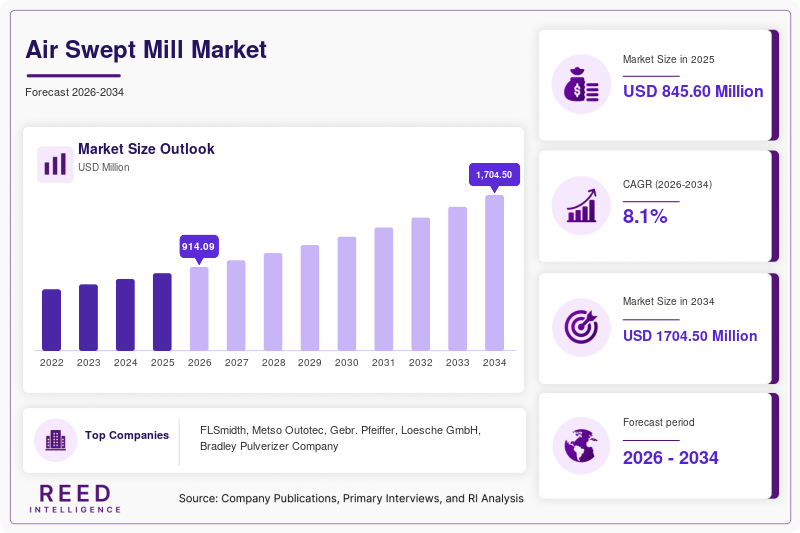
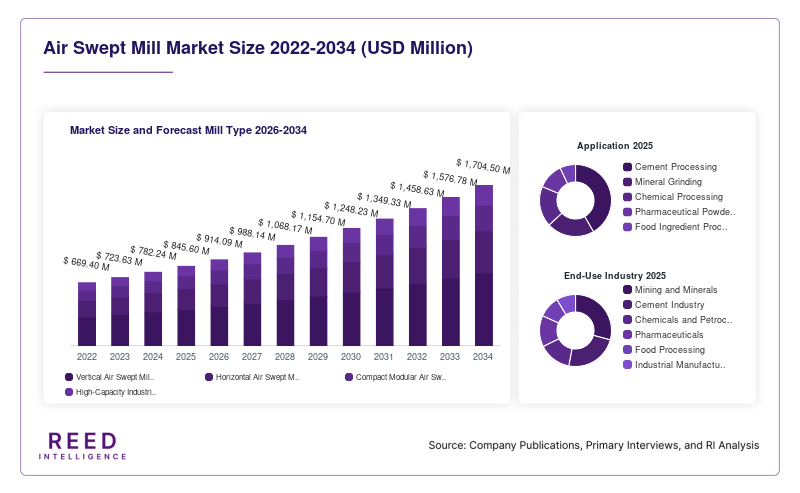
The global Air Swept Mill Market size was valued at USD 845.6 million in 2026 and is projected to reach USD 1580 million by 2034, expanding at a CAGR of 8.1% during the forecast period from 2026 to 2034. Air swept mills are widely used in powder processing and grinding applications across mining, cement, chemicals, food processing, and pharmaceutical industries. The market continues to witness stable expansion due to rising industrial automation, increasing demand for fine particle processing, and the growing focus on energy-efficient grinding technologies. Manufacturers are also integrating digital monitoring systems into milling equipment to improve production efficiency and reduce maintenance downtime.
A major global factor supporting market growth is the steady rise in infrastructure development and mineral processing activities across emerging economies. Countries in Asia Pacific, Latin America, and the Middle East are investing in industrial manufacturing and construction projects, creating demand for cement, lime, minerals, and chemical powders. Air swept mills are preferred in these sectors because they provide continuous drying and grinding in a single process, improving operational productivity. In addition, the transition toward sustainable manufacturing practices has encouraged industries to replace conventional grinding systems with advanced milling technologies that reduce power consumption and material waste.
Key Highlights
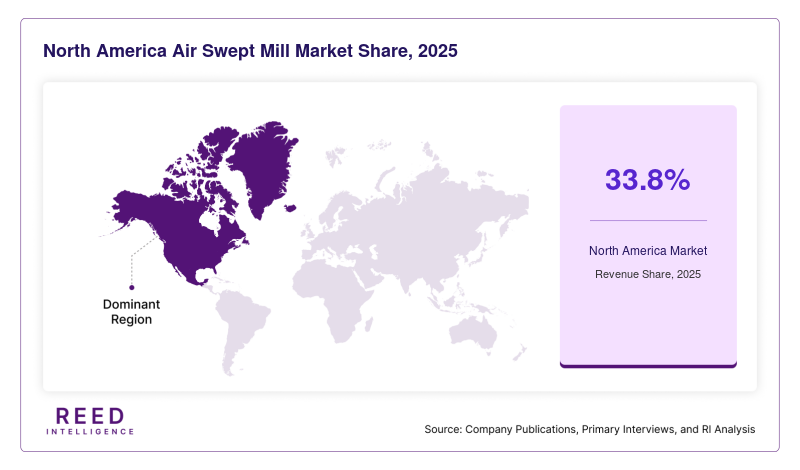
- North America dominated the market with a 33.8% share in 2025.
- Asia Pacific is expected to grow at the fastest CAGR of 10.6% during 2026–2034.
- By mill type, vertical air swept mills accounted for the largest share of 39.4%.
- while compact modular mills are projected to grow at a CAGR of 11.8%.
- By application, cement processing led with a 36.7% share.
- whereas pharmaceutical powder processing is expected to expand at a CAGR of 12.1%.
- By end-use industry, mining and minerals held the dominant share of 34.9%.
- while food processing is anticipated to witness a CAGR of 10.9%.
- The United States remained the dominant country, with market values of USD 238 million in 2024 and USD 256 million in 2025.
Market Trends
Integration of Smart Monitoring Technologies in Milling Equipment
The Air Swept Mill Market is experiencing growing adoption of smart monitoring technologies that improve equipment efficiency and operational visibility. Industrial operators are increasingly implementing sensor-based systems, predictive maintenance platforms, and automated process controls to monitor grinding performance in real time. These technologies help manufacturers reduce equipment downtime, optimize airflow distribution, and improve particle consistency. Digital monitoring systems also support remote diagnostics, enabling plant operators to identify performance issues before major failures occur. The trend is particularly strong in cement and mining facilities where continuous production is critical. Equipment suppliers are introducing integrated software platforms that provide energy consumption analytics and automated adjustment functions. As industrial facilities prioritize productivity and operational cost reduction, the demand for intelligent air swept mills is expected to increase steadily during the forecast period.
Rising Preference for Energy-Efficient and Compact Grinding Systems
Manufacturers across multiple industries are increasingly adopting compact and energy-efficient grinding systems to reduce operating costs and meet sustainability goals. Air swept mills are gaining traction because they combine drying, conveying, and grinding operations into a single integrated process, minimizing energy usage and floor space requirements. This trend is particularly important in urban industrial zones where facility expansion is limited. Compact modular mill systems are becoming popular among mid-sized chemical and pharmaceutical manufacturers due to their easier installation and lower maintenance requirements. Equipment producers are also redesigning internal airflow systems and grinding chambers to improve throughput efficiency while reducing power consumption. In addition, stricter environmental regulations related to industrial emissions and energy management are encouraging industries to upgrade aging grinding infrastructure with modern air swept mill systems that deliver higher productivity with lower environmental impact.
Market Drivers
Expansion of Mining and Mineral Processing Activities
The expansion of mining and mineral processing operations worldwide is contributing significantly to the growth of the Air Swept Mill Market. Demand for processed minerals, industrial powders, and construction materials has increased due to urbanization and infrastructure development projects across developing economies. Air swept mills are extensively used in grinding limestone, coal, clinker, gypsum, and metallic ores because they provide consistent particle size distribution and efficient material drying. Mining companies are investing in advanced grinding systems to improve production capacity and reduce energy consumption during mineral processing operations. Furthermore, rising investments in rare earth mineral extraction and industrial metal production are supporting the installation of high-capacity milling systems. The ability of air swept mills to handle large volumes of abrasive materials while maintaining stable operational performance makes them a preferred solution in modern mineral processing plants.
Increasing Demand from Cement and Construction Industries
Rapid growth in construction and cement manufacturing activities is another major factor driving the Air Swept Mill Market. Governments and private investors are increasing spending on transportation infrastructure, residential projects, industrial facilities, and renewable energy installations. These developments are generating substantial demand for cement and related building materials that require efficient grinding systems during production. Air swept mills are widely utilized in cement plants for grinding clinker and raw materials while simultaneously removing moisture from the feed material. Their ability to improve production efficiency and reduce fuel usage supports their adoption across large-scale cement facilities. In addition, manufacturers are focusing on enhancing throughput capacity and reducing operational downtime, encouraging the replacement of traditional grinding systems with advanced air swept mill technologies designed for continuous high-volume production.
Market Restraint
High Initial Installation and Maintenance Costs
The Air Swept Mill Market faces challenges associated with high capital investment and maintenance requirements, particularly for small and medium-sized industrial operators. Installation of advanced air swept milling systems requires significant expenditure on grinding equipment, air handling systems, dust collection infrastructure, and automated control units. Many companies operating in cost-sensitive markets delay equipment upgrades due to budget limitations and uncertain returns on investment. Maintenance costs also remain a concern because air swept mills operate under high-temperature and abrasive conditions that can lead to wear in grinding components, liners, and airflow channels. Frequent replacement of internal parts increases operational expenses and may disrupt production schedules. Industries with limited technical expertise often encounter difficulties in optimizing airflow and grinding efficiency, resulting in reduced productivity. These cost-related challenges may limit market penetration in developing regions where industrial modernization is progressing gradually.
Market Opportunities
Growth of Pharmaceutical and Fine Chemical Manufacturing
The expanding pharmaceutical and fine chemical sectors present considerable growth opportunities for the Air Swept Mill Market. Pharmaceutical manufacturers require highly controlled grinding systems capable of producing ultra-fine and uniform powders used in tablet production, active pharmaceutical ingredients, and specialty formulations. Air swept mills are increasingly being adopted because they support precise particle size control and efficient material handling while minimizing contamination risks. Demand for advanced milling technologies is rising in countries with expanding pharmaceutical manufacturing capabilities, particularly in Asia Pacific and Europe. Fine chemical producers are also investing in compact milling systems designed for specialty chemicals, pigments, and additives. As healthcare spending and pharmaceutical exports continue to increase globally, manufacturers are expected to invest in modern powder processing infrastructure that improves product quality and manufacturing efficiency.
Emerging Demand for Sustainable Industrial Processing Solutions
Industries worldwide are increasingly focusing on sustainable manufacturing practices, creating favorable opportunities for advanced air swept milling technologies. Companies are seeking energy-efficient grinding systems that reduce electricity consumption, material waste, and industrial emissions. Air swept mills support sustainability objectives by combining multiple production functions into a single process, lowering overall operational energy requirements. Equipment manufacturers are developing systems with improved airflow management, heat recovery technologies, and optimized grinding components to enhance efficiency. Demand for environmentally responsible industrial equipment is particularly strong in Europe and North America where emission regulations are becoming more stringent. In addition, growing investment in recycling, biomass processing, and alternative fuel production is creating new applications for air swept mills. These developments are expected to expand the adoption of modern milling technologies across diversified industrial sectors during the forecast period.
Segmental Analysis
By Mill Type
Vertical air swept mills accounted for the largest share of 39.4% in 2024 due to their high processing efficiency, compact design, and suitability for continuous industrial operations. These mills are extensively used in cement manufacturing, mineral processing, and chemical production facilities where stable grinding performance and reduced energy consumption are essential. Vertical configurations provide improved airflow management and consistent particle size distribution while occupying less installation space compared to conventional horizontal systems. Industrial manufacturers prefer vertical air swept mills because they support simultaneous drying and grinding processes, reducing overall production complexity. In addition, advancements in wear-resistant materials and automated process control technologies have enhanced equipment durability and operational reliability. Growing demand for high-throughput grinding systems in large-scale industrial facilities continues to strengthen the adoption of vertical air swept mills across developed and emerging economies.
Compact modular air swept mills are projected to witness the fastest CAGR of 11.8% during the forecast period owing to increasing demand from small and medium-sized manufacturing facilities. These systems offer easier installation, flexible plant integration, and lower operational costs compared to conventional large-scale mills. Pharmaceutical manufacturers, food processing companies, and specialty chemical producers are increasingly adopting modular systems because they support precise grinding performance in limited production spaces. The growing preference for decentralized manufacturing facilities and flexible production lines is further accelerating demand for compact milling equipment. Manufacturers are introducing modular designs equipped with digital monitoring capabilities and energy-efficient airflow systems to improve operational efficiency. Rising investment in specialty powder production and customized processing applications is expected to create substantial opportunities for compact modular air swept mills during the coming years.
By Application
Cement processing held the dominant share of 36.7% in 2024 due to extensive use of air swept mills in clinker grinding and raw material preparation. Cement manufacturers rely on these systems to achieve efficient grinding while simultaneously controlling moisture content within the production process. The ability of air swept mills to maintain consistent particle fineness and high throughput capacity makes them suitable for large-scale cement production facilities. Rapid urbanization and increasing infrastructure development projects across Asia Pacific, the Middle East, and Latin America continue to generate strong demand for cement products. Industrial operators are also upgrading grinding infrastructure to improve fuel efficiency and reduce production downtime. In addition, stricter environmental regulations are encouraging cement producers to adopt modern milling technologies that reduce power consumption and optimize material handling performance.
Pharmaceutical powder processing is expected to register the fastest CAGR of 12.1% through 2034 due to rising demand for fine and contamination-free particle processing solutions. Pharmaceutical manufacturers require advanced grinding technologies capable of delivering precise particle size control for active pharmaceutical ingredients, nutritional supplements, and specialty formulations. Air swept mills are increasingly preferred because they support controlled airflow systems and minimize heat generation during grinding operations. Expanding pharmaceutical manufacturing activities in India, China, Germany, and the United States are contributing significantly to segment growth. Equipment manufacturers are introducing hygienic milling systems with stainless steel construction and automated cleaning features to meet regulatory standards. Growing investment in biotechnology products, personalized medicine, and high-value pharmaceutical compounds is expected to further support demand for advanced air swept milling equipment.
By End-Use Industry
Mining and minerals represented the leading end-use industry segment with a 34.9% share in 2024. The segment benefits from extensive utilization of air swept mills for grinding coal, limestone, gypsum, metallic ores, and industrial minerals. Mining operators increasingly prioritize efficient grinding systems that improve ore recovery rates and reduce operational energy costs. Air swept mills are suitable for handling abrasive materials and maintaining stable production performance under demanding industrial conditions. Growing global demand for industrial metals, rare earth minerals, and construction aggregates continues to support investment in advanced mineral processing infrastructure. In addition, mining companies are implementing automated monitoring systems and energy-efficient grinding technologies to improve operational productivity and meet sustainability objectives. These factors collectively strengthen the position of mining and minerals as the dominant end-use industry in the market.
Food processing is anticipated to witness the fastest CAGR of 10.9% during the forecast period due to rising demand for processed food ingredients and specialty powders. Food manufacturers are increasingly utilizing air swept mills for grinding spices, grains, sugar, cocoa, and dehydrated ingredients while maintaining product consistency and hygiene standards. The growing popularity of packaged foods, functional nutrition products, and instant beverage mixes is encouraging investment in modern powder processing equipment. Compact milling systems with automated airflow control are particularly attractive to food manufacturers seeking efficient and contamination-free production processes. In addition, stricter food safety regulations and increasing consumer preference for high-quality processed ingredients are supporting the adoption of advanced grinding technologies. Expansion of food manufacturing industries across Asia Pacific and Latin America is expected to create additional opportunities for air swept mill suppliers.
Regional Analysis
North America
North America accounted for 33.8% of the global Air Swept Mill Market in 2025 and is expected to maintain stable growth with a forecast CAGR of 7.4% through 2034. The region benefits from a mature industrial infrastructure, advanced mining operations, and high adoption of automated grinding technologies. Cement manufacturers and mineral processing companies continue to upgrade existing grinding systems to improve operational efficiency and comply with environmental standards. Increasing investments in industrial modernization and energy-efficient production systems are supporting market demand across the United States and Canada.
The United States remained the dominant country in the regional market due to extensive mining, cement production, and chemical processing activities. A key growth factor in the country is the rising replacement of aging industrial grinding infrastructure with digitally integrated milling systems. Industrial facilities are increasingly adopting predictive maintenance technologies and automated airflow management systems to improve production consistency and reduce operational costs.
Europe
Europe represented 27.1% of the global Air Swept Mill Market in 2025 and is projected to expand at a CAGR of 7.8% during the forecast period. The region continues to benefit from strong industrial automation capabilities and strict environmental regulations related to energy consumption and emissions. Manufacturers in Germany, France, and Italy are investing in energy-efficient grinding technologies to improve production sustainability. Demand for advanced air swept mills is increasing in cement manufacturing, industrial minerals, and food ingredient processing applications where precision grinding and reduced power usage are important operational priorities.
Germany emerged as the leading country within the European market due to its advanced manufacturing ecosystem and engineering expertise. One unique growth factor supporting the German market is the widespread adoption of sustainable industrial production strategies. Industrial companies are prioritizing low-emission processing technologies and integrating digital process monitoring systems into grinding operations.
Asia Pacific
Asia Pacific held 24.6% of the global Air Swept Mill Market in 2025 and is anticipated to register the fastest CAGR of 10.6% from 2026 to 2034. Rapid industrialization, urban infrastructure development, and expanding manufacturing activities are supporting substantial market growth across the region. Countries such as China, India, Japan, and South Korea continue to increase investments in cement production, mining operations, and industrial processing facilities. Rising demand for energy-efficient grinding systems and automated material handling solutions is further encouraging adoption of advanced air swept mills in large-scale manufacturing plants.
China dominated the Asia Pacific market owing to its extensive industrial base and large-scale mineral processing sector. A major growth factor in the country is the continuous expansion of infrastructure and renewable energy projects that require high volumes of processed cement and industrial minerals. Chinese manufacturers are increasingly modernizing grinding operations to improve production efficiency and comply with environmental standards.
Middle East & Africa
The Middle East & Africa accounted for 8.1% of the global Air Swept Mill Market in 2025 and is expected to expand at a CAGR of 8.5% through 2034. Growing investment in construction, mining, and industrial manufacturing is supporting demand for grinding and material processing equipment across the region. Governments are prioritizing infrastructure diversification and industrial development programs that require large-scale cement and mineral production capacities. Air swept mills are increasingly utilized in cement processing facilities due to their ability to manage high-temperature and moisture-rich materials efficiently.
Saudi Arabia remained the dominant country in the regional market because of ongoing investments in industrial expansion and infrastructure modernization projects. A unique growth factor driving the market in the country is the development of integrated industrial zones focused on manufacturing diversification beyond oil production. Cement plants and mining operations are adopting modern grinding technologies to improve throughput and reduce operational energy consumption.
Latin America
Latin America captured 6.4% of the global Air Swept Mill Market in 2025 and is forecast to grow at a CAGR of 8.2% during the assessment period. Expanding mining activities and infrastructure investments are contributing to market development across Brazil, Mexico, Chile, and Argentina. Industrial operators are increasingly modernizing processing facilities to improve production efficiency and reduce maintenance costs. The market is also benefiting from growing demand for processed minerals and cement products used in transportation infrastructure and urban housing developments throughout the region.
Brazil emerged as the dominant country within the Latin American market due to its extensive mining industry and expanding industrial manufacturing sector. One significant growth factor supporting the Brazilian market is the increasing production of iron ore and industrial minerals for export-oriented industries. Mining companies are investing in advanced grinding technologies to improve ore processing efficiency and reduce energy consumption.
Competitive Landscape
The Air Swept Mill Market is characterized by the presence of established industrial equipment manufacturers competing through technological innovation, product customization, and regional expansion strategies. Companies are focusing on improving grinding efficiency, reducing energy consumption, and integrating automated monitoring systems into milling equipment. Strategic partnerships with mining operators, cement producers, and chemical manufacturers remain an important competitive approach for expanding market presence. In addition, manufacturers are investing in research and development activities to introduce compact and energy-efficient milling systems designed for specialized industrial applications.
FLSmidth maintained a leading position in the market due to its broad industrial equipment portfolio and strong presence across cement and mining sectors. The company recently introduced an upgraded air swept milling platform with advanced digital monitoring features aimed at improving operational reliability and reducing maintenance downtime. Other major players are also expanding manufacturing capabilities and strengthening distribution networks to support growing demand across Asia Pacific, Europe, and Latin America. Competitive intensity is expected to increase further as industrial operators prioritize sustainable processing technologies and higher production efficiency.
Key Players
- FLSmidth
- Metso Outotec
- Gebr. Pfeiffer
- Loesche GmbH
- Bradley Pulverizer Company
- Williams Patent Crusher
- Hosokawa Micron Group
- Bepex International
- Schenck Process
- Thyssenkrupp Industrial Solutions
- Shanghai Clirik Machinery
- ALPA Powder Technology
- Prater Industries
- KHD Humboldt Wedag
- Christian Pfeiffer Maschinenfabrik
Recent Developments
- In February 2026, FLSmidth launched an advanced digital air swept mill platform featuring predictive maintenance analytics and automated airflow optimization systems for cement plants.
- In September 2025, Gebr. Pfeiffer expanded its manufacturing facility in Germany to increase production capacity for energy-efficient grinding equipment used in mineral processing industries.
- In June 2025, Metso Outotec introduced a compact modular air swept mill designed for specialty chemical and pharmaceutical applications requiring precise particle size distribution.
- In November 2025, Loesche GmbH partnered with a mining operator in South America to supply high-capacity air swept grinding systems for copper ore processing facilities.
Air Swept Mill Market Segments
Mill Type
- Vertical Air Swept Mills
- Horizontal Air Swept Mills
- Compact Modular Air Swept Mills
- High-Capacity Industrial Air Swept Mills
Application
- Cement Processing
- Mineral Grinding
- Chemical Processing
- Pharmaceutical Powder Processing
- Food Ingredient Processing
End-Use Industry
- Mining and Minerals
- Cement Industry
- Chemicals and Petrochemicals
- Pharmaceuticals
- Food Processing
- Industrial Manufacturing
By Region
- North America
- Europe
- APAC
- Middle East and Africa
- LATAM