Airborne Fire Control Radar Market Size, Share & Demand Report By Platform (Fighter Aircraft, Combat Helicopters, Unmanned Aerial Vehicles, Special Mission Aircraft), By Technology (Active Electronically Scanned Array, Passive Electronically Scanned Array, Mechanical Scanning Radar, Software-Defined Radar), By End-Use (Defense Forces, Homeland Security, Border Surveillance Agencies, Special Operations Units) By Region & Segment Forecasts, 2026–2034
USD 3950
Market Overview
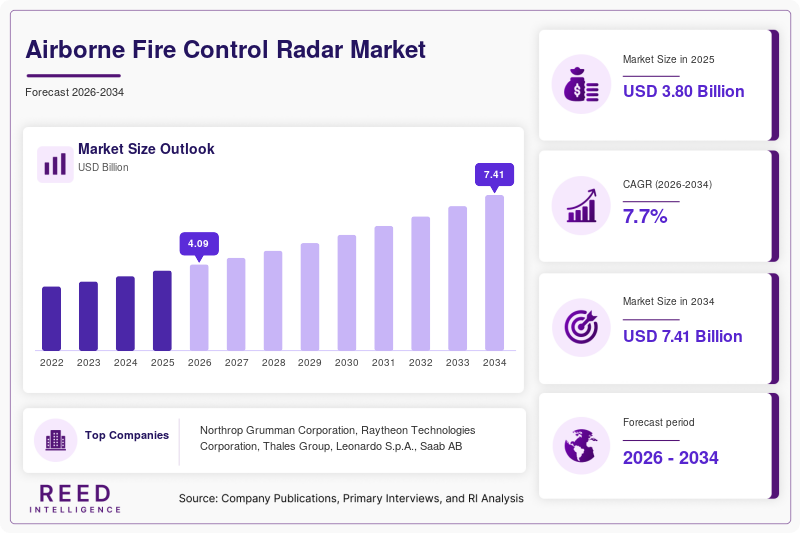
The Airborne Fire Control Radar Market size was valued at USD 3.8 billion in 2026 and is projected to reach USD 6.9 billion by 2034, expanding at a CAGR of 7.7% during 2026–2034. The market growth is being supported by the rising modernization of military aircraft fleets worldwide, driven by increasing geopolitical tensions and the need for advanced targeting and surveillance systems.
A key global factor contributing to the growth of the Airborne Fire Control Radar Markett is the increasing defense budgets across major economies, enabling procurement of next-generation avionics and radar systems. Governments are investing in advanced fighter aircraft equipped with multi-mode radar capabilities that enhance precision targeting, situational awareness, and mission effectiveness.
Key Highlights
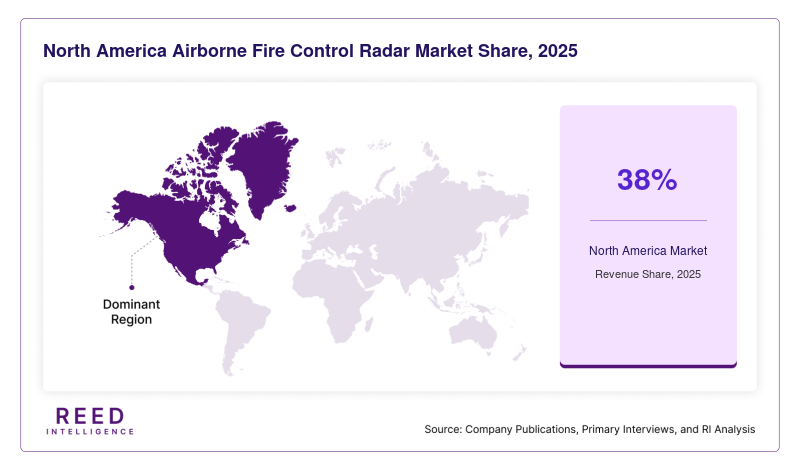
- North America dominated the market with a 38% share in 2025, while Asia Pacific is projected to grow at the fastest CAGR of 8.9% during 2026–2034.
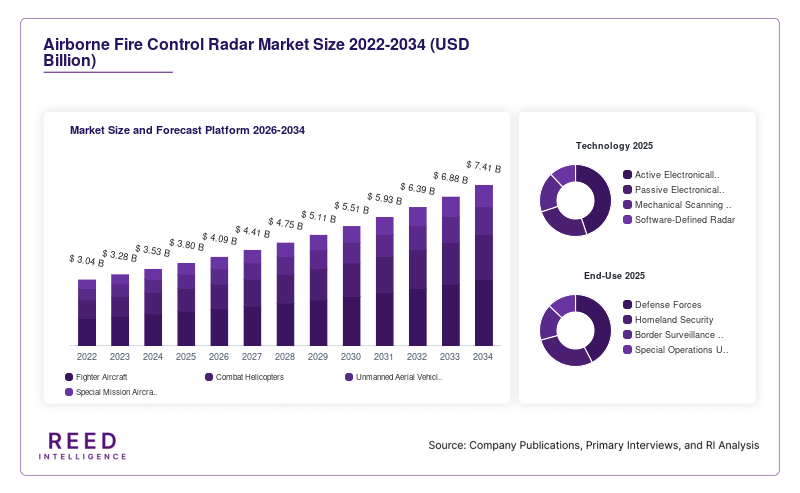
- By platform, fighter aircraft was the leading subsegment with a 52% share in 2025, while unmanned aerial vehicles (UAVs) are expected to grow at the fastest CAGR of 9.4%.
- By technology, Active Electronically Scanned Array (AESA) held the dominant share of 61% in 2025, while software-defined radar systems are projected to grow at a CAGR of 10.2%.
- The United States remained the dominant country, with market values of USD 1.2 billion in 2024 and USD 1.3 billion in 2025, supported by continuous investments in advanced defense systems.
Market Trends
Integration of Multi-Mode Radar Capabilities
The Airborne Fire Control Radar Markett is witnessing increasing integration of multi-mode functionalities, enabling systems to perform air-to-air, air-to-ground, and maritime operations within a single platform. This trend enhances operational flexibility and reduces the need for multiple radar systems.
Adoption of AI and Signal Processing Advancements
Advancements in artificial intelligence and digital signal processing are enabling radar systems to deliver enhanced detection accuracy and target discrimination. These technologies improve real-time decision-making capabilities, which is essential for modern combat environments.
Market Drivers
Rising Defense Modernization Programs
Governments across the globe are upgrading their air defense capabilities by procuring advanced fighter jets and retrofitting legacy aircraft with modern radar systems. This ongoing modernization is a primary driver for the Airborne Fire Control Radar Markett.
Increasing Demand for Precision Targeting Systems
Modern warfare requires high-precision targeting to minimize collateral damage and improve mission success rates. Airborne fire control radar systems provide accurate targeting data, supporting their increasing adoption across defense forces.
Market Restraint
High Development and Integration Costs
The development and integration of advanced radar systems involve significant costs related to research, testing, and certification. These high costs can limit adoption, especially among developing nations with constrained defense budgets.
Market Opportunities
Expansion of UAV-Based Radar Systems
The increasing deployment of unmanned aerial vehicles for surveillance and combat operations is creating opportunities for compact and lightweight radar systems. This trend is expected to drive innovation and market expansion.
Growth in Export-Oriented Defense Manufacturing
Emerging economies are focusing on defense exports, creating opportunities for radar manufacturers to collaborate with international partners and expand their global footprint.
Segmental Analysis
By Platform
The fighter aircraft segment dominated the Airborne Fire Control Radar Markett with a 52% share in 2025, as these platforms require advanced radar systems for combat missions.
The UAV segment is projected to grow at the fastest CAGR of 9.4%, driven by increasing deployment in surveillance and tactical operations.
By Technology
The AESA radar segment held the largest share of 61% in 2025, owing to its superior performance, reliability, and electronic scanning capabilities.
The software-defined radar segment is expected to grow at a CAGR of 10.2%, supported by its adaptability and cost efficiency in upgrading existing systems.
By Frequency Band
The X-band segment dominated with a 46% share in 2025, due to its widespread use in targeting and tracking applications.
The Ku/Ka-band segment is expected to grow at a CAGR of 8.8%, driven by advancements in high-frequency radar technologies.
By End-Use
The defense segment accounted for 88% share in 2025, as airborne fire control radar systems are primarily used in military applications.
The homeland security segment is projected to grow at a CAGR of 7.6%, supported by increasing focus on border surveillance and threat detection.
Regional Analysis
North America
North America accounted for 38% of the market share in 2025 and is expected to grow at a CAGR of 7.1% during the forecast period. The United States dominated the region due to sustained investments in next-generation fighter programs and advanced radar technologies.
Europe
Europe held a 24% share in 2025 and will grow at a CAGR of 6.9%. France emerged as the dominant country, supported by strong domestic aerospace manufacturing capabilities and ongoing defense collaborations within the region.
Asia Pacific
Asia Pacific captured 22% of the market share in 2025 and is projected to expand at a CAGR of 8.9%. China led the regional market, driven by rapid military modernization and increased procurement of advanced aircraft systems.
Middle East & Africa
The Middle East & Africa region accounted for 9% share in 2025 and will grow at a CAGR of 7.5%. Saudi Arabia dominated due to its focus on enhancing air defense systems and strategic defense partnerships.
Latin America
Latin America held a 7% share in 2025 and is anticipated to grow at a CAGR of 6.4%. Brazil led the region, supported by investments in indigenous aerospace programs and defense system upgrades.
Competitive Landscape
The Airborne Fire Control Radar Markett is characterized by the presence of established defense technology providers focusing on innovation and strategic partnerships. Key players include Northrop Grumman Corporation, Raytheon Technologies Corporation, Thales Group, Leonardo S.p.A., and Saab AB. Among these, Northrop Grumman Corporation is recognized as a market leader due to its extensive portfolio of advanced radar systems and continuous investment in research and development.
Companies are focusing on enhancing radar capabilities through integration of AI-driven signal processing and multi-mode functionalities. Strategic collaborations with defense agencies and aircraft manufacturers are also shaping the competitive landscape. For instance, recent developments include the introduction of next-generation AESA radar systems designed for improved detection range and operational efficiency. These advancements are enabling companies to strengthen their market position and address evolving defense requirements.
Key Players List
- Northrop Grumman Corporation
- Raytheon Technologies Corporation
- Thales Group
- Leonardo S.p.A.
- Saab AB
- BAE Systems plc
- Lockheed Martin Corporation
- Elbit Systems Ltd.
- Israel Aerospace Industries Ltd.
- L3Harris Technologies, Inc.
- Honeywell International Inc.
- ASELSAN A.S.
- Bharat Electronics Limited
- Mitsubishi Electric Corporation
- Hensoldt AG
Recent Developments
- In 2025, a leading defense manufacturer introduced a new AESA radar system designed for enhanced multi-target tracking capabilities.
- In 2024, collaborations between radar manufacturers and aircraft OEMs increased to integrate next-generation fire control systems into new fighter programs.
- In 2025, advancements in software-defined radar technology enabled easier upgrades and improved operational flexibility.
- In 2024, several countries initiated procurement programs for UAV-based radar systems to enhance surveillance capabilities.
- In 2025, investments in AI-enabled radar processing improved detection accuracy and reduced response times.
Airborne Fire Control Radar Market Segments
Platform
- Fighter Aircraft
- Combat Helicopters
- Unmanned Aerial Vehicles (UAVs)
- Special Mission Aircraft
Technology
- Active Electronically Scanned Array (AESA)
- Passive Electronically Scanned Array (PESA)
- Mechanical Scanning Radar
- Software-Defined Radar
End-Use
- Defense Forces
- Homeland Security
- Border Surveillance Agencies
- Special Operations Units
By Region
- North America
- Europe
- APAC
- Middle East and Africa
- LATAM