Airborne Pod Market Size, Share & Demand Report By Pod Type (Targeting Pods, Surveillance Pods, Electronic Warfare Pods), By Platform (Combat Aircraft, Unmanned Aerial Vehicles (UAVs), Special Mission Aircraft), By Application (Surveillance & Reconnaissance, Targeting, Electronic Warfare), By Region & Segment Forecasts, 2026–2034
USD 3950
Market Overview
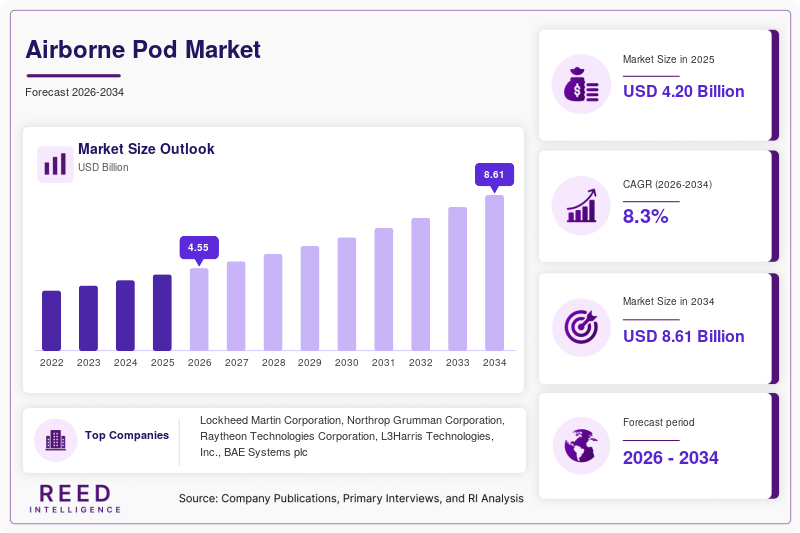
The Airborne Pod Market was valued at approximately USD 4.2 billion in 2026 and is projected to reach USD 7.9 billion by 2034, expanding at a compound annual growth rate (CAGR) of 8.3% during 2026–2034. The market growth is primarily driven by increasing investments in advanced airborne surveillance, intelligence, and reconnaissance systems across defense and homeland security sectors. Airborne pods, which include electro-optical/infrared (EO/IR), targeting, and electronic warfare systems, are widely deployed on fighter jets, UAVs, and special mission aircraft.
A key global factor supporting market growth is the rising geopolitical tensions and modernization of defense fleets. Governments worldwide are focusing on upgrading their airborne capabilities to ensure enhanced situational awareness, border surveillance, and precision targeting. This has significantly increased demand for modular and mission-specific airborne pod systems that can be integrated across multiple aircraft platforms.
Key Highlights
- North America dominated the market with a 36.8% share in 2025.
- while Asia Pacific is expected to grow at the fastest CAGR of 9.6% during 2026–2034.
- By pod type, targeting pods accounted for the largest share of 40.2%.
- while electronic warfare pods are projected to grow at a CAGR of 9.9%.
- By platform, combat aircraft led with a 52.6% share, whereas UAV platforms are expected to expand at a CAGR of 10.4%.
- The United States remained the dominant country, with market values of USD 1.02 billion in 2024 and USD 1.12 billion in 2025.
Market Trends
Increasing Integration of AI and Sensor Fusion Technologies
The Airborne Pod Market is experiencing a shift toward intelligent systems enabled by artificial intelligence and advanced sensor fusion. Modern airborne pods are no longer limited to passive imaging or targeting; instead, they are evolving into intelligent mission systems capable of real-time analytics and autonomous decision-making. Sensor fusion allows multiple inputs—such as infrared, radar, and optical imaging—to be combined into a single, actionable data stream. This reduces pilot workload and enhances operational accuracy during complex missions. AI algorithms further improve target recognition, threat assessment, and tracking capabilities, especially in low-visibility conditions. These advancements are particularly relevant in modern warfare scenarios where speed, precision, and adaptability are critical. As defense agencies prioritize data-driven operations, manufacturers are increasingly investing in AI-powered airborne pod solutions, thereby shaping the future trajectory of the market.
Growing Adoption of Modular and Multi-Mission Pods
Another prominent trend is the growing demand for modular airborne pods that support multiple mission profiles. Military forces are seeking flexible solutions that can be quickly reconfigured based on operational requirements, such as surveillance, targeting, or electronic warfare. Modular pods allow easy integration and interchangeability across different aircraft types, reducing costs associated with platform-specific systems. This trend is especially beneficial for countries with limited defense budgets, as it maximizes operational efficiency without requiring large-scale fleet expansion. Additionally, multi-mission pods enhance interoperability among allied forces, which is increasingly important in joint operations. The ability to upgrade individual modules rather than replacing entire systems also supports long-term cost savings and technological adaptability, making modular airborne pods a key focus area for manufacturers and defense planners.
Market Drivers
Rising Defense Expenditure and Military Modernization Programs
A major driver for the Airborne Pod Market is the consistent increase in global defense budgets, particularly in emerging economies. Governments are investing heavily in military modernization programs to enhance combat capabilities and maintain strategic superiority. Airborne pods play a critical role in these upgrades by enabling advanced targeting, surveillance, and electronic warfare functionalities without requiring entirely new aircraft platforms. For example, upgrading legacy fighter jets with modern targeting pods can significantly enhance precision strike capabilities. Additionally, NATO and allied nations are emphasizing interoperability and joint mission readiness, further boosting demand for standardized airborne pod systems. These investments are expected to sustain long-term market growth, especially as geopolitical uncertainties continue to influence defense strategies worldwide.
Increased Demand for ISR (Intelligence, Surveillance, Reconnaissance) Capabilities
The growing need for real-time intelligence and surveillance is another key factor driving the Airborne Pod Market. Modern military operations rely heavily on ISR capabilities to monitor threats, secure borders, and conduct counter-terrorism missions. Airborne pods equipped with high-resolution sensors and advanced imaging systems provide critical situational awareness, enabling faster and more informed decision-making. The rise of asymmetric warfare and unmanned operations has further increased the importance of ISR systems. UAVs equipped with airborne pods are increasingly used for persistent surveillance missions, particularly in remote or hostile environments. This demand is also extending to homeland security and disaster management applications, where airborne pods assist in search and rescue operations, environmental monitoring, and infrastructure assessment.
Market Restraint
High Development and Integration Costs
One of the primary restraints affecting the Airborne Pod Market is the high cost associated with the development, procurement, and integration of advanced pod systems. Airborne pods incorporate sophisticated technologies such as high-resolution sensors, AI-based analytics, and secure communication systems, all of which require substantial investment in research and development. Additionally, integrating these pods with existing aircraft platforms can be technically complex and costly, especially when dealing with legacy systems. Compatibility issues, certification requirements, and system testing further add to the overall expenditure.
For smaller defense budgets or developing nations, these costs can limit adoption and delay procurement decisions. For example, upgrading an aging fleet with advanced targeting or electronic warfare pods may require significant modifications to avionics and power systems, increasing the total cost of ownership. Moreover, maintenance and lifecycle costs, including software updates and component replacements, add to the financial burden. As a result, cost constraints can hinder market penetration, particularly in regions where defense spending is limited or subject to economic fluctuations.
Market Opportunities
Expansion of UAV-Based Airborne Pod Applications
The rapid growth of unmanned aerial vehicles presents a significant opportunity for the Airborne Pod Market. UAVs are increasingly being deployed for surveillance, reconnaissance, and combat missions, and airborne pods enhance their operational capabilities. Lightweight and compact pod designs are being developed specifically for UAV platforms, enabling advanced functionalities such as real-time imaging, electronic warfare, and communication relay. This trend is particularly relevant for border security, maritime surveillance, and disaster response operations. As UAV adoption continues to rise across military and civilian sectors, the demand for compatible airborne pod systems is expected to grow significantly, creating new revenue streams for manufacturers.
Increasing Demand in Emerging Markets
Emerging economies in Asia Pacific, the Middle East, and Latin America are investing in defense infrastructure and technology upgrades, creating substantial growth opportunities for the Airborne Pod Market. These regions are focusing on enhancing their surveillance and combat capabilities to address regional security challenges. Additionally, many countries are seeking cost-effective solutions that offer high performance and flexibility, making airborne pods an attractive option. Partnerships between local governments and global defense manufacturers are also facilitating technology transfer and domestic production, further supporting market expansion. As these regions continue to modernize their defense systems, they are expected to play a crucial role in shaping the future growth of the airborne pod industry.
Segmental Analysis
By Pod Type
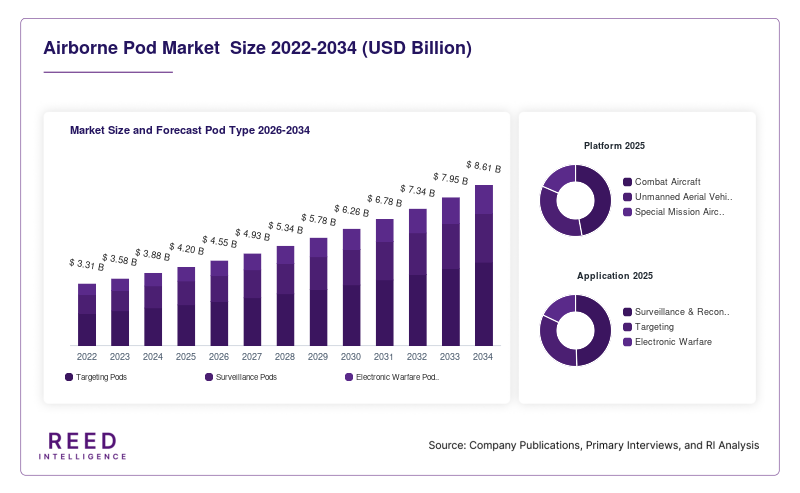
Targeting pods dominated the Airborne Pod Market, accounting for 40.2% of the market share in 2024. These pods are widely used in combat aircraft for precision targeting and strike missions. They provide high-resolution imaging, laser designation, and tracking capabilities, enabling accurate engagement of ground targets. The increasing demand for precision-guided munitions and advanced targeting systems is driving the adoption of targeting pods. Additionally, their compatibility with various aircraft platforms makes them a preferred choice for defense forces worldwide. Continuous advancements in sensor technology and data processing are further enhancing the performance of targeting pods.
Electronic warfare pods are expected to be the fastest-growing subsegment, with a CAGR of 9.9% during the forecast period. These pods are designed to detect, jam, and neutralize enemy radar and communication systems, making them critical in modern warfare. The growing emphasis on electronic warfare capabilities and cyber defense is driving demand for these systems. Additionally, the increasing complexity of battlefield environments requires advanced electronic countermeasures, further supporting the growth of this subsegment.
By Platform
Combat aircraft dominated the platform segment, holding a 52.6% share in 2024. These aircraft are the primary carriers of airborne pods, particularly for targeting and surveillance missions. The widespread use of fighter jets in military operations and ongoing modernization programs are driving demand for advanced pod systems. Additionally, the integration of airborne pods with combat aircraft enhances mission flexibility and operational efficiency.
UAV platforms are projected to be the fastest-growing subsegment, with a CAGR of 10.4% during 2026–2034. The increasing adoption of UAVs for surveillance, reconnaissance, and combat missions is driving demand for lightweight and compact airborne pods. These systems enable UAVs to perform complex tasks, such as real-time monitoring and threat detection. The growing use of UAVs in both military and civilian applications is expected to significantly boost this segment.
By Application
Surveillance and reconnaissance applications dominated the market, accounting for 45.8% of the share in 2024. Airborne pods play a critical role in ISR missions, providing real-time data and high-resolution imagery. The increasing need for situational awareness and border security is driving demand for these systems. Additionally, advancements in imaging and sensor technologies are enhancing the effectiveness of surveillance operations.
Electronic warfare applications are expected to grow at the fastest CAGR of 9.2% during the forecast period. The rising importance of electronic warfare in modern conflicts is driving demand for advanced airborne pods. These systems enable detection and neutralization of enemy threats, improving mission success rates. The increasing focus on cyber and electronic defense is further supporting the growth of this segment.
Regional Analysis
North America
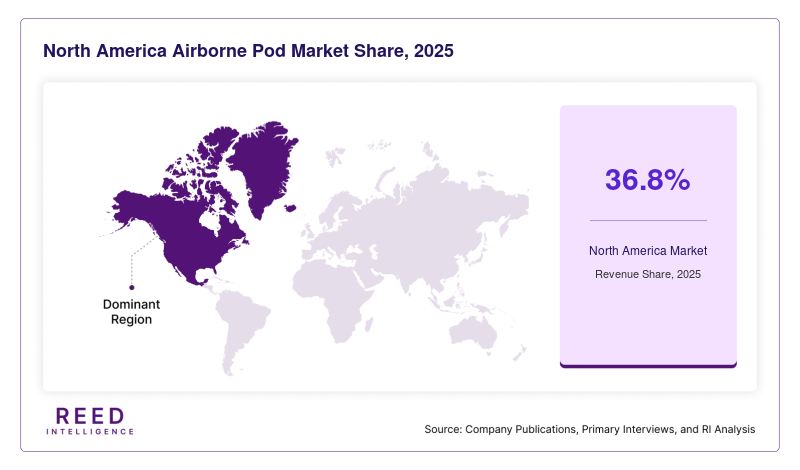
North America accounted for a 36.8% market share in 2025 and is projected to grow at a CAGR of 7.8% during 2026–2034. The region’s dominance is attributed to high defense spending, advanced technological capabilities, and strong presence of leading aerospace and defense companies. The United States, in particular, continues to invest in next-generation airborne systems, including advanced targeting and electronic warfare pods. Additionally, ongoing modernization programs for fighter jets and UAVs are supporting steady market growth.
The United States remains the dominant country in this region, driven by its focus on maintaining global military superiority. A unique growth factor is the country’s emphasis on network-centric warfare, which requires seamless integration of airborne pods with communication and command systems. This approach enhances real-time data sharing and mission coordination, thereby increasing the demand for advanced pod technologies.
Europe
Europe held a 24.5% market share in 2025 and is expected to grow at a CAGR of 7.5% during the forecast period. The region’s growth is supported by collaborative defense initiatives among European Union member states and increasing investments in joint military programs. Countries such as France, Germany, and the United Kingdom are actively upgrading their air fleets with advanced airborne pod systems to improve operational capabilities.
The United Kingdom stands out as a key contributor, supported by its ongoing defense modernization efforts. A unique growth factor in Europe is the emphasis on cross-border defense collaboration, which encourages the development of interoperable airborne pod systems. This trend is driving innovation and increasing demand for standardized solutions that can be deployed across multiple allied forces.
Asia Pacific
Asia Pacific is expected to be the fastest-growing region, with a CAGR of 9.6% from 2026 to 2034, and held a 21.3% market share in 2025. Rapid economic growth, increasing defense budgets, and rising geopolitical tensions are key factors driving market expansion. Countries such as China, India, and Japan are investing heavily in advanced airborne technologies to strengthen their defense capabilities.
China is the dominant country in this region, supported by its large-scale military modernization programs. A unique growth factor is the country’s focus on indigenous development of defense technologies, including airborne pods. This approach reduces reliance on imports and supports domestic innovation, contributing to sustained market growth.
Middle East & Africa
The Middle East & Africa region accounted for 10.2% of the market share in 2025 and is projected to grow at a CAGR of 8.4% during the forecast period. The region’s growth is driven by ongoing security challenges and the need for advanced surveillance and defense systems. Countries such as Saudi Arabia and the United Arab Emirates are investing in modern airborne capabilities to enhance their military operations.
Saudi Arabia is a key market in this region, driven by its defense spending and modernization initiatives. A unique growth factor is the country’s focus on strengthening border security and counter-terrorism capabilities. This has led to increased demand for airborne pods equipped with advanced imaging and surveillance technologies.
Latin America
Latin America held a 7.2% market share in 2025 and is expected to grow at a CAGR of 7.1% during 2026–2034. The region’s growth is supported by efforts to improve national security and combat organized crime. Countries such as Brazil and Mexico are investing in airborne surveillance systems to enhance border control and law enforcement operations.
Brazil is the dominant country in this region, supported by its defense modernization programs. A unique growth factor is the increasing use of airborne pods in civil applications, such as environmental monitoring and disaster management. This diversification of use cases is contributing to steady market growth.
Competitive Landscape
The Airborne Pod Market is characterized by the presence of established aerospace and defense companies focusing on innovation and strategic partnerships. Key players are investing in research and development to enhance product capabilities and maintain competitive advantage. The market is moderately consolidated, with a few major companies dominating global sales.
One leading player is Lockheed Martin Corporation, which has a strong portfolio of advanced targeting and surveillance pods. The company continues to invest in next-generation technologies, including AI-enabled systems and sensor fusion capabilities. A recent development includes the introduction of upgraded targeting pods with enhanced imaging and data processing features, aimed at improving mission effectiveness.
Other major players are focusing on expanding their global footprint through collaborations and contracts with defense agencies. These strategies are helping companies strengthen their market position and address evolving customer requirements.
Key Players List
- Lockheed Martin Corporation
- Northrop Grumman Corporation
- Raytheon Technologies Corporation
- L3Harris Technologies, Inc.
- BAE Systems plc
- Thales Group
- Elbit Systems Ltd.
- Saab AB
- Leonardo S.p.A.
- Israel Aerospace Industries Ltd.
- General Dynamics Corporation
- Boeing Defense, Space & Security
- Rheinmetall AG
- ASELSAN A.S.
- FLIR Systems, Inc.
Recent Developments
- Lockheed Martin introduced an upgraded targeting pod with enhanced AI-based tracking capabilities in 2025.
- Thales Group secured a contract to supply advanced surveillance pods for European defense programs in 2024.
- Elbit Systems launched a lightweight airborne pod designed specifically for UAV platforms in 2025.
Airborne Pod Market Segments
Pod Type
- Targeting Pods
- Surveillance Pods
- Electronic Warfare Pods
Platform
- Combat Aircraft
- Unmanned Aerial Vehicles (UAVs)
- Special Mission Aircraft
Application
- Surveillance & Reconnaissance
- Targeting
- Electronic Warfare
By Region
- North America
- Europe
- APAC
- Middle East and Africa
- LATAM