Airborne UHF Band Satcom Market Size, Share Demand Report By Component (Terminals, Transceivers, Antennas, Modems), By Platform (Fixed-Wing Aircraft, Rotary-Wing Aircraft, Unmanned Aerial Vehicles), By Application (Military Communication, ISR, Search and Rescue, Navigation) By Region & Segment Forecasts, 2026–2034
USD 3950
Market Overview
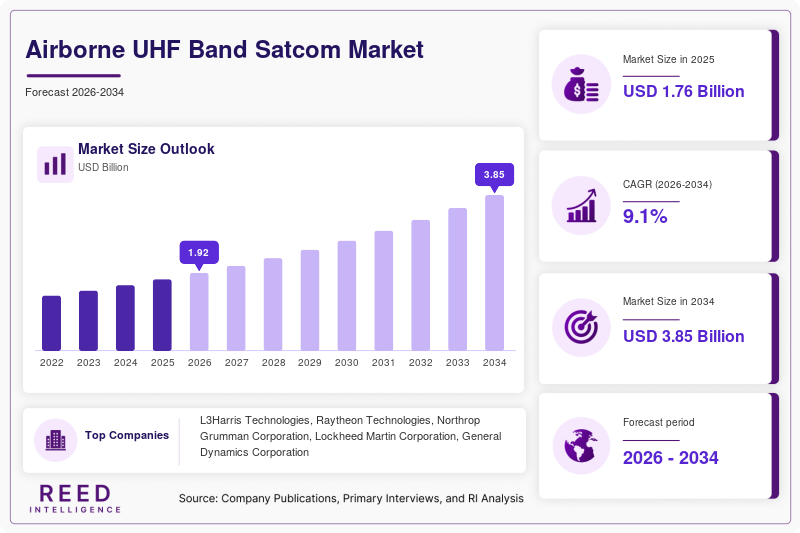
The Airborne UHF Band Satcom Market size is projected to reach a valuation of approximately USD 1.92 billion in 2026 and is expected to expand to around USD 3.86 billion by 2034, registering a compound annual growth rate (CAGR) of 9.1% during the forecast period. The market continues to evolve due to increasing reliance on secure and beyond-line-of-sight (BLOS) communication systems in military aviation. UHF band satellite communication plays a critical role in ensuring reliable connectivity in complex environments where higher-frequency bands face limitations due to weather or terrain interference.
A key global factor supporting market growth is the rising defense expenditure across major economies, particularly aimed at modernizing airborne communication infrastructure. Governments are prioritizing resilient communication frameworks for intelligence, surveillance, reconnaissance (ISR), and tactical operations. This has accelerated investments in advanced UHF SATCOM payloads, terminals, and network systems. Additionally, the integration of interoperable communication platforms across allied forces is further strengthening demand for standardized UHF solutions.
Key Highlights
- North America dominated the market with a 36.4% share in 2025.
- Asia Pacific is expected to grow at the fastest CAGR of 10.7% during 2026–2034.
- By component, terminals accounted for the largest share of 42.1%, while airborne transceivers are projected to grow at a CAGR of 10.9%.
- By platform, fixed-wing aircraft led with a 48.3% share, whereas unmanned aerial vehicles are expected to expand at a CAGR of 11.6%.
- The United States remained the dominant country, with market values of USD 620 million in 2024 and USD 675 million in 2025.
Market Trends
Increasing integration of UHF SATCOM in unmanned aerial systems
The growing deployment of unmanned aerial systems (UAS) across defense and surveillance missions is shaping the demand trajectory of airborne UHF band SATCOM solutions. These systems require reliable communication links for command and control, especially in contested or remote environments. UHF frequencies offer stable communication with lower susceptibility to signal disruption, making them suitable for long-range drone operations. Defense agencies are increasingly equipping UAV fleets with compact and lightweight UHF SATCOM terminals to ensure uninterrupted connectivity during intelligence missions.
In addition, advancements in miniaturization technologies have enabled integration of UHF systems into smaller UAV platforms without compromising performance. This trend is also supported by rising cross-border security concerns and the need for persistent surveillance capabilities. As countries expand their drone fleets, the demand for interoperable communication systems that function seamlessly across platforms is expected to increase, reinforcing the importance of UHF SATCOM in future airborne communication architectures.
Transition toward software-defined communication systems
A notable shift in the market is the transition from hardware-centric systems to software-defined communication solutions. Software-defined radios (SDRs) are becoming a preferred choice for airborne UHF SATCOM due to their flexibility, scalability, and ability to adapt to evolving communication protocols. These systems allow real-time reconfiguration, enabling aircraft to operate across multiple frequency bands and communication standards without requiring hardware modifications.
This trend is particularly relevant in multi-domain operations where interoperability between allied forces is essential. SDR-based UHF SATCOM systems facilitate seamless communication across different platforms and missions. Furthermore, ongoing advancements in cybersecurity are being integrated into these systems to protect sensitive data transmissions. As defense organizations focus on future-proof communication technologies, the adoption of software-defined UHF SATCOM solutions is expected to accelerate significantly over the forecast period.
Market Drivers
Rising defense modernization programs
The expansion of global defense modernization programs is a major driver of the Airborne UHF Band Satcom Market. Governments across developed and emerging economies are upgrading their military communication systems to enhance operational efficiency and ensure secure communication in complex environments. UHF SATCOM systems are widely adopted due to their ability to provide reliable communication in adverse conditions, including dense foliage, urban settings, and maritime environments.
These modernization initiatives include upgrading legacy aircraft communication systems, integrating advanced SATCOM terminals, and enhancing network resilience. Additionally, increasing geopolitical tensions and the need for real-time situational awareness are pushing defense agencies to invest in robust airborne communication systems. As military operations become more data-driven, the importance of uninterrupted communication continues to grow, further supporting the adoption of UHF SATCOM technologies.
Growing need for secure and jam-resistant communication
The demand for secure and jam-resistant communication systems is another significant driver of market growth. In modern warfare scenarios, communication networks are often targeted by electronic warfare tactics, including jamming and interception. UHF band SATCOM systems offer enhanced resistance to such threats due to their lower frequency range and ability to penetrate obstacles effectively.
This capability is particularly critical for mission-critical operations such as tactical coordination, emergency response, and intelligence gathering. Defense organizations are increasingly prioritizing communication systems that ensure data integrity and confidentiality. As a result, investments in encryption technologies, anti-jamming features, and secure communication protocols are increasing. These advancements are strengthening the role of UHF SATCOM in defense communication infrastructure and driving sustained market growth.
Market Restraint
High deployment and maintenance costs
The high cost associated with the deployment and maintenance of airborne UHF SATCOM systems acts as a key restraint for market growth. These systems require specialized components, including advanced antennas, transceivers, and secure network infrastructure, which significantly increase overall costs. Additionally, integration of UHF SATCOM into existing aircraft platforms often involves complex engineering processes and regulatory compliance, further adding to expenses.
Maintenance and operational costs also remain high due to the need for continuous monitoring, upgrades, and cybersecurity enhancements. Smaller defense budgets, particularly in developing regions, may limit the adoption of such advanced communication systems. For example, countries with constrained financial resources may prioritize basic communication infrastructure over advanced SATCOM capabilities. This cost barrier can slow down market penetration, especially in regions where defense spending is relatively lower.
Market Opportunities
Expansion of multi-domain operations
The increasing adoption of multi-domain operations presents a significant opportunity for the Airborne UHF Band Satcom Market. Modern military strategies emphasize coordinated operations across land, air, sea, space, and cyber domains. This requires seamless communication between various platforms and units, which can be effectively supported by UHF SATCOM systems.
These systems enable reliable communication in environments where traditional communication networks may fail. As defense organizations continue to invest in integrated operational frameworks, the demand for interoperable communication systems is expected to rise. UHF SATCOM plays a crucial role in ensuring connectivity across different domains, making it an essential component of next-generation military operations.
Technological advancements in satellite constellations
Advancements in satellite technology and the deployment of new satellite constellations are creating growth opportunities for the market. The development of more efficient and high-capacity satellites is enhancing the performance of UHF communication systems. These advancements are enabling improved signal quality, wider coverage, and increased data transmission capabilities.
Additionally, the integration of hybrid communication systems that combine UHF with other frequency bands is gaining traction. This approach enhances overall communication reliability and flexibility. As satellite technology continues to evolve, the capabilities of airborne UHF SATCOM systems are expected to improve, opening new avenues for market expansion.
Segmental Analysis
By Component
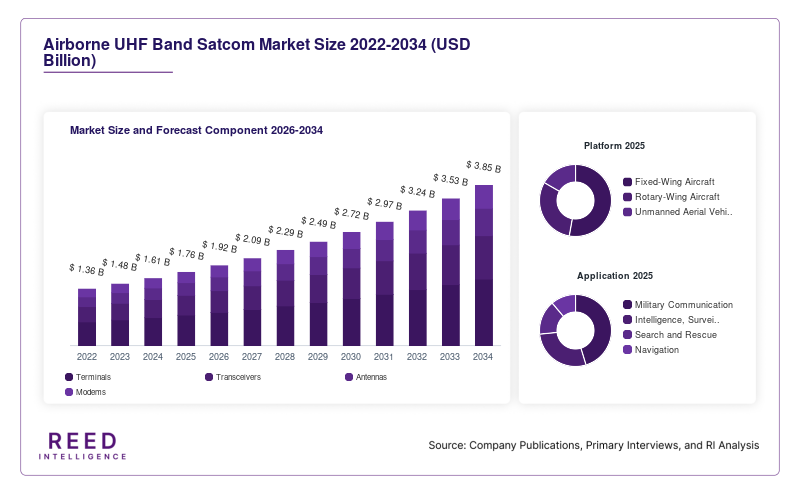
The terminals segment accounted for the largest share of approximately 42.1% in 2024, driven by their critical role in establishing communication links between aircraft and satellite networks. These terminals are widely used across various airborne platforms due to their reliability and compatibility with existing communication systems. The increasing deployment of advanced terminals with enhanced data transmission capabilities is further supporting segment growth.
Airborne transceivers are expected to be the fastest-growing subsegment, registering a CAGR of 10.9% during the forecast period. The growth is attributed to advancements in communication technology and the need for efficient signal processing systems. These components enable seamless communication across multiple platforms, making them essential for modern military operations.
By Platform
Fixed-wing aircraft dominated the market in 2024, accounting for a share of 48.3%. These aircraft are extensively used in defense operations and require robust communication systems for long-range missions. The integration of UHF SATCOM systems into fixed-wing platforms ensures reliable communication in challenging environments.
Unmanned aerial vehicles are projected to grow at the fastest CAGR of 11.6%. The increasing adoption of UAVs for surveillance and reconnaissance missions is driving demand for advanced communication systems. UHF SATCOM provides reliable connectivity, making it a preferred choice for UAV applications.
By Application
Military communication applications held the largest share in 2024, driven by the increasing need for secure and reliable communication systems in defense operations. UHF SATCOM systems are widely used for command and control, intelligence gathering, and tactical coordination.
ISR applications are expected to grow at the fastest CAGR of 10.8%. The rising demand for real-time data and situational awareness is driving the adoption of advanced communication systems. UHF SATCOM enables seamless data transmission, supporting the growth of ISR applications.
Regional Analysis
North America
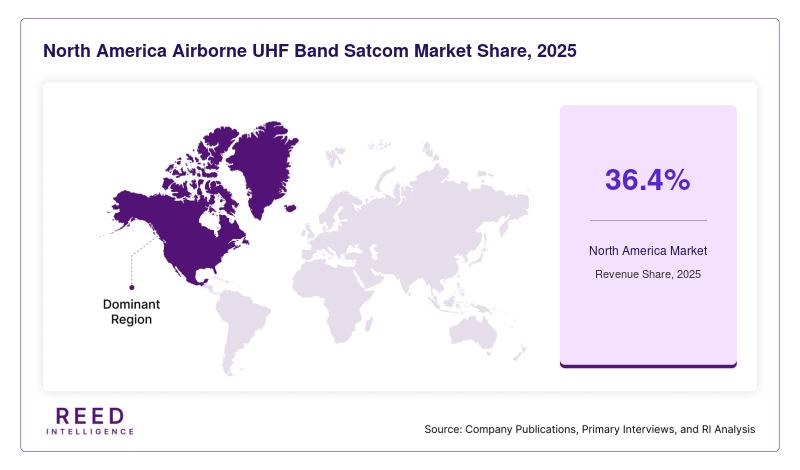
North America held a significant share of the Airborne UHF Band Satcom Market in 2025, accounting for approximately 36.4% of the global market. The region is expected to maintain steady growth with a projected CAGR of 8.7% during the forecast period. This growth is supported by substantial defense budgets and ongoing investments in advanced communication technologies.
The United States dominates the regional market due to its extensive military infrastructure and focus on technological innovation. A key growth factor is the continuous modernization of airborne communication systems within defense programs. The integration of advanced SATCOM technologies into both manned and unmanned platforms is further driving market expansion.
Europe
Europe accounted for a notable share of the market in 2025 and is projected to grow at a CAGR of 8.4% over the forecast period. The region benefits from increasing collaboration among defense organizations and joint military initiatives aimed at enhancing communication capabilities.
The United Kingdom is a leading contributor to the European market. A unique growth factor is the emphasis on interoperability among NATO forces, which requires standardized communication systems. This has led to increased adoption of UHF SATCOM solutions across various airborne platforms.
Asia Pacific
Asia Pacific is expected to witness the fastest growth, with a projected CAGR of 10.7% from 2026 to 2034. The region’s market expansion is driven by rising defense expenditure and increasing focus on strengthening military communication infrastructure.
China dominates the regional market, supported by its growing investments in satellite technology and defense modernization. A key growth factor is the rapid expansion of UAV fleets, which require reliable communication systems for surveillance and reconnaissance missions.
Middle East & Africa
The Middle East & Africa region is experiencing steady growth, with a CAGR of 8.9% during the forecast period. The market is driven by increasing security concerns and the need for advanced communication systems in defense operations.
Saudi Arabia is a major contributor to the regional market. A unique growth factor is the focus on enhancing defense capabilities through strategic partnerships and procurement of advanced communication technologies, including UHF SATCOM systems.
Latin America
Latin America holds a moderate share of the global market and is expected to grow at a CAGR of 7.8% during the forecast period. The region’s growth is supported by gradual improvements in defense infrastructure and increasing investments in communication technologies.
Brazil leads the regional market, driven by its efforts to modernize military communication systems. A key growth factor is the adoption of advanced SATCOM solutions to support border security and surveillance operations.
Competitive Landscape
The Airborne UHF Band Satcom Market is characterized by the presence of several established players focusing on technological innovation and strategic partnerships. Companies are investing in research and development to enhance the performance and reliability of their communication systems.
A leading player in the market is L3Harris Technologies, known for its advanced SATCOM solutions and strong presence in defense communication systems. The company has recently introduced upgraded UHF SATCOM terminals designed to improve communication efficiency and security.
Other key players are also focusing on expanding their product portfolios and strengthening their market presence through collaborations and acquisitions. The competitive landscape remains dynamic, with companies continuously striving to gain a competitive edge.
Key Players
- L3Harris Technologies
- Raytheon Technologies
- Northrop Grumman Corporation
- Lockheed Martin Corporation
- General Dynamics Corporation
- BAE Systems
- Thales Group
- Airbus Defence and Space
- Cobham Limited
- Viasat Inc.
- Iridium Communications
- Hughes Network Systems
- Leonardo S.p.A.
- Rohde & Schwarz
- Elbit Systems
Recent Developments
- L3Harris Technologies introduced a next-generation UHF SATCOM terminal designed for improved interoperability and enhanced security features.
- Northrop Grumman Corporation secured a contract to develop advanced airborne communication systems for defense applications.
- Viasat Inc. announced the expansion of its satellite network to support enhanced UHF communication capabilities for airborne platforms.
Airborne UHF Band Satcom Market Segments
Component
- Terminals
- Transceivers
- Antennas
- Modems
Platform
- Fixed-Wing Aircraft
- Rotary-Wing Aircraft
- Unmanned Aerial Vehicles
Application
- Military Communication
- Intelligence, Surveillance & Reconnaissance (ISR)
- Search and Rescue
- Navigation
By Region
- North America
- Europe
- APAC
- Middle East and Africa
- LATAM