Airborne Wind Energy Market Size, Share, Demand Report By System Type (Rigid-Wing Airborne Systems, Kite-Based Systems, Hybrid Airborne Energy Systems), By Application (Utility-Scale Power Generation, Off-Grid Remote Energy Systems, Offshore Renewable Energy Projects), By End-Use (Utilities, Industrial, Defense & Emergency Services, Commercial Infrastructure) By Region & Segment Forecasts, 2026–2034
USD 3950
Market Overview
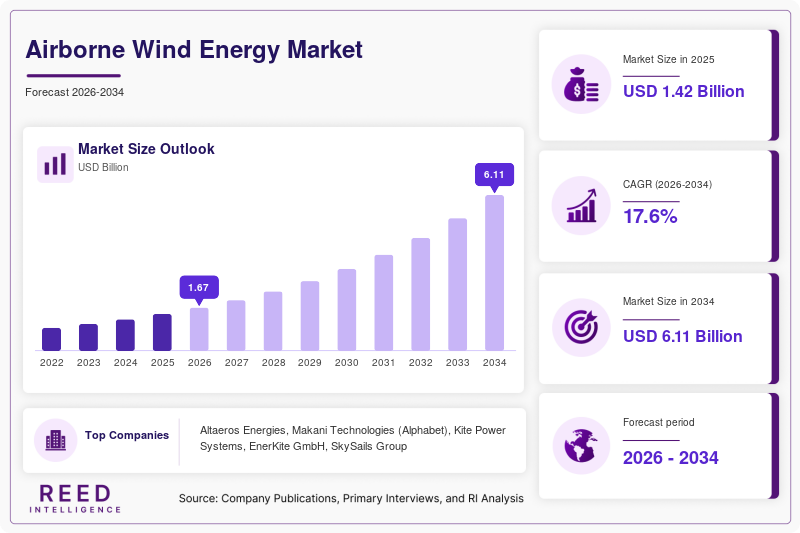
The Airborne Wind Energy Market is projected to be valued at USD 1.42 billion in 2026 and is expected to reach USD 5.18 billion by 2034, registering a compound annual growth rate (CAGR) of 17.6% during the forecast period (2026–2034). Airborne wind energy systems, which utilize tethered flying devices such as kites, drones, and autonomous airfoils to capture high-altitude wind energy, are gaining attention as an alternative to conventional wind turbines. Rising demand for clean energy transition strategies and increasing pressure to reduce carbon emissions across developed and emerging economies are supporting market expansion.
One of the key global factors supporting growth is the rapid advancement in lightweight composite materials and autonomous flight control systems. These innovations have improved the efficiency, stability, and cost-effectiveness of airborne systems, enabling longer flight durations and higher energy yields. Additionally, increasing investments in offshore renewable energy projects and energy access initiatives in remote areas are further accelerating adoption.
Key Highlights
- North America dominated the market with a 34.2% share in 2025.
- Asia Pacific is expected to grow at the fastest CAGR of 11.2% during 2026–2034.
- By system type, rigid-wing airborne systems accounted for the largest share of 38.5%
- while hybrid kite-based systems are projected to grow at a CAGR of 13.1%.
- By application, utility-scale power generation led with a 44.6% share, whereas off-grid remote energy solutions are expected to expand at a CAGR of 12.9%.
- The United States remained the dominant country, with market values of USD 620 million in 2024 and USD 685 million in 2025.
Market Trends
Integration of Autonomous Flight Control Systems
The integration of autonomous navigation and AI-based flight optimization systems is reshaping the Airborne Wind Energy Market. These technologies enable airborne devices to dynamically adjust altitude, angle, and trajectory to capture optimal wind currents. Advanced machine learning algorithms are being deployed to predict wind behavior and improve energy harvesting efficiency. This trend is particularly relevant in offshore and high-altitude applications where manual control is not feasible. Companies are increasingly investing in sensor fusion technologies and real-time data analytics to enhance system reliability and reduce operational risks, thereby improving commercial viability.
Expansion of Hybrid Energy Systems
Another significant trend is the integration of airborne wind energy systems with hybrid renewable energy setups, including solar and battery storage systems. Hybridization helps stabilize intermittent energy output, making airborne wind solutions more suitable for grid integration. This trend is gaining momentum in remote and island regions where energy infrastructure is limited. Energy developers are focusing on modular airborne systems that can be easily deployed alongside other renewables. The trend is also supported by government incentives promoting diversified clean energy portfolios and increasing private-sector participation in distributed energy generation projects.
Market Drivers
Rising Demand for High-Altitude Wind Energy Efficiency
The growing demand for higher energy efficiency is a key driver of the Airborne Wind Energy Market. Traditional wind turbines are limited by tower height and land constraints, whereas airborne systems can access stronger and more consistent winds at higher altitudes. This significantly increases energy yield per unit area. As global electricity demand rises, especially in industrial and urban sectors, airborne wind energy offers a scalable solution. Governments are also promoting research programs to enhance airborne system efficiency, encouraging pilot projects and prototype deployments across coastal and offshore zones.
Increasing Investments in Renewable Energy Innovation
Rising investments in renewable energy innovation and climate-focused funding programs are accelerating market growth. Venture capital firms and energy companies are supporting startups working on tethered energy systems and autonomous airborne platforms. Public-private partnerships are also emerging to test airborne wind technologies in real-world environments. Additionally, global carbon neutrality commitments are pushing utilities to diversify energy portfolios, making airborne wind energy an attractive supplementary source. This financial support is helping reduce technology development risks and speeding up commercialization efforts.
Market Restraint
A key restraint in the Airborne Wind Energy Market is the high technological complexity and regulatory uncertainty associated with airborne systems. These systems operate in shared airspace, requiring compliance with aviation safety regulations, which vary significantly across regions. Certification processes for autonomous flying devices are still evolving, leading to delays in large-scale commercial deployment. Furthermore, the need for continuous tether management and structural durability under varying weather conditions adds to operational challenges.
Another limitation is the relatively high initial development and maintenance cost compared to conventional wind turbines. Although airborne systems reduce material usage, the advanced control systems, lightweight materials, and continuous monitoring infrastructure increase upfront investment. This cost barrier limits adoption among small utilities and developing regions. Additionally, concerns regarding system reliability during extreme weather conditions create hesitation among investors, slowing down full-scale commercialization.
Market Opportunities
Expansion in Remote and Off-Grid Energy Applications
Airborne wind energy systems present significant opportunities in remote and off-grid energy markets. Regions lacking traditional grid infrastructure, such as islands, mountainous areas, and desert regions, can benefit from portable airborne systems that are easy to deploy and relocate. These systems reduce dependence on diesel generators and provide sustainable energy alternatives. Governments and NGOs are increasingly supporting rural electrification programs, which creates a favorable environment for airborne wind energy adoption. The portability and modular design of these systems make them particularly suitable for emergency power supply and disaster recovery operations.
Offshore Renewable Energy Integration
Offshore wind energy integration is another major opportunity area. Airborne systems can be deployed in deep-water locations where traditional turbines are not feasible due to high installation costs. These systems can harness stronger and more consistent wind flows available at higher altitudes above ocean surfaces. Energy companies are exploring hybrid offshore platforms that combine floating turbines with airborne systems to maximize output. This approach reduces infrastructure costs while increasing energy efficiency, making it attractive for large-scale renewable energy projects across Europe, Asia Pacific, and North America.
Segmental Analysis
By System Type
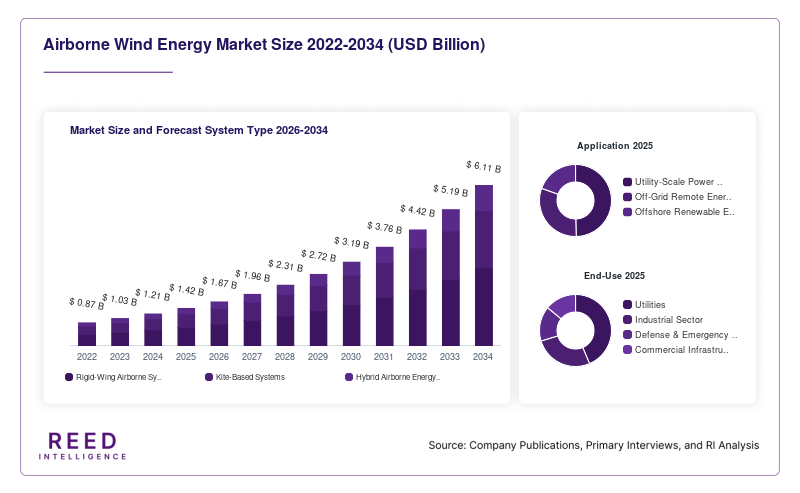
Rigid-wing airborne systems dominated the market with a 2024 share of 38.5%, driven by their higher stability, longer operational duration, and better energy conversion efficiency. These systems are widely used in utility-scale applications where consistent power generation is required. Their aerodynamic design allows for improved lift and reduced drag, making them suitable for offshore environments and high-altitude wind harvesting projects. Increasing deployment in pilot projects across Europe and North America further supports segment dominance.
Hybrid kite-based systems are expected to grow at a CAGR of 13.1%, driven by their lightweight structure and lower material costs. These systems are easier to deploy and require less infrastructure, making them suitable for remote and off-grid applications. Technological improvements in tether control and automated launch systems are enhancing performance reliability, encouraging adoption in emerging markets.
By Application
Utility-scale power generation accounted for a 41.7% market share in 2024, supported by large renewable energy projects and grid integration initiatives. These systems are increasingly being used to supplement conventional wind farms and reduce land dependency. Strong investments from utilities and government-backed clean energy programs are reinforcing segment leadership.
Off-grid remote energy solutions are projected to grow at a CAGR of 12.9%, driven by rising demand for decentralized power in rural and island regions. Airborne systems provide flexible and mobile energy solutions, reducing reliance on diesel-based generation systems. Increasing focus on rural electrification programs is accelerating segment expansion.
By End-Use
The utilities sector held a 39.2% share in 2024, supported by large-scale renewable energy integration projects. Utilities are adopting airborne wind systems to diversify energy portfolios and improve grid stability. Strong regulatory incentives for clean energy adoption further support growth.
The defense and emergency response segment is expected to grow at a CAGR of 12.6%, driven by demand for rapid-deployment energy systems. Airborne wind solutions are being tested for field operations, disaster relief, and temporary base camps where traditional energy infrastructure is unavailable.
Regional Analysis
North America
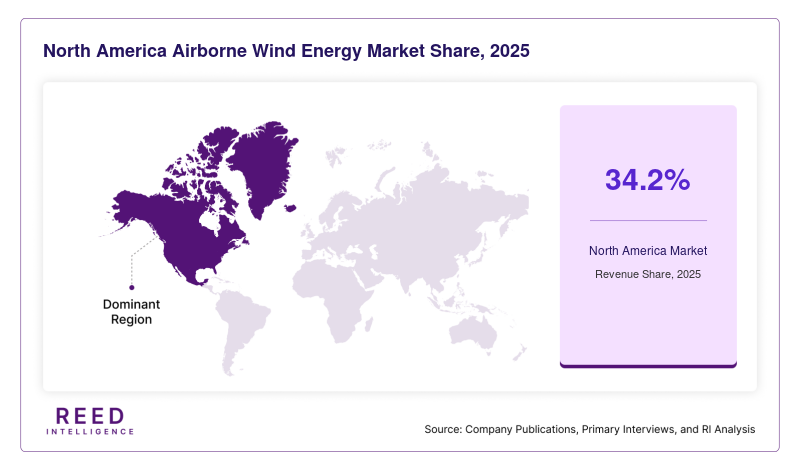
North America accounted for approximately 34.2% share of the Airborne Wind Energy Market in 2025 and is projected to grow at a CAGR of 16.8% during 2026–2034. Strong research funding, advanced aerospace capabilities, and early adoption of renewable energy technologies contribute to regional dominance. The presence of key innovators and pilot projects in the United States and Canada supports steady development of airborne wind systems.
The United States leads the regional market, driven by strong investments in clean energy R&D and collaborations between universities and energy startups. A key growth factor is the integration of airborne wind systems into offshore energy testing zones along coastal areas, particularly in California and the East Coast, where wind resources are abundant and policy support is strong.
Europe
Europe held a 29.5% share in 2025, with a projected CAGR of 17.2% through 2034. The region benefits from aggressive decarbonization targets and strong renewable energy frameworks. Countries such as Germany, the Netherlands, and the United Kingdom are actively investing in airborne wind prototypes and demonstration projects.
Germany dominates the European market due to its advanced engineering ecosystem and renewable energy transition policies. A key growth driver is the integration of airborne systems into industrial decarbonization programs aimed at reducing fossil fuel dependency in manufacturing clusters.
Asia Pacific
Asia Pacific accounted for 22.8% share in 2025 and is expected to record the fastest CAGR of 19.1% during 2026–2034. Rapid industrialization, rising energy demand, and government support for renewable diversification are key growth drivers. China, Japan, and India are leading adoption efforts.
China dominates the region due to large-scale renewable investments and strong manufacturing capabilities. A key growth factor is the deployment of airborne wind systems in coastal industrial zones to support energy-intensive production hubs.
Middle East & Africa
The region held a 7.4% share in 2025 and is projected to grow at a CAGR of 15.9% through 2034. Increasing focus on renewable diversification away from oil dependency is driving market growth. Countries like the UAE and South Africa are leading pilot projects.
The UAE dominates due to strong government-backed renewable initiatives. A key growth factor is the use of airborne systems in desert regions where conventional wind infrastructure is limited but wind potential at higher altitudes is significant.
Latin America
Latin America accounted for a 6.1% share in 2025, with a CAGR of 16.3% expected through 2034. Expanding renewable energy investments in Brazil, Chile, and Mexico are supporting growth. The region benefits from abundant wind resources and increasing energy demand.
Brazil leads the market, driven by its renewable energy diversification policies. A key growth factor is the deployment of airborne systems in coastal and rural regions to support decentralized energy access programs.
Competitive Landscape
The Airborne Wind Energy Market is moderately consolidated, with key players focusing on technology innovation, pilot deployments, and strategic collaborations. Leading companies include Altaeros Energies, Kite Power Systems, Makani Technologies (Alphabet), EnerKite GmbH, and SkySails Group. These companies are actively investing in autonomous flight systems, tether optimization, and high-altitude energy capture technologies.
Among them, Makani Technologies has maintained a leadership position due to its strong aerospace engineering capabilities and early-stage prototype deployments in offshore environments. A recent development includes enhanced airborne turbine prototypes designed for improved energy conversion efficiency and reduced operational downtime. Strategic partnerships between technology developers and energy utilities are also shaping competitive dynamics, enabling faster commercialization of airborne wind systems.
Key Players List
- Altaeros Energies
- Makani Technologies
- Kite Power Systems
- EnerKite GmbH
- SkySails Group
- Twingtec AG
- Ampyx Power
- Joby Energy
- Windlift Inc.
- Kitemill AS
- X-Wind Technologies
- Swiss Kite Power
- Enerkite Solutions
- Flying Wind Systems Ltd.
- AeroWind Innovations
Recent Developments
- In 2025, several European startups expanded pilot airborne wind farms in offshore testing zones to validate long-duration flight stability.
- A North American energy consortium announced collaboration with aerospace firms to develop AI-powered autonomous tether control systems for airborne turbines.
- In 2026, Asian manufacturers increased investment in lightweight composite materials to improve system durability and reduce lifecycle costs of airborne wind platforms.
Airborne Wind Energy Market Segments
System Type
- Rigid-Wing Airborne Systems
- Kite-Based Systems
- Hybrid Airborne Energy Systems
Application
- Utility-Scale Power Generation
- Off-Grid Remote Energy Systems
- Offshore Renewable Energy Projects
End-Use
- Utilities
- Industrial Sector
- Defense & Emergency Services
- Commercial Infrastructure
By Region
- North America
- Europe
- APAC
- Middle East and Africa
- LATAM