Aircraft Auxiliary Power Unit (APU) Market Size, Share & Trends Analysis Report By Type (Gas Turbine APUs, Electric APUs and Hybrid APUs), By Aircraft Type (Commercial Aircraft, Military Aircraft, Business & General Aviation and Helicopters & UAVs), By Application (OEM, Aftermarket and Retrofit) and By Region (North America, Europe, Asia Pacific, Latin America, Middle East & Africa) Forecasts, 2026–2034
USD 3950
Aircraft Auxiliary Power Unit (APU) Market Size
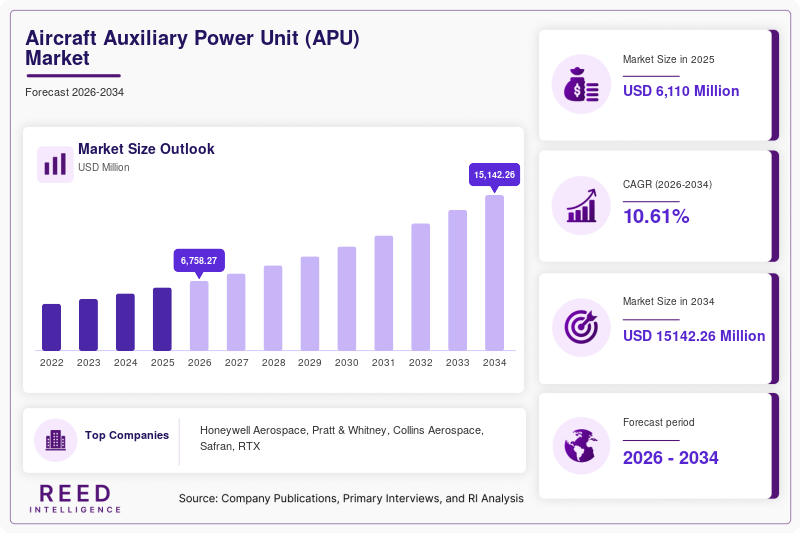
The global aircraft auxiliary power unit (APU) market was valued at USD 6,110 million in 2025 and is projected to grow from USD 6,620 million in 2026 to USD 15,142.26 million by 2034, registering a CAGR of 10.61% during the forecast period from 2026 to 2034.
Aircraft auxiliary power units are compact onboard power-generation systems used primarily to start main engines, supply electricity to aircraft systems and provide pneumatic air for cabin conditioning and other functions. Depending on aircraft architecture, an APU can support ground operations, provide backup electrical power during flight and reduce dependence on external airport ground equipment. The technology is particularly important for commercial aircraft where reliable onboard power directly affects dispatch operations and passenger-service functions.
Gas turbine APUs remain the core technology because they provide high power density and can supply electrical and pneumatic power from a compact package. Pratt & Whitney's APS3200, for example, provides electrical power and bleed air for Airbus A320-family aircraft, while the PW980 provides electrical and pneumatic capability for the Airbus A380.
Aircraft Auxiliary Power Unit (APU) Market Drivers
Expansion of Commercial Aircraft Fleets
Commercial aircraft production and fleet expansion create direct demand for APUs because virtually every new large commercial aircraft platform requires an auxiliary power-generation solution. Narrowbody and widebody aircraft use APUs for engine starting, cabin conditioning, electrical power and backup functions, making APU installations closely linked to aircraft deliveries.
The commercial aftermarket also expands as aircraft accumulate flight hours. Collins Aerospace reported an 8% year-over-year increase in Q2 2026 sales, with commercial original-equipment sales increasing 26% and commercial aftermarket sales increasing 10%. Although Collins' results encompass broader aerospace systems, they demonstrate the underlying expansion in aircraft equipment production and aftermarket activity relevant to auxiliary power and aircraft systems.
Shift Toward More-Electric Aircraft
Aircraft electrical architectures are becoming more sophisticated as manufacturers seek to replace or reduce pneumatic and mechanically driven systems. APUs are therefore being evaluated not only as independent power sources but also as elements of increasingly integrated electrical architectures.
The FAA's electric-power discipline explicitly identifies the industry's transition beyond conventional engine-driven generators, APUs and standard batteries toward hybrid-electric and electric-flight technologies. This transition creates demand for APUs and auxiliary power systems capable of supporting higher electrical loads while improving efficiency and reducing emissions.
Increasing Focus on APU Efficiency and Time-on-Wing
Airlines increasingly evaluate APUs according to fuel consumption, reliability, maintenance intervals and availability rather than acquisition price alone. Improvements that reduce fuel burn or increase time-on-wing can generate measurable lifecycle savings across large fleets.
Honeywell's 131-9A/9B High Efficiency Mode demonstrates this approach: the upgrade can provide 1–2% fuel-efficiency improvement, increase time-on-wing by as much as 1,500 hours, and reduce annual CO₂ emissions by up to 22 metric tons per APU, depending on operating conditions.
Aircraft Auxiliary Power Unit (APU) Market Restraints
High Certification and Development Costs
Aircraft APUs operate under demanding certification requirements because failures can affect multiple aircraft systems and, in some circumstances, flight-critical functions. Manufacturers must validate performance across temperature, altitude, vibration, electrical-load and operational conditions before a new APU architecture can enter service.
The certification burden becomes more complex for electric and hybrid architectures because electrical generation, storage, distribution and thermal management must be assessed as integrated systems. EASA's 2026 continuing-airworthiness amendments for electric- and hybrid-propulsion aircraft illustrate the evolving regulatory framework surrounding these technologies.
Supply-Chain and Component Complexity
APUs contain precision turbine components, compressors, generators, gearboxes, electronic controllers, fuel systems and thermal-management components. Manufacturing disruptions involving specialized materials or aerospace-grade components can therefore affect production schedules.
The issue is particularly relevant as aircraft production rates increase. Safran reported in July 2026 that supply-chain production capability remained a watch item while it expanded production to address higher aerospace demand. Similar constraints can affect APU suppliers and their aircraft OEM customers when component availability limits assembly rates.
Aircraft Auxiliary Power Unit (APU) Market Opportunities
Electric and Hybrid Auxiliary Power Architectures
The transition toward more-electric aircraft creates an opportunity for APU suppliers to develop systems capable of supplying higher electrical loads with reduced pneumatic dependence. Electric and hybrid APUs can potentially be integrated with aircraft energy-storage and distribution systems rather than operating as isolated turbine-based units.
Safran's eAPU60 already targets more-electric and all-electric aircraft, while its broader electrical-power activities are focused on next-generation aircraft architectures. Collins Aerospace is also advancing hybrid-electric power systems through Clean Aviation programs, including integrated testing of megawatt-class motor-generators and controllers.
APU Retrofit and Performance-Upgrading
The installed aircraft base creates a substantial aftermarket opportunity because airlines can upgrade existing APUs rather than replace the complete unit. Fuel-efficiency improvements, software upgrades, improved components and enhanced monitoring can extend service life while lowering operating costs.
Honeywell's 131-9A/9B High Efficiency Mode is an example of this approach, with the upgrade designed to be installed during a major service event and improve efficiency and time-on-wing. The commercial opportunity extends to digital monitoring, predictive maintenance, component repair and long-term maintenance agreements.
Aircraft Auxiliary Power Unit (APU) Market Segmental Analysis
By Type
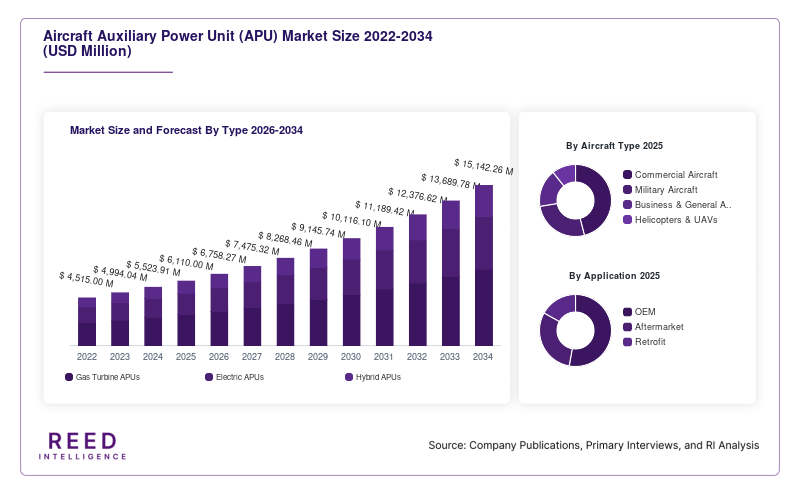
Gas Turbine APUs accounted for approximately 82% market share in 2025, maintaining dominance because turbine-based systems provide a mature combination of electrical generation, pneumatic power, engine-start capability, compact packaging and established certification pathways. Major commercial aircraft platforms continue to rely on turbine APUs, including the PW980 for the Airbus A380 and APS3200 for the Airbus A320 family.
Electric APUs represented approximately 13% share, while Hybrid APUs accounted for around 5%. Hybrid APUs are projected to be the fastest-growing type at approximately 18.4% CAGR, as aircraft manufacturers investigate hybrid-electric power architectures. Electric APUs are estimated to grow at 14.8% CAGR, supported by more-electric aircraft development, while Gas Turbine APUs are projected to expand at approximately 9.7% CAGR.
By Aircraft Type
Commercial Aircraft dominated with approximately 64% market share in 2025, reflecting the large installed base of narrowbody and widebody aircraft and the requirement for APUs across major commercial platforms. The category benefits from both new aircraft production and replacement, repair and overhaul demand from airlines.
Military Aircraft accounted for approximately 20%, Business & General Aviation for 10%, and Helicopters & UAVs for approximately 6%. Helicopters & UAVs are projected to be the fastest-growing aircraft category at approximately 12.7% CAGR, supported by increasing onboard electrical requirements and development of more-electric aircraft. Military Aircraft are estimated to grow at 10.6% CAGR, Commercial Aircraft at 10.1%, and Business & General Aviation at 9.3%.
By Application
OEM accounted for approximately 58% market share in 2025, supported by installation of APUs on newly manufactured commercial, military and business aircraft. Long-term aircraft production programs provide suppliers with recurring platform-based production opportunities once an APU is selected and certified.
Aftermarket represented approximately 31%, while Retrofit accounted for approximately 11%. Aftermarket is projected to grow at the fastest rate of approximately 12.4% CAGR, supported by maintenance contracts, overhaul activity, component replacement and efficiency upgrades. Pratt & Whitney's 2026 APS5000 agreement with Scoot covers at least 24 APUs for 15 years, illustrating the long-term service model associated with installed APU fleets. OEM applications are estimated to grow at 9.8% CAGR, while Retrofit is expected to grow at 11.7% CAGR.
Aircraft Auxiliary Power Unit (APU) Market Regional Analysis
North America Aircraft Auxiliary Power Unit (APU) Market
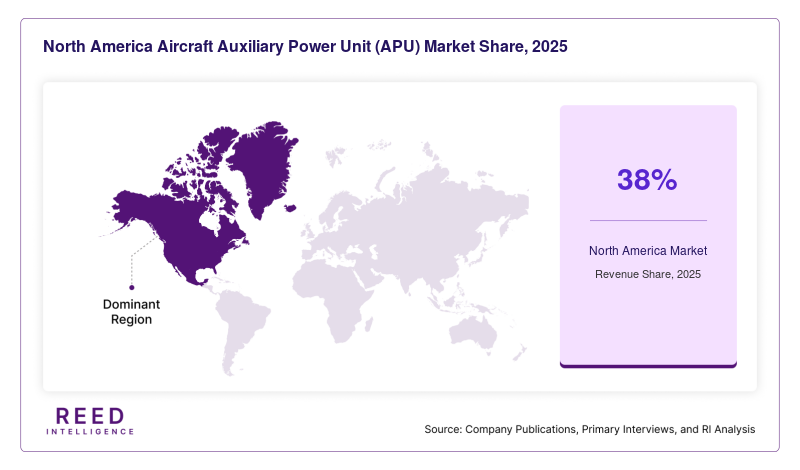
North America held the dominant regional position with approximately 38% market share in 2025. The region benefits from major aircraft OEMs, engine manufacturers, APU suppliers, MRO providers and a large commercial and military aircraft fleet. Honeywell, Pratt & Whitney and Collins Aerospace maintain extensive aerospace power-system capabilities, supporting both original equipment and aftermarket activity.
The United States represents the principal regional demand center, with aircraft production, defense programs and airline fleet maintenance supporting APU demand. North America is estimated to expand at approximately 9.6% CAGR through 2034. The region's mature MRO infrastructure also supports APU overhaul, component repair and performance-upgrade programs.
Europe Aircraft Auxiliary Power Unit (APU) Market
Europe is estimated to register approximately 10.2% CAGR during 2026–2034. Airbus aircraft production, established aerospace supply chains and extensive aviation MRO infrastructure support demand for auxiliary power systems. European suppliers are also investing heavily in electrical architectures that could influence future APU configurations.
France, Germany, the United Kingdom, Spain and Italy remain important aerospace manufacturing and engineering centers. Safran's eAPU technology and its work on hybrid-electric aircraft demonstrate the region's focus on integrating auxiliary and electrical power technologies into future aircraft architectures.
Asia Pacific Aircraft Auxiliary Power Unit (APU) Market
Asia Pacific is projected to be the fastest-growing region at approximately 12.8% CAGR. Expansion of commercial aviation fleets, rising passenger traffic, aircraft deliveries and increasing MRO activity are expanding the installed base requiring APU maintenance and replacement. China, India, Japan, Singapore and Southeast Asia represent important aviation markets.
The region is also developing a stronger aftermarket ecosystem. Pratt & Whitney Canada's February 2026 agreement with Scoot covers maintenance for at least 24 APS5000 APUs on Boeing 787 aircraft, demonstrating the importance of long-term APU service demand in the Asian airline market.
Latin America Aircraft Auxiliary Power Unit (APU) Market
Latin America is estimated to expand at approximately 10.7% CAGR through 2034. Commercial aviation fleet renewal, increasing aircraft utilization and MRO activity support demand for APU maintenance and replacement. Brazil and Mexico represent the principal aviation manufacturing and operational centers.
The aftermarket is particularly relevant because operators can extend the service life of existing aircraft through APU maintenance, component replacement and efficiency upgrades. Regional airlines are also increasingly focused on fuel efficiency and aircraft availability, making APU reliability and time-on-wing important procurement considerations.
Middle East & Africa Aircraft Auxiliary Power Unit (APU) Market
Middle East & Africa is estimated to grow at approximately 11.3% CAGR during 2026–2034. Large airline fleets in the Gulf region, expansion of aviation hubs and continued investment in commercial and defense aviation support demand for APUs and associated MRO services.
The United Arab Emirates, Saudi Arabia and Qatar represent major aviation centers, while South Africa contributes through commercial, military and MRO activity. High aircraft utilization in major Gulf airline fleets increases the importance of APU reliability, maintenance planning, component availability and lifecycle service agreements.
Aircraft Auxiliary Power Unit (APU) Market Competitive Landscape
The Aircraft Auxiliary Power Unit Market is concentrated around aerospace propulsion and aircraft-system manufacturers with long-standing OEM relationships, certification capabilities and global aftermarket networks. Competition is shaped by APU fuel efficiency, power output, reliability, weight, emissions, time-on-wing, maintainability and compatibility with specific aircraft platforms.
Honeywell Aerospace remains a major APU supplier with a broad installed base across commercial, business, defense and general-aviation platforms. Its portfolio includes the 131-9A/9B family, while its 2026 standalone-company strategy continues to emphasize electrification, autonomy and integrated aerospace systems. Honeywell's Investor Day materials specifically highlight the 131-9A APU's efficiency upgrades and lifecycle benefits.
Key Market Players
- Honeywell Aerospace
- Pratt & Whitney
- Collins Aerospace
- Safran
- RTX
- GE Aerospace
- Rolls-Royce
- PBS Aerospace
- Kinetics
- Aegis Power Systems
- Boeing
- Airbus
- Hamilton Sundstrand legacy platforms
Aircraft Auxiliary Power Unit (APU) Market Recent Developments
- September 2026 -Honeywell Aerospace: Honeywell Aerospace's 2026 Investor Day materials highlighted the 131-9A/9B APU High-Efficiency Mode as an installed-base upgrade focused on greater fuel efficiency and improved time-on-wing. The company reported that the upgrade has eliminated an estimated 4.7 million gallons of fuel consumption for operators since 2020, as of March 2026.
- July 2026 -Safran: Safran reported continued expansion of its aerospace equipment activities and highlighted electrical-system demand across aircraft programs. Its H1 2026 Equipment & Defense revenue increased 14.0%, while electrical-system sales were supported by programs including the 737 MAX, A320neo and A350.
Aircraft Auxiliary Power Unit (APU) Market Segments
By Type
- Gas Turbine APUs
- Electric APUs
- Hybrid APUs
By Aircraft Type
- Commercial Aircraft
- Military Aircraft
- Business & General Aviation
- Helicopters & UAVs
By Application
- OEM
- Aftermarket
- Retrofit
By Region
- North America
- Europe
- APAC
- Middle East and Africa
- LATAM