Size, Share & Demand Report By Brake Type (Carbon Brake Systems, Steel Brake Systems), By Aircraft Type (Commercial Aircraft, Military Aircraft, Business Jets), By Component (Brake Discs, Brake Housings), By End-Use (OEM, Aftermarket), By Distribution Channel (Direct OEM Contracts, Authorized Aviation Suppliers, Aircraft Maintenance Providers), By Region & Segment Forecasts, 2026–2034
USD 3950
Market Overview
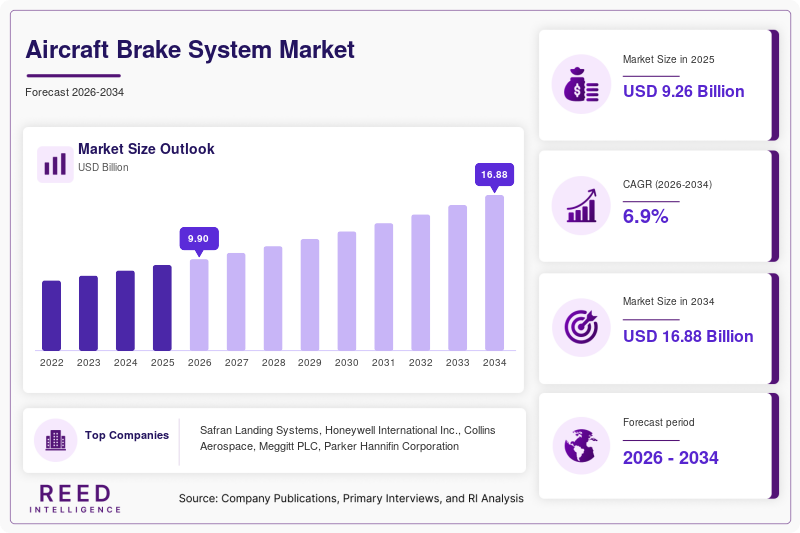
The global Aircraft Brake System Market size was valued at USD 9.26 billion in 2026 and is projected to reach USD 15.84 billion by 2034, expanding at a CAGR of 6.9% during the forecast period (2026–2034). The market growth has been supported by rising global air passenger traffic and increasing aircraft production activities across commercial and military aviation sectors. Expanding airline fleets and modernization of aircraft safety systems have accelerated demand for advanced braking technologies in the aviation industry.
Aircraft brake systems are critical safety components designed to control aircraft movement during landing, taxiing, and emergency stopping operations. These systems include wheels, brake assemblies, anti-skid systems, and electronic control technologies that ensure operational safety and performance reliability. Increasing investments in aviation infrastructure and fleet expansion programs have contributed significantly to market demand.
Key Highlights
- North America accounted for 36.4% of the global Aircraft Brake System Market share in 2025, while Asia Pacific is projected to register the fastest CAGR of 7.8% during the forecast period.
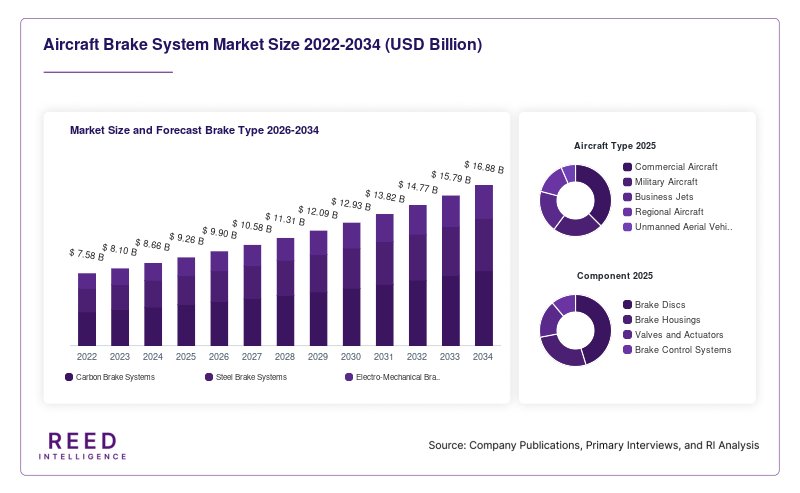
- By brake type, carbon brake systems dominated with a 52.1% market share in 2025, whereas electro-mechanical brake systems are anticipated to grow at a CAGR of 8.5% through 2034.
- By aircraft type, commercial aircraft held the largest market share of 48.7% in 2025, while unmanned aerial vehicles are expected to expand at a CAGR of 8.9%.
- By component, brake discs captured 33.6% of the market in 2025, whereas brake control systems are forecast to grow at a CAGR of 8.1%.
- The United States remained the dominant country market, valued at USD 2.14 billion in 2024 and USD 2.28 billion in 2025.
Market Trends
Increasing Adoption of Lightweight Carbon Brake Systems
Aircraft manufacturers and airline operators are increasingly adopting lightweight carbon brake systems to improve operational efficiency and reduce aircraft weight. Carbon brake systems offer advantages such as improved heat resistance, longer operational lifespan, and lower maintenance requirements compared to traditional steel braking systems. The trend is expected to accelerate as airlines focus on fuel efficiency and operational cost optimization.
Growing Integration of Smart Brake Monitoring Technologies
The aviation industry is witnessing rising integration of digital monitoring and predictive maintenance technologies in aircraft brake systems. Advanced sensors and analytics platforms are enabling real-time monitoring of brake wear, temperature, and operational performance. These smart technologies help reduce unscheduled maintenance events and improve aircraft safety management.
Market Drivers
Expansion of Commercial Aviation Fleet
The rapid expansion of commercial airline fleets has significantly supported the Aircraft Brake System Market. Airlines are increasing aircraft procurement to accommodate rising passenger traffic and expanding regional connectivity networks. Aircraft brake systems are essential components in new aircraft production and aftermarket maintenance activities, supporting continuous market demand.
Rising Defense Aircraft Procurement
Defense modernization programs and increasing military aircraft procurement are driving growth in the aircraft brake system industry. Governments are investing in advanced fighter aircraft, transport aircraft, and surveillance platforms to strengthen defense capabilities. These aircraft require durable and high-performance braking systems designed for demanding operational conditions.
Market Restraint
High Maintenance and Replacement Costs
Aircraft brake systems require regular inspection, maintenance, and replacement to comply with aviation safety standards. Advanced carbon brake systems and electronic brake technologies often involve high operational and servicing costs. These expenses can create financial challenges for smaller airline operators and maintenance providers.
Market Opportunities
Growth in Electric and Hybrid Aircraft Development
The development of electric and hybrid aircraft is creating new opportunities for aircraft brake system manufacturers. Emerging aircraft platforms require lightweight and energy-efficient braking technologies that support improved operational performance. Manufacturers are expected to develop advanced electro-mechanical braking systems for next-generation aircraft applications.
Increasing Demand for Aftermarket Maintenance Services
The expansion of global aircraft fleets is generating growth opportunities in aircraft brake system aftermarket services. Airlines and maintenance providers increasingly require replacement brake components, repair services, and predictive maintenance solutions to improve aircraft availability and operational efficiency.
Segmental Analysis
By Brake Type
Carbon Brake Systems Dominated the Market
Carbon brake systems accounted for 52.1% of the Aircraft Brake System Market share in 2025. The segment maintained dominance because of its lightweight structure, improved braking performance, and enhanced heat resistance. Commercial airlines and military aircraft operators widely adopted carbon brake systems to improve operational efficiency and reduce aircraft weight.
Electro-Mechanical Brake Systems to Witness Fastest Growth
Electro-mechanical brake systems are projected to expand at a CAGR of 8.5% during the forecast period. The segment is expected to gain traction due to increasing development of electric aircraft and next-generation aviation technologies. Manufacturers are anticipated to focus on advanced braking systems with improved automation and energy efficiency capabilities.
By Aircraft Type
Commercial Aircraft Held the Largest Share
Commercial aircraft represented 48.7% of the global Aircraft Brake System Market share in 2025. The segment dominated because commercial airlines require reliable and high-performance braking systems for frequent flight operations. Expanding airline fleets and increasing aircraft deliveries globally supported segment growth.
Unmanned Aerial Vehicles Expected to Grow Rapidly
Unmanned aerial vehicles are anticipated to register a CAGR of 8.9% during the forecast period. Increasing utilization of UAVs for defense surveillance, cargo transportation, and industrial monitoring applications will support segment expansion. Manufacturers are expected to develop lightweight braking technologies specifically designed for UAV platforms.
By Component
Brake Discs Led the Market
Brake discs accounted for 33.6% of the Aircraft Brake System Market share in 2025. The segment benefited from its essential role in aircraft braking operations and replacement demand during maintenance cycles. Airlines and maintenance providers increasingly invested in durable carbon brake disc technologies to improve operational reliability.
Brake Control Systems to Register Strong Growth
Brake control systems are projected to grow at a CAGR of 8.1% through 2034. The segment is expected to benefit from increasing integration of electronic monitoring and automation technologies within aircraft braking operations. Advanced brake control systems improve operational precision and support predictive maintenance capabilities.
By End-Use
OEM Segment Dominated the Market
The OEM segment held 57.4% of the Aircraft Brake System Market share in 2025. The segment maintained dominance because aircraft manufacturers require integrated braking systems during aircraft production processes. Rising aircraft deliveries and fleet expansion programs supported segment demand.
Aftermarket Segment to Expand Significantly
The aftermarket segment is expected to grow at a CAGR of 7.9% during the forecast period. Increasing aircraft maintenance activities and rising replacement demand for brake components will support segment growth. Airlines are expected to increase investments in predictive maintenance solutions and component replacement services.
Regional Analysis
North America
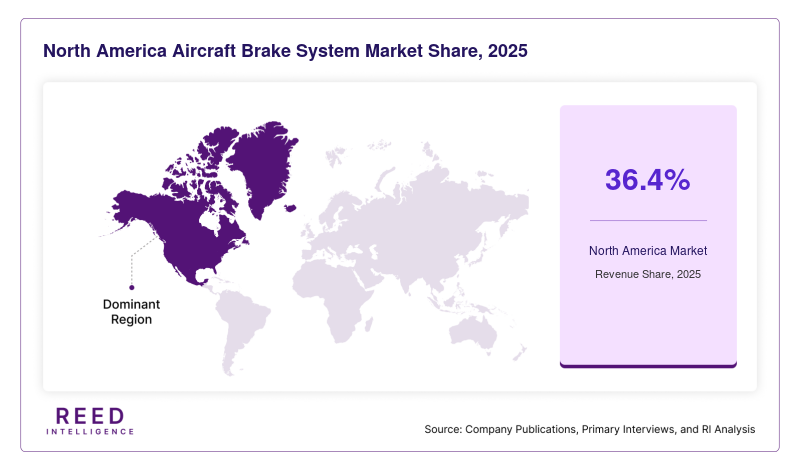
North America accounted for 36.4% of the global Aircraft Brake System Market share in 2025 and is projected to grow at a CAGR of 6.5% during the forecast period. The regional market benefited from strong aircraft manufacturing activities and expanding defense modernization programs. The United States dominated the regional market due to the presence of major aircraft manufacturers and rising investments in aviation safety technologies. Increasing commercial aviation operations also supported regional demand.
Europe
Europe held 27.1% of the global Aircraft Brake System Market share in 2025 and is anticipated to expand at a CAGR of 6.7% through 2034. The regional market was supported by increasing aircraft production activities and growing adoption of advanced aviation technologies. France emerged as the leading country market due to the strong presence of aerospace manufacturing companies and aviation engineering expertise. Expanding aircraft maintenance activities contributed to regional market growth.
Asia Pacific
Asia Pacific represented 24.8% of the global Aircraft Brake System Market share in 2025 and is forecast to register the fastest CAGR of 7.8% during the forecast period. China dominated the regional market due to expanding airline fleets and increasing investments in domestic aircraft manufacturing programs. Rising air passenger traffic and airport infrastructure development are expected to strengthen regional market demand.
Middle East & Africa
The Middle East & Africa accounted for 7.0% of the global Aircraft Brake System Market share in 2025 and is projected to grow at a CAGR of 7.1% between 2026 and 2034. The United Arab Emirates led the regional market owing to rapid airline fleet expansion and increasing aviation infrastructure investments. Growing demand for commercial aviation services is expected to support market development across the region.
Latin America
Latin America captured 4.7% of the global Aircraft Brake System Market share in 2025 and is expected to grow at a CAGR of 6.2% during the forecast period. Brazil dominated the regional market due to increasing regional aircraft operations and expanding aerospace manufacturing activities. Rising investments in aviation maintenance infrastructure are anticipated to contribute to regional market expansion.
Competitive Landscape
The Aircraft Brake System Market remains moderately consolidated with the presence of aerospace component manufacturers, aviation system suppliers, and aircraft technology companies. Market participants are focusing on lightweight material innovation, predictive maintenance technologies, and strategic collaborations to strengthen their competitive position.
Safran Landing Systems emerged as a leading market participant due to its advanced aircraft braking technologies and extensive aerospace manufacturing capabilities. The company recently expanded its carbon brake production operations to address increasing demand from commercial aviation programs.
Honeywell International Inc. strengthened its aviation systems portfolio through advanced brake control and monitoring technologies.
Collins Aerospace focused on lightweight aircraft braking solutions for commercial and military aviation platforms.
Meggitt PLC expanded its advanced aircraft wheel and brake technologies for regional aircraft applications.
Parker Hannifin Corporation invested in electro-mechanical braking systems and predictive maintenance platforms.
Key Players List
- Safran Landing Systems
- Honeywell International Inc.
- Collins Aerospace
- Meggitt PLC
- Parker Hannifin Corporation
- Lufthansa Technik AG
- Crane Aerospace & Electronics
- Beringer Aero
- Jay-Em Aerospace Corporation
- Boeing
- Airbus
- AAR Corp.
- RTX Corporation
- MATCO Manufacturing Inc.
- Grove Aircraft Landing Gear Systems Inc.
Recent Developments
- In 2025, Safran Landing Systems expanded its carbon aircraft brake manufacturing capacity for commercial aviation applications.
- In 2024, Honeywell International Inc. introduced advanced brake health monitoring systems for next-generation aircraft platforms.
- In 2025, Collins Aerospace launched lightweight aircraft braking technologies for fuel-efficient aviation operations.
- In 2024, Meggitt PLC expanded its regional aircraft wheel and brake product portfolio.
- In 2025, Parker Hannifin Corporation invested in electro-mechanical aircraft braking technologies for hybrid aircraft systems.
Aircraft Brake System Market Segments
Brake Type
- Carbon Brake Systems
- Steel Brake Systems
- Electro-Mechanical Brake Systems
Aircraft Type
- Commercial Aircraft
- Military Aircraft
- Business Jets
- Regional Aircraft
- Unmanned Aerial Vehicles
Component
- Brake Discs
- Brake Housings
- Valves and Actuators
- Brake Control Systems
End-Use
- OEM
- Aftermarket
Distribution Channel
- Direct OEM Contracts
- Authorized Aviation Suppliers
- Aircraft Maintenance Providers
- Online Aerospace Platforms
- Defense Procurement Channels
By Region
- North America
- Europe
- APAC
- Middle East and Africa
- LATAM