Aircraft Engine Forging Market Size, Share & Trends Analysis Report By Forging Type (Closed Die Forging, Open Die Forging, Seamless Rolled Ring Forging), By Material (Nickel Superalloys, Titanium Alloys, Steel Alloys, Aluminum Alloys, Other Alloys), By Engine Component (Turbine Disks, Compressor Blades, Shafts, Casings, Other Components), By Engine Type (Turbofan Engines, Turbojet Engines, Turboprop Engines, Turboshaft Engines), By Aircraft Type (Fixed Wing Aircraft, Rotary Wing Aircraft) and By
USD 3950
Aircraft Engine Forging Market Size
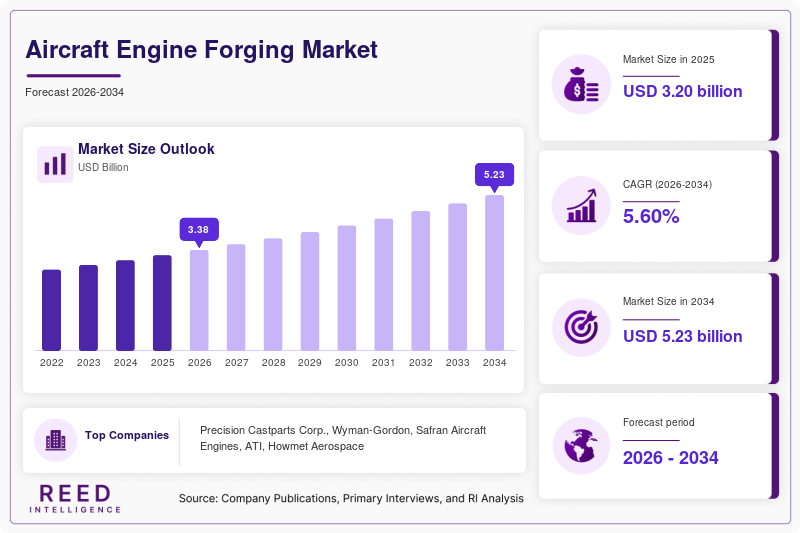
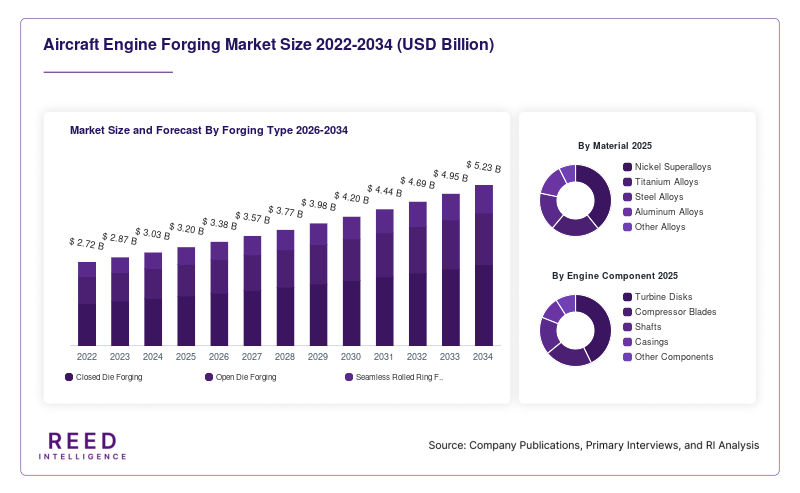
The global Aircraft Engine Forging Market size was valued at USD 3.20 billion in 2025 and is projected to grow from USD 3.39 billion in 2026 to USD 5.23 billion by 2034, registering a CAGR of 5.60% during the forecast period from 2026 to 2034.
The market is being shaped by higher aircraft production, increasing engine delivery rates, replacement demand, and investment in forging capacity for critical engine components. Airbus delivered 793 commercial aircraft in 2025 and ended the year with a record backlog of 8,754 aircraft, while Boeing reported more than 6,200 commercial aircraft in backlog by June 2026. These production pipelines translate into longer-term demand for forged turbine disks, shafts, compressor components, rings, and structural parts.
At the engine level, CFM LEAP production is a particularly important demand signal. Safran reported 1,030 LEAP deliveries during the first half of 2026, up 41% year over year, while its Gennevilliers investment adds a 30,000-metric-ton press for strategic commercial and military engine parts.
Aircraft engine forging is a high-specification manufacturing activity used to produce components that must withstand high temperature, pressure, rotational forces, fatigue and long operating cycles. Forging provides controlled grain flow and high mechanical integrity, making it important for turbine disks, compressor components, shafts, rings and other load-bearing engine parts. Nickel-based superalloys are particularly important in hot-section applications, while titanium is widely used where weight reduction and high strength-to-weight performance are priorities. ATI, for example, supplies aerospace customers with titanium, nickel- and cobalt-based materials, specialty steels, forgings and machined components across engine applications.
Aircraft Engine Forging Market Drivers
Rising Commercial Aircraft Production and Engine Delivery Rates
Aircraft production is the main demand transmission mechanism for new engine forgings. Airbus delivered 793 commercial aircraft in 2025 and ended the year with 8,754 aircraft in backlog. Boeing reported 600 commercial deliveries in 2025 and more than 6,200 commercial aircraft in backlog by June 2026. The increase in production rates for narrow-body programs is particularly relevant because each engine requires multiple precision-forged components.
Engine production data reinforces this relationship. Safran reported that CFM delivered 1,030 LEAP engines during the first half of 2026, up 41% year over year. Safran is targeting additional capacity because LEAP production is continuing to ramp. Its Gennevilliers forging investment is designed to support LEAP as well as military and high-thrust engine programs.
For forging suppliers, this creates recurring demand for turbine disks, shafts, compressor components, rings and other critical parts throughout an engine program's production cycle. The counterbalance is that aircraft delivery schedules can still be constrained by certification, labor, materials and broader aerospace supply-chain issues.
Increasing Requirement for High-Temperature and Lightweight Engine Materials
Modern engines require materials that retain mechanical performance under increasingly demanding thermal and mechanical conditions. Nickel superalloys remain important for hot-section components because of their high-temperature strength, oxidation resistance and creep performance. Titanium remains important in compressor and structural applications where reducing weight improves overall propulsion efficiency. ATI's aerospace portfolio includes titanium, nickel and cobalt-based materials, specialty steels, powder superalloys and multiple forging technologies.
This material shift changes the economics of forging. Advanced alloys require tighter temperature control, specialized dies, heat treatment, inspection and machining. As a result, suppliers with integrated melting, forging, machining and inspection capabilities can address more stages of the production chain. ATI specifically describes an integrated value chain from melting through finished components, while its 2026 Mexico expansion combines machining, nondestructive testing, finishing and quality verification.
OEM Investment in Forging Capacity and Supply-Chain Resilience
Aerospace forging capacity is difficult to expand quickly because large presses, furnaces, tooling and inspection systems require major capital investment and lengthy qualification. OEMs and major suppliers are therefore investing ahead of production increases.
In April 2026, Safran announced a €150 million investment in a 30,000-metric-ton hydraulic press at Gennevilliers. The facility is expected to be operational in 2029, produce up to 14,000 parts annually at full rate and nearly double site production by 2035.
ATI has similarly expanded downstream aerospace manufacturing in Mexico to move components from forging through machining and inspection. The company said the operation is intended to address persistent aerospace supply-chain constraints and support next-generation engine demand.
Aircraft Engine Forging Market Restraints
High Capital and Qualification Requirements
Aircraft engine forging requires expensive presses, tooling, heat-treatment systems, material processing equipment and nondestructive inspection. New suppliers must also meet stringent aerospace quality and certification requirements before their components can enter production programs. The FAA's aircraft certification process extends from standards and design through build, testing, certification and production, illustrating the structured nature of aerospace qualification.
These requirements limit the number of suppliers capable of competing for critical engine components. They also make capacity additions slower than demand changes. For OEMs, this can create supply bottlenecks when aircraft production increases faster than qualified forging capacity.
Raw-Material, Energy and Supply-Chain Volatility
Forging operations depend heavily on titanium, nickel-based alloys and specialty steels. These materials require controlled melting, processing and traceability, while forging itself is energy intensive. ATI notes that aerospace customers increasingly value secure and certified global supply chains, while the company is also seeing customers pursue dual sourcing and reduce single points of failure.
Material availability therefore affects both cost and production schedules. Long qualification cycles make substitution difficult, meaning that shortages of aerospace-grade material can propagate into engine-component production. This creates an incentive for OEMs and suppliers to vertically integrate or establish multiple qualified sources.
Aircraft Engine Forging Market Opportunities
Advanced Forging for Next-Generation Engines
The transition toward higher-efficiency propulsion creates demand for components capable of handling higher temperatures, pressures and rotational loads while controlling weight. This supports investment in nickel superalloy forging, titanium forging, near-net-shape processes, isothermal forging and precision machining. Safran's 30,000-ton press investment demonstrates how engine manufacturers are expanding forging capability specifically around next-generation commercial and military engine programs.
Expansion of Aerospace Manufacturing in India and Asia
India and wider APAC are becoming increasingly relevant to aircraft-engine manufacturing and supply chains. Rolls-Royce states that its Indian supply chain began with HAL's forging division for ring forgings and now includes suppliers such as Bharat Forge and other aerospace manufacturers.
The 2026 IndiGo-CFM agreement for more than 1,000 LEAP-1A engines also illustrates the scale of future engine demand connected to Indian aviation. The agreement includes long-term material services and MRO support, strengthening the broader engine ecosystem around India's expanding aircraft fleet.
Segmental Analysis
By Forging Type
Closed Die Forging represents approximately 49% of the global market in 2025, supported by its ability to deliver repeatable dimensions, controlled grain flow and tight tolerances for high-volume critical engine components. Turbine disks, shafts and other rotating components require consistent metallurgical properties and dimensional accuracy, making closed-die processes important to OEM production programs. The segment benefits directly from higher narrow-body engine production and continued demand for precision components.
Seamless Rolled Ring Forging is the fastest-growing forging type, registering approximately 7.0% CAGR through 2034. Larger engine architectures and high-integrity rings for casings and rotating assemblies are supporting demand for rolled-ring technologies. The process provides continuous grain flow and structural integrity for large circular components, making it relevant as engine designs become more demanding.
By Material
Nickel Superalloys account for approximately 43% of the market in 2025, making them the dominant material category. Their position is linked to the severe temperature, oxidation and creep conditions encountered in turbine disks and other hot-section components. ATI identifies nickel alloys as materials used in the hottest sections of engines, while aerospace forging suppliers continue to expand capabilities around nickel-based components.
Titanium Alloys are the fastest-growing material category at approximately 8.6% CAGR. Their strength-to-weight characteristics make them valuable in compressor and other weight-sensitive engine applications. The growth mechanism is linked to engine weight reduction and increasing use of advanced compressor architectures rather than replacement of nickel alloys in the hottest sections.
By Engine Component
Turbine Disks represent approximately 34% of the market in 2025, supported by their critical function in rotating engine assemblies and their demanding requirements for fatigue strength, temperature resistance and dimensional integrity. Nickel-based forging is particularly relevant in these applications.
Compressor Blades are the fastest-growing component category, with approximately 7.5% CAGR. Increasing compressor pressure ratios and continued efforts to reduce propulsion-system weight support demand for precision titanium and advanced-alloy components. Safran's investment in advanced engine-component production and its titanium compressor-blade manufacturing expansion demonstrate the continuing industrial focus on this part of the engine.
By Engine Type
Turbofan Engines account for approximately 71% of the market in 2025, reflecting their dominance across modern commercial aviation and their extensive use of forged rotating and structural components. The large commercial aircraft backlog at Airbus and Boeing directly supports the long-term production pipeline for turbofan engines.
Turboshaft Engines represent the fastest-growing engine category at approximately 6.8% CAGR, supported by military helicopters, utility rotorcraft and specialized aviation programs. Defense procurement and helicopter modernization provide a second demand channel beyond commercial narrow-body production.
By Aircraft Type
Fixed Wing Aircraft represent approximately 89% of the market in 2025, reflecting the scale of commercial and military fixed-wing engine production. Airbus' 793 commercial deliveries in 2025 and Boeing's 600 deliveries demonstrate the production base supporting this segment.
Rotary Wing Aircraft are growing at approximately 6.5% CAGR, supported by military helicopter programs, utility rotorcraft and aftermarket replacement requirements. Demand is more program-specific than commercial fixed-wing production but can require high-value, high-performance forged components.
By End User
OEMs account for approximately 73% of the market in 2025, supported by new aircraft and engine production. The strong order books of Airbus, Boeing, Safran/CFM and Rolls-Royce create visibility for original-equipment forging demand. Rolls-Royce's large-engine order book reached 2,207 engines at the end of 2025.
Aftermarket is the fastest-growing end-user segment at approximately 6.3% CAGR. Rising engine utilization increases demand for replacement life-limited parts and maintenance components. Rolls-Royce reported 712 total LTSA shop visits in the first half of 2026, while Safran and CFM are expanding MRO capacity to support the growing LEAP fleet.
Regional Analysis
North America Aircraft Engine Forging Market
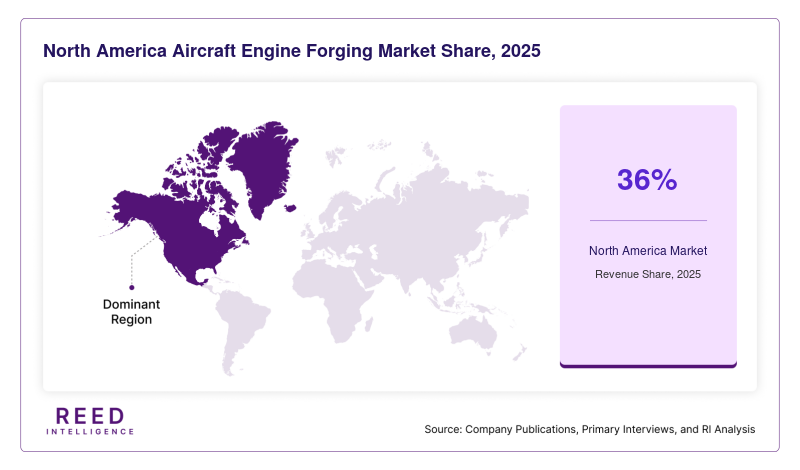
North America represents approximately 36% of the global aircraft engine forging market in 2025, supported by a large aerospace manufacturing base, major engine OEMs, defense programs and specialized forging suppliers. The region is expected to register approximately 5.0% CAGR through 2034. Boeing reported more than 6,200 commercial aircraft in backlog by June 2026, while GE Aerospace and other engine manufacturers continue expanding manufacturing capabilities.
The U.S. also has a broad ecosystem spanning engine design, materials, forging, machining, certification and aftermarket services. Howmet describes aerospace as its largest and fastest-growing market and supplies forgings, seamless rings, titanium products and other components for aero engines.
GE Aerospace's May 2026 investment of INR 100 crore in its Pune facility also demonstrates how North American engine companies are extending manufacturing networks internationally while retaining technology and program control. The investment supports production for GE90, GEnx, GE9X and LEAP programs.
Europe Aircraft Engine Forging Market
Europe holds approximately 29% of the market in 2025, with a CAGR of approximately 5.2%. The region benefits from Airbus, Safran, Rolls-Royce and a dense network of specialist aerospace-material and forging companies.
Safran's €150 million Gennevilliers investment is a direct indicator of regional forging demand. The 30,000-ton press is intended for commercial and military engine components and is expected to produce up to 14,000 parts annually once fully operational.
Rolls-Royce also reported strong large-engine demand, with its order book increasing 20% in 2025. The company operates major civil aerospace manufacturing and service activities across the UK, Germany and other locations.
The European market is therefore supported by both original equipment and aftermarket activity, although capacity constraints and long qualification cycles can limit the speed at which suppliers respond to higher engine production.
APAC Aircraft Engine Forging Market
APAC accounts for approximately 24% of the global market in 2025 and is the fastest-growing region at approximately 8.1% CAGR. The growth mechanism combines expanding commercial aviation fleets, engine MRO development, local aerospace manufacturing and increasing participation by Asian suppliers.
India is an important contributor. Rolls-Royce's Indian supply chain includes HAL's forging operations and suppliers such as Bharat Forge, while CFM's 2026 agreement with IndiGo covers more than 1,000 LEAP-1A engines for 510 Airbus A320neo-family aircraft.
Japan, China, India and Southeast Asia are also increasing their aerospace manufacturing roles. The region's faster growth is linked to aircraft fleet expansion and the localization of engine-related production and MRO rather than simply higher aircraft deliveries.
Middle East and Africa Aircraft Engine Forging Market
Middle East and Africa represents approximately 6% of the market in 2025 and is growing at approximately 6.7% CAGR. Demand is supported by commercial fleet expansion, military aviation programs and the region's position as an important MRO center.
CFM's LEAP durability upgrades are specifically being industrialized for severe operating environments including the Middle East and India. CFM stated that the new durability kit is designed to extend time on wing and reduce maintenance requirements.
The region remains more dependent on imported aerospace components than North America and Europe, but expanding MRO networks and government-backed aerospace manufacturing programs are increasing local participation.
LATAM Aircraft Engine Forging Market
LATAM accounts for approximately 5% of the global market in 2025 and is expected to grow at approximately 6.0% CAGR. Commercial aviation remains the primary demand channel, with additional requirements coming from military aircraft and regional MRO.
Mexico is particularly relevant because Safran has expanded its engine-production footprint in Querétaro, creating a more integrated North American aerospace manufacturing network. Safran describes the site as part of an engine lifecycle ecosystem covering parts, modules, assembly, repair, maintenance and testing.
Brazil and Mexico provide the strongest industrial foundations in the region, while fleet expansion and increasing aerospace localization provide additional demand for precision components.
Competitive Landscape
The aircraft engine forging market has a technically concentrated competitive structure because suppliers must demonstrate metallurgical expertise, large-scale forging capacity, inspection capabilities and qualification history. Major participants include integrated aerospace manufacturers as well as specialist materials and forging companies.
Howmet Aerospace combines forgings, seamless rings, titanium products, fasteners and machined components. Its 2026 acquisition of Consolidated Aerospace Manufacturing for approximately USD 1.8 billion expanded its precision fastener and fluid-fitting portfolio, while the company also sold its Savannah disk-forging facility.
ATI is expanding its integrated aerospace supply chain. Its Mexico facility brings machining, nondestructive testing, finishing and inspection closer to its forging operations, allowing the company to qualify and deliver components through more stages of the manufacturing process.
Key Market Players
- Precision Castparts Corp.
- Wyman-Gordon
- Safran Aircraft Engines
- ATI
- Howmet Aerospace
- Aubert & Duval
- Forgital Group
- Otto Fuchs
- Bharat Forge
- Doncasters Group
- voestalpine BÖHLER Aerospace
- GE Aerospace
- Rolls-Royce
- Pratt & Whitney
- Mitsubishi Heavy Industries
Recent Market Developments
- September 2026 – Howmet Aerospace: Continued portfolio restructuring following its 2026 acquisition of Consolidated Aerospace Manufacturing and the divestiture of its Savannah disk-forging facility. The transactions adjust Howmet's aerospace portfolio toward higher-value engineered products and components.
- May 2026 – GE Aerospace: GE invested INR 100 crore in its Pune manufacturing facility to expand production capability, inspection, automation and precision manufacturing for multiple engine programs.
Aircraft Engine Forging Market Segments
By Forging Type
- Closed Die Forging
- Open Die Forging
- Seamless Rolled Ring Forging
By Material
- Nickel Superalloys
- Titanium Alloys
- Steel Alloys
- Aluminum Alloys
- Other Alloys
By Engine Component
- Turbine Disks
- Compressor Blades
- Shafts
- Casings
- Other Components
By Engine Type
- Turbofan Engines
- Turbojet Engines
- Turboprop Engines
- Turboshaft Engines
By Aircraft Type
- Fixed Wing Aircraft
- Rotary Wing Aircraft
By End User
- OEM
- Aftermarket
By Region
- North America
- Europe
- APAC
- Middle East and Africa
- LATAM