Aircraft Formation Beacon Light Market Size, Share & Demand Report By Type (LED Lights, Incandescent Lights, Infrared Lights), By Application (Military Aviation, Commercial Aviation, UAVs and Drones), By End-Use (OEM, Aftermarket) By Region & Segment Forecasts, 2025–2034
USD 3950
Market Overview
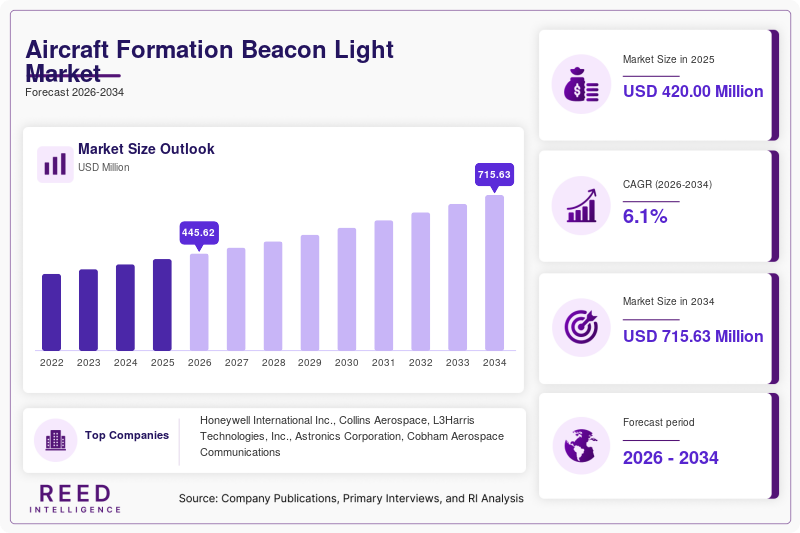
The Aircraft Formation Beacon Light Market size was valued at approximately USD 420 million in 2025 and is projected to reach USD 455 million in 2026. Over the forecast period from 2025 to 2034, the market is expected to grow at a compound annual growth rate (CAGR) of 6.1%, reaching an estimated value of USD 765 million by 2034. The growth trajectory reflects rising adoption of formation flying systems in defense operations, enhanced visibility requirements, and advancements in LED-based lighting technologies.
One of the primary growth factors is the increasing focus on military aviation modernization programs across major economies. Countries are investing in next-generation fighter jets and transport aircraft equipped with advanced formation lighting systems to improve operational efficiency and reduce collision risks during night missions. Additionally, the rising adoption of unmanned aerial vehicles (UAVs) and coordinated drone swarms is contributing to the demand for compact and energy-efficient beacon lighting systems.
Key Highlights
- Market size reached USD 420 million in 2025 and is estimated to grow to USD 455 million in 2026. This steady increase reflects consistent demand across both military and commercial aviation sectors.
- The market is projected to reach USD 765 million by 2034, expanding at a CAGR of 6.1% during the forecast period. This growth is supported by long-term investments in aviation safety and fleet expansion.
- LED-based lighting systems are gaining rapid adoption due to their energy efficiency, longer lifespan, and improved brightness control. These advantages are encouraging aircraft manufacturers to replace traditional lighting technologies.
- Military aviation modernization is a major growth driver, with governments investing in advanced aircraft and mission capabilities. Formation beacon lights are essential for safe and coordinated operations in defense applications.
Market Trends
Increasing Integration of LED and Smart Lighting Technologies
The Aircraft Formation Beacon Light Market is experiencing a notable shift toward LED-based and smart lighting systems. These advanced lighting solutions offer superior energy efficiency, durability, and enhanced visibility compared to conventional incandescent systems. Manufacturers are increasingly incorporating programmable lighting features that allow pilots to adjust brightness and intensity based on mission requirements. Additionally, smart lighting systems integrated with aircraft avionics enable synchronized illumination across multiple aircraft in formation, improving coordination and safety during complex operations.
The trend is further supported by advancements in miniaturization and thermal management technologies, allowing the development of compact and lightweight beacon lights. These systems are particularly beneficial for UAVs and next-generation aircraft platforms where weight reduction is critical. Moreover, infrared-compatible LED lights are gaining traction in defense applications, enabling covert operations without compromising visibility among allied aircraft.
Growing Adoption in Unmanned and Autonomous Aircraft Systems
Another prominent trend in the Aircraft Formation Beacon Light Market is the increasing use of formation lighting systems in unmanned and autonomous aircraft. With the rise of drone swarms and coordinated UAV missions, there is a growing need for reliable and synchronized lighting systems to maintain formation integrity. These systems play a crucial role in enabling safe navigation, collision avoidance, and efficient communication between multiple aerial units operating simultaneously.
The expansion of commercial drone applications, including logistics, surveillance, and infrastructure inspection, is further driving this trend. Manufacturers are developing specialized beacon lights tailored for UAV platforms, focusing on lightweight design and low power consumption. Additionally, advancements in artificial intelligence and automation are enabling intelligent lighting systems that adapt dynamically to environmental conditions and mission requirements, enhancing operational efficiency.
Market Drivers
Expansion of Military Aviation and Defense Budgets
The growth of the Aircraft Formation Beacon Light Market is significantly driven by increasing defense budgets and the expansion of military aviation capabilities. Governments worldwide are investing in advanced fighter jets, transport aircraft, and surveillance systems to strengthen their defense infrastructure. Formation beacon lights are essential components in military operations, enabling safe and coordinated flight during night missions and adverse weather conditions.
Modern military aircraft require sophisticated lighting systems that support stealth operations and compatibility with night vision devices. This has led to increased demand for infrared and low-signature lighting solutions. Additionally, the rise in joint military exercises and multinational operations is further emphasizing the need for standardized and interoperable formation lighting systems. These factors collectively contribute to sustained market growth.
Rising Emphasis on Aviation Safety and Regulatory Compliance
Another key driver is the growing emphasis on aviation safety and stringent regulatory standards. Aviation authorities across the globe are implementing regulations that mandate the use of advanced lighting systems to improve aircraft visibility and reduce the risk of mid-air collisions. Formation beacon lights play a critical role in ensuring that aircraft maintain proper spacing and alignment during group flights.
Airlines and aircraft operators are increasingly investing in upgrading their lighting systems to comply with these regulations. Additionally, the adoption of advanced lighting technologies enhances pilot situational awareness, especially during low-visibility conditions. The integration of automated lighting controls further improves operational safety by reducing human error. As safety remains a top priority in the aviation industry, the demand for reliable and high-performance beacon lighting systems continues to grow.
Market Restraint
High Installation and Maintenance Costs
One of the major challenges facing the Aircraft Formation Beacon Light Market is the high cost associated with installation and maintenance of advanced lighting systems. Modern LED and smart lighting solutions require significant upfront investment, particularly for retrofitting older aircraft. This can be a barrier for small and mid-sized airlines or operators with limited budgets, slowing down adoption rates.
Additionally, the maintenance of these systems requires specialized expertise and periodic inspections to ensure optimal performance. In military applications, the need for rugged and highly reliable lighting systems further increases costs due to stringent quality requirements. For example, integrating infrared-compatible lights for stealth operations involves complex engineering and testing processes, adding to the overall expense.
The cost factor can also impact procurement decisions in developing regions, where budget constraints may limit the adoption of advanced lighting technologies. While long-term benefits such as reduced maintenance and energy efficiency can offset initial costs, the high upfront investment remains a key restraint affecting market growth.
Market Opportunities
Growth in Commercial Aviation Fleet Expansion
The expansion of commercial aviation fleets presents a significant opportunity for the Aircraft Formation Beacon Light Market. Emerging economies are witnessing rapid growth in air travel demand, leading to increased aircraft procurement and fleet expansion. Airlines are focusing on enhancing safety and operational efficiency, which includes upgrading lighting systems to modern standards.
Additionally, the trend of aircraft retrofitting offers opportunities for manufacturers to supply advanced beacon lighting solutions. Older aircraft are being upgraded with LED-based systems to improve performance and comply with regulatory requirements. This creates a steady demand for replacement and upgrade components, contributing to market growth.
Technological Advancements in Autonomous and Electric Aircraft
The development of autonomous and electric aircraft is opening new avenues for the Aircraft Formation Beacon Light Market. These next-generation aircraft require innovative lighting solutions that are lightweight, energy-efficient, and capable of integrating with advanced control systems. Formation beacon lights play a crucial role in enabling safe and coordinated operations in autonomous flight environments.
Furthermore, the increasing focus on urban air mobility (UAM) and air taxi services is driving demand for compact and efficient lighting systems. Manufacturers have the opportunity to develop customized solutions tailored to these emerging applications. The integration of smart technologies, such as adaptive lighting and real-time monitoring, is expected to further enhance the functionality and appeal of formation beacon lights.
Segmental Analysis
By Type
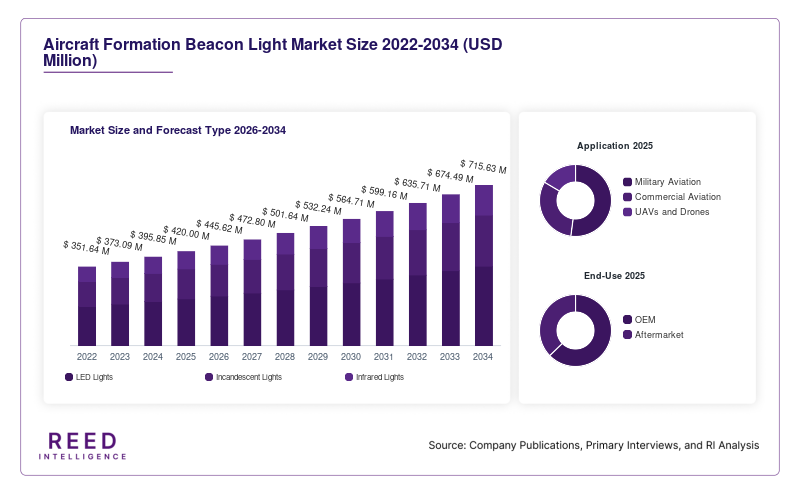
The LED-based formation beacon light segment dominated the Aircraft Formation Beacon Light Market in 2024, accounting for approximately 68% of the total market share. This dominance is attributed to the superior performance characteristics of LED systems, including higher energy efficiency, longer lifespan, and enhanced brightness control. These features make LED lights particularly suitable for both military and commercial aviation applications, where reliability and durability are critical. Additionally, LED systems offer flexibility in design and integration, allowing manufacturers to develop compact and lightweight solutions that meet modern aircraft requirements.
The fastest-growing subsegment is infrared-compatible LED lights, which are expected to register a CAGR of 7.5% during the forecast period. The growth of this subsegment is driven by increasing demand for stealth operations in military aviation. Infrared lights enable aircraft to remain visible to allied forces using night vision equipment while remaining undetectable to the naked eye. This capability is crucial for modern defense strategies, leading to increased adoption of advanced infrared lighting solutions.
By Application
Military aviation emerged as the dominant application segment in 2024, holding a market share of around 60%. The high demand for formation beacon lights in military aircraft is driven by the need for coordinated flight operations, especially during night missions and adverse weather conditions. These systems play a vital role in ensuring safety and maintaining formation integrity, making them indispensable in defense operations. Additionally, ongoing modernization programs and the introduction of advanced aircraft platforms further support segment growth.
The UAV and drone segment is the fastest-growing application, with a projected CAGR of 8.1%. The rapid expansion of drone technology in both military and commercial sectors is driving demand for specialized lighting systems. Formation beacon lights are essential for maintaining coordination among multiple drones operating in swarms. The increasing use of drones in logistics, surveillance, and emergency response further accelerates the adoption of these lighting solutions.
By End-Use
Original Equipment Manufacturers (OEMs) dominated the market in 2024, accounting for approximately 65% of the total share. OEMs integrate formation beacon lights during the aircraft manufacturing process, ensuring compatibility and optimal performance. The growing production of new aircraft, particularly in emerging markets, supports the dominance of this segment. Additionally, OEMs benefit from long-term contracts and partnerships with aircraft manufacturers, providing a steady revenue stream.
The aftermarket segment is expected to grow at the fastest rate, with a CAGR of 6.8% during the forecast period. The growth of this segment is driven by the increasing need for retrofitting and upgrading existing aircraft with modern lighting systems. Airlines and operators are investing in replacing outdated lighting systems to improve efficiency and comply with regulatory standards. This trend creates significant opportunities for aftermarket service providers and component manufacturers.
Regional Analysis
North America
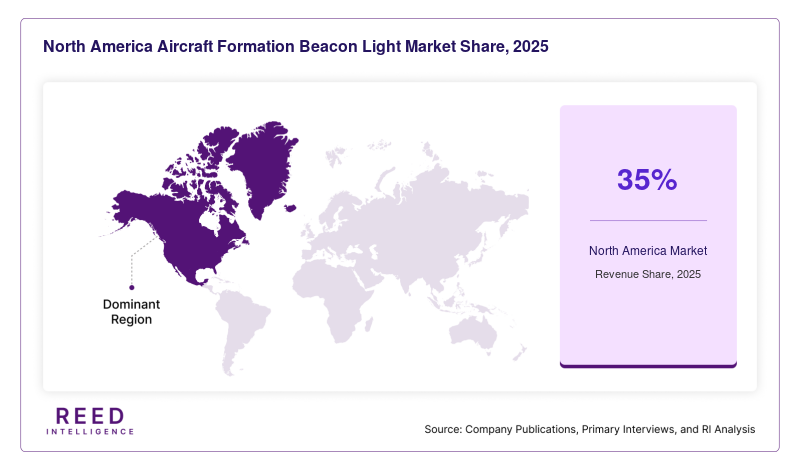
North America held a significant share of the Aircraft Formation Beacon Light Market in 2025, accounting for approximately 35% of the global market. The region is expected to maintain steady growth with a CAGR of around 5.8% during the forecast period. This growth is driven by strong defense spending, technological advancements, and the presence of major aircraft manufacturers and suppliers.
The United States dominates the regional market due to its extensive military aviation programs and ongoing fleet modernization initiatives. A key growth factor is the increasing investment in next-generation fighter jets and UAV systems, which require advanced formation lighting technologies. Additionally, the presence of established aerospace companies supports innovation and product development.
Europe
Europe accounted for nearly 25% of the Aircraft Formation Beacon Light Market share in 2025 and is projected to grow at a CAGR of 5.6% through 2034. The region’s growth is supported by strong regulatory frameworks emphasizing aviation safety and environmental standards, encouraging the adoption of advanced lighting systems.
Germany is a leading country in the European market, driven by its robust aerospace manufacturing sector. A unique growth factor is the region’s focus on sustainability and energy efficiency, leading to increased adoption of LED-based lighting systems. Collaborative defense projects across European nations also contribute to market expansion.
Asia Pacific
Asia Pacific is the fastest-growing region in the Aircraft Formation Beacon Light Market, with a 2025 share of around 22% and a projected CAGR of 7.2%. Rapid economic growth and increasing air travel demand are driving investments in aviation infrastructure and fleet expansion.
China dominates the regional market, supported by significant investments in both commercial and military aviation. A key growth factor is the expansion of domestic aircraft manufacturing capabilities, which increases demand for locally produced components, including formation beacon lights. Rising defense budgets further support market growth.
Middle East & Africa
The Middle East & Africa region held approximately 10% of the market share in 2025 and is expected to grow at a CAGR of 5.4%. Growth is driven by increasing investments in aviation infrastructure and the expansion of airline fleets in the Middle East.
Saudi Arabia is a major contributor to regional growth due to its focus on diversifying the economy and investing in aerospace development. A unique growth factor is the region’s strategic emphasis on becoming a global aviation hub, which drives demand for advanced aircraft systems, including formation beacon lights.
Latin America
Latin America accounted for around 8% of the Aircraft Formation Beacon Light Market in 2025 and is projected to grow at a CAGR of 5.2%. The region’s growth is supported by gradual expansion in commercial aviation and increasing investments in defense capabilities.
Brazil leads the market in Latin America, driven by its well-established aerospace industry. A key growth factor is the rising demand for regional aircraft and modernization of existing fleets, which necessitates the adoption of advanced lighting systems to enhance safety and compliance.
Competitive Landscape
The Aircraft Formation Beacon Light Market is characterized by moderate competition, with several established players focusing on technological innovation and strategic partnerships. Leading companies are investing in research and development to enhance product performance and expand their portfolios. The market also witnesses collaborations between lighting manufacturers and aircraft OEMs to develop customized solutions.
A key market leader is Honeywell International Inc., known for its advanced aerospace technologies and strong global presence. The company has recently introduced a new line of energy-efficient LED formation lights designed for next-generation aircraft platforms. Other prominent players are focusing on expanding their production capabilities and entering emerging markets to strengthen their competitive position.
Overall, the competitive landscape is shaped by continuous innovation, product differentiation, and strategic alliances aimed at meeting evolving industry requirements.
Key Players
- Honeywell International Inc.
- Collins Aerospace
- L3Harris Technologies, Inc.
- Astronics Corporation
- Cobham Aerospace Communications
- Safran S.A.
- Diehl Stiftung & Co. KG
- Aveo Engineering Group
- Oxley Group
- Whelen Aerospace Technologies
- Bruce Aerospace
- STG Aerospace
- Precise Flight, Inc.
- Soderberg Manufacturing Company
- Heads Up Technologies
Recent Developments
- In 2024, Honeywell International Inc. launched a new LED-based formation beacon light system designed for enhanced energy efficiency and durability.
- In 2023, Collins Aerospace partnered with a major aircraft manufacturer to develop integrated lighting systems for next-generation fighter jets.
- In 2024, Astronics Corporation expanded its product portfolio by introducing advanced infrared-compatible lighting solutions for military applications.
Aircraft Formation Beacon Light Market Segments
Type
- LED Lights
- Incandescent Lights
- Infrared Lights
Application
- Military Aviation
- Commercial Aviation
- UAVs and Drones
End-Use
- OEM
- Aftermarket
By Region
- North America
- Europe
- APAC
- Middle East and Africa
- LATAM